Why Slate Roof Replacement is a Major Investment Decision
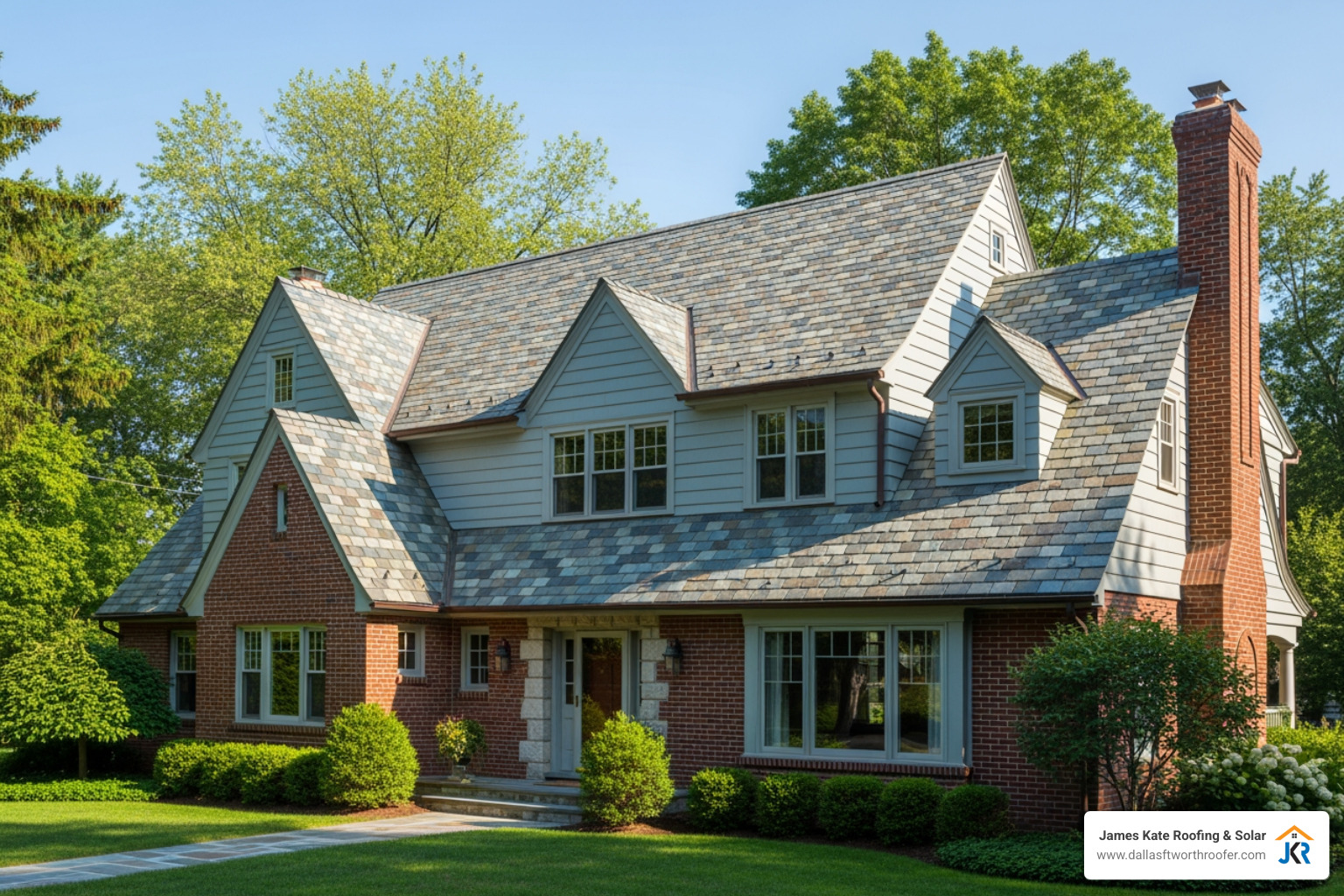
Slate roof replacement is one of the most significant roofing investments you can make for your home. If you’re considering this premium material, here’s what you need to know upfront:
Key Cost and Lifespan Facts:
- Average cost range: $16,000 to $70,000 for a 2,000 sq ft roof
- Natural slate: $20-$35 per square foot installed
- Synthetic slate: $8-$15 per square foot installed
- Natural slate lifespan: 75-200 years
- Synthetic slate lifespan: 40-70 years
- Structural reinforcement: May add $1,000-$10,000 to project cost
Most homeowners have asphalt shingle roofs because they’re affordable and readily available. But slate roofs offer something asphalt can’t match: a roof that can outlast your ownership of the home and even be passed down to future generations.
The catch? Slate is heavy—weighing 8-10 pounds per square foot—and requires specialized installation skills that most roofers don’t have. Your home may need structural reinforcement before installation, and the upfront cost is significantly higher than standard roofing materials.
This guide breaks down everything you need to know about slate roof replacement costs, materials, installation requirements, and when repair makes more sense than full replacement. We’ll help you understand if this premium investment is right for your home.
I’m Dustin Eatman, owner of James Kate Roofing & Restorationin the Dallas-Fort Worth area, and I’ve worked with property owners through the entire process of slate roof replacement, from structural assessment to final installation and long-term maintenance planning. My goal is to help you make an informed decision based on realistic expectations and accurate information about this unique roofing system.
Deconstructing the Cost of a Slate Roof Replacement
A slate roof replacement is a substantial upfront investment. Understanding the cost breakdown is crucial for any DFW homeowner considering this beautiful and durable option.
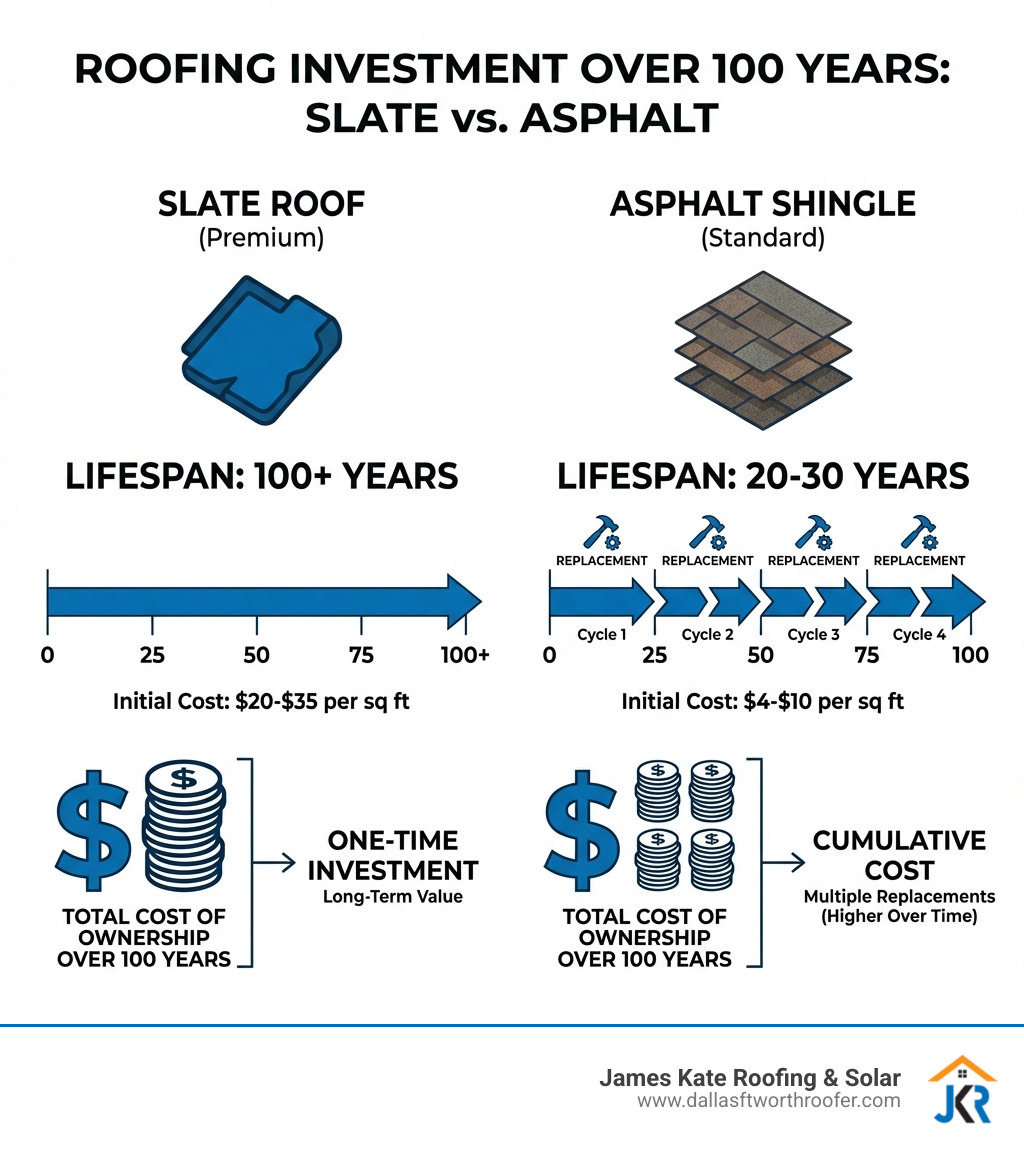
The average cost for a slate roof in Texas ranges from $8 to $35 per square foot, installed. For a 2,000-square-foot roof, this means an investment of $16,000 to $70,000, depending on the type of slate and other factors.
Let’s compare slate to some other common roofing materials to put its cost and lifespan into perspective:
| Roofing Material | Average Cost Per Square Foot (Installed) | Typical Lifespan |
|---|---|---|
| Natural Slate | $20 – $35 | 75 – 200 years |
| Synthetic Slate | $8 – $15 | 40 – 70 years |
| Asphalt Shingles | $4 – $10 | 15 – 25 years |
| Metal Roofing | $5 – $40 | 30 – 70 years |
| Tile Roofing | $5.90 – $14.68 | 50 – 100 years |
| Wood Shingles/Shakes | $8 – $14 | 25 – 30 years |
Average Cost: Natural vs. Synthetic Slate
The most significant factor influencing the cost of your slate roof replacement is the type of slate you choose.
- Natural Slate: Natural slate, quarried stone cut into tiles, costs $20 to $35 per square foot installed. For a 2,500-square-foot roof, this is $50,000 to $87,500. The cost reflects its authenticity and longevity. Soft slate costs less ($10-$30/sq ft) and lasts 50-100 years, while hard slate is more expensive ($20-$30/sq ft) and can last 75-200 years.
- Synthetic Slate: Engineered from composites, synthetic slate mimics the look of natural slate for a lower cost of $8 to $15 per square foot installed. A 2,500-square-foot roof would cost $20,000 to $37,500. While not as long-lasting as natural slate, it offers significant durability and aesthetic appeal at a more accessible price.
We also offer expertise in tile roofing services if you’re exploring other durable options for your DFW home.
Key Factors That Influence Your Final Price
Beyond the choice between natural and synthetic slate, several other elements contribute to the overall cost of a slate roof replacement:
- Labor Rates: Slate roofing requires specialized skills, making labor 50%-60% of the total cost. Experienced slate roofers in the DFW area command higher rates than general contractors.
- Roof Size and Complexity: Larger roofs and complex designs with multiple valleys, hips, or dormers require more materials and labor, increasing costs.
- Roof Pitch: Steep roofs are more challenging to work on, requiring extra safety measures and increasing labor costs.
- Structural Reinforcement: Slate is up to four times heavier than asphalt shingles. If your home’s structure can’t support the weight, reinforcements are needed, adding $1,000 to $10,000 to the cost.
- Old Roof Removal (Tear-Off): Tearing off and disposing of your old roof costs $2-$5 per square foot, an essential step when switching from a lighter material to heavy slate.
Is a Slate Roof Replacement Worth the Investment?
Is a slate roof replacement worth the high upfront cost for your DFW home? For many homeowners, the answer is yes.
- Best Longevity: A natural slate roof can last 75-150+ years, far outliving asphalt shingles (15-25 years). You may never need another roof replacement, making it a legacy asset with clear long-term value.
- Exceptional Durability: Slate is fireproof and highly resistant to hail, high winds, and extreme temperatures, making it ideal for Texas weather. It absorbs little water, preventing warping or cracking.
- Increased Curb Appeal and Home Value: The timeless beauty of a slate roof adds significant curb appeal and increases your home’s resale value, making it a standout in the DFW market.
- Environmental Benefits: As a natural, recyclable material, slate reduces landfill waste compared to asphalt shingles.
Though the initial cost is high, the ROI comes from reduced maintenance, superior protection, and improved property value, making it a once-in-a-lifetime investment.
Natural Slate vs. Synthetic Slate: Making the Right Choice
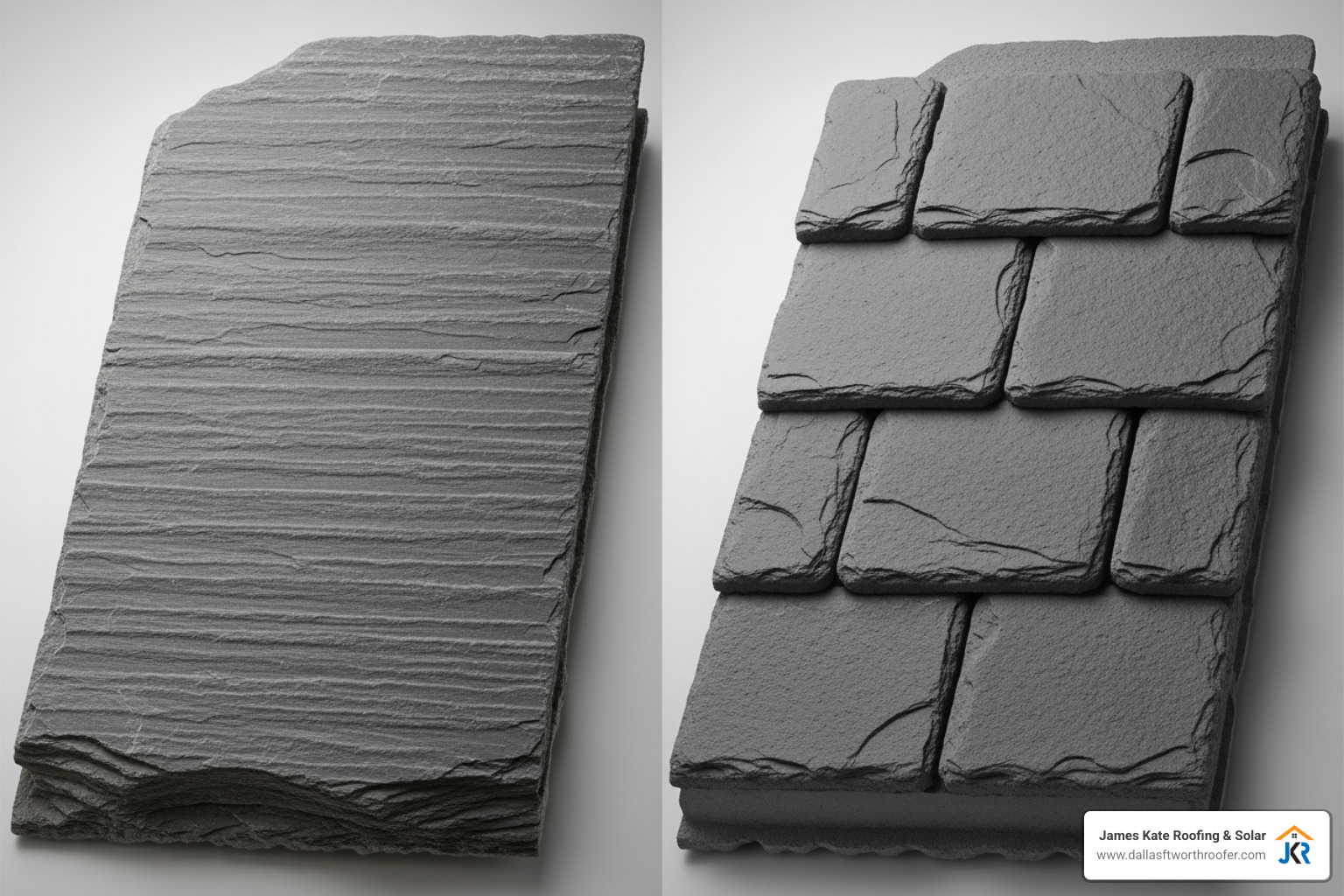
Choosing between natural and synthetic slate is a pivotal decision for your slate roof replacement. Both offer the classic slate look but differ in cost, weight, and performance. Understanding these differences is key to choosing the right option for your DFW home.
The Pros and Cons of Natural Slate
Natural slate has been revered for centuries as the “king of roofing materials.” Its appeal is undeniable, but so are its demands.
Pros of Natural Slate:
- Unrivaled Longevity: Natural slate is legendary for its lifespan, often lasting 75 to 200 years. Hard slates can endure for centuries, making it the last roof you’ll ever need.
- Exceptional Curb Appeal: The authentic texture and varied colors of natural slate add a sophisticated elegance that significantly boosts curb appeal and home value.
- Durability and Weather Resistance: Natural slate is fireproof, durable against hail and wind, and impervious to rot, insects, and freeze-thaw damage due to low water absorption.
- Eco-Friendly: As a natural stone, slate is an environmentally sustainable and recyclable material.
- Classic and Timeless: Its historic look complements many architectural styles, enhancing your DFW home’s character.
Cons of Natural Slate:
- High Cost: Natural slate is one of the most expensive roofing materials for both the material and specialized labor.
- Significant Weight: Weighing 8-10 pounds per square foot, it’s much heavier than asphalt and often requires costly structural reinforcement.
- Fragility: Individual tiles can be fragile, cracking if walked on improperly, which makes repairs delicate.
- Difficult and Specialized Repairs: Repairs require skilled roofers and sourcing matching slate can be difficult for older roofs, as quarries close or colors weather uniquely.
- No Material Warranty: Unlike manufactured products, natural slate tiles typically do not come with a manufacturer’s material warranty.
The Pros and Cons of Synthetic Slate
Synthetic slate shingles offer an attractive alternative, providing the aesthetic of natural slate without some of its inherent challenges.
Pros of Synthetic Slate:
- Lower Cost: Synthetic slate is more affordable, with synthetic slate roofing tiles can run 40% cheaper than natural slate. Easier installation also lowers labor costs.
- Lighter Weight: Being much lighter than natural slate, it often eliminates the need for costly structural reinforcement, making it suitable for more DFW homes.
- Excellent Impact and Weather Resistance: Many products have a Class 4 impact rating for superior hail resistance and are engineered to withstand high winds (up to 180 mph) and freeze-thaw cycles.
- Aesthetic Diversity: Available in a vast spectrum of colors and styles, synthetic slate allows for greater customization and easier matching.
- Easier Installation and Repair: These tiles are easier to install and less fragile underfoot, simplifying repairs. Finding matching replacements is also easier due to consistent manufacturing.
- Fire Resistance: Synthetic slate shingles are highly fire-resistant, contributing to the safety of your home.
Cons of Synthetic Slate:
- Shorter Lifespan: While still very durable, synthetic slate typically lasts 40 to 70 years, which is less than the 75-200 year lifespan of natural slate.
- Can Look Artificial: Depending on the quality, some products may not perfectly replicate the natural variations of genuine stone, looking less authentic up close.
- Fading Potential: Some materials can fade or warp over time under the Texas sun, though manufacturing advancements are improving color stability.
- Environmental Impact: While some are made from recycled materials, their production and disposal have a different environmental footprint than natural stone.
Weighing these pros and cons is essential. If budget and weight are primary concerns, synthetic slate is a compelling solution. If ultimate authenticity and longevity are your priorities, natural slate remains the gold standard.
The Critical Role of Structural Integrity & Installation
A slate roof replacement requires more than just beautiful tiles; your home’s structure must support the weight, and installation must be done by a specialist. Cutting corners on structural integrity or expert installation can lead to costly failures and negate the benefits of a slate roof.
Can Your Home Handle the Weight?
The most critical question for a slate roof replacement is whether your home can handle the weight. Natural slate weighs 8-10 pounds per square foot, up to four times heavier than asphalt shingles. Your existing roof framing may not be able to bear this load.
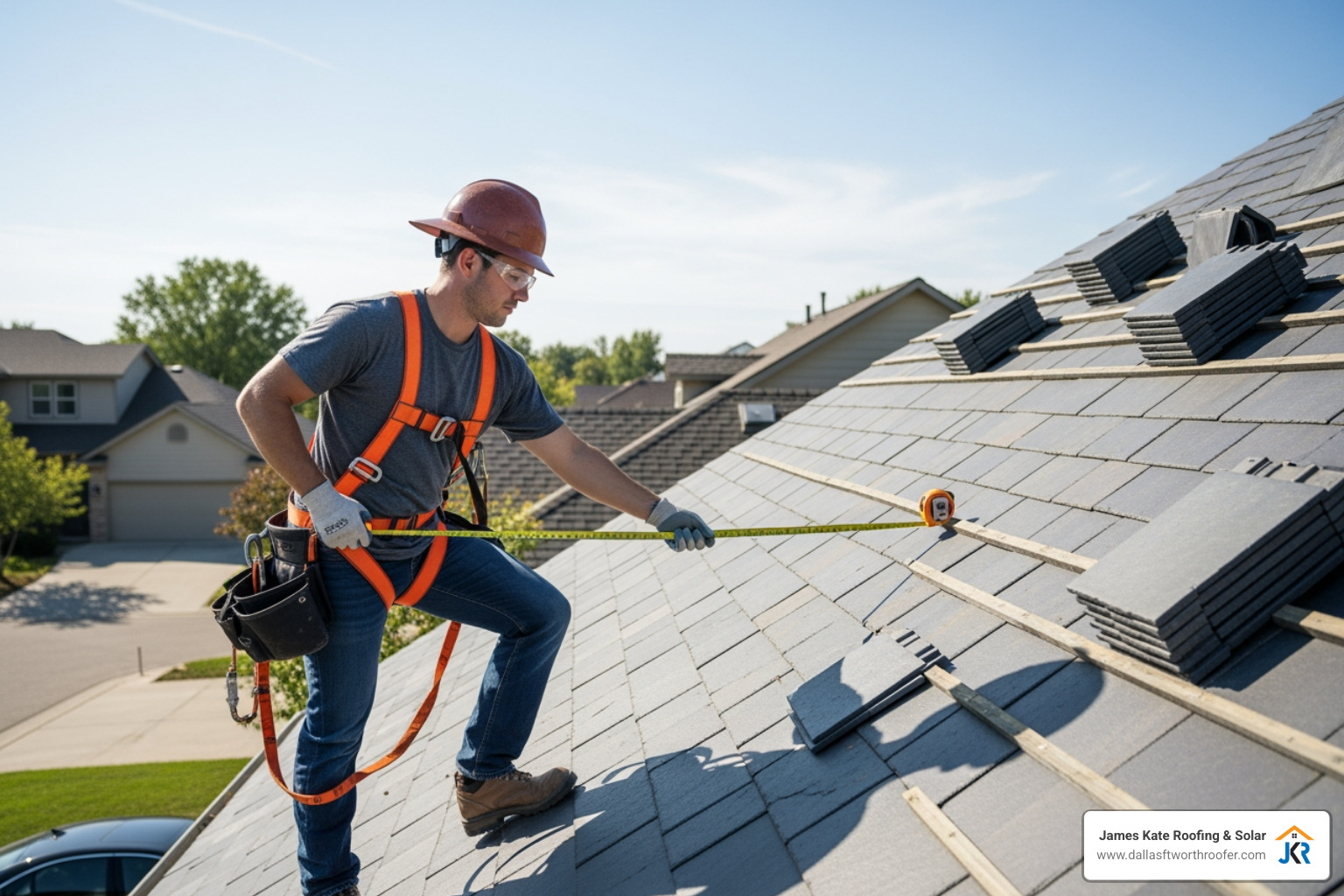
- Structural Assessment: Before any installation begins, we conduct a thorough structural assessment, often consulting with a structural engineer to evaluate your home’s framework.
- Necessary Reinforcements: If your home wasn’t built for a slate roof, modifications are necessary. This may involve strengthening rafters, beams, and joists, or even foundation work. These reinforcements can add $1,000 to $10,000 to the cost and are a non-negotiable assessment for DFW homes.
- Transitioning from Asphalt Shingles: When switching from asphalt to slate, the weight difference is the main concern. We ensure your home’s structure is robust enough to carry the heavier roof and prevent issues like sagging.
Why Specialized Workmanship is Non-Negotiable
Installing a slate roof is an art and a science, demanding expertise few contractors possess. Specialized workmanship is crucial for a successful, long-lasting slate roof replacement.
- Risks of Inexperienced Contractors: Inexperienced contractors can be a disaster for a slate roof. Improper installation, including incorrect nailing, headlap, or flashing, leads to leaks, broken tiles, and a shortened lifespan.
- Proper Installation Process: Natural slate requires pre-drilled holes and precise placement with the correct headlap (the overlap of tiles) to ensure it sheds water properly. A typical headlap is three inches but varies with roof slope. This meticulous process is key to a watertight, durable roof.
- Underlayment and Waterproofing: A high-quality, Class A fire-rated underlayment is essential. We typically use a double layer of asphalt-saturated felt, which acts as a secondary water barrier.
- Flashing Materials and Techniques: Flashings are weak points. For slate, we use durable metals like 16-ounce copper or terne-coated stainless steel with a lifespan comparable to slate. Inferior materials or installation can cause premature leaks.
- Nailing Techniques: Slates are secured with two non-ferrous nails (copper or stainless steel) long enough to penetrate the sheathing. Nails must be driven correctly—not too tight to crack the slate, and not too loose to allow movement.
- Tools: Specialized tools like a slate ripper and a slate hammer are essential for proper installation and repair.
The National Park Service offers a terrific overview on The Repair, Replacement and Maintenance of Historic Slate Roofs, highlighting the intricate details involved. When considering your slate roof replacement in DFW, trust our team with our proven track record and expertise in these specialized installations. Learn more about our roof replacement and installation process to see how we ensure quality and longevity.
Repair or Replace? Knowing When to Make the Call
Even with their incredible longevity, slate roofs eventually require attention. Deciding whether to repair a few damaged tiles or undertake a full slate roof replacement is a critical decision that balances cost, the extent of damage, and the overall condition and age of your roof. For homeowners in the DFW area, understanding the signs and proper procedures is key to maximizing your investment.
Telltale Signs Your Slate Roof Needs a Full Replacement
While slate roofs are built to last, they’re not indestructible. Here are the clear indicators that your slate roof may be signaling it’s time for a full slate roof replacement:
- Widespread Cracked, Broken, or Missing Tiles: If 20% or more of the slates on your roof or a particular slope are damaged, it’s generally more cost-effective to replace the entire section or roof rather than attempting individual repairs. This often indicates the roof is nearing the end of its serviceable life.
- Roof Sagging: A sagging roofline is a serious structural issue. It can indicate compromised decking, weakened rafters, or inadequate support for the roof’s weight, especially if you have an older slate roof. This demands immediate attention and likely a full replacement with structural remediation.
- Leaks in the Attic or Ceiling: While a single leak might point to a localized issue, multiple or persistent leaks suggest widespread problems with the roof system, such as failing underlayment, compromised flashing, or extensive tile damage.
- Failing Flashing: Flashings are the metal components around chimneys, skylights, valleys, and vents. If these are corroded, rusted, or pulling away, they are no longer providing a watertight seal. Repairing isolated flashing issues is possible, but widespread failure often necessitates a full replacement.
- Age of the Roof System: Even the longest-lasting hard slate has a maximum lifespan (up to 200 years). Soft slate typically lasts 50-100 years, and synthetic slate 40-70 years. If your roof is approaching or has exceeded these ranges, even if it looks okay from a distance, it might be at the end of its functional life.
- Rusted Nails: If you can see rusted nails, especially on the underside of the roof deck, it’s a sign that the fasteners are failing. This can lead to slates sliding out of position and indicates a systemic problem.
The Process for a Targeted Slate Roof Repair
If your slate roof is mostly in good condition with only a few damaged tiles, targeted repairs can significantly extend its lifespan, typically costing between $300 and $1,000. This is a far more economical option than a full slate roof replacement.
- Individual Tile Replacement: The core of slate roof repair involves removing damaged slates and replacing them with new ones. This requires a skilled hand and specialized tools.
- Specialized Tools: A primary tool for this job is the slate ripper. This thin, long tool is slid under the damaged slate to hook onto and either pull out or cut the shanks of the nails holding it. Once the nails are removed, the broken slate can be carefully coaxed out.
- Matching New Slates: When replacing a slate, it’s crucial to match the existing slates in type (e.g., region quarried), color, weathering characteristics (fading/unfading), size, shape, and texture. Matching size is especially critical for maintaining proper headlap and offset, ensuring the roof remains watertight. For older roofs, finding an exact match can be challenging; sometimes, salvaged or reclaimed slates are the best option.
- Installing the New Slate: A new or salvaged slate is then carefully slid into the vacant spot. It’s often secured with a single nail inserted through the vertical joint between the slates in the course above. A piece of copper (a “bib” or “strip”) is then slid under the joint above the new slate, covering the nail head and preventing water from entering through the nail hole. This technique ensures the new slate is firmly in place without compromising the watertight integrity of the courses above.
- Recommended Materials: For repairs, we always recommend using durable, non-ferrous materials. Copper nails are preferred because they resist corrosion for decades. For flashing repairs, copper or terne-coated stainless steel are ideal, ensuring their lifespan matches the slate. Galvanized steel elements should be avoided as they can rust and stain the slate.
- Safety Precautions: Working on a slate roof requires extreme caution. Slates can be brittle and slippery. We always advise homeowners to never walk on a slate roof themselves. Our professional roofers use specialized equipment like hook ladders, roof jacks, and planks to distribute weight and avoid stepping directly on the slates. When inspection from the roof is necessary, soft-soled shoes are worn, and steps are taken on the lower-middle portion of the exposed slate for minimal stress.
For more detailed guidance on slate roof care and repair, the Slate Roof Repair & Care – National Slate Association is an excellent resource. If you’re unsure about the condition of your slate roof, we encourage you to schedule a professional roof inspection with our team in DFW. We’ll provide an honest assessment and recommend the most cost-effective solution.
Frequently Asked Questions about Slate Roof Replacement
We understand that a slate roof replacement is a complex topic, and homeowners often have many questions. Here, we address some of the most common inquiries we receive in the DFW area.
How long does a slate roof really last?
The longevity of a slate roof is one of its most remarkable features, often making it a multi-generational investment.
- Natural Slate: A well-installed natural slate roof can last anywhere from 75 to over 150 years, with some types exceeding 200 years. The exact lifespan depends heavily on the quality of the slate (its geological origin and mineral composition), the roof’s pitch, and the quality of installation and maintenance.
- Hard vs. Soft Slate: This distinction significantly impacts lifespan. Soft slates typically last 50-100 years, while hard slates can last 75-200 years. Hard slates, like those from Buckingham, Virginia, are known to last 175 years or more.
- Synthetic Slate: While not as long-lasting as natural slate, synthetic slate roofs still offer excellent durability, typically lasting 40 to 70 years. This is still significantly longer than asphalt shingles and provides substantial value.
- Impact of Installation: Regardless of the type, the lifespan of any slate roof is heavily dependent on professional, expert installation. An improperly installed slate roof, even with the highest quality materials, will not achieve its potential longevity.
How does climate affect a slate roof?
Slate roofs are exceptionally well-suited to withstand a wide range of climatic conditions, including the diverse weather patterns we experience in Texas.
- Weather Resistance: Slate is inherently fireproof, a significant advantage in areas prone to wildfires or even just for general home safety. It has very low water absorption, which means it resists the damaging effects of freeze-thaw cycles. Unlike other materials, slate tiles won’t warp, crack, or fade significantly due to water absorption.
- Hail Impact: Natural slate is very durable against hail, though severe impacts can cause breakage. Many synthetic slate products, however, offer superior impact resistance, often achieving a Class 4 impact rating, the highest possible, making them an excellent choice for hail-prone areas like DFW.
- High Winds: Both natural and quality synthetic slate roofs are designed to withstand high winds. Synthetic slate tiles, for instance, can resist winds up to 180 mph, offering robust protection during severe Texas storms.
- Maintenance in Different Climates: While slate is durable, routine maintenance is still important. In climates with frequent rainfall, strong winds, heavy snow (less common in DFW but relevant for general context), or extreme temperature fluctuations, annual inspections are crucial to address any minor issues before they escalate.
Is slate roofing energy efficient?
Yes, slate roofing can contribute to your home’s energy efficiency, offering benefits beyond its durability and aesthetics.
- Natural Insulation Properties: Slate is a dense material, which gives it some natural insulating properties. It helps to regulate indoor temperatures by slowing down heat transfer.
- Air Gap Creation: When installed on traditional wood sheathing with spaces between the boards, a slate roof can create a natural air gap. This air gap acts as an additional layer of insulation, reducing heat transfer into your attic during hot DFW summers and retaining heat during colder months.
- Reduced Cooling Costs: By helping to keep your attic cooler, a slate roof can reduce the workload on your air conditioning system, potentially leading to lower energy bills.
- Recyclability: Natural slate is an all-natural material that can often be reused or recycled at the end of its very long life, contributing to its overall environmental friendliness and sustainability. Some synthetic slate options also incorporate recycled materials.
Your Next Steps for a Flawless Slate Roof
A slate roof is a lifetime investment, not just a purchase. Its unparalleled longevity and beauty come with specific requirements for cost, structural support, and expert installation. By understanding these factors, you can make an informed decision that adds lasting value and protection to your home. For a trusted, expert evaluation of your home’s readiness for a slate roof replacement in the DFW area, the team at James Kate Roofing & Restorationis here to help.
We pride ourselves on our commitment to honesty, integrity, and providing top-tier roofing services. With our GAF President’s Club recognition and a 25-year workmanship warranty, you can be confident in our expertise. If you’re in Addison, Arlington, Dallas, Fort Worth, Frisco, Garland, Grand Prairie, Irving, McKinney, Plano, Richardson, or any of our other DFW service areas, we’re ready to assist.
Contact us for a professional consultation today and let us guide you through every step of your slate roof replacement journey.

Dustin Eatman is a seasoned roofing professional with deep, hands-on expertise that spans residential and commercial roofing, insurance solar, and long-term roof asset management. As the owner of James Kate Roofing & solar in the Dallas–Fort Worth metroplex, he’s built a reputation for diagnosing roof systems accurately, communicating clearly, and executing projects with a high standard of workmanship and documentation. Dustin understands the technical details that make roofs perform—proper underlayment selection, slope and drainage considerations, ventilation strategy, flashing and penetration detailing, and manufacturer-specific installation requirements—because he’s worked through the real-world challenges that cause leaks, premature wear, and warranty issues. He’s equally fluent in the operational side of roofing: jobsite planning, quality control, safety, material ordering, crew coordination, and customer experience from inspection to closeout. In insurance-related projects, Dustin brings practical knowledge of claim workflows, adjuster meetings, scope alignment, supplements, and the importance of photo evidence and thorough records, helping property owners navigate stressful situations with confidence. For commercial clients—especially property and facility managers—he emphasizes proactive maintenance and targeted repairs that reduce disruption, extend roof life, and prevent expensive interior damage. Dustin also stays focused on doing things the right way: educating customers on realistic options, setting expectations, and prioritizing solutions that hold up over time rather than quick fixes. That blend of technical skill, field experience, process discipline, and owner-level accountability is what makes Dustin Eatman a trusted expert in the roofing industry.