

Why Proper Roofing Shingles Installation Is the Key to a Long-Lasting Roof
Roofing shingles installation is more than just nailing pieces of material to your roof—it’s a precise process that demands attention to detail, proper technique, and a solid understanding of how water-shedding systems work. Whether you’re a homeowner considering a DIY project or simply want to understand what goes into a professional installation, knowing the fundamentals can save you from costly leaks and premature roof failure.
Key Steps for Successful Roofing Shingles Installation:
- Prepare the roof deck – Remove old materials, inspect for damage, and create a clean surface
- Install protective layers – Apply drip edge, ice and water shield, and underlayment in the correct sequence
- Lay starter shingles – Create a sealed edge along eaves and rakes
- Install field shingles – Maintain proper stagger pattern, exposure, and nailing technique
- Flash all penetrations – Seal valleys, vents, chimneys, and sidewalls correctly
- Cap the ridge – Finish with ridge cap shingles and ensure proper ventilation
The global roofing market was valued at USD 141.1 billion in 2023 and continues to grow, reflecting just how critical quality roofing is to property owners everywhere. Yet even with today’s advanced materials, improper installation remains the leading cause of roof failures during storms—often due to incorrect nailing patterns or inadequate flashing.
As experienced professionals know, a sloped shingle roof relies entirely on gravity and proper overlapping to shed water effectively. Every component—from the underlayment to the final ridge cap—must work together as a system. Miss one detail, and you’re inviting water intrusion, wind damage, or ice dam problems down the line.
I’m Dustin Eatman, owner of James Kate Roofing & Solar in the Dallas-Fort Worth area, and I’ve spent years diagnosing roof failures, executing insurance solar projects, and training crews on the technical details that make roofing shingles installation successful. Through hands-on experience with everything from basic tear-offs to complex flashing details, I’ve learned that doing it right the first time—whether you’re a DIYer or hiring a pro—is always worth the extra effort.
Planning and Safety: Your Blueprint for Success
Before we even think about laying a single shingle, thorough planning and an unwavering commitment to safety are paramount. A roofing project, no matter the size, involves working at heights, handling heavy materials, and using power tools. It’s not a job to be taken lightly.
Safety, as the old saying goes, is always first. This isn’t just a recommendation; it’s a non-negotiable rule. We prioritize the safety of our team members above all else, and we encourage any homeowner considering a DIY approach to do the same. This means investing in proper fall protection equipment, such as a safety harness, rope, and anchor that can withstand a fall. For anyone working on a residential roof, a properly fitted safety harness is your best friend.
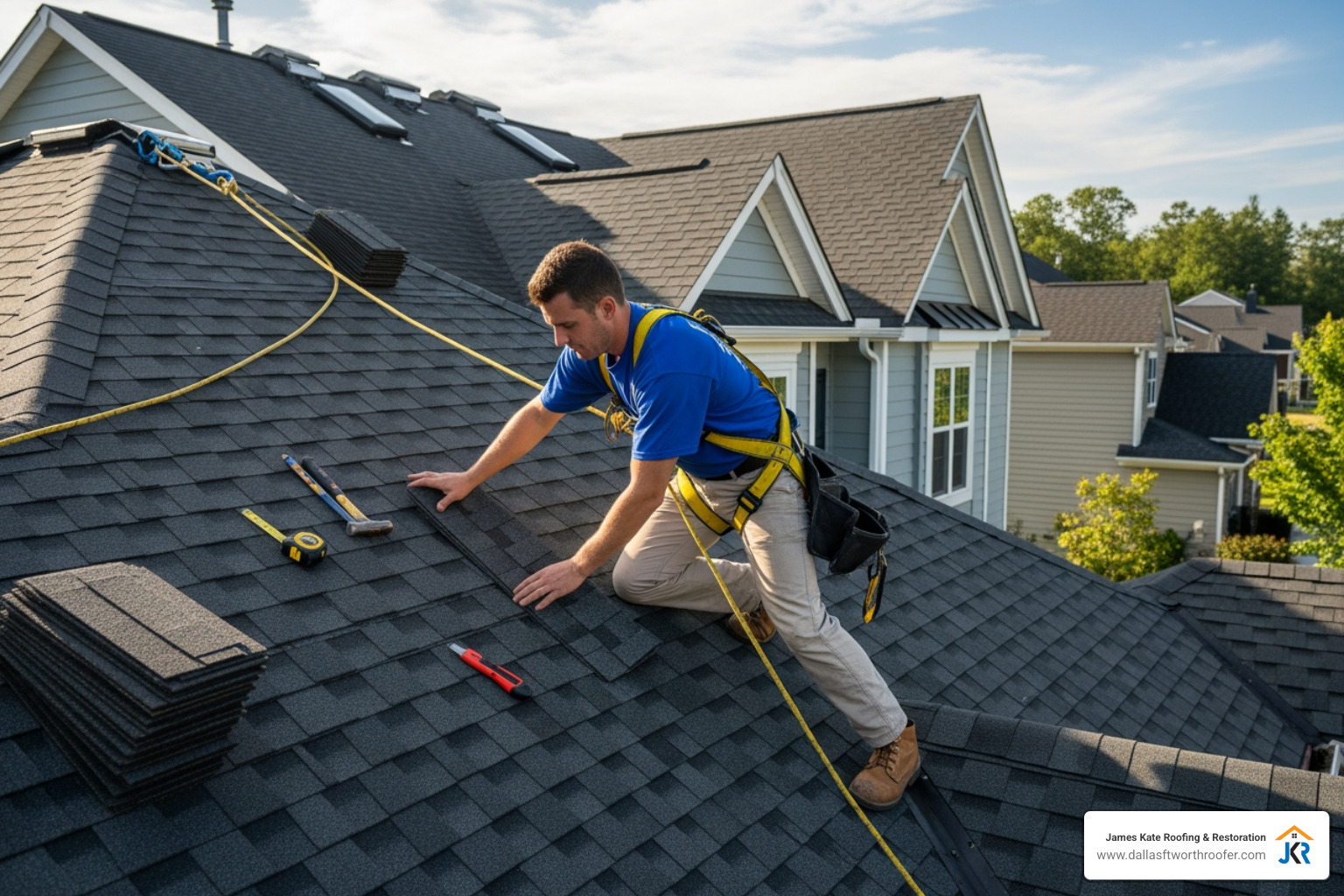
Ladder safety is another critical aspect. Ensure your ladder is securely positioned on stable, level ground and extends at least three feet above the roofline. Always tie off your ladder at the top to prevent it from slipping. Proper attire also plays a significant role in safety and efficiency. We always recommend wearing rubber-soled shoes for good traction, work gloves to protect your hands, and eye protection to guard against debris.
Weather conditions are also a major factor. The ideal weather for roofing shingles installation is dry, with temperatures between 50 and 80 degrees Fahrenheit. Working on a wet roof is extremely dangerous due to slipping hazards. Extreme heat can make shingles too soft and prone to damage, while cold weather can make them brittle and difficult to work with, affecting their ability to seal properly. Always check the forecast and plan accordingly.
Essential Tools, Materials, and Estimating
Having the right tools and materials is like having the right ingredients for a perfect meal – essential for a successful outcome. Here’s a rundown of what you’ll need for a typical roofing shingles installation:
- Roofing Nailer and Air Compressor: For efficient and consistent nailing.
- Claw Hammer: For hand-nailing in tight spots or for removing old nails.
- Utility Knife: For cutting shingles and underlayment.
- Tape Measure and Chalk Line: For accurate measurements and straight lines.
- Pry Bar or Roof Shovel: For removing old shingles.
- Caulk Gun: For applying roofing cement.
- Framing Square: For precise cuts and angles.
- Ladder: Safe access to the roof.
- Magnetic Sweeper: Invaluable for collecting fallen nails during and after the project.
- Safety Gear: Harness, gloves, eye protection, and appropriate footwear.
As for materials, you’ll need:
- Roof Shingles: The star of the show!
- Starter Shingles: Essential for a clean, sealed edge at the eaves and rakes.
- Ridge Cap Shingles: To cover the roof’s peak and hips.
- Roofing Underlayment: Felt paper or synthetic, providing a secondary water barrier.
- Leak Barrier/Ice-and-Water Barrier: A self-adhering membrane for vulnerable areas.
- Drip Edge Flashing: Metal flashing for the roof edges.
- Pipe Collars/Flashing: For sealing around plumbing stacks and vents.
- Step Flashing: For roof-to-wall intersections.
- Roofing Nails: Galvanized, 11- or 12-gauge, with a 3/8-inch head, long enough to penetrate 3/4-inch into the roof deck.
- Roofing Cement: For sealing and adhering certain components.
Estimating the quantity of materials needed is a crucial planning step. First, measure the total square footage of your roof. Divide this number by 100 to determine the number of “squares” (a roofing square equals 100 square feet). Shingles are typically sold in bundles, with about three bundles making up one square. Always add 10% to 15% to your shingle estimate to account for waste from trimming and potential mistakes. This is also a good opportunity to Get a professional estimate from us to ensure accuracy and avoid over- or under-ordering.
DIY vs. Hiring a Professional
While the idea of tackling a roofing shingles installation yourself can be appealing, especially with the promise of saving money, realistically assess the project’s complexity and your own capabilities. We’ve seen the pitfalls of well-intentioned DIY efforts.
Consider the roof’s slope and pitch. Professional roofers generally consider any pitch lower than 8/12 walkable, but for DIYers, we often recommend a maximum of 6/12 or lower for safety and ease of work. Complex roof designs with multiple valleys, dormers, or skylights significantly increase the difficulty and the potential for errors that can lead to leaks.
Then there’s the time commitment. A full roof replacement is not a weekend job. It can take several days to a week, or even longer, depending on the size and complexity of your roof. Do you have that time to dedicate, and can you afford to have your home exposed to the elements during the process?
Tool requirements are also a factor. While some tools can be rented, the cost can add up, and operating specialized equipment like a roofing nailer requires practice.
Perhaps most importantly, consider the warranty implications. Most shingle manufacturers offer warranties that are contingent on proper installation according to their specifications. DIY installation, if not executed perfectly, could potentially void these warranties. Professional roofing companies, like James Kate Roofing & Solar, often provide their own workmanship warranties, sometimes up to 25 years, giving you peace of mind.
So, when should you call a pro? If your roof has a steep pitch, complex design, or if you’re uncomfortable with heights, heavy lifting, or power tools, hiring a professional is undoubtedly the safest and smartest choice. We have the experience, the specialized equipment, and the trained crews to ensure your roofing shingles installation is done correctly, safely, and efficiently. Learn about professional installation services we offer across the DFW metroplex.
A Step-by-Step Guide to Roofing Shingles Installation
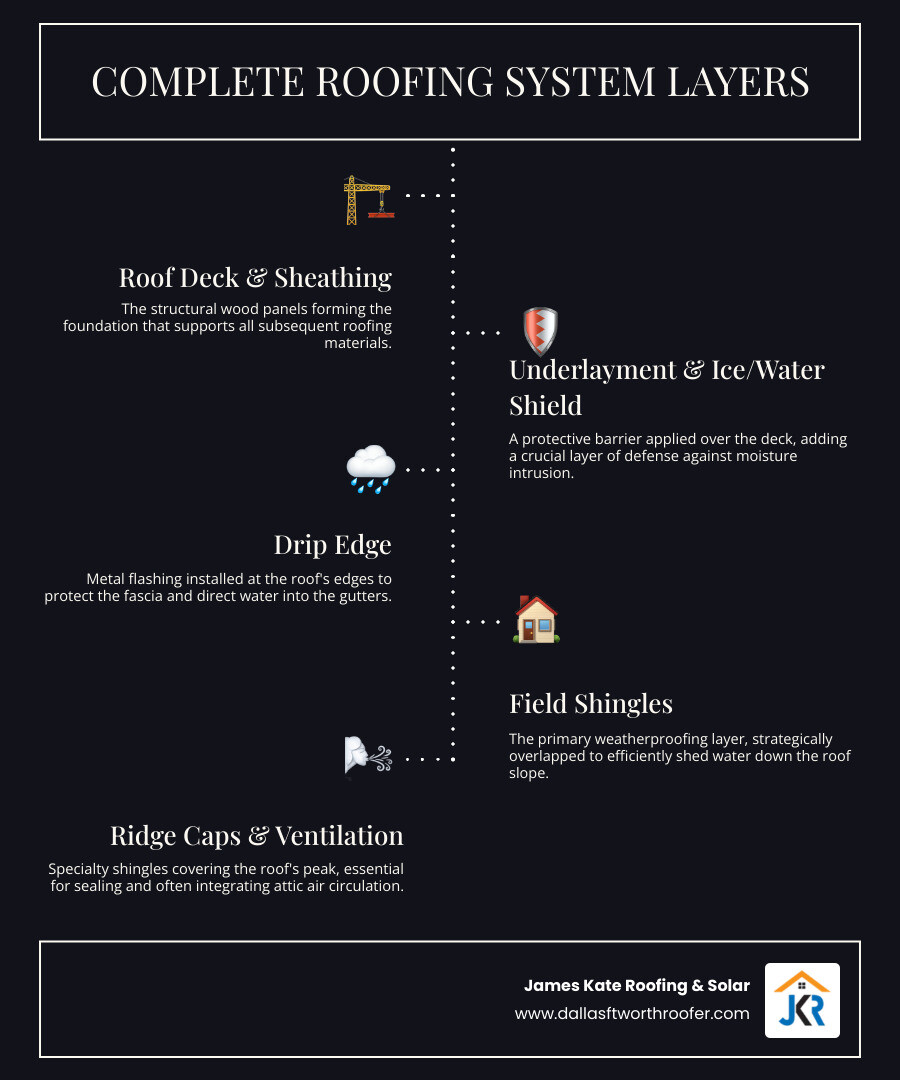
Once you’ve made the decision to move forward, whether DIY or professional, the first physical step is always roof deck preparation. This involves carefully removing all old roofing materials, including shingles, underlayment, and flashing, down to the bare roof sheathing. We then carefully inspect the sheathing for any signs of water damage, rot, or structural issues. Any damaged or deteriorated wood must be replaced to ensure a solid foundation for your new roof. Finally, we create a clean, smooth, and nail-free surface, pounding down or removing any protruding nails to prevent them from damaging the new underlayment and shingles.
Step 1: Installing the Protective Base Layers
The base layers are your roof’s first line of defense, even before the shingles go on. Getting these right is crucial for a watertight system.
We start with drip edge installation. This metal flashing is installed along the eaves (the lower edges of the roof) first, directly onto the roof deck. It should extend about 1/2 inch beyond the fascia board to guide water directly into the gutters, preventing it from wicking back under the roof. After the underlayment is applied, drip edge is then installed along the rakes (the sloped edges of the roof) on top of the underlayment.
Next comes the ice and water shield, a self-adhering, waterproofing membrane. In colder climates, this is vital for preventing ice dams—a common problem where melted snow refreezes at the eaves, causing water to back up under the shingles. Even in our warmer DFW climate, we recommend it for extra protection in valleys, around chimneys, and along the eaves, especially if the roof pitch is low (2:12 to less than 4:12). This barrier seals around fasteners, offering an extra degree of water-shedding protection. It should extend from the eaves to at least 24 inches inside the interior wall line.
Finally, we install the underlayment, which can be asphalt-saturated felt paper (like 15-lb or 30-lb felt) or synthetic underlayment. Underlayment provides a secondary water barrier, protecting the roof deck if water gets past the shingles. We lay it parallel to the eaves, starting from the bottom. Each course should overlap the one below by at least two inches, and vertical seams should be overlapped by at least six inches and staggered by at least six feet in subsequent courses to prevent a continuous path for water. It’s critical that the underlayment lies flat, without wrinkles or lumps, as these can telegraph through the shingles.
Step 2: The Art of Roofing Shingles Installation: Nailing and Staggering
With the protective base layers in place, we’re ready for the main event: the roofing shingles installation. This is where precision and proper technique truly shine.
We begin with the starter shingle placement. These are specifically designed or cut shingles that create a sealed edge along the eaves and rakes, providing a solid base for the first course of field shingles and preventing wind uplift. Starter shingles should overhang the drip edge by about 1/2 to 3/4 inch.
To ensure our shingle rows are perfectly straight and aesthetically pleasing, we use chalk lines. These horizontal lines are snapped across the roof deck at regular intervals (based on the shingle’s exposure) to guide the placement of each shingle course. This prevents “wavy” lines and ensures proper water runoff.
The staggering pattern (or offset) is critical for both watertightness and appearance. Shingles are installed so that the vertical joints of one course do not align with the joints of the courses directly above or below it. This creates an overlapping pattern that prevents water from seeping through the gaps. For architectural shingles, a common offset is 8 inches, or even a random pattern, while 3-tab shingles traditionally use a 6-inch offset.
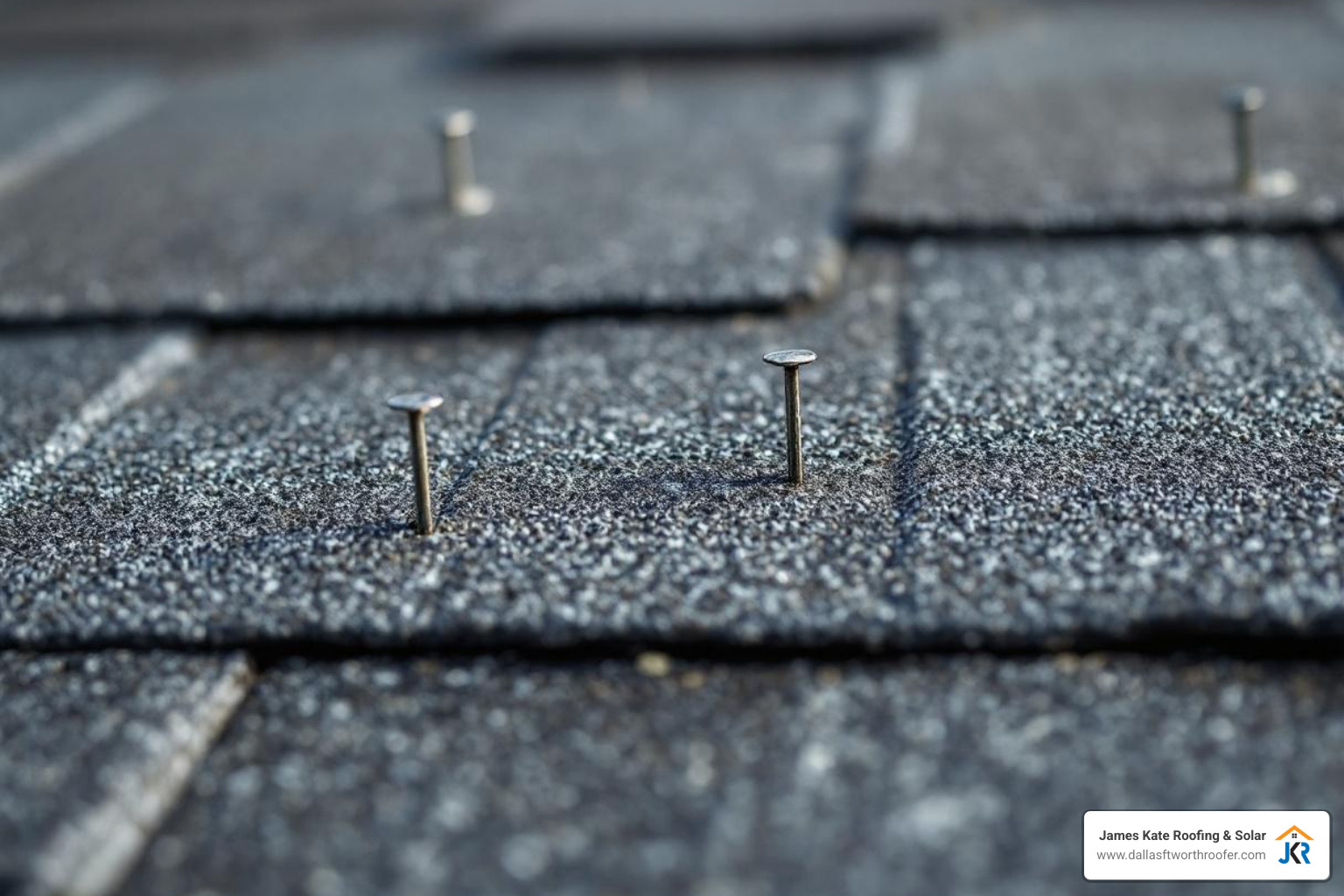
Correct nailing technique and depth are perhaps the most vital aspect of shingle installation. Improper nailing is a leading cause of roof failures in storms. Nails must be driven flush with the shingle surface – not overdriven (which can cut through the shingle) or underdriven (which can leave the shingle loose). They must penetrate at least 3/4 inch into the roof sheathing. For architectural shingles, there’s a designated “nailing zone” – a specific strip where fasteners should be placed to ensure proper adhesion and wind resistance. For standard slopes and wind conditions, four nails per shingle are typically sufficient. However, for steep slopes (over 21 inches per 12 inches) or high-wind areas, six nails per shingle are often required.
To learn more about the different options available, Learn more about shingle types and how each can impact the beauty and resilience of your home.
Mastering Tricky Spots: Flashing and Penetrations
Even the most perfectly installed field shingles won’t protect your home if the roof’s vulnerable areas aren’t properly addressed. Flashing is the unsung hero of a watertight roof, diverting water away from interruptions in the shingle layer. These are the critical areas where water can intrude, and getting them right is non-negotiable for true leak prevention.
How to Install Flashing in Valleys, Walls, and Chimneys
Valleys are perhaps the most critical areas for flashing, as they collect a large volume of water. There are two primary methods for valley flashing:
- Open Valleys: These use a continuous metal liner (minimum 24-inch wide, 26-gauge pre-finished galvanized metal) centered in the valley. Shingles are then trimmed back from the centerline, leaving the metal exposed. This method allows for a clear channel for water flow and is often recommended for longer roof performance.
- Closed-Cut Valleys: In this method, shingles from one side of the valley extend at least 12 inches across the centerline. Shingles from the other side are then laid over them and trimmed back about 2 inches from the centerline, creating a “cut” line. The underlying shingles provide the waterproofing, and the cut line gives a neat appearance. A 36-inch wide valley liner of self-adhering underlayment should always be installed first in either method.
Where a roof meets a vertical wall, such as at a dormer or a side wall, step flashing is essential. These are individual pieces of L-shaped metal flashing (typically 8×8 inches, 26-gauge) that are woven into each shingle course. Each piece is installed over a shingle and under the next, with the vertical flange extending up the wall. They overlap each other by at least 3 inches, creating a stair-step pattern that sheds water down and away from the wall.
For larger vertical structures like chimneys, more complex flashing is needed. This typically involves several components: an apron flashing at the front, step flashing along the sides, and a cricket or saddle at the back (for chimneys wider than 30 inches) to divert water around the obstruction. Counter flashing is then installed into the chimney masonry, overlapping the base flashing to prevent water from running down the chimney and behind the base flashing. Proper sealing with roofing cement is also crucial here.
It’s vital to Apply flashing materials in concert with the shingle installation procedure to ensure every layer works together seamlessly.
Sealing Around Pipes, Vents, and Other Penetrations
Any penetration through the roof deck—from plumbing stacks to attic vents to skylights—is a potential leak point. We use specialized flashing components and sealing techniques to ensure these areas are watertight.
Pipe boots (also known as pipe collars) are pre-formed rubber or metal flashing components designed to fit snugly around plumbing vent pipes. These are installed over the shingles below the pipe and under the shingles above it. The base of the boot is nailed to the roof deck, and the top portion is integrated with the shingle courses. We always apply a generous bead of roofing cement around the base of the pipe boot and under its edges for an extra layer of protection.
For attic vents and other roof-mounted accessories, specialized vent flashing is used. This metal flashing typically has a wide base that slides under the upper shingles and over the lower ones, with a collar that fits around the vent. Similar to pipe boots, roofing cement is used to seal any exposed edges or fasteners.
The key to sealing around any penetration is to cut shingles to fit neatly around the flashing, ensuring that no raw edges are exposed to direct water flow. Any exposed nail heads on flashing should be covered with a quality roofing cement or sealant (like Lexel, which is known for its durability and resistance to UV). This meticulous attention to detail ensures that these vulnerable areas are as robust as the rest of your roof. For a visual guide, you can Watch how to flash around plumbing stacks and attic vents.
Finishing the Job and Key Considerations
We’re almost there! The final steps in your roofing shingles installation are crucial for both the long-term performance and the aesthetic appeal of your new roof. A professional finish ensures durability and improves curb appeal, protecting your investment for years to come.
Capping the Ridge and Ensuring Ventilation
The ridge, the highest point of your roof, and the hips, the angled intersections, are the final areas to be covered. This is where ridge cap shingles come into play. These are typically thicker, pre-formed shingles designed to bend over the peak of the roof, providing a watertight seal and a finished look. We install them from the bottom of the hip or the end of the ridge opposite the prevailing wind direction, overlapping each piece to shed water effectively. Longer nails are often needed to penetrate through the ridge cap shingle and the underlying field shingles into the roof deck. Any exposed nail heads on the ridge caps are sealed with roofing cement.
Proper attic ventilation is also integrated at this stage. Ridge vents are a continuous vent system installed along the entire ridge line, working in conjunction with soffit vents to create a balanced airflow. This system allows hot, moist air to escape the attic, preventing heat buildup that can prematurely age shingles and reducing moisture condensation that can lead to wood rot. Ensuring adequate ventilation meets FHA Minimum Property Standards and local building codes is essential for the longevity of your roof and the energy efficiency of your home. To see this process in action, you can Learn about hip and ridge capping.
3-Tab vs. Architectural Shingles: An Installation Comparison
While the fundamental principles of roofing shingles installation remain similar, there are key differences between installing traditional 3-tab shingles and their more modern counterparts, architectural (or laminate) shingles.
Final Cleanup and Inspection for your Roofing Shingles Installation
The job isn’t truly finished until the work area is pristine and every detail is checked. This final stage of roofing shingles installation is crucial for safety and ensuring the long-term integrity of your roof.
First, we address any exposed nails. While proper nailing techniques aim to conceal fasteners, some may inevitably be exposed, especially on ridge caps or around flashing. These nails must be carefully sealed with a high-quality roofing cement or sealant to prevent water intrusion. We then perform a thorough final inspection of all sealed areas, ensuring that all flashing is correctly installed, shingles are properly aligned, and there are no gaps or vulnerabilities.
Next comes the thorough site cleanup. This goes beyond just picking up large debris. We use a magnetic sweeper to carefully go over the entire perimeter of the house, including driveways, walkways, and landscaping, to collect every stray nail. This prevents flat tires, injuries, and ensures a safe environment for your family and pets. Finally, we clean out your gutters, which can accumulate debris during the installation process, ensuring they’re clear and ready to handle rainwater.
Conclusion: Protecting Your Investment with a Flawless Installation
As we’ve seen, roofing shingles installation is a complex, multi-step process that demands precision, proper technique, and a deep understanding of roofing principles. From meticulous planning and rigorous safety measures to the careful layering of protective materials, the art of staggering shingles, and the critical role of flashing, every detail contributes to the overall watertightness and longevity of your roof.
The value of precision cannot be overstated. A flawlessly installed roof acts as your home’s primary shield against the elements, protecting your most valuable asset from water damage, wind uplift, and premature deterioration. While a DIY approach might seem appealing, the complexities involved, especially on steeper or more intricate roofs, often make professional expertise invaluable.
For homeowners in the DFW area seeking a flawless, warrantied roofing shingles installation, James Kate Roofing & Solar provides expert service with honesty and integrity. We’re a GAF President’s Club recognized company, and we stand by our work with up to a 25-year workmanship warranty, giving you ultimate peace of mind. Our team understands the unique climate challenges of Texas, from scorching summers to sudden hailstorms, and we install every roof to withstand them. Don’t leave your home’s protection to chance; Contact us for a professional roofing shingles installation that you can trust.

Dustin Eatman is a seasoned roofing professional with deep, hands-on expertise that spans residential and commercial roofing, insurance solar, and long-term roof asset management. As the owner of James Kate Roofing & solar in the Dallas–Fort Worth metroplex, he’s built a reputation for diagnosing roof systems accurately, communicating clearly, and executing projects with a high standard of workmanship and documentation. Dustin understands the technical details that make roofs perform—proper underlayment selection, slope and drainage considerations, ventilation strategy, flashing and penetration detailing, and manufacturer-specific installation requirements—because he’s worked through the real-world challenges that cause leaks, premature wear, and warranty issues. He’s equally fluent in the operational side of roofing: jobsite planning, quality control, safety, material ordering, crew coordination, and customer experience from inspection to closeout. In insurance-related projects, Dustin brings practical knowledge of claim workflows, adjuster meetings, scope alignment, supplements, and the importance of photo evidence and thorough records, helping property owners navigate stressful situations with confidence. For commercial clients—especially property and facility managers—he emphasizes proactive maintenance and targeted repairs that reduce disruption, extend roof life, and prevent expensive interior damage. Dustin also stays focused on doing things the right way: educating customers on realistic options, setting expectations, and prioritizing solutions that hold up over time rather than quick fixes. That blend of technical skill, field experience, process discipline, and owner-level accountability is what makes Dustin Eatman a trusted expert in the roofing industry.