
Why Finding the Best Facing Roof for Solar Panels Matters for Your DFW Home
The best facing roof for solar panels in the Northern Hemisphere is south-facing, which typically generates the most electricity throughout the year. However, east and west-facing roofs are also excellent candidates, producing only 15–20% less energy while potentially offering better financial returns depending on your utility rate structure. North-facing roofs generally aren’t recommended due to significantly reduced production (up to 50% less).
Quick Reference: Roof Direction Impact on Solar Production
Roof Direction
Annual Production vs. South
Best For
South
Baseline (100%)
Maximum energy generation
East
80–85%
Morning energy use, lower Time-of-Use rates
West
80–85%
Afternoon/evening use, peak demand offset
North
50–60%
Rarely recommended
If you’re a DFW homeowner exploring solar, understanding how your roof’s orientation affects energy production is the first step toward making a smart investment. Your roof’s direction determines how much sunlight your panels capture throughout the day, which directly impacts your energy savings and return on investment.
But here’s the good news: most roofs in North Texas can support productive solar systems, even if they don’t face due south. The key is understanding the trade-offs between different orientations and how factors like your utility’s rate structure, roof angle, and available space all work together.
Many homeowners assume they can’t go solar because their roof doesn’t face the “perfect” direction. That’s simply not true. With the right system design and realistic expectations, east and west-facing roofs regularly deliver excellent results. In some cases—particularly with Time-of-Use electricity rates—west-facing panels can actually save you more money than south-facing ones, even though they produce slightly less total energy.
Direction isn’t the only factor that matters, either. Your roof’s angle (pitch), the amount of shading from trees or neighboring structures, your roof’s condition and material, and how much space you have available all play important roles in determining your solar potential.
I’m Dustin Eatman, owner of James Kate Roofing & Solar, and over my years working with DFW homeowners, I’ve assessed hundreds of roofs for solar viability—including many that owners initially thought weren’t suitable. Understanding the best facing roof for solar panels and how to work with what you have is essential to maximizing your investment and energy savings.
What is the Best Facing Roof for Solar Panels in the Northern Hemisphere?
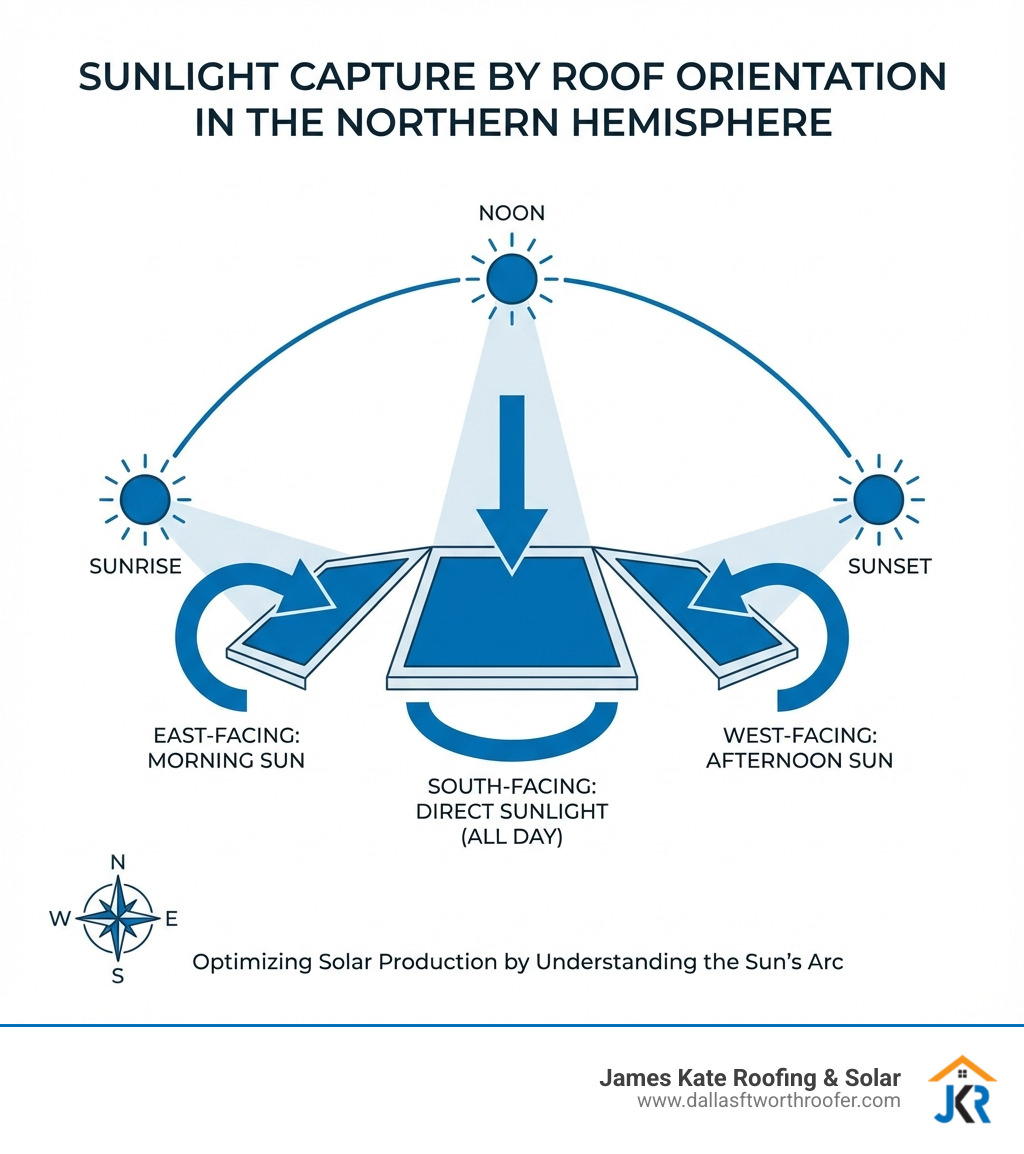
When we talk about the best facing roof for solar panels in the Northern Hemisphere, the general rule of thumb is unequivocally south-facing. This orientation allows solar panels to capture the maximum amount of direct sunlight throughout the day, leading to the highest possible energy production.
In our part of the world, specifically here in DFW, the sun traces an arc across the southern sky from east to west. A south-facing roof is perfectly positioned to receive this direct sunlight for the longest duration, from morning to late afternoon. This consistent, direct exposure is what translates into peak energy generation.
The direction your roof faces is technically called its azimuth. For optimal solar production, we aim for an azimuth of 180 degrees, which is true south. It’s important to distinguish this from magnetic south, which a compass points to. Solar installers will always account for the difference to ensure your panels are aligned with true south. The U.S. Department of Energy affirms that for maximum output, the sweet spot for solar panels in the continental U.S. is facing roughly south. For more authoritative guidance, you can refer to An authoritative guide from the Department of Energy.
Why South is the “Solar Sweet Spot”
The reason south is considered the “solar sweet spot” is quite simple: direct sunlight. Solar panels thrive on direct, unobstructed sunlight. When a panel faces south, it receives the sun’s rays perpendicularly (or very close to it) for the majority of the day, especially around solar noon when the sun is at its highest point.
This consistent, all-day sun exposure means that south-facing systems almost always generate the most electricity annually. For DFW homeowners, this translates directly into the highest annual production, which in turn maximizes your return on investment (ROI). More electricity generated means more savings on your utility bill and a faster payback period for your solar system. The efficiency of your solar panels is largely dependent on how much direct sunlight they receive, and south-facing roofs provide the ideal conditions for this.
What About the Southern Hemisphere?
While our focus at James Kate Roofing & Solar is on DFW and the Northern Hemisphere, it’s worth noting for a global understanding that the principles are simply reversed in the Southern Hemisphere. There, the sun travels across the northern sky, making a north-facing roof the ideal orientation for solar panels. This illustrates a universal principle in solar energy: panels should always face the equator to maximize direct sunlight exposure.
Beyond South: Evaluating East, West, and North-Facing Roofs
While south is often touted as the ideal, it’s far from the only viable option. In the real world, many homes in DFW don’t have perfectly south-facing roofs, and that’s perfectly okay. East and west-facing roofs are excellent alternatives and can still provide significant energy production and savings.
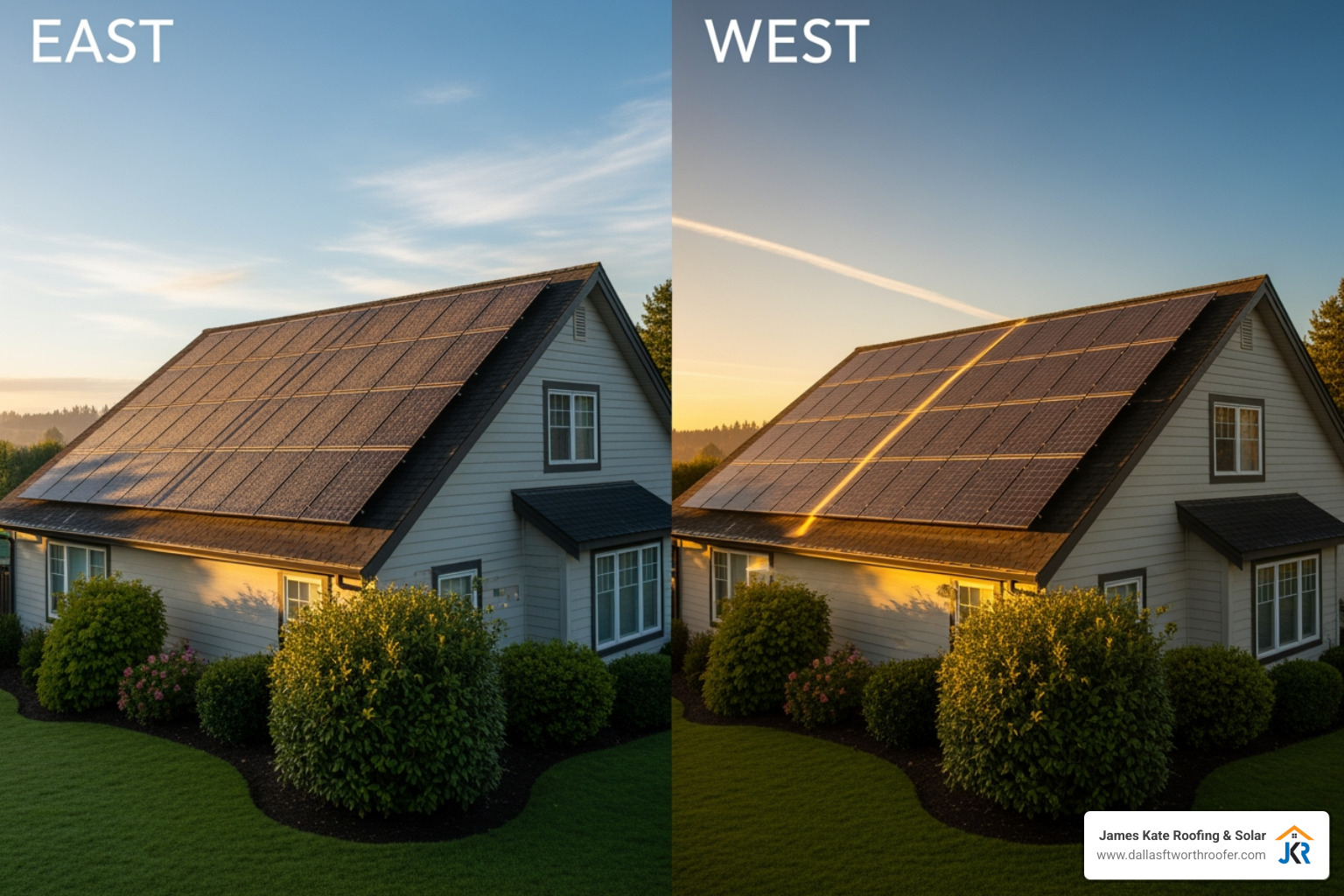
Compared to a southern roof, east and west-facing panels typically experience about a 15–20% drop in annual production. However, this doesn’t mean they’re less beneficial. An ideal east-west setup might only lose 10–15% of its annual production compared to a perfect south-facing system. This makes them very much viable for solar installations, and in some specific scenarios, they might even be preferable.
East and west-facing systems offer a different energy generation curve. East-facing panels will produce more energy in the morning, while west-facing panels will generate more in the afternoon and early evening. This can be a strategic advantage, as we’ll discuss next.
East vs. West-Facing Panels: A Trade-Off
Choosing between east and west-facing panels often comes down to a trade-off that aligns with your household’s energy consumption patterns.
East-facing panels are fantastic for DFW homeowners who use a lot of electricity in the mornings. If your family is typically home and active during breakfast, getting ready for school or work, or running appliances before noon, east-facing panels can directly offset that morning usage.
West-facing panels, on the other hand, shine in the afternoon and early evening. If your family’s energy consumption peaks when everyone returns home from work and school – running air conditioning, cooking dinner, watching TV – then west-facing panels can be incredibly beneficial.
As mentioned, both east and west-facing orientations typically see about a 15–20% reduction in overall annual production compared to a south-facing system. However, this slight dip in total kilowatt-hours doesn’t always translate to less savings. For a deeper dive into this discussion, you can read A discussion on south-facing vs. west-facing panels.
How Utility Rates Make West the “New Best”
This is where the financial strategy truly comes into play. The optimal direction for your panels isn’t just about maximizing production; it’s about maximizing savings. And in many areas, including parts of DFW, utility rate structures are evolving, making west-facing panels increasingly attractive.
Many electric utilities are moving towards Time-of-Use (TOU) pricing. With TOU rates, electricity costs more during peak demand hours (often late afternoon to early evening) and less during off-peak hours. If your utility has TOU pricing, and your household’s energy use peaks during those expensive afternoon hours, west-facing panels can provide a significant financial advantage. They generate power precisely when electricity is most expensive, directly offsetting your high-cost consumption.
Furthermore, the landscape of net metering is also changing. Net metering is a billing mechanism that credits solar energy system owners for the electricity they add to the grid. Historically, this has often been a 1:1 credit. However, increasingly fewer US electric utilities are offering full-rate 1:1 net metering. Instead, some utilities might pay you only a portion of the retail price for the electricity you send to the grid – often referred to as net billing. In such scenarios, where the buy-back rate for exported power is low, maximizing self-consumption becomes paramount. And for many DFW households, that means generating power when they’re actually home and using it, which often aligns with the afternoon output of west-facing panels.
So, while south-facing panels might produce the most overall energy, west-facing panels can often generate the most valuable energy, leading to greater savings under specific utility rate structures. It’s a classic case of maximizing savings over maximizing raw production.
Is a North-Facing Roof Ever an Option?
We’re going to be honest with you: north-facing roofs are generally not the best facing roof for solar panels in DFW, or anywhere in the Northern Hemisphere for that matter. Our research shows that north-facing roofs can experience almost a 50% drop in production compared to south-facing roofs. This significant reduction in energy output almost always leads to a very poor return on investment for a homeowner.
That’s why, at James Kate Roofing & Solar, we rarely recommend installing panels on north-facing roof planes for owned systems. The economics simply don’t make sense for most DFW homeowners looking to maximize their savings. One industry expert even stated that north-facing panels only make sense on “one out of 1,000 installs.”
However, there are extremely rare exceptions. If electricity prices are extraordinarily high, and there are no other viable roof planes (south, east, or west) available, it might be considered as a last resort. In such cases, specialized tilt-up brackets could be used to angle the panels more aggressively towards the south, trying to “force” them to capture more sunlight. But even with these measures, the efficiency and ROI would still be significantly compromised. For the vast majority of DFW homeowners, however, north-facing is a definite “no.”
The Perfect Pair: How Roof Angle (Tilt) Affects Performance
Beyond direction, the angle or “tilt” of your solar panels is another crucial factor that influences how much sunlight they capture. Your roof’s pitch, which is its steepness, directly dictates the tilt angle of roof-mounted solar panels.
The ideal tilt angle is one that allows the panels to be perpendicular to the sun’s rays for the longest possible duration throughout the year. A common rule of thumb for optimal annual production is to tilt your panels at an angle roughly equivalent to your geographical latitude. For DFW homeowners, this means an angle somewhere in the low to mid-30s (Dallas is around 32–33 degrees North latitude). However, the optimal angle can vary slightly depending on whether you want to prioritize summer or winter production, or an even spread throughout the year.
How tilt can make a non-south roof the best facing roof for solar panels
Even if your roof isn’t perfectly south-facing, a strategic tilt can still help you get the most out of your solar panels.
More Than Direction: Other Factors That Impact Solar Viability
While finding the best facing roof for solar panels and optimizing their tilt are crucial, they are just two pieces of a larger puzzle. A holistic assessment of your property’s solar potential involves several other critical factors that often outweigh orientation in determining overall suitability and economic viability.
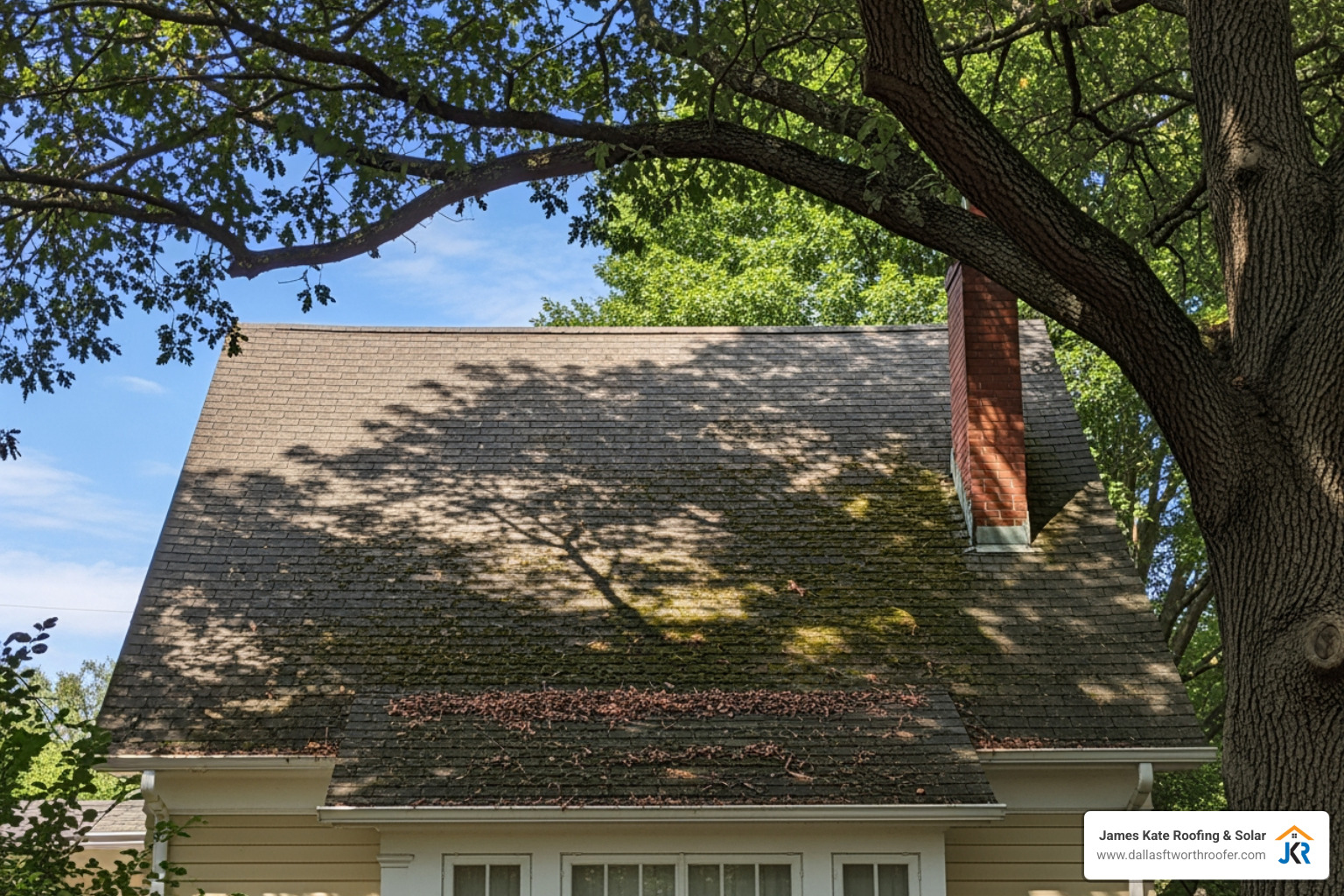
Small roofs, bad solar policies (not typically an issue in DFW with our robust market), and heavy shading are much more likely than roof orientation to wreck solar economics. These factors collectively determine the solar economics, system design, and overall suitability of a solar installation for your DFW home.
The Critical Role of Shading
Shade is the archenemy of solar panels. Even partial shading on just one panel can significantly reduce the output of an entire string of panels. Common sources of shading in DFW include:
Tree cover: Mature trees can cast long shadows, especially in the morning and late afternoon.
Chimneys and vents: These roof structures can create self-shading on panels.
Neighboring buildings: Tall adjacent structures can block sunlight, particularly in dense urban areas.
When we design a solar system for your home, our experts at James Kate Roofing & Solar carefully analyze shading patterns throughout the year. We use specialized tools to identify potential obstructions and design the array to minimize their impact. Technologies like microinverters or power optimizers can also help mitigate the effects of shading by allowing individual panels to operate independently, preventing one shaded panel from dragging down the performance of others.
Why Roof Size, Condition, and Material Matter
Your roof itself is the foundation of your solar system, and its characteristics are paramount:
Available roof space: The average US home solar system size is 5 kilowatts, requiring about 12–13 panels. With each panel needing approximately 15 square feet, you typically need about 200 square feet of clear, unshaded roof space for an average system. For a system to be economically viable, we generally look for enough space to install at least 8–10 panels, or around 3 kW.
Roof age and lifespan: Solar panels are guaranteed to last for 25 years or more. It makes sense to install them on a roof that has a similar remaining lifespan. If your asphalt shingle roof is nearing its 20-year mark, we might recommend replacing it before installing solar to avoid the costly process of removing and reinstalling panels just a few years down the line. Metal, slate, and tile roofs, which can last 50 years or more, are excellent long-term partners for solar.
Structural integrity: Your roof must be strong enough to support the additional weight of the solar panels and racking system, typically 3 to 5 pounds per square foot. We always conduct a thorough structural assessment to ensure your roof can safely bear the load.
Suitable materials: Most common DFW roofing materials like asphalt shingles and metal roofs are excellent for solar installations. Metal roofs, especially standing seam, can even allow for direct panel attachment without drilling. Tile roofs are also suitable, though installation can be more labor-intensive.
How to determine the best facing roof for solar panels on your property
Determining the best facing roof for solar panels on your specific DFW property is a multi-step process, but there are resources to help:
Online Tools for Initial Assessment: You can use online tools like Google Maps to look up an aerial photo of your home and visually assess your roof’s direction and potential shading. Google’s Project Sunroof is another fantastic tool that analyzes your roof’s direction, angle, and shading to estimate your solar potential.
Professional Site Assessment: While online tools provide a great starting point, nothing beats a professional site assessment. Our experts at James Kate Roofing & Solar will visit your home, conduct a detailed inspection of your roof’s condition, measure its precise azimuth and pitch, analyze shading patterns with specialized software, and assess its structural integrity. This comprehensive evaluation allows us to design a custom solar system that maximizes your energy production and savings.
Frequently Asked Questions about Solar Panel Direction
How much less energy do east or west-facing panels produce?
East and west-facing panels typically produce about 15–20% less energy annually compared to an ideal south-facing system. However, this can be offset by financial gains from Time-of-Use rates if your DFW utility implements them, as west-facing panels produce power when electricity is often most expensive.
Is my roof still good for solar if it doesn’t face south?
Absolutely. The vast majority of roofs in the U.S. are good candidates for solar. The National Renewable Energy Laboratory suggests that at least 82% of buildings get enough sunlight to qualify. East and west-facing roofs are very common and effective for solar installations, especially when considering your home’s energy usage patterns and utility rate structures. Don’t let a non-south-facing roof deter you from exploring solar.
What’s more important: roof direction or roof angle?
Direction is generally more impactful on annual production than angle. While an ideal tilt angle is beneficial, a roof with a good direction (south, east, or west) but a non-ideal angle (within reason) will almost always outperform a roof with a perfect angle that faces north. Small adjustments to angle have less impact than a major shift in direction. Other factors like shading and roof size often play a more critical role than either precise angle or direction alone.
Conclusion: Find Your Home’s Solar Sweet Spot
Navigating solar can seem complex, but understanding the best facing roof for solar panels is a fantastic first step. We’ve learned that a south-facing roof is typically ideal for maximizing annual energy production in DFW, but east and west-facing roofs are excellent, viable alternatives. In fact, with evolving utility rate structures like Time-of-Use pricing, a west-facing array might even offer greater financial savings by aligning production with peak demand.
The precise tilt of your panels, the presence of shading, your roof’s size, age, and material are all equally, if not more, important than direction alone. These factors combine to create your home’s unique solar potential.
At James Kate Roofing & Solar, we believe in honesty, integrity, and providing top-tier services to our DFW community. We’re here to cut through the jargon and provide you with clear, actionable insights specific to your property. For a comprehensive evaluation of your roof’s potential and to explore the best rack-mounted solar options for your DFW home, contact our experts today. We’ll help you open up your roof’s full potential and find your home’s solar sweet spot.