Why the Category of Water Loss Determines Everything About Your Recovery
The category of water loss in your home or business is the single most important factor in deciding how dangerous the water is, what materials can be saved, and how fast you need to act.
Here is a quick breakdown:
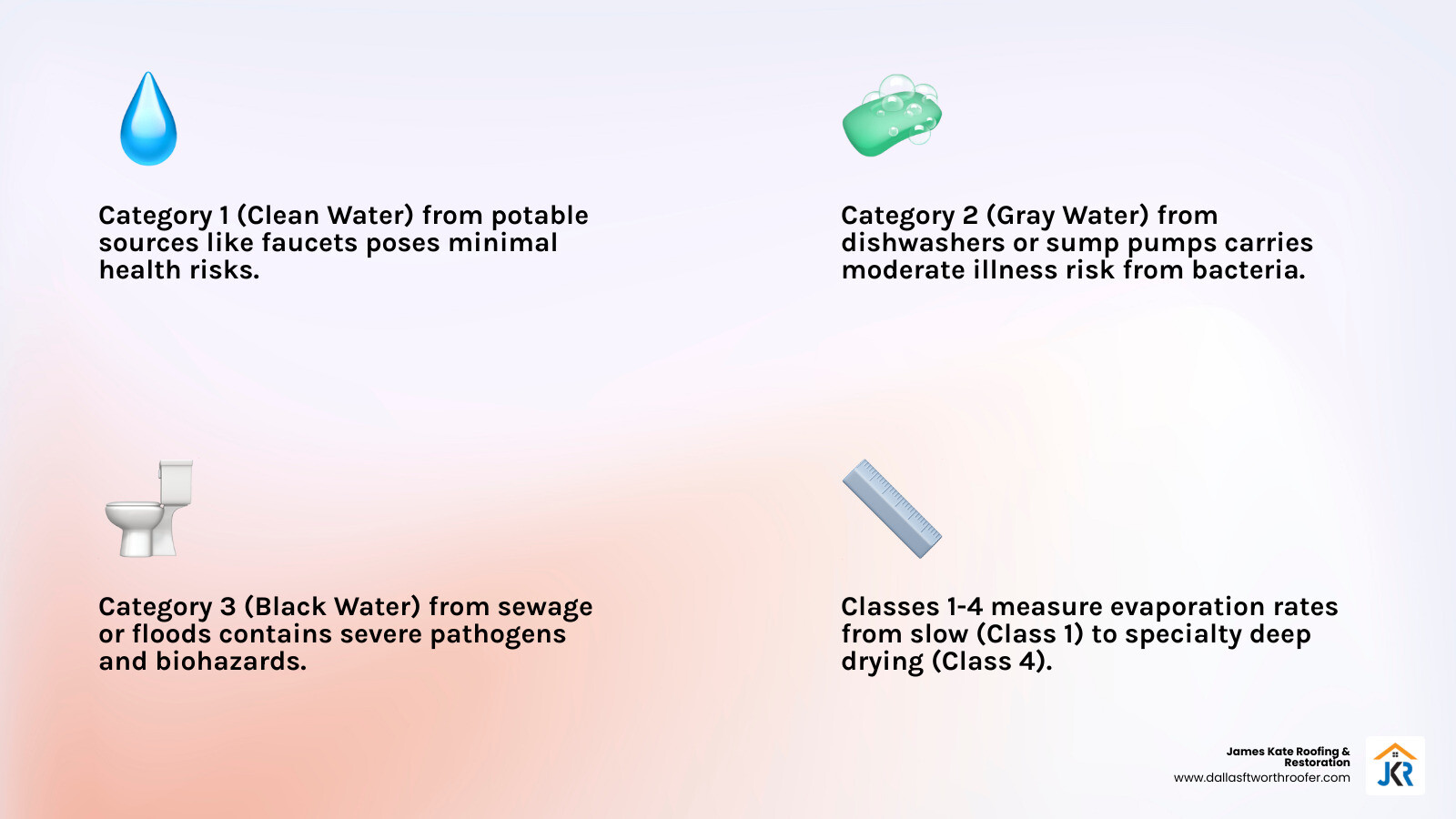
| Category | Name | Source Examples | Health Risk |
|---|---|---|---|
| Category 1 | Clean Water | Supply lines, faucet leaks, toilet tanks | Minimal |
| Category 2 | Gray Water | Dishwasher overflow, sump pump failure, washing machine | Moderate — can cause illness |
| Category 3 | Black Water | Sewage backup, river flooding, seawater | Severe — pathogens and biohazards |
And water damage is also classified by how far it has spread:
| Class | Evaporation Rate | What It Looks Like |
|---|---|---|
| Class 1 | Slow | Small area, low-porosity materials |
| Class 2 | Fast | Whole room, walls wet up to 24 inches |
| Class 3 | Fastest | Overhead source, ceiling to floor saturation |
| Class 4 | Specialty | Deep saturation in hardwood, concrete, or plaster |
These two systems — category (contamination level) and class (saturation extent) — work together to define your solar plan, your health risk, and your insurance claim.
Did you know that 98% of basements will experience some form of water damage in their lifetime? Most homeowners don’t realize that what looks like a simple wet floor could already be shifting into a much more serious — and costly — situation.
I’m Dustin Eatman, owner of James Kate Roofing & solar in the Dallas–Fort Worth area, and I’ve worked on hundreds of water damage jobs where correctly identifying the category of water loss made the difference between a straightforward dry-out and a full structural rebuild. In this guide, I’ll walk you through exactly how to identify what you’re dealing with — and what to do next.
Category of water loss terms to learn:
Understanding the Three Categories of Water Loss
When we arrive at a home in Mansfield or Grand Prairie to assess a flood, the first thing we do isn’t grabbing a mop—it’s identifying the “cleanliness” of the water. In the solar industry, we follow the IICRC S500 standards, which break water damage down into three distinct categories based on the level of contamination.
Identifying the category of water loss is vital because it dictates the safety protocols our team must follow. If we treat sewage like tap water, we risk the health of the occupants and our technicians. Conversely, if we over-treat a simple sink overflow, we might cause unnecessary costs for the homeowner.
Category 1: Clean Water Sources
Category 1 water originates from a sanitary source and does not pose a substantial risk if you were to accidentally touch it or even ingest it (though we certainly don’t recommend a taste test!). This is essentially potable water—the stuff you drink or bathe in.
Common sources include:
- Broken indoor water supply lines.
- Tub or sink overflows where no contaminants are present.
- Malfunctioning toilet tanks (the upper tank, not the bowl).
- Melting ice or falling rainwater.
While Category 1 is the “best-case scenario,” it is a ticking time bomb. If this water sits for more than 24 to 48 hours, it can quickly degrade into a more hazardous category as it mixes with dust, floor finishes, or structural soils. To learn more about how we handle these clean-water situations, check out our solar services.
Category 2 and 3: Gray and Black Water Hazards
As we move up the scale, the health risks increase exponentially.
Category 2 (Gray Water) contains significant contamination. This water has the potential to cause discomfort or even sickness if consumed or contacted. It often contains microorganisms or nutrients for microorganisms.
- Sources: Discharge from dishwashers or washing machines, overflows from toilet bowls (containing urine but no feces), and sump pump failures.
Category 3 (Black Water) is the most dangerous category of water loss. This water is “grossly unsanitary.” It contains pathogenic agents, toxins, or harmful biohazards.
- Sources: Sewage backups from beyond the toilet trap, seawater, rising water from rivers or streams (which picks up animal waste and pesticides), and wind-driven rain from hurricanes or tropical storms.
In the DFW area, we often see Category 3 losses during heavy spring storms when ground surface water rushes into basements or crawlspaces. This water is never safe for DIY cleanup; it requires professional-grade disinfectants and full Personal Protective Equipment (PPE).
The Four Classes of Water Loss and Evaporation Rates
If the category tells us how dirty the water is, the class tells us how much water there is and how hard it will be to dry out. The class is determined by the “evaporation load”—essentially, how much moisture the air needs to pull out of the materials.
Class 1 and 2: Slow to Fast Evaporation
Class 1 (Slow Evaporation Rate): This involves only a small area and affects materials with low porosity, such as plywood, particle board, or structural wood. There is very little moisture absorbed by the materials, making it the easiest and fastest to dry.
Class 2 (Fast Evaporation Rate): This is a more significant loss. It usually affects an entire room and involves carpet and cushion (padding). One of the hallmark signs of a Class 2 loss is that water has wicked up the walls—but no higher than 24 inches. Because there is more surface area of wet material, we need more powerful air movers and dehumidifiers to stabilize the environment.
Class 3 and 4: Severe and Specialty Drying
Class 3 (Fastest Evaporation Rate): This is the “overhead” nightmare. Usually caused by a burst pipe in the ceiling or a water heater failure on an upper floor, Class 3 means the water has saturated the entire area—ceilings, walls, insulation, carpet, and subflooring. The water is coming from everywhere, and the evaporation load is at its peak.
Class 4 (Specialty Drying Situations): This class is reserved for “deep pockets” of moisture. It involves materials with very low permeance or porosity, such as:
- Hardwood floors.
- Plaster walls.
- Brick and stone.
- Concrete or crawlspaces.
These materials don’t give up water easily. We can’t just blow air on them; we often need specialty equipment like floor drying mats or pressurized drying trailers to pull moisture out from deep within the structure.
| Feature | Class 1 | Class 2 | Class 3 | Class 4 |
|---|---|---|---|---|
| Area Affected | Small portion of a room | Entire room / Carpet | Entire area / Ceilings | Structural elements |
| Wicking | Minimal | Up to 24 inches | Full wall saturation | Deep penetration |
| Drying Time | 2-3 Days | 3-5 Days | 5-7+ Days | Long-term / Specialty |
| Primary Goal | Surface drying | Carpet/Pad extraction | Full structural dry-out | Deep moisture extraction |
How a Category of Water Loss Degrades Over Time
One of the biggest misconceptions we encounter in Arlington and Granbury is the idea that “it’s just clean water, I can wait until Monday to call.” In solar, time is your greatest enemy. A category of water loss is dynamic—it doesn’t stay the same.
Factors Influencing Your Category of Water Loss
A Category 1 loss can become a Category 2 or even a Category 3 in a matter of days. This degradation is influenced by several factors:
- Stagnation: Standing water becomes a breeding ground for bacteria.
- Temperature: The hot Texas sun can turn a damp house into an incubator. High temperatures accelerate the growth of mold and bacteria.
- Organic Load: If clean water saturates “dirty” materials like subfloors or drywall, it dissolves the organic matter (food for mold) and increases the contamination level.
- Odor Indicators: If you start to smell a “musty” or “sour” odor, that is a biological sign that your Category 1 water has already shifted into Category 2 or 3.
Managing Health Risks Based on Your Category of Water Loss
The health risks associated with water damage are real. In a Category 3 situation, the risk of E. coli, Salmonella, and various viruses is high. According to the Centers for Disease Control and Prevention (CDC), exposure to contaminated floodwater can lead to serious illness. Even Category 2 water can cause skin rashes or respiratory distress if the water contains chemical residues from cleaning products or detergents.
When we handle a Category 3 loss, we establish “containment.” This involves using heavy-duty plastic sheeting and HEPA air scrubbers to ensure that pathogens aren’t blown into the unaffected parts of your home. We also wear full-body suits and respirators—not because we want to look like astronauts, but because the biological load in black water can lead to serious long-term health issues.
Professional Assessment and Insurance Impacts
When you file an insurance claim for water damage, the adjuster isn’t just looking at the puddle; they are looking for the professional classification. Insurance companies rely on IICRC-certified restorers to document the category of water loss and the class of damage to determine what they will pay for.
Identifying Your Category of Water Loss for Claims
The category determines the “salvageability” of your belongings.
- Category 1: We can usually dry out and save your carpets and pads.
- Category 2: We typically must remove and discard the carpet padding, but the carpet itself might be saved if it can be properly disinfected.
- Category 3: Almost all porous materials must go. This includes carpet, padding, drywall, and insulation. If it touched black water, it is considered a biohazard.
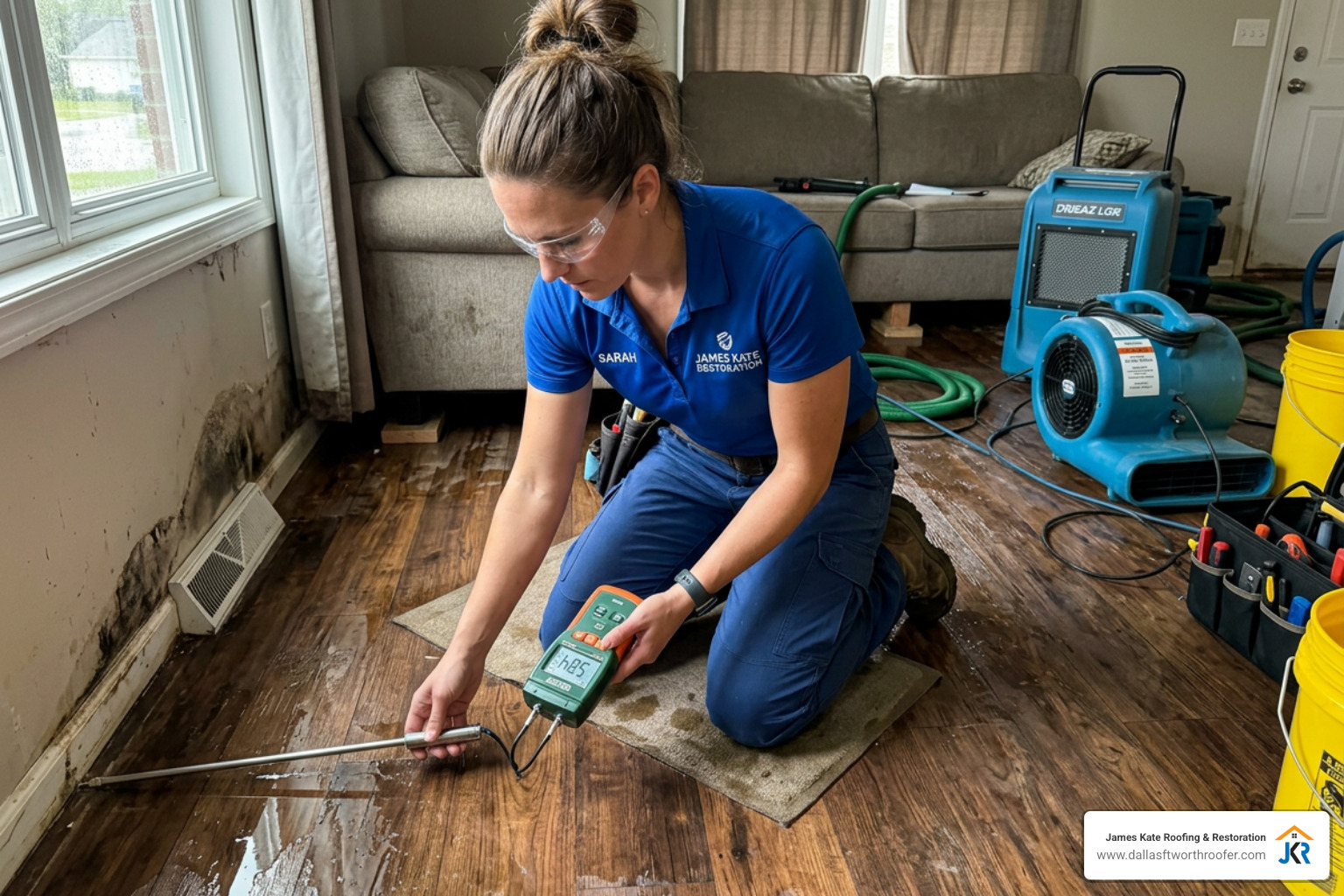
Correctly documenting the source and the category is the difference between a claim being approved or denied. We use moisture meters and thermal imaging cameras to create a “moisture map” that proves the extent of the damage to your insurance provider. For business owners, this is even more critical to minimize downtime. You can learn more about our commercial solar needs to see how we handle large-scale losses.
Immediate Steps for Homeowners
If you discover water damage in your Midlothian or Mansfield home, every minute counts. Here is what you should do immediately:
- Stop the Source: If it’s a burst pipe, shut off the main water valve.
- Turn Off Power: If water is near outlets or appliances, shut off the breakers.
- Document Everything: Take photos and videos before any cleanup begins. This is vital for your insurance category assessment.
- Elevate Furniture: Place aluminum foil or wood blocks under furniture legs to prevent permanent staining and further wicking.
- Call a Professional: Do not wait. A Class 1/Category 1 loss is much cheaper to fix than a Class 4/Category 3 loss that has sat for three days.
If the water came from a roof leak during a storm, you’ll also need to address the exterior. Check out our residential roofing and storm repair page for help with the source of the intrusion.
Frequently Asked Questions about Water Damage
What is the difference between a category and a class of water loss?
The category refers to the quality or contamination level of the water (how dirty it is). The class refers to the quantity of water and the expected evaporation rate (how much of the house is wet and how hard it is to dry). You need both to create a solar plan.
Can Category 1 water turn into Category 3?
Yes, absolutely. If clean water (Category 1) sits long enough to support significant bacterial and fungal growth, or if it flows through a contaminated area (like a crawlspace with animal droppings), it is reclassified as Category 3. This usually happens within 48 to 72 hours.
Why does Class 4 water damage require specialty equipment?
Class 4 involves materials like hardwood or concrete that have “deep-seated” moisture. Standard fans aren’t enough because the water is trapped inside the material’s cellular structure. We use specialized tools like desiccant dehumidifiers—which can create extremely low humidity—to “pull” that deep moisture out.
Conclusion
Dealing with water damage is stressful, but understanding the category of water loss gives you the knowledge to act decisively. Whether it’s a minor sink overflow in Midlothian or a major sewage backup in Grand Prairie, the steps you take in the first 24 hours will define the future of your property.
At James Kate Roofing & solar, we are a family-owned DFW company built on honesty, integrity, and Biblical principles. We don’t just “dry things out”—we provide a complete solution. From the initial water mitigation and mold remediation to the final build-back construction, our team is with you every step of the way. We are proud GAF President’s Club members and offer workmanship warranties that give you peace of mind long after the fans are turned off.
Don’t let a small leak turn into a Category 3 catastrophe. Contact us for a solar consultation today and let our family take care of yours.