
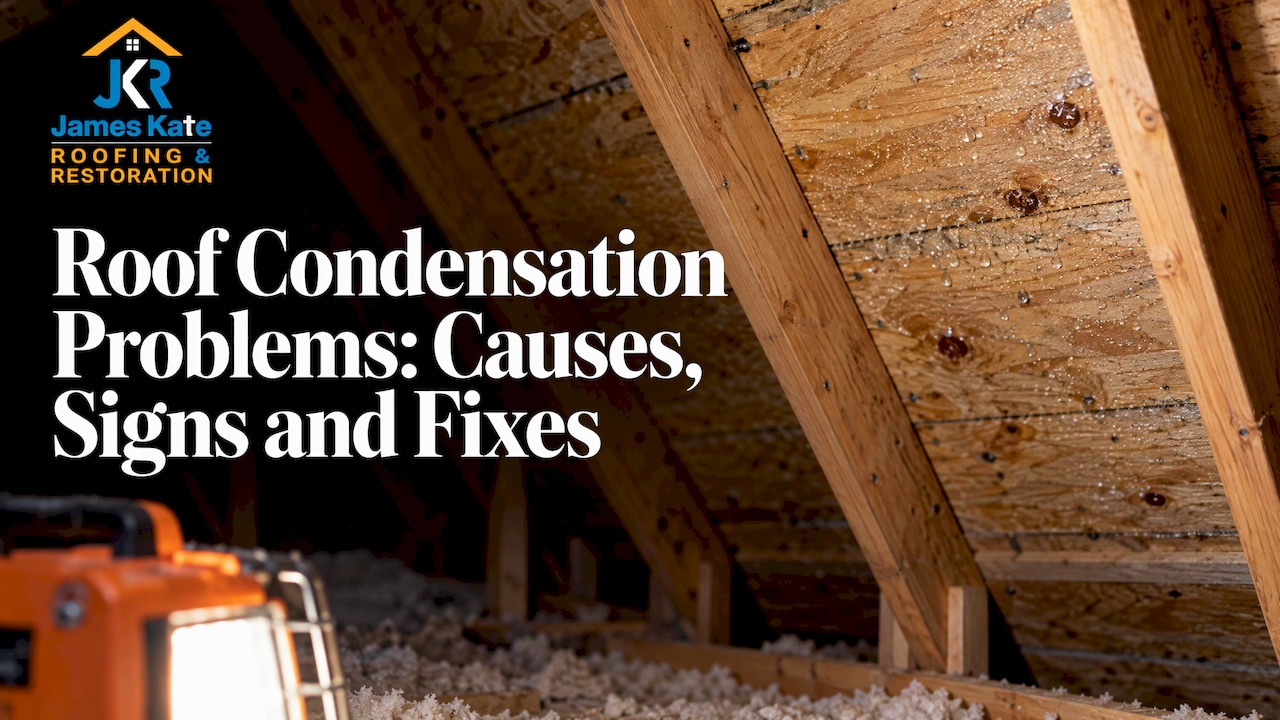
Condensation under a roof happens when warm, moist air from inside your home reaches a cold surface, usually the underside of the roof deck, and turns to water. The fix is almost never a patch on the roof. It is stopping the air leaks, controlling indoor humidity and giving the attic or roof assembly a way to dry out. Because condensation looks so much like a leak, a proper roof inspection is the fastest way to know which problem you have. We offer free roof inspections and estimates across Dallas-Fort Worth.
TL;DR
- Condensation is warm, damp air meeting a cold surface in the attic or roof assembly. The main source is air leaking from the house into the attic.
- A leak leaves stains in small areas. Condensation tends to stain or grow mold over a very large area.
- Left alone, it can cause mold, rotted sheathing and corroded fasteners.
- The cure is air sealing, correct insulation, exhaust fans vented outdoors and balanced ventilation.
- Repeated stains after a repair usually mean the cause was misdiagnosed. An inspection settles it.
Table of Contents
- What condensation under a roof actually is
- Where the moisture comes from
- Condensation or a roof leak?
- What condensation does to a roof and a home
- How to reduce condensation in a roof
- When to have a roofer look at it
- What we do about it
- Our perspective
- FAQ
- Sources
What condensation under a roof actually is
Air carries water vapor. Warm air holds more of it than cold air. When that warm, humid air touches a surface colder than its dew point (the temperature at which vapor turns to liquid), water forms. Inside a house, the cold surface is often the underside of the roof sheathing, the roof trusses or the nail points that poke through the deck.
The Pacific Northwest National Laboratory, a U.S. Department of Energy lab, describes the same chain: warm, moist air from the house or from ducts in the attic escapes into a cold attic and condenses on trusses or the underside of the sheathing. Four things drive it: surfaces below the dew point, air leaking through holes in the ceiling, high indoor humidity and too little ventilation or drying potential.
Why it shows up in North Texas too
Condensation is usually pictured as a northern problem, and cold climates do see more of it. But North Texas gets hard freezes and sharp overnight swings in winter, and homes here run heaters, showers and cooking on the same days. A cold deck over a heated, humid house is all it takes. The same conditions can appear in reverse in summer, when cold air-conditioned ceilings meet humid attic air. Metal roofs, which cool quickly at night, are especially prone to it. Our guide on how winter weather affects your roof covers the seasonal side.
Where the moisture comes from
Air leaks from the living space
The primary cause of attic moisture is warm air escaping from the heated home into the unheated attic. Cornell’s housing research says this airflow also warms the attic enough to melt snow and form ice dams. Typical leak points are:
- Recessed can lights
- Attic hatches and pull-down stairs
- Gaps around plumbing stacks and wiring
- Duct boots and ceiling drywall seams
- Chimney and flue chases
Indoor humidity and bad exhaust
Oregon State University’s extension service says indoor relative humidity between 30 and 50 percent keeps comfort high and moisture problems low, and that mold can start when air near a surface is above 70% relative humidity. Bathroom and kitchen fans that dump into the attic instead of outdoors feed the problem directly. Federal guidance on a similar case checked that fan vents end outside.
Missing or blocked ventilation
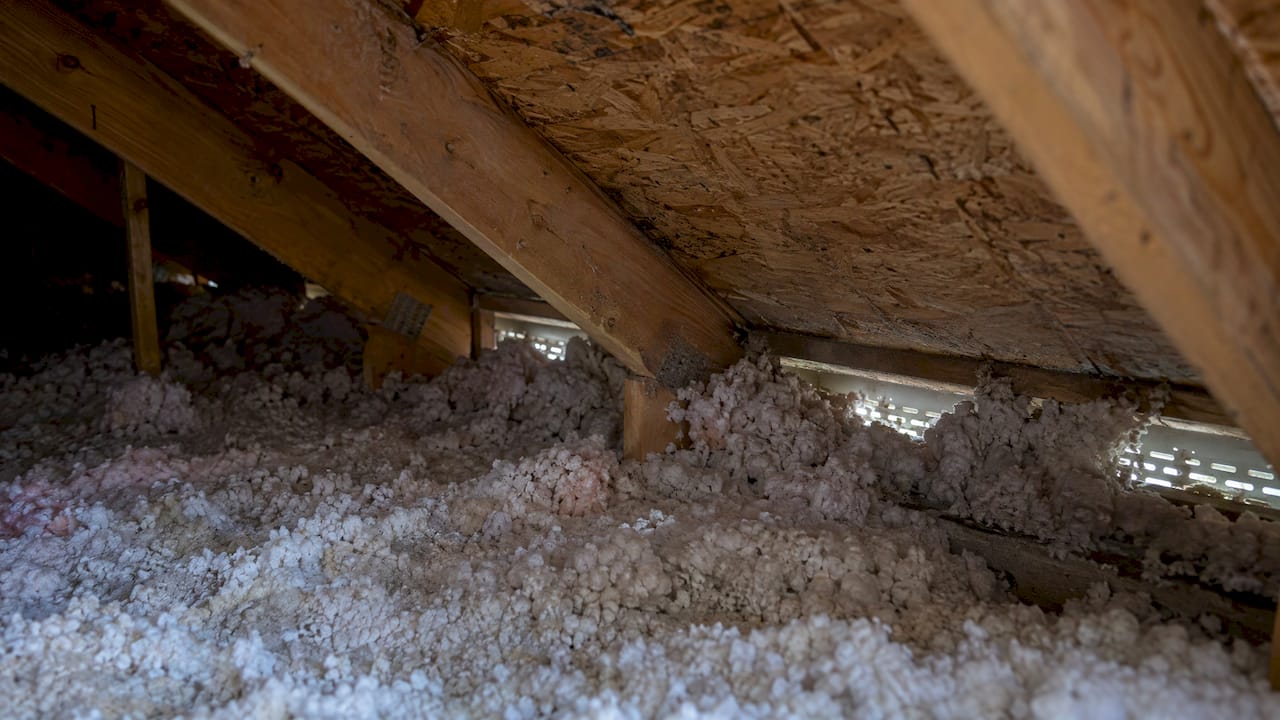
Roofing materials are generally vapor-impermeable, so ventilation below the deck is the only practical way to dry the assembly, according to PNNL. Insulation stuffed into the eaves, missing baffles and blocked soffit vents all choke that airflow. Professional roofing researchers note that condensation is rarely a problem in steep-slope roofs with properly ventilated attics, because outside air replaces the damp attic air.
Construction moisture and insulation choices
New buildings carry their own water. A trade association paper reports that a four-inch concrete slab releases about 240 gallons of water per 1,000 square feet as it cures. That matters most on commercial and low-slope roofs.
Insulation can contribute too. A Building America report warns that open-cell foam applied to the underside of a roof deck in cold or mixed climates can allow condensation on the deck and rot. And when adding attic insulation, Oregon State advises loose-fill or unfaced batts over existing insulation, since kraft paper backing can act as an unwanted vapor barrier.
Condensation or a roof leak?
This is the question that costs homeowners the most money, because the two are treated very differently.
| Clue | Roof leak | Condensation |
|---|---|---|
| Stain size | Small, localized area | Very large area |
| Timing | Follows rain or hail | Follows cold snaps, even dry ones |
| Attic sheathing | Wet near the entry point | Widespread dampness or mold on the underside |
| Nails | Usually dry | Droplets or frost on nail tips in winter |
| After a patch | Stops | Stains return |
The small-versus-large stain distinction and the frost on nail ends come from Cornell’s fact sheet. A HUD publication documents a home where brown ceiling stains appeared during a dry, cold period. They were treated as a leak and coated with roof cement, then came back. The real cause was moist air leaking into the attic.
If you have had a stain “fixed” and it keeps returning, that is a diagnostic warning. For real leaks, see our article on three unsuspected causes of a roof leak.
One caution from HUD: stain-blocking paint is a vapor barrier and can make a condensation problem worse if used to cover condensation stains. Find the source first, then repaint.
What condensation does to a roof and a home
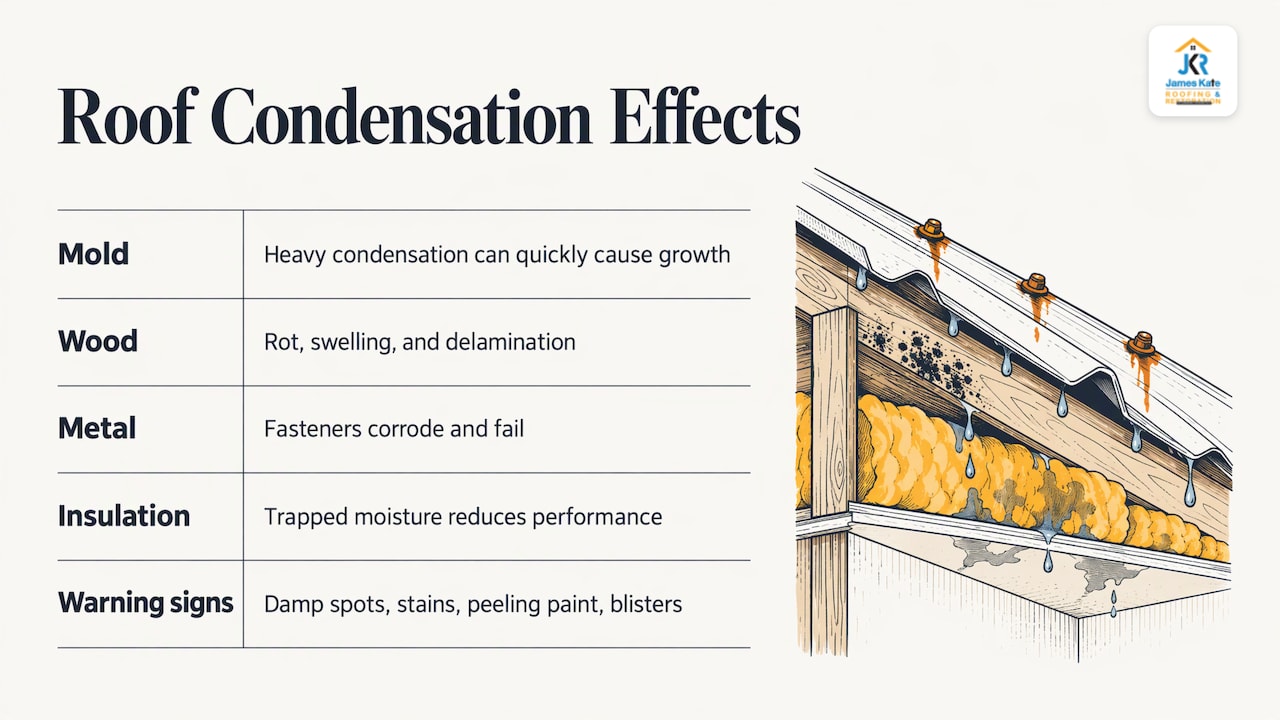
PNNL states that heavy condensation can quickly lead to mold growth, and that repeated or prolonged condensation can cause rot, swelling and delamination of OSB and plywood, plus corrosion and failure of metal fasteners that can weaken load-bearing parts. In metal building systems, trapped moisture corrodes metal components and reduces insulation performance. Signs of concealed condensation include damp spots, stains, peeling paint, blisters in asphaltic surfaces and damp insulation.
If mold has already appeared, read how to safely remove mold from your attic and our overview of water damage and mold repair. Treating the cause and the mold together is what keeps it from coming back.
How to reduce condensation in a roof
The order matters. Seal air first, then insulate, then ventilate.
- Seal air leaks from the house. Penetrations in the top-floor ceiling, especially recessed lights, are the priority. Penn State’s housing research recommends air sealing ceiling drywall seams and penetrations and pairing it with ridge and soffit ventilation with clear baffles. Most insulation is not an air barrier, so adding more on top does not stop leaks.
- Vent exhaust outdoors. Bathroom fans and range hoods should terminate outside the house, not in the attic.
- Check insulation depth. The Department of Energy recommends R-49 for ceilings, or about 15 inches of cellulose or 27 inches of fiberglass, with R-60 for cathedral ceilings with electric heat. Confirm the right level for your area with the DOE or local code.
- Restore ventilation. The same fact sheet gives 1 square foot of vent area per 300 square feet of attic floor (1 per 150 for cathedral ceilings), split equally between high and low openings. Baffles should keep a 2-inch airspace between the deck and the insulation.
- Keep humidity in range. Aim for the 30 to 50 percent band mentioned above.
Sealing an attic properly is detailed work. Cornell’s authors note that the typical homeowner lacks the expertise, equipment and experience to air-seal an attic adequately and advise bringing in a professional. A blower door test, which pressurizes the house to reveal leaks, is the way PNNL suggests verifying the air barrier. Heavy icicles in winter are also a sign that the same moisture factors are at work.
Metal roofs
Metal roofs have little drying capacity, so the air barrier and ventilation matter even more. Industry articles describe 2-inch closed-cell spray foam at roughly $3 to $7 per square foot installed, and vapor-permeable synthetic underlayment at roughly $0.40 to $1.20 per square foot installed during a full re-roof. Spray foam on the deck of a vented attic creates an unvented assembly under the International Residential Code, which changes how the vents must be handled. Each choice depends on the roof, so have it specified for your home rather than copying a figure.
Flat and low-slope commercial roofs
For commercial buildings, the design details are different. SPRI’s cold-climate recommendations include placing the vapor retarder so that it stays warmer than the dew point, using at least two staggered layers of insulation, and sealing deck-to-wall joints and penetrations. GAF’s vapor retarder guide adds that a retarder is not required by building code, and that it must be sealed at perimeters and penetrations and tied to the wall air barrier so air cannot bypass it. For property managers, this is a design question that belongs in any re-roof scope.
When to have a roofer look at it
Call for an inspection when:
- A ceiling stain returns after a repair
- You see mold or dark staining across the underside of the roof deck
- Frost or droplets collect on attic nails in cold weather
- Insulation feels damp or compressed
- Heavy icicles or ice dams form
- A commercial roof has stains in several areas or soft spots underfoot
On commercial roofs, a typical moisture investigation starts with a nuclear, electronic impedance or infrared survey to map moisture, then core cuts to confirm it. A field guide to commercial diagnostics describes four tests (water, flood, electronic leak detection and infrared or moisture survey) that answer different questions, which is why one method alone can miss the cause.
What we do about it
We are a GAF Master Elite® contractor serving the Dallas-Fort Worth area, and we inspect and diagnose roofs for homeowners, commercial owners and property managers. Our free inspections and estimates look at the whole roof system, including leak diagnosis and repair, so a stain gets traced to the real source. If the roof needs repair or replacement, we handle it, and our residential roof replacements carry a transferable 15-year workmanship warranty.
Start with a home roof inspection, or for a building, a commercial roof inspection.

If the stain appeared after a storm, ask about our hail and wind damage inspections on our main site. For an active drip, see emergency roofing.
Our perspective
Most of the condensation calls we hear about started as a “leak” that someone patched. The patch dried, the stain came back in the next cold snap, and the homeowner assumed the roofer had done a bad job. Usually the roof was fine and the diagnosis was wrong.
We think a roof inspection should answer one question before anything else: where is the water coming from? Our inspections and estimates are free, and our approach is built around clear communication, so you see what we see and understand the options before deciding anything.
That matters because the right fix may be air sealing, ventilation or a replacement done with the moisture path in mind, not another tube of sealant. If a roof does need replacing, we want it done right, backed by our transferable 15-year workmanship warranty on residential replacements.
Dustin Eatman
FAQ
Can condensation under a roof really cause damage?
Yes. Repeated condensation can rot and delaminate plywood and OSB, corrode fasteners and encourage mold, according to PNNL. The damage is gradual and hidden, so early inspection saves repair cost.
Why is there moisture in my roof space when it has not rained?
Warm, humid air from the house is the usual reason. It rises through ceiling gaps, hits the cold deck and condenses. Stains that appear in dry weather and cover wide areas point to this rather than a leak.
Does a metal roof need ventilation?
Yes. Metal roofs are vapor-impermeable and cool fast, so moisture has few ways out. Air sealing the ceiling, venting exhaust fans outdoors and a properly designed underlayment or ventilation path all help. We can assess your roof system during an inspection.
What should I not do when I see ceiling stains?
Don’t cover them with stain-blocking paint or roof cement before finding the cause. Federal guidance notes that stain-blocking paint can worsen condensation, and the stain will usually return.
Sources
- PNNL: Condensation Control in Attics and Roofs in Cold Weather
- Cornell: Causes and Cures of Attic Condensation and Roof Ice Damming
- CCE: Causes and Cures of Attic Condensation and Roof Ice Damming Problems
- HUD: Moisture Problems in Manufactured Homes
- Oregon State University: Home Moisture Problems
- Penn State PHRC: Moisture Considerations for Insulated Roof/Attic Assemblies
- Building America: Managing the Drivers of Air Flow and Water Vapor Transport
- SPRI: Construction Generated Moisture and its Effect on Roof Systems
- IIBEC: Avoiding Condensation in Low-Slope Roofing Assemblies
- MBMA: Condensation Fact Sheet
- GAF: A Guide to Vapor Retarder Design
- Anvilfield: Roof leak diagnosis and troubleshooting
- The Roofing Brief: Metal Roof Condensation
Recommended
- Three Unsuspected Causes of Your Roof Leak
- Common Roofing Problems and Fixes
- Roof Warning Signs That Need Immediate Attention
- Early Signs of Roof Damage to Look Out For

Dustin Eatman is a seasoned roofing professional with deep, hands-on expertise that spans residential and commercial roofing, insurance solar, and long-term roof asset management. As the owner of James Kate Roofing & solar in the Dallas–Fort Worth metroplex, he’s built a reputation for diagnosing roof systems accurately, communicating clearly, and executing projects with a high standard of workmanship and documentation. Dustin understands the technical details that make roofs perform—proper underlayment selection, slope and drainage considerations, ventilation strategy, flashing and penetration detailing, and manufacturer-specific installation requirements—because he’s worked through the real-world challenges that cause leaks, premature wear, and warranty issues. He’s equally fluent in the operational side of roofing: jobsite planning, quality control, safety, material ordering, crew coordination, and customer experience from inspection to closeout. In insurance-related projects, Dustin brings practical knowledge of claim workflows, adjuster meetings, scope alignment, supplements, and the importance of photo evidence and thorough records, helping property owners navigate stressful situations with confidence. For commercial clients—especially property and facility managers—he emphasizes proactive maintenance and targeted repairs that reduce disruption, extend roof life, and prevent expensive interior damage. Dustin also stays focused on doing things the right way: educating customers on realistic options, setting expectations, and prioritizing solutions that hold up over time rather than quick fixes. That blend of technical skill, field experience, process discipline, and owner-level accountability is what makes Dustin Eatman a trusted expert in the roofing industry.