The Reality Check: How Long Do 50-Year Shingles Really Last?
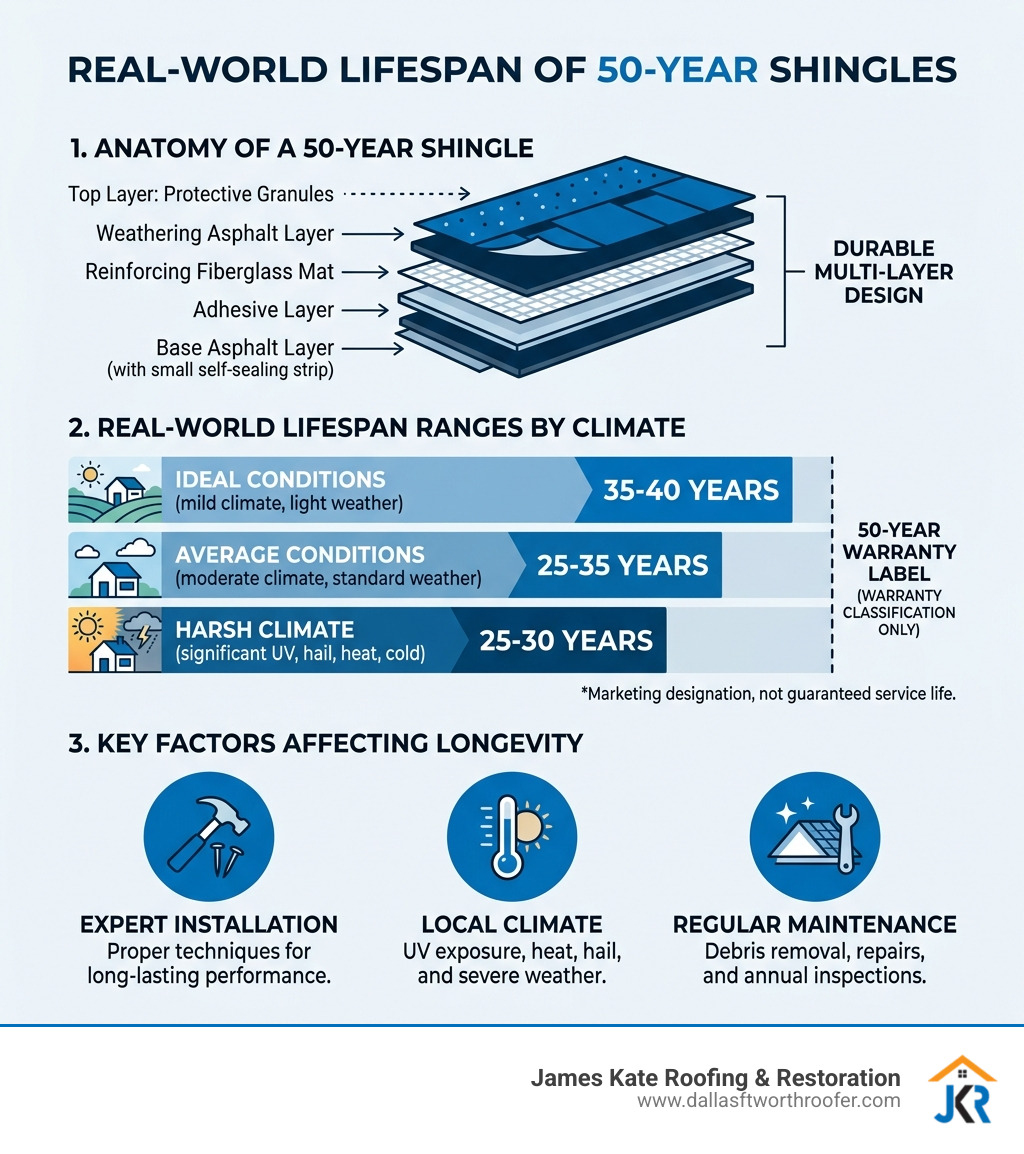
How long do 50-year shingles really last? The short answer: not 50 years — but significantly longer than cheaper alternatives when installed and maintained correctly.
| Condition | Realistic Lifespan |
|---|---|
| Ideal conditions (mild climate, expert install, regular maintenance) | 35-40 years |
| Average conditions (moderate climate, quality install) | 25-35 years |
| Harsh climate (DFW/Texas, UV exposure, hail, heat) | 25-30 years |
| Poor installation or neglected maintenance | 15-20 years |
The “50-year” label is a warranty classification, not a lifespan guarantee. Most homeowners in real-world conditions can realistically expect 25 to 40 years from these shingles — depending on where they live, how well the roof was installed, and how consistently it’s maintained.
That gap between the marketing promise and reality catches a lot of homeowners off guard. You invest in what sounds like a lifetime roof, and a few decades later you’re facing an unexpected replacement. Understanding what that “50-year” label actually means — and what genuinely drives shingle longevity — is the difference between a smart roofing investment and a costly surprise.
I’m Dustin Eatman, owner of James Kate Roofing & Solar in the Dallas–Fort Worth area, and I’ve spent years diagnosing exactly how long do 50-year shingles really last across hundreds of DFW roofs in some of the harshest roofing conditions in the country. In this guide, I’ll give you a straight, no-fluff breakdown of what to expect — and how to get the most out of your roof.
Learn more about how long do 50-year shingles really last:
- how long does a 30 year roof really last
- composite roof shingles lifespan
- how long do 3-tab shingles last
When you hear the term “50-year shingle,” it’s easy to imagine your roof standing tall and pristine through the year 2074. However, in the roofing industry, these numbers are often more about “marketing magic” and warranty tiers than literal expiration dates.
So, how long do 50-year shingles really last? In real-world conditions, these premium products typically provide 25 to 40 years of service. If you are in a relatively calm climate, you might push toward that 40-year mark. But if you’re living in Mansfield or Arlington, where the weather likes to throw a tantrum every spring, the reality is often closer to 25 or 30 years.
The reason for this discrepancy is “environmental degradation.” Manufacturers test shingles in controlled laboratories. They don’t necessarily account for the 105-degree August afternoon followed by a sudden cold front, or the relentless UV rays that bake the pliability right out of the asphalt. Over time, the oils in the shingles dry out, the granules wash away, and the fiberglass mat becomes brittle.
For a deeper dive into how different materials hold up, check out our More info about roofing services page.
Real-World Performance: How long do 50-year shingles really last in the DFW climate?
Texas is legendary for its hospitality, but its climate is downright hostile to roofs. If you’re asking how long do 50-year shingles really last in the DFW area, you have to factor in the “Texas Tax.”
- Extreme Heat and UV Exposure: Our sun is relentless. UV radiation breaks down the chemical bonds in the asphalt. This leads to “dry rot,” where the shingles lose their ability to shed water and become prone to cracking.
- Thermal Shock: This is a big one in North Texas. We can have a 100-degree day followed by a 60-degree night. This rapid expansion and contraction causes “thermal shock,” which can lead to shingles splitting or losing their seal.
- Humidity and Rain: While we aren’t Seattle, our humidity can foster algae growth (those dark streaks you see on roofs). While 50-year shingles often have better algae resistance, the constant moisture-to-heat cycle still accelerates wear.
A good rule of thumb for our local area (Grand Prairie, Midlothian, and beyond) is to expect about 80-85% of the rated life. For a 50-year shingle, that puts you in the 30 to 40-year range under good conditions, but closer to 25 years if the roof takes a few direct hits from our famous hailstorms.
Maintenance Secrets: How long do 50-year shingles really last with professional care?
The difference between a roof that lasts 20 years and one that lasts 35 years is often found in the maintenance log. You wouldn’t buy a luxury car and never change the oil; your roof is no different.
- Gutter Cleaning: When gutters clog, water backs up under the eaves. This can rot the roof deck and cause the bottom layer of shingles to fail prematurely.
- Debris Removal: Leaves and branches trap moisture against the shingles. This moisture can lead to rot and provide a breeding ground for moss or lichen, which “eat” the granules.
- Granule Retention: Those little rocks on your shingles aren’t just for color; they are the UV armor for the asphalt. If you see “bald spots,” your shingle’s lifespan is plummeting.
- Annual Professional Inspections: We recommend an inspection every year or at least after every major storm. Catching a small leak or a few loose shingles early can prevent a full-scale failure.
30-Year vs. 50-Year Shingles: Construction, Design, and Cost
If 50-year shingles don’t actually last 50 years, why pay more for them? The answer lies in the “bones” of the product.
| Feature | 30-Year (Architectural) | 50-Year (Premium/Luxury) |
|---|---|---|
| Thickness | Standard dual-layer | Triple-layer or high-density dual-layer |
| Weight | ~230-250 lbs per square | ~350-450 lbs per square |
| Asphalt Quality | Standard grade | Modified or high-polymer grade |
| Wind Rating | Usually 110-130 mph | Often 130 mph+ with enhanced seals |
| Aesthetics | Flat, dimensional look | Mimics wood shake or slate tiles |
| Upfront Cost | $ | $$$ |
50-year shingles are significantly thicker and heavier. This extra mass makes them much harder for high winds to lift. They also use a higher-quality fiberglass mat and more robust asphalt compounds, which resist the “drying out” process much better than 30-year shingles.
From a design perspective, 50-year shingles fall into the “Luxury” or “Designer” category. They offer incredible curb appeal, often mimicking the look of hand-split cedar shakes or natural slate. For homeowners in Granbury or Mansfield looking to boost their home’s value, the aesthetic upgrade alone is often worth the price gap.
Why Climate and Installation Dictate Roof Longevity
You could buy the most expensive shingle in the world, but if it’s installed by someone who doesn’t know what they’re doing, it won’t last a decade.

As noted in the guide 3 Signs That It’s Time to Replace Your Roof, visible damage is just the tip of the iceberg.
Attic Ventilation: The Silent Killer
If your attic isn’t breathing, your shingles are being “baked” from both sides. During a DFW summer, attic temperatures can soar above 150 degrees if not properly vented. This extreme heat cooks the shingles from underneath, causing them to blister, curl, and lose granules at an alarming rate. Proper airflow is non-negotiable for roof longevity.
Workmanship Matters
How many nails go into each shingle? Where are they placed? How is the flashing around your chimney installed? These “invisible” details determine if your roof survives the next thunderstorm.
- Nailing Patterns: High-wind areas like Arlington require specific nailing patterns (often 6 nails per shingle instead of 4).
- Flashing: Most leaks don’t happen in the middle of a shingle; they happen at the joints. Quality metal flashing and proper sealing are what keep the water out.
- Overhanging Trees: We love our Texas oaks, but branches rubbing against shingles will strip the granules off in a single season.
Decoding the “Lifetime” Warranty: Myths vs. Reality
The word “Lifetime” is used a lot in roofing, but in the fine print, “Lifetime” usually means “as long as the original homeowner owns the home,” and even then, it’s a Limited Lifetime Warranty.
- Manufacturing Defects vs. Wear and Tear: Warranties cover mistakes made at the factory. They do not cover your roof getting old, nor do they cover damage from a 70-mph wind gust or a hailstone the size of a golf ball.
- Prorated Coverage: This is the big “gotcha.” Most warranties offer 100% coverage for the first 10 to 15 years (the “non-prorated” period). After that, the value of the warranty drops every year. By year 30, the manufacturer might only cover a tiny fraction of the material cost.
- Labor and Disposal: Many standard warranties only cover the cost of the shingles. They don’t pay for the labor to tear off the old roof, the labor to install the new one, or the fees to haul the trash away.
- Certified Installers: To get the best warranties (like GAF’s Golden Pledge), you must use a certified contractor. As a GAF President’s Club recognized company, we can offer extended warranties that cover workmanship and labor—something the “guy with a truck” simply cannot do.
Is the Higher Upfront Cost Worth the Investment?
Are 50-year shingles worth the extra $5,000 to $15,000? It depends on your goals.
Choose 50-Year Shingles if:
- You’re in your “Forever Home”: If you plan to stay for 20+ years, the lower “cost per year” makes these shingles a bargain.
- You want maximum Curb Appeal: If you have a luxury home in Mansfield or Arlington, 50-year shingles provide that high-end look that 30-year shingles can’t match.
- You want Insurance Discounts: Many 50-year shingles carry a Class 4 Impact Resistance rating. In Texas, this can lead to significant discounts on your annual homeowners’ insurance premiums.
Stick with 30-Year Shingles if:
- You’re selling soon: You likely won’t recoup the full cost of a luxury roof if you’re moving in 3 years.
- Budget is the priority: 30-year architectural shingles are still an excellent, durable product that looks great on almost any home.
Frequently Asked Questions about 50-Year Shingles
Do 50-year shingles actually last 50 years?
In the DFW area, no. You should realistically expect 25 to 35 years. The “50-year” designation is a warranty tier, not a literal prediction of the shingle’s life in the Texas sun.
What is the difference between a 30-year and 50-year shingle?
Weight and thickness are the primary physical differences. 50-year shingles are much heavier, use more asphalt, and are designed with high-end aesthetics in mind. They also typically come with longer non-prorated warranty periods.
Are 50-year shingles more expensive to install?
Yes. Because they are much heavier, they take longer to install and require more labor. The material cost is also significantly higher because you are getting a premium, multi-layered product.
Conclusion
At James Kate Roofing & solar, we believe in giving our neighbors in Mansfield, Arlington, and across the DFW metroplex the cold, hard truth about their homes. We don’t hide behind “marketing mumbo-jumbo.”
When you ask us how long do 50-year shingles really last, we’ll tell you exactly what we’ve seen on the roofs in your specific neighborhood. Our commitment to honesty, integrity, and Biblical principles means we treat your home like our own. Whether you need a simple repair or a luxury “50-year” replacement, you’re backed by our GAF President’s Club recognition and our industry-leading workmanship warranties.
If you’re ready for a roof that’s built to withstand the Texas elements, or if you just need a professional eye to tell you how much life your current roof has left, give us a call. We’re here to help you protect what matters most.
https://www.dallasftworthroofer.com/

Dustin Eatman is a seasoned roofing professional with deep, hands-on expertise that spans residential and commercial roofing, insurance solar, and long-term roof asset management. As the owner of James Kate Roofing & solar in the Dallas–Fort Worth metroplex, he’s built a reputation for diagnosing roof systems accurately, communicating clearly, and executing projects with a high standard of workmanship and documentation. Dustin understands the technical details that make roofs perform—proper underlayment selection, slope and drainage considerations, ventilation strategy, flashing and penetration detailing, and manufacturer-specific installation requirements—because he’s worked through the real-world challenges that cause leaks, premature wear, and warranty issues. He’s equally fluent in the operational side of roofing: jobsite planning, quality control, safety, material ordering, crew coordination, and customer experience from inspection to closeout. In insurance-related projects, Dustin brings practical knowledge of claim workflows, adjuster meetings, scope alignment, supplements, and the importance of photo evidence and thorough records, helping property owners navigate stressful situations with confidence. For commercial clients—especially property and facility managers—he emphasizes proactive maintenance and targeted repairs that reduce disruption, extend roof life, and prevent expensive interior damage. Dustin also stays focused on doing things the right way: educating customers on realistic options, setting expectations, and prioritizing solutions that hold up over time rather than quick fixes. That blend of technical skill, field experience, process discipline, and owner-level accountability is what makes Dustin Eatman a trusted expert in the roofing industry.