Why Commercial Roof Repair Can’t Wait
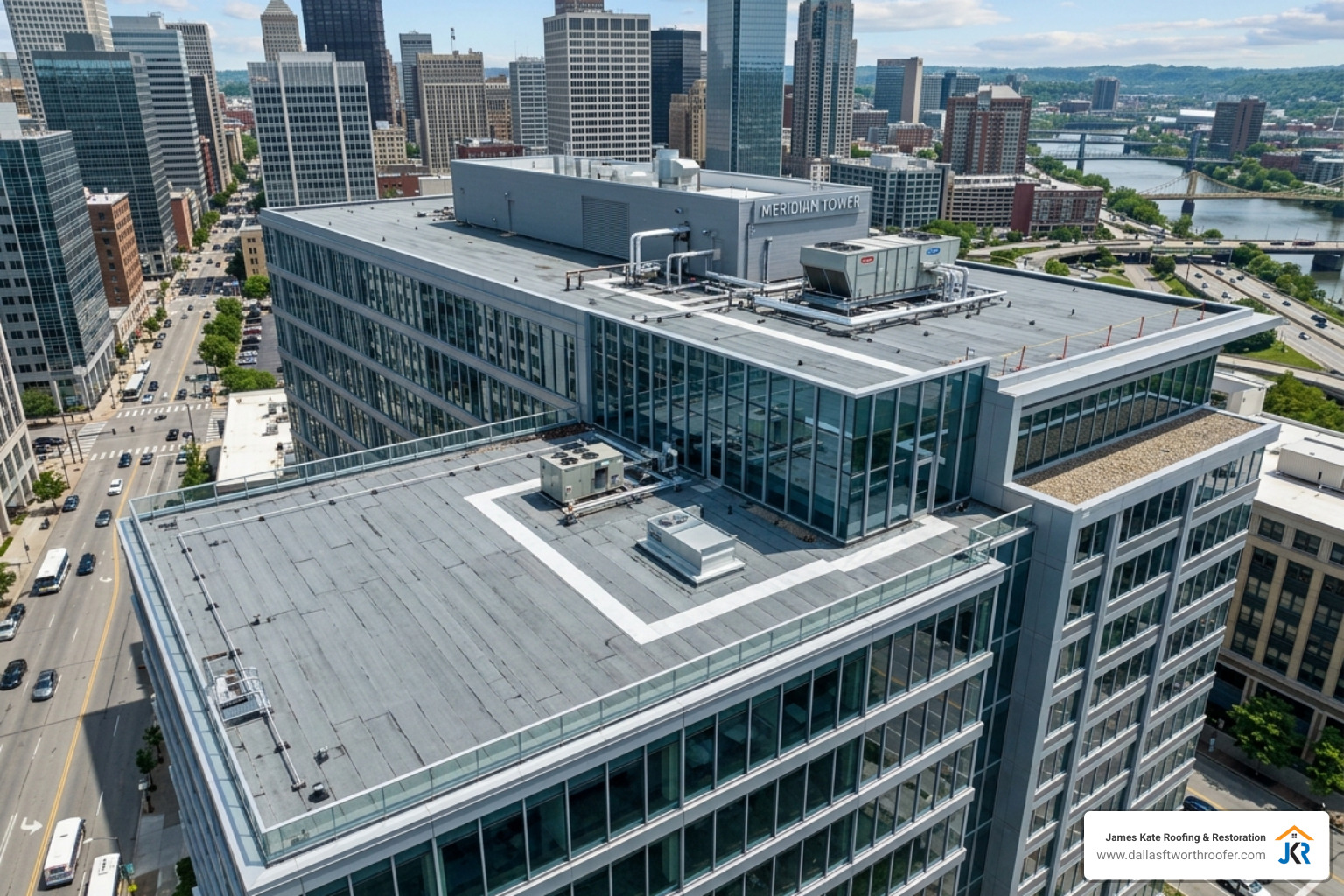
Commercial roof repair is the process of fixing damage to a business building’s roofing system — whether that’s a leaking membrane, failed flashing, ponding water, or storm damage — before it turns into a much bigger and more expensive problem.
Here’s a quick snapshot of what you need to know:
| Topic | Key Fact |
|---|---|
| Most common issue | Ponding water (40% of problems) |
| Second most common | Flashing failures (30%) |
| Early repair vs. delayed | Waiting 6 months can cost 10x more |
| When to repair vs. replace | Repair if damage is under 25% of roof area and roof is under 15 years old |
| Inspection frequency | Twice a year minimum, plus after major storms |
| Typical repair cost | $500–$8,000+ depending on size and damage |
Your roof isn’t just a lid. It protects your equipment, your inventory, your employees, and your ability to keep doing business.
A small leak on a flat commercial roof costs almost nothing to fix early. Leave it six months, and you’re looking at damaged inventory, potential mold, and a repair bill that’s ten times higher — or worse, a full replacement you didn’t budget for.
In DFW, that risk is real. Hail, high winds, summer UV intensity, and the occasional hard freeze put constant stress on commercial roofing systems. Most damage starts small and invisible — a seam that’s separating, flashing that’s pulling away, or a drain that’s slowly losing the battle with debris.
I’m Dustin Eatman, owner of James Kate Roofing & solar, and I’ve spent years diagnosing and repairing commercial roofing systems across the Dallas–Fort Worth area — from routine maintenance to full storm solar — with a focus on accurate scopes, honest recommendations, and repairs that actually hold up. Commercial roof repair is one of the most high-stakes decisions a property owner or facility manager can make, and this guide is built to help you make it with confidence.
Commercial roof repair word list:
Common Issues Requiring Commercial Roof Repair
Maintaining a commercial property in North Texas means battling a unique set of environmental factors. Whether your building is in Mansfield or Arlington, the flat or low-slope design of most commercial structures makes them vulnerable to specific types of failure. Understanding these common culprits is the first step in protecting your investment.
Addressing Ponding Water and Drainage
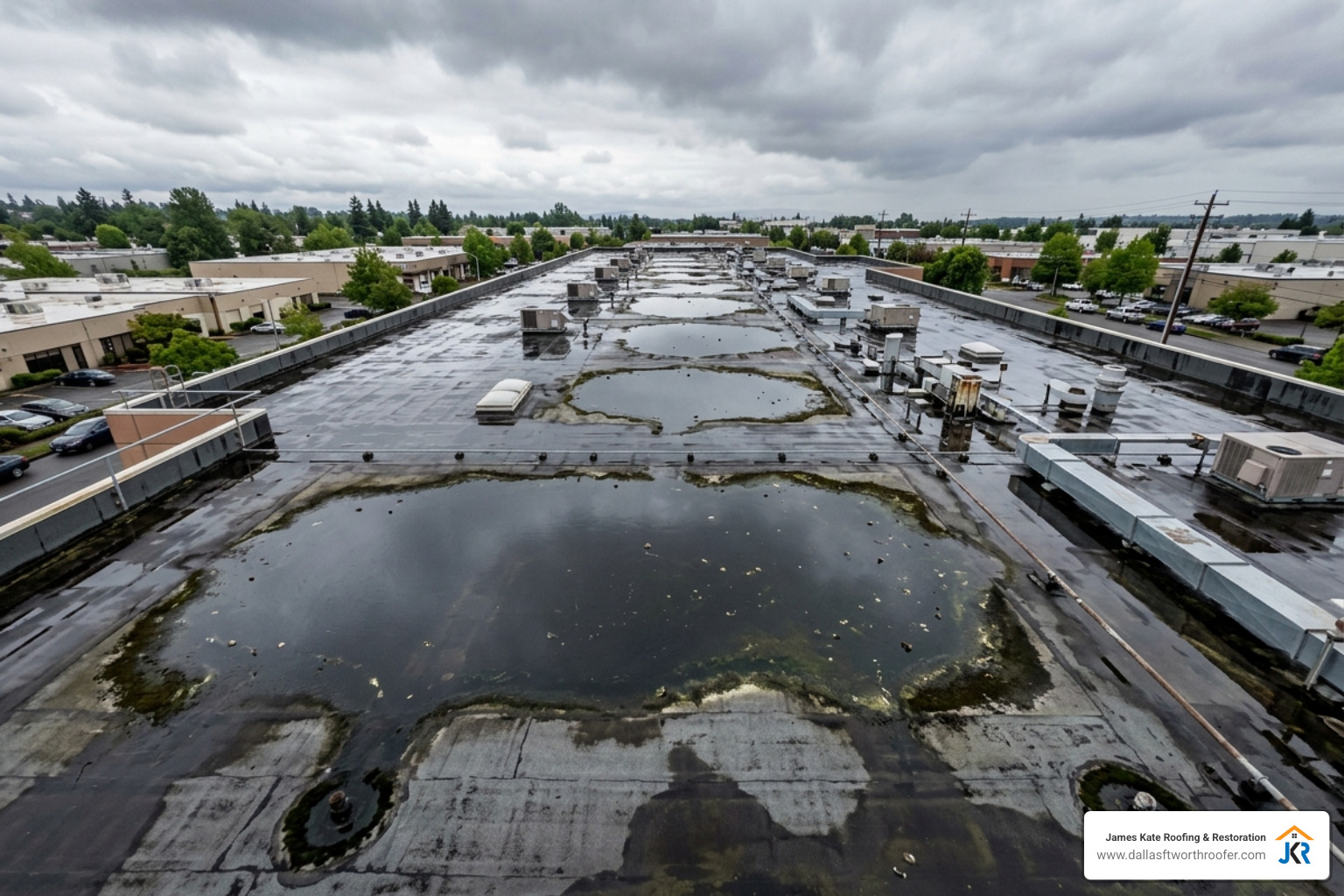
In the roofing world, we live by the “48-hour rule.” If you see standing water on your roof more than two days after a rainfall, you have a ponding issue. This isn’t just an aesthetic problem; it accounts for roughly 40% of all commercial roof repair needs.
Ponding water acts like a magnifying glass for UV rays, accelerating the degradation of your roof membrane. Furthermore, the sheer weight of standing water puts immense structural load on the building deck. We often find that inadequate drainage—caused by clogged scuppers, poorly pitched internal drains, or sagging spots in the roof deck—is the primary cause. Fixing this early prevents the water from eventually seeping through seams and saturating your insulation.
Fixing Membrane Punctures and Seam Failures in Commercial Roof Repair
While ponding is the most frequent issue, membrane damage is a close second.
- Punctures: These often happen during HVAC maintenance when a technician drops a tool or drags heavy equipment across the surface. Even a tiny hole can allow gallons of water to enter the substrate over time.
- Seam Failures: Single-ply systems like TPO and EPDM rely on the integrity of their seams. Over time, thermal expansion (the roof growing and shrinking as temperatures fluctuate from 100°F days to 30°F nights in DFW) can cause these seams to “pop” or pull apart.
- Shrinkage: EPDM (rubber) roofs are particularly prone to shrinkage, which pulls the membrane away from the edges and creates massive tension on the flashing.
Signs Your Building Needs Professional Attention
Waiting for a bucket-worthy leak to appear in your lobby is a dangerous game. By the time water is dripping from the ceiling, the damage underneath is likely extensive.
Identifying Early Warning Signs of Commercial Roof Repair Needs
We recommend facility managers keep an eye out for these “quiet” indicators:
- Musty Odors: If a specific room smells like a damp basement, moisture is likely trapped in the insulation above.
- Blistering or Bubbling: This suggests that moisture has already gotten under the membrane. When the sun hits the roof, that trapped water turns to vapor, expanding and creating “bubbles.”
- Loose Flashing: Check the edges of the roof and around HVAC units. If the metal strips (flashing) are pulling away, you have an open door for water.
- Rising Energy Bills: Saturated insulation loses its R-value. If your AC is working harder than usual, a wet roof could be the culprit.
Regional Weather Impacts on DFW Roofs
Our local climate is particularly harsh on commercial lids. In places like Midlothian and Grand Prairie, hail is a constant threat. While a TPO roof might look fine from the ground after a storm, hail can create “micro-fractures” in the membrane that only show up months later. Additionally, the intense Texas UV radiation dries out sealants and causes plasticizers in PVC and TPO to migrate, making the roof brittle and prone to cracking during our winter freeze-thaw cycles.
Repair vs. Replacement: Making the Right Investment
One of the most common questions we get at James Kate Roofing & solar is: “Can I just patch this, or do I need a whole new roof?” To answer this, we look at the “30% Rule.” If repairs are going to cost more than 30–50% of the total replacement cost, or if more than 25% of the roof area is damaged, replacement is usually the smarter financial move.
When to Choose Localized Repairs
Localized commercial roof repair is ideal when:
- The roof is less than 15 years old (or less than 50% through its expected lifespan).
- The damage is confined to a specific area (like a single HVAC unit or a specific corner).
- The insulation underneath is still dry (verified by an infrared moisture survey).
- Budget constraints require a short-term fix to maintain business continuity.
When Full Replacement is Necessary
Replacement becomes unavoidable when the roof has reached its 20-30 year limit or when “widespread saturation” occurs. If water has soaked into the insulation across large sections of the building, patching the top layer won’t help; the trapped moisture will eventually rot the structural deck and lead to mold growth. In DFW, building codes also typically limit you to two layers of roofing; if you already have two, a full tear-off is required by law.
Specialized Methods for Different Roofing Systems
Every commercial roof is different, and using the wrong repair material is a recipe for disaster. You can’t just put “tar” on a TPO roof—the chemicals aren’t compatible and will actually eat through the membrane.
Repairing Single-Ply Membranes (TPO, EPDM, PVC)
- TPO & PVC: These are thermoplastic materials. The best repair is a “heat-weld.” We clean the area, lay down a matching patch, and use a robotic or hand-held welder to fuse the two pieces together at roughly 900°F. When done right, the patch becomes part of the original roof.
- EPDM: Since rubber can’t be melted, we use specialized primers and heavy-duty adhesive tapes. It’s critical that the EPDM patch is cut with rounded corners to prevent “peel-back” at the edges.
Restoring Bituminous and Metal Systems
- Modified Bitumen & BUR: These “multi-ply” roofs often require “torch-down” repairs or cold-process adhesives to layer new bitumen over the damaged area.
- Metal Roofing: Most metal roof issues stem from fastener failure. Over time, the rubber washers on screws dry out and crack. Repairing these involves replacing the fasteners with oversized “repair” screws and applying high-grade seam sealants to prevent leaks at the laps.
The Financial Impact of Preventive Maintenance
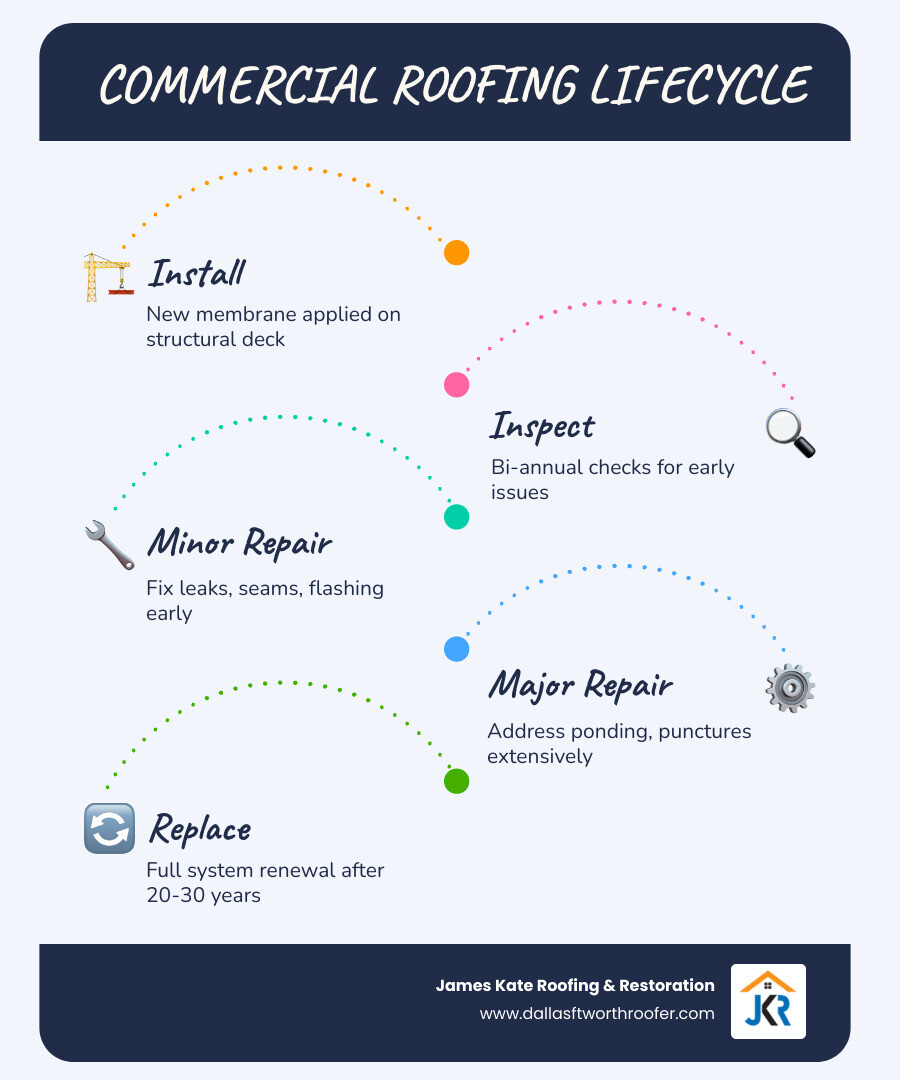
The old saying “an ounce of prevention is worth a pound of cure” was written for commercial roofs. Statistics show that proactive maintenance can extend a roof’s life by 30–50%. For a 20,000-square-foot building, that extra 10 years of life translates to tens of thousands of dollars in saved capital.
Extending Roof Lifespan Through Maintenance
We recommend a bi-annual inspection schedule (Spring and Fall). During these visits, we:
- Clear Debris: Leaves and trash clog drains, leading to ponding water.
- Inspect Sealants: Pitch pockets and caulking around penetrations usually fail long before the roof membrane does.
- Check Walkway Pads: Ensuring that foot traffic is confined to designated paths prevents accidental punctures.
- Documentation: We provide digital reports that serve as a “health record” for your roof, which is invaluable for insurance claims after a DFW hailstorm.
Emergency Procedures for Active Leaks
If you have an active leak, time is your enemy.
- Containment: Move electronics and inventory. Use “leak diverters” (tarp funnels) to channel water into buckets.
- Documentation: Take photos of the interior damage and the roof surface if it’s safe to go up. This is vital for your insurance adjuster.
- Professional Dispatch: Call a reputable contractor like James Kate Roofing & solar immediately. We offer rapid response to get a temporary “tarp or patch” in place to stop the bleeding while we work on a permanent solution.
Frequently Asked Questions about Commercial Roof Repair
How much do commercial roof repairs typically cost?
Small membrane patches (under 10 square feet) typically cost between $500 and $1,500. If you are dealing with larger issues, such as major flashing failures or extensive seam resealing (50+ square feet), costs generally range from $2,000 to $8,000. Factors like roof height, accessibility, and the type of material (TPO vs. Metal) will influence the final quote.
How often should a commercial roof be inspected?
At a minimum, you should have a professional inspection twice a year. However, for the best protection in the DFW area, we recommend quarterly checks plus a “post-storm” walk-through after any significant hail or high-wind event. This ensures that small punctures from storm debris don’t sit for months and turn into major interior damage.
Do commercial roof repairs require building permits?
In cities like Arlington and Mansfield, minor repairs (usually defined as less than 100 square feet) often do not require a permit. However, if the repair involves structural work, changing the roof’s slope, or a major solar coating, a permit is almost always required. We handle the permitting process for our clients to ensure everything is code-compliant.
Conclusion
Your commercial roof is a massive asset, and managing it shouldn’t be a source of stress. At James Kate Roofing & solar, we bring a family-owned touch to the DFW commercial market, built on a foundation of honesty and integrity. Whether you are in Granbury or Grand Prairie, our GAF President’s Club recognized team is ready to provide the accurate diagnostics and high-quality workmanship your building deserves. Don’t wait for a small drip to become a major disaster.
Schedule your professional commercial roofing assessment today
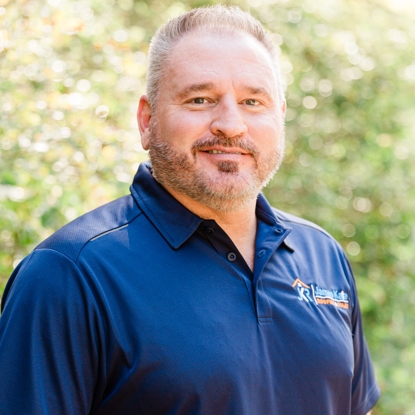
Dustin Eatman is a seasoned roofing professional with deep, hands-on expertise that spans residential and commercial roofing, insurance solar, and long-term roof asset management. As the owner of James Kate Roofing & solar in the Dallas–Fort Worth metroplex, he’s built a reputation for diagnosing roof systems accurately, communicating clearly, and executing projects with a high standard of workmanship and documentation. Dustin understands the technical details that make roofs perform—proper underlayment selection, slope and drainage considerations, ventilation strategy, flashing and penetration detailing, and manufacturer-specific installation requirements—because he’s worked through the real-world challenges that cause leaks, premature wear, and warranty issues. He’s equally fluent in the operational side of roofing: jobsite planning, quality control, safety, material ordering, crew coordination, and customer experience from inspection to closeout. In insurance-related projects, Dustin brings practical knowledge of claim workflows, adjuster meetings, scope alignment, supplements, and the importance of photo evidence and thorough records, helping property owners navigate stressful situations with confidence. For commercial clients—especially property and facility managers—he emphasizes proactive maintenance and targeted repairs that reduce disruption, extend roof life, and prevent expensive interior damage. Dustin also stays focused on doing things the right way: educating customers on realistic options, setting expectations, and prioritizing solutions that hold up over time rather than quick fixes. That blend of technical skill, field experience, process discipline, and owner-level accountability is what makes Dustin Eatman a trusted expert in the roofing industry.