What You’ll Actually Pay for a Roof Tarp — and Why It Matters Fast
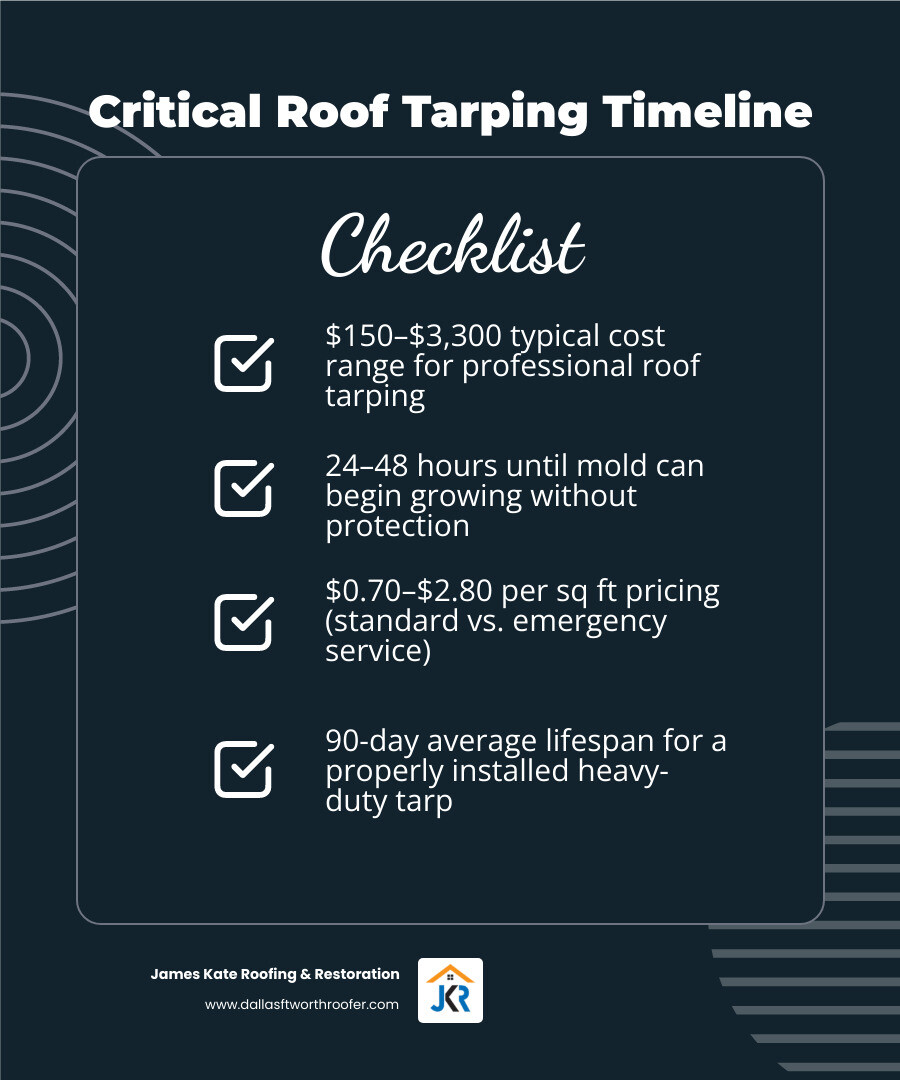
Roof tarping cost typically falls between $150 and $3,300, with most homeowners paying around $450 for a standard job.
Here’s a quick breakdown before we dive deeper:
| Scenario | Typical Cost Range |
|---|---|
| Small area (under 100 sq ft) | $150 – $350 |
| Medium area (standard storm damage) | $350 – $700 |
| Large or complex job | $700 – $1,500 |
| Whole-roof or severe damage | $1,500 – $3,300+ |
| Emergency / after-hours service | Add 30-40% to base cost |
Standard professional tarping runs $0.70-$2.00 per square foot. Emergency service jumps to $1.00-$2.80 per square foot – often with an additional $100-$200 call-out fee.
When your roof takes a hit from a storm, falling tree, or sudden structural failure, the clock starts immediately. Water intrusion can begin within minutes, and mold can start growing within 24-48 hours of exposure. That window is not a marketing scare tactic – it’s what the EPA, CDC, and FEMA all reference as the critical drying timeline. A properly installed tarp is the fastest way to stop the damage from compounding while you arrange permanent repairs.
The cost feels urgent. But the cost of waiting is almost always higher.
I’m Dustin Eatman, owner of James Kate Roofing & solar in the Dallas-Fort Worth area, and I’ve worked through dozens of emergency tarping situations – helping homeowners understand roof tarping cost, navigate insurance claims, and protect their homes when time is the enemy. In this guide, I’ll walk you through exactly what drives those costs and how to make smart decisions under pressure.
Understanding the Average Roof Tarping Cost
At a high level, most roof tarping jobs in Mansfield, Arlington, Granbury, Grand Prairie, Midlothian, and nearby DFW areas fall into a few predictable pricing bands. The challenge is that no two roofs are exactly alike, and a “simple tarp” can turn into a more technical project fast.

Nationally, the average job is often cited around $450, but the full range of $150 to $3,300 is realistic depending on size, safety needs, and urgency. Labor is usually the biggest part of the bill, not the tarp itself. Material often runs only about $0.10 to $0.30 per square foot, while labor and installation commonly account for $0.60 to $2.50 per square foot.
That makes sense when you think about what you are really paying for:
- Damage assessment
- Safe ladder setup and fall protection
- Debris clearing
- Proper tarp sizing
- Secure fastening with battens or boards
- Weather-resistant placement that directs water off the roof
- Emergency mobilization if the call comes after hours
If you are also trying to understand how tarping fits into larger roof expenses, our guide on how much it really costs to reroof your house can help connect the short-term emergency cost to the bigger repair picture.
Here is a simple side-by-side comparison:
| Service Type | Typical Price |
|---|---|
| Scheduled professional tarping | $0.70-$2.00 per sq ft |
| Emergency professional tarping | $1.00-$2.80 per sq ft |
| Average smaller job | Around $175-$700 |
| 100 sq ft damaged area | About $70-$200 |
| 2,000 sq ft tarped area | About $1,400-$4,000 |
Standard vs. Emergency Service Rates
Scheduled tarping is almost always cheaper than emergency tarping. If the damage is active but the weather is calm and service can be booked during normal business hours, pricing usually stays in the $0.70 to $2.00 per square foot range.
Emergency service is different. Crews may need to respond at night, on weekends, after hailstorms, or during periods of heavy local demand. That is why emergency rates often rise to $1.00 to $2.80 per square foot, plus a possible call-out fee of $100 to $200.
In plain English: if your roof starts leaking at 2 p.m. on a Tuesday, that is one price. If a tree lands on it at 2 a.m. during a storm line moving across DFW, that is another price entirely.
A good emergency tarp is still usually cheaper than interior drywall damage, insulation saturation, flooring damage, and mold cleanup. If wind is the culprit, our article on repairing wind damage before your roof takes flight is a useful next read.
Material Quality and Thickness
Not all tarps are created equal. Some are basically glorified picnic blankets. Others are built for serious temporary weather protection.
Common professional options include:
- Polyethylene tarps
- UV-resistant reinforced tarps
- Heavy-duty vinyl tarps for longer temporary use
Thickness is often measured in mils. For short-term protection, lighter materials may work, but for Texas sun, wind, and possible repair delays, heavier-duty tarp material is usually a smarter choice. Research commonly points to 10-25 mil options depending on expected duration and weather exposure.
A better tarp costs more upfront, but it usually performs better by:
- Resisting UV breakdown
- Handling wind uplift better
- Reducing tears around fasteners
- Holding up longer while permanent repairs are scheduled
Key Factors Influencing Your Total Expense
The main reason roof tarping cost varies so widely is that the roof itself determines how difficult the job will be.
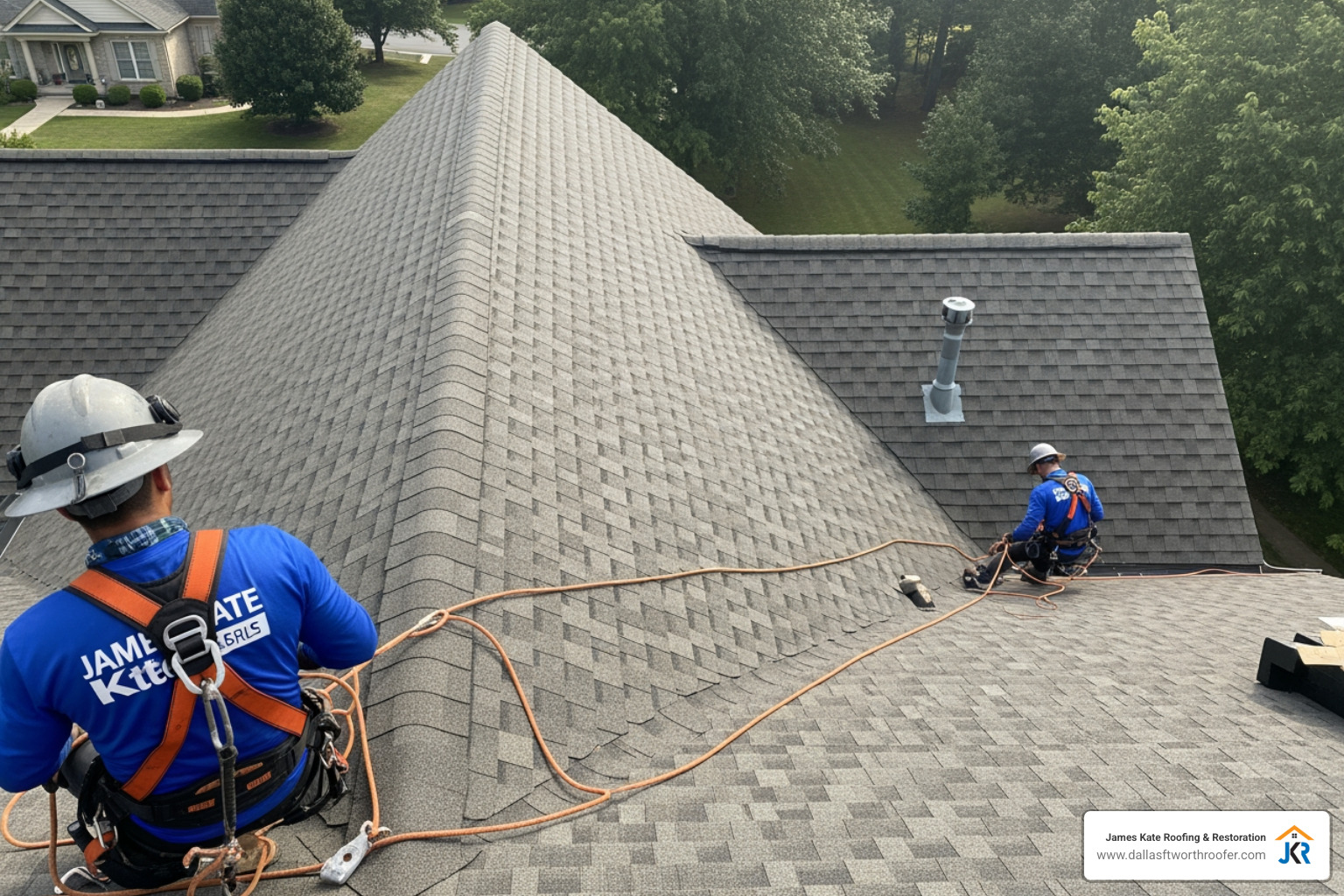
A small damaged area on a low-slope, single-story home is one thing. A steep, two-story roof with limited access and storm debris is another. Same tarp category, very different invoice.
The biggest cost drivers include:
- Size of the damaged area
- Roof pitch or steepness
- Number of stories
- Accessibility around the home
- Amount of debris on the roof
- Whether tree limbs must be removed first
- Complexity of roof design
- Weather conditions at the time of service
- Need for same-day or after-hours response
If you want to better understand how contractors price roof work in general, our roof replacement cost estimation guide explains the broader logic behind labor, safety, and materials.
How Urgency Impacts Roof Tarping Cost
Urgency is one of the fastest ways to move a tarp job from “manageable” to “expensive.”
When a crew has to stop scheduled work, load materials, mobilize quickly, and work around a narrow weather window, the cost rises. This is especially true after major North Texas storms, when many homeowners are calling at once.
Urgency-related cost increases may come from:
- After-hours dispatch
- Weekend or holiday calls
- Fast mobilization requirements
- Limited safe weather windows
- Higher demand after hail or wind events
A common rule of thumb from the research is that emergency or after-hours tarping adds about 30% to 40% over standard pricing. In some markets and surge conditions, it can be even more.
Calculating Your Total Roof Tarping Cost
A practical way to estimate your job is to start with the damaged area, then add complexity.
Here is a rough framework:
- Measure the area that needs coverage.
- Add extra coverage beyond the visible damage.
- Consider whether the tarp needs to cross the ridge.
- Factor in roof height, pitch, and access.
- Add emergency premiums if timing is urgent.
- Add debris clearing or tree removal if needed.
Professionally, the tarp should usually extend at least 3 to 4 feet beyond the damaged area and ideally over the ridge line when possible, so water sheds away instead of sneaking under the cover. That means you are rarely paying only for the exact visible hole.
Typical real-world scenarios:
- Small, accessible storm damage: $300-$600
- Moderate damage on a larger or steeper roof: $600-$1,000
- Severe damage, difficult access, or urgent response: $1,000-$1,500+
- Whole-roof temporary coverage after major impact: $1,500-$3,300+
If a fallen limb is involved, removal may be a separate cost before tarping can even begin.
Insurance Claims and the Duty to Mitigate
One of the most common questions we hear is simple: will insurance pay for this?
Often, yes. But not automatically, and not in every situation.
When roof damage is caused by a covered peril like wind, hail, or a fallen tree, emergency tarping is often considered a mitigation expense. In other words, your policy expects you to take reasonable steps to prevent further damage. A tarp is usually one of those steps.
That said, coverage depends on:
- Whether the original cause of damage is covered
- Your deductible
- Your policy language
- Proper documentation
- Whether the work was reasonable and necessary
Tarping related to renovation delays, old age, neglected maintenance, or wear and tear is usually a different story. Insurance typically does not pay to solve a maintenance problem that has been quietly auditioning for disaster for months.
For homeowners thinking beyond the immediate emergency, our guide on how to finance your roof replacement or repair can help if the claim leaves you with out-of-pocket costs.
Documentation for Claim Success
If you need a tarp and may file a claim, documentation matters almost as much as the tarp itself.
Best practices include:
- Take wide and close-up photos before tarping
- Use timestamped photos if possible
- Photograph any interior staining or active drips
- Save all receipts and invoices
- Request an itemized invoice
- Note the date and time the damage occurred
- Keep records of conversations with your insurer
- Photograph the tarp after installation
Do not wait for the adjuster if water is actively entering the house. In most cases, preventing further damage is the right move. Just document everything first, then keep the damaged materials and records available when possible.
When Tarping is Not Necessary
Not every roofing issue needs a tarp. Sometimes tarping is essential. Sometimes it is overkill. Sometimes it is just a very expensive blue decoration.
You likely do need tarping when:
- There is an active leak into living space
- Shingles or decking are missing and underlayment is exposed
- A tree or branch has punctured the roof
- Flashing failure has left an opening before rain
- Storm damage is likely to worsen before repairs can be made
Tarping may not be necessary when:
- Damage is cosmetic only
- A few shingles are bruised but the roof is still watertight
- Minor shingle loss has not exposed vulnerable areas
- The issue can be permanently repaired immediately without interim protection
- The leak source is not actually the roof
If you are weighing repair versus larger replacement costs, our article on the price of your next roof can help you think through the bigger decision.
Professional Installation vs. DIY Safety Considerations
Yes, a homeowner can tarp a roof in some cases. No, that does not mean it is a good idea in most cases.
Roof work becomes dangerous fast. Wet shingles, steep pitches, storm debris, soft decking, power lines, and wind all turn a “quick fix” into something much riskier than it looks from the driveway.
Our rule of thumb is simple: DIY might be reasonable only on a single-story, low-slope, dry, safely accessible roof in calm weather. Anything beyond that should push most homeowners toward professional help.
For context on how roof materials and installation choices affect long-term performance, see our guide to the real cost of asphalt shingles.
Safety basics professionals follow include:
- Avoid tarping during active rain, wind, or storms
- Use proper ladder placement with the ladder extending above the roof edge
- Wear gloves, eye protection, and slip-resistant footwear
- Use fall protection where required
- Check for power lines and structural instability
- Work with a second person, not alone
Risks of Improper DIY Tarping
Improper DIY tarping can create new problems while trying to solve the old one.
Common mistakes include:
- Using a tarp that is too small
- Laying it only over the hole instead of over the ridge
- Securing with loose bricks or random weights
- Fastening directly in ways that create more leaks
- Leaving slack that catches wind
- Allowing water to pond on the tarp
- Walking on the tarp and tearing it
Those mistakes can lead to:
- Wind lift and total tarp failure
- Water being redirected into new areas
- Damage to shingles or decking
- Faster interior staining and insulation damage
- Potential warranty issues from bad fastening methods
DIY material cost may look cheap at first. Small tarps can cost only a few dollars, and larger heavy-duty ones may run into the low hundreds. But one improper install can cost far more than the savings.
Professional Methods and Longevity
A professional tarp job is about more than “covering the hole.” The goal is to create a temporary water-shedding system.
Proper professional installation usually includes:
- Inspecting the damaged area from safe access points
- Clearing loose debris
- Measuring enough tarp to cover beyond the damage
- Extending the tarp over the ridge when possible
- Tucking the upper portion beneath shingles when appropriate
- Anchoring edges with 2×4 battens or wood strips
- Fastening securely to resist wind lift
- Minimizing unnecessary penetrations into undamaged roofing
- Checking for sagging, gaps, and runoff direction
This batten method is one of the most important differences between a pro install and a sloppy one. It helps distribute tension and keep the tarp from peeling off in the next gusty Texas storm.
As for lifespan, a properly installed standard tarp usually lasts about 30 to 90 days, with 90 days often treated as the practical limit before UV exposure and weather begin degrading performance. Heavier-duty vinyl may last longer, but tarping should still be viewed as temporary protection, not a substitute for repair.
If you are already planning beyond the temporary fix, our article on understanding asphalt roof replacement costs explains what comes next.
Frequently Asked Questions about Roof Tarping
How long does a properly installed roof tarp typically last?
Most professionally installed tarps are best treated as a short-term solution lasting up to about 90 days. Some heavy-duty materials may last longer, but the real goal should be scheduling permanent repairs as soon as possible.
North Texas sun, wind, hail, and temperature swings are not gentle on tarp materials. We recommend weekly visual checks and another inspection after any major storm. Warning signs of failure include:
- Sagging
- Tears
- Pulled fasteners
- Tarp shifting
- Water pooling
- New interior stains
Will a tarp stop a roof leak completely?
A tarp can often stop or greatly reduce a leak, but it is still a temporary barrier, not a true repair. Its success depends on proper placement, secure anchoring, and whether the tarp directs water away from the damaged area.
The best results usually happen when the tarp:
- Extends beyond the damaged area
- Crosses the ridge line
- Is tensioned properly
- Is secured with battens
- Does not allow water to pool
If the leak source is complicated, such as flashing details, multiple punctures, or hidden underlayment damage, a tarp may reduce water intrusion without eliminating it entirely.
Is emergency roof tarping covered by homeowners insurance?
Often yes, if the damage came from a covered event and the tarping was necessary to prevent additional loss. Insurers generally view emergency tarping as mitigation, not as a permanent repair.
Coverage usually depends on:
- Covered cause of loss
- Policy terms
- Deductible amount
- Prompt reporting
- Good documentation
The most important habit is to save everything: photos, notes, invoices, and communication records.
Conclusion
A roof tarp is not glamorous. No one shows off a blue tarp to the neighbors and says, “We upgraded the curb appeal.” But when storm damage hits, it is often the fastest and smartest way to protect your home from a much more expensive chain reaction.
The biggest takeaways are simple:
- Roof tarping cost usually ranges from $150 to $3,300
- Standard service commonly runs $0.70-$2.00 per square foot
- Emergency service often runs $1.00-$2.80 per square foot
- After-hours work usually adds 30% to 40%
- Proper installation matters more than tarp material alone
- Insurance often covers tarping when tied to a covered loss and documented correctly
- Most tarps should be treated as temporary protection for about 90 days or less
At James Kate Roofing & solar, we help homeowners across DFW make calm, informed decisions when roofs are damaged and time matters. As a family-owned company, we believe in honesty, integrity, and doing the job the right way. We also provide water mitigation, mold mitigation, fire mitigation, and build-back construction when damage has gone beyond the roof itself.
If you need help understanding what comes after the tarp, start with our guide on how much it really costs to reroof your house. If you are in Mansfield, Arlington, Granbury, Grand Prairie, Midlothian, or nearby DFW communities and need a professional assessment, we are here to help protect the property first and solve the bigger problem next.

Dustin Eatman is a seasoned roofing professional with deep, hands-on expertise that spans residential and commercial roofing, insurance solar, and long-term roof asset management. As the owner of James Kate Roofing & solar in the Dallas–Fort Worth metroplex, he’s built a reputation for diagnosing roof systems accurately, communicating clearly, and executing projects with a high standard of workmanship and documentation. Dustin understands the technical details that make roofs perform—proper underlayment selection, slope and drainage considerations, ventilation strategy, flashing and penetration detailing, and manufacturer-specific installation requirements—because he’s worked through the real-world challenges that cause leaks, premature wear, and warranty issues. He’s equally fluent in the operational side of roofing: jobsite planning, quality control, safety, material ordering, crew coordination, and customer experience from inspection to closeout. In insurance-related projects, Dustin brings practical knowledge of claim workflows, adjuster meetings, scope alignment, supplements, and the importance of photo evidence and thorough records, helping property owners navigate stressful situations with confidence. For commercial clients—especially property and facility managers—he emphasizes proactive maintenance and targeted repairs that reduce disruption, extend roof life, and prevent expensive interior damage. Dustin also stays focused on doing things the right way: educating customers on realistic options, setting expectations, and prioritizing solutions that hold up over time rather than quick fixes. That blend of technical skill, field experience, process discipline, and owner-level accountability is what makes Dustin Eatman a trusted expert in the roofing industry.