What’s the Real Difference Between a Composition Roof and Asphalt Shingles?
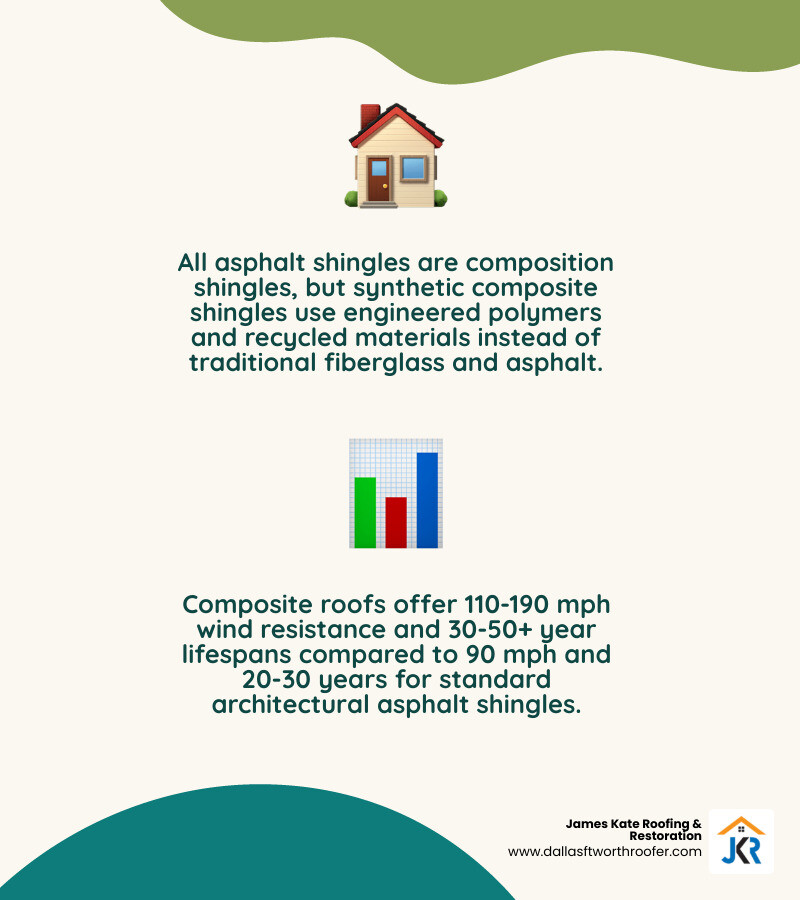
When it comes to composition roof vs asphalt shingles, the most important thing to know upfront is this: all asphalt shingles are composition shingles, but not all composition shingles are asphalt.
The term “composition roof” simply means the shingles are made from a blend of materials. Standard asphalt shingles — fiberglass mat, asphalt coating, mineral granules — qualify. But so do premium synthetic (composite) shingles made from engineered polymers, recycled rubber, and plastics.
Here’s a quick breakdown to answer the core comparison:
| Factor | Asphalt Shingles | Synthetic Composite Shingles |
|---|---|---|
| Cost installed | $3.50–$5.50/sq ft | $6.00–$9.00+/sq ft |
| Lifespan | 20–30 years (architectural) | 30–50+ years |
| Wind resistance | Up to ~90 mph | 110–190 mph |
| Curb appeal | Good (esp. architectural/luxury) | Excellent — mimics slate, cedar shake |
| Environmental impact | Petroleum-based, harder to recycle | Often recycled content, more recyclable |
| Best for | Budget-conscious, shorter timelines | Long-term homeowners, harsh climates |
Most DFW homeowners searching this topic are trying to decide whether the higher upfront cost of synthetic composite shingles is worth it — or whether quality architectural asphalt shingles make more financial sense for their situation. The answer depends on your budget, how long you plan to stay in the home, and how your roof needs to perform in Texas weather.
I’m Dustin Eatman, owner of James Kate Roofing & solar in the Dallas–Fort Worth area, and I’ve spent years helping homeowners navigate exactly this composition roof vs asphalt shingles decision across hundreds of residential projects in DFW. In this guide, I’ll walk you through every factor that matters — cost, durability, warranties, aesthetics, and climate performance — so you can make a confident, informed choice.
Understanding the Terminology: Composition Roof vs Asphalt Shingles
If you’ve been talking to roofing contractors in Arlington or Mansfield, you’ve probably heard the terms “composition,” “asphalt,” and “composite” thrown around like confetti. It’s enough to make any homeowner’s head spin. Let’s clear the air.
Historically, the term “composition shingle” was created to describe any shingle that wasn’t made of a single natural material like wood or stone. Because traditional asphalt shingles are a “composite” of fiberglass, bitumen (asphalt), and crushed stone granules, the industry labeled them composition shingles.
However, as we move through 2026, the terminology has evolved. Today, when people discuss composition roof vs asphalt shingles, they are usually comparing standard asphalt products against high-end synthetic composite shingles. These synthetic options are engineered to look like slate or cedar shake but are made from advanced polymers.
At James Kate Roofing & solar, we believe in transparency. When we talk about Key Differences Between Asphalt and Composite Roofing, we’re looking at how the “recipe” of the shingle affects your home’s protection. Asphalt shingles use a fiberglass mat as the backbone, while synthetic composites use a solid injection-molded polymer base. This distinction is the foundation of every other difference, from how long the roof lasts to how much it costs.
Key Differences in Composition Roof vs Asphalt Shingles Materials
To really understand what you’re putting over your head, we have to look at the “ingredients.”
Standard Asphalt Shingles: These are composed of a fiberglass base mat. This mat is saturated with petroleum-derived asphalt to make it waterproof. Finally, a layer of ceramic-coated mineral granules is pressed into the top. These granules aren’t just for color; they protect the asphalt from UV rays. Without them, the Texas sun would bake the asphalt into a brittle mess in just a few years.
Synthetic Composite Shingles: These are the “new school” of roofing. Instead of a mat-and-coating system, these are often solid pieces of engineered material. They can include:
- Compressed recycled plastics and rubber.
- Specialized resins and polymers.
- Slate dust or cellulosic fibers.
Because they aren’t just “coated” but are made of the same material all the way through, they don’t lose granules over time. When comparing Asphalt Vs Composite Shingles (Which Is Better For You), the material choice dictates everything. Synthetic composites are often molded from real pieces of hand-split cedar or natural slate, giving them a texture that asphalt struggles to replicate.
Performance Ratings: Composition Roof vs Asphalt Shingles in 2026
In the DFW area, performance isn’t just a marketing term—it’s a survival requirement. Between the straight-line winds in Grand Prairie and the localized hailstorms in Midlothian, your roof needs to be a fortress.
By 2026 standards, synthetic composite shingles are the clear winners in raw performance. While standard architectural asphalt shingles are typically rated for wind speeds up to 90 or 110 mph, many synthetic composites carry ratings from 110 to 190 mph. That is the difference between losing a few shingles during a spring storm and keeping your entire roof deck protected.
Impact resistance is another huge factor. Most synthetic composites carry a Class 4 Impact Rating, the highest available. This means they can withstand the impact of a 2-inch steel ball dropped from 20 feet without cracking. While some luxury asphalt shingles also achieve this, synthetic materials are naturally more resilient to the “bruising” that leads to leaks. When you use The Ultimate Guide to Picking Composition Roof Shingles, you’ll see that these performance ratings often translate directly into insurance premium discounts for North Texas homeowners.
Durability and Lifespan Comparison
Let’s talk about the elephant in the room: how often are you going to have to do this again? Replacing a roof is a major investment, and we want to make sure it’s an investment that lasts.
Asphalt shingles have a predictable lifespan. A standard 3-tab shingle might last 15 to 20 years, though we rarely recommend them for the DFW climate. Architectural (dimensional) asphalt shingles—which cover 75–80% of U.S. residential roofs—typically last 25 to 30 years under ideal conditions. However, in our local heat, we often see them begin to show significant wear at the 20-year mark.
Synthetic composite shingles are in a different league. Most manufacturers offer a service life of 30 to 50 years, and some even claim 70+ years. Because they don’t rely on granules for protection and don’t dry out like petroleum-based asphalt, they remain flexible and functional for decades longer.
According to the Composite vs Asphalt Shingles: 2026 Cost & Durability Comparison, choosing a composite roof can mean the difference between replacing your roof once and replacing it twice in the same span of homeownership. If you plan on staying in your Mansfield or Granbury home for the long haul, that extra durability pays for itself.
Weather Resistance in Texas Climates
Texas weather is a special kind of brutal. We have a saying at James Kate: if you don’t like the weather, wait five minutes—but make sure your roof is ready for whatever comes next.
Heat and UV Exposure: In cities like Arlington and Grand Prairie, the summer sun is relentless. Asphalt shingles absorb a tremendous amount of heat. Over time, this heat causes “thermal shock”—the shingles expand during the day and contract rapidly at night. This leads to cracking and shingle curling. Synthetic composites often feature “cool roof” technology, reflecting more sunlight and resisting the degradation caused by UV rays.
Hail and Impact: If you live in North Texas, you know that hail is an inevitability, not a possibility. Asphalt shingles can suffer from “bruising,” where the impact of a hailstone knocks the granules off and fractures the fiberglass mat. Once that mat is exposed, the shingle is no longer waterproof.
Synthetic composites, being made of polymers and rubber, tend to “bounce back.” They are designed to absorb the energy of the impact without structural failure. This is why we often suggest them to homeowners who are tired of filing insurance claims every time a storm rolls through. For more on this, check out Your Guide to Asphalt Shingles: Types, Benefits and Durability to see how different asphalt tiers stack up against our local weather.
Cost Analysis and Long-Term Value
We know that budget is usually the deciding factor for most families. When comparing composition roof vs asphalt shingles, the upfront price tag can be a bit of a shock.
Asphalt shingles are the most affordable roofing material on the market. For an architectural asphalt roof, you can expect to pay between $3.50 and $5.50 per square foot installed. For a standard 2,500-square-foot roof, that’s roughly $8,750 to $13,750.
Synthetic composite shingles, however, are a premium product. They typically cost between $6.00 and $9.00+ per square foot installed. Some ultra-premium synthetic slate options can even reach $12.00 to $20.00 per square foot.
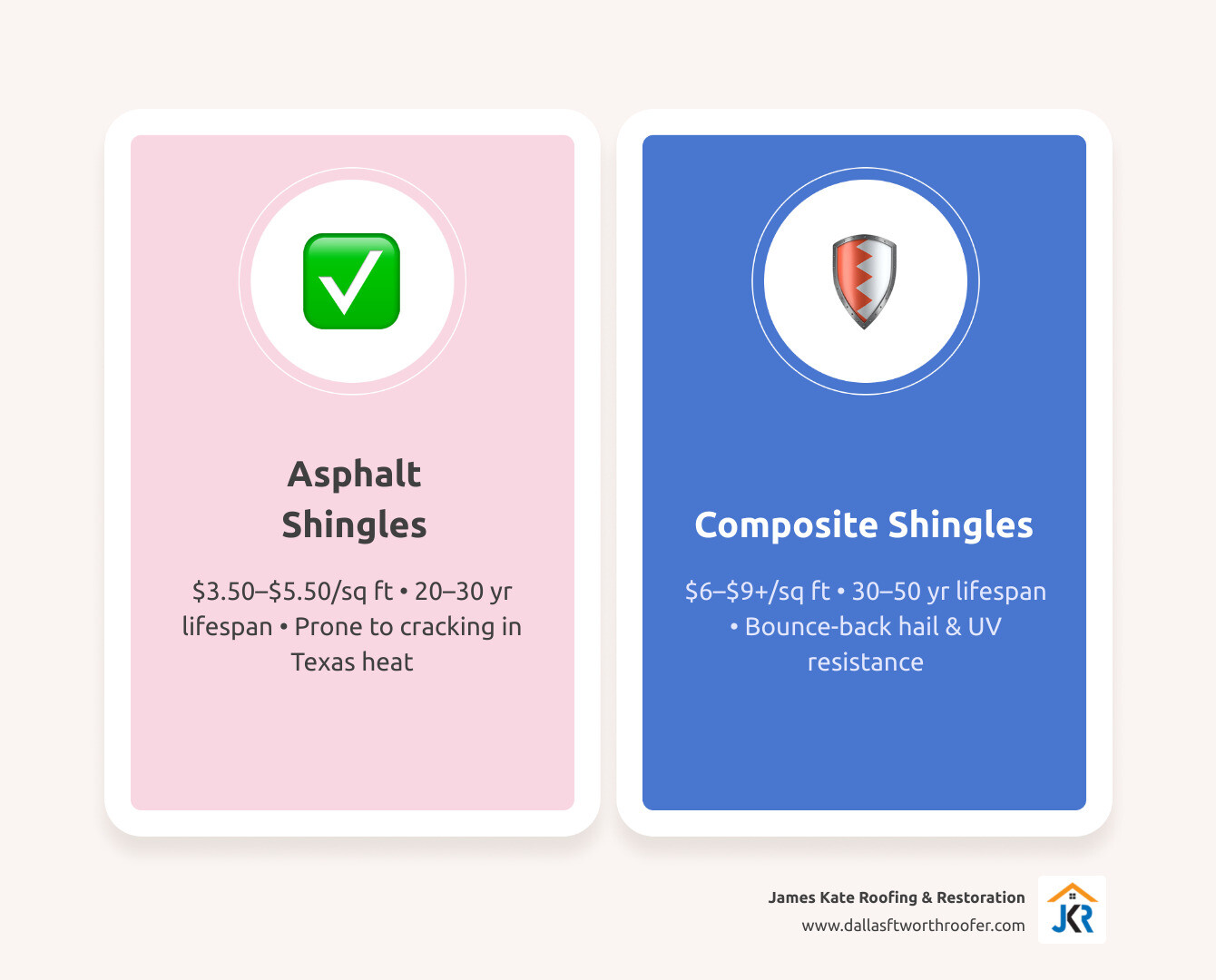
While the upfront cost of synthetic is roughly double (or triple) that of asphalt, the long-term value tells a different story. If you divide the cost of the roof by its expected lifespan, the “annual cost of ownership” is often lower for composite. Furthermore, many insurance companies offer significant discounts—sometimes up to 20%—for installing Class 4 impact-resistant materials.
We always tell our clients to Invest in the Best: Our Guide to Top Composite Roof Shingle Brands to find the sweet spot between budget and performance. If you’re planning to sell your home in five years, asphalt is likely the smarter financial move. If this is your “forever home,” the synthetic composite is the better investment.
Warranty and Maintenance Requirements
A roof is only as good as the company and the warranty standing behind it. Because asphalt shingles have been the industry standard for decades, their warranties are very structured. Most architectural shingles come with a 30-year limited warranty, but we can often offer an enhanced 50-year non-prorated manufacturer warranty because of our GAF President’s Club status.
Synthetic composite warranties are often even more robust, reflecting the manufacturer’s confidence in the material’s 50-year lifespan. However, these warranties often require specialized installation techniques. If your roofer doesn’t follow the specific fastening patterns required for high-wind areas like Granbury, your warranty could be void before the first storm hits.
Maintenance Needs:
- Asphalt: Requires regular checks for granule loss, curling, and algae growth (though many modern shingles are algae-resistant). You should budget for minor repairs after about 15 years.
- Composite: Virtually maintenance-free. They don’t rot, they don’t lose granules, and they are highly resistant to moss and algae. Your main task will be keeping the gutters clean and checking the flashing around chimneys.
At James Kate Roofing & solar, we back our work with up to a 25-year workmanship warranty. Whether you choose asphalt or composite, we ensure the installation is done to the highest standard, so you don’t have to worry about the “fine print” of a manufacturer warranty.
Aesthetics and Curb Appeal Options
Your roof can account for up to 40% of your home’s visible exterior. It’s the “hat” of your house, and it needs to look good.
Asphalt shingles have come a long way. Gone are the days of flat, boring gray squares. Modern architectural shingles offer deep shadow lines and a “dimensional” look that mimics wood shakes. Luxury asphalt shingles, like the GAF Grand Canyon or Camelot lines, are even thicker and designed to look like old-world slate.
However, synthetic composite shingles are the undisputed kings of curb appeal. Because they are molded from real natural materials, the texture is incredibly authentic. From the street, it is almost impossible to tell a high-quality synthetic slate roof from a real stone slate roof.
When Choosing Your Roof: A Comprehensive Guide to Asphalt and Composite Shingles, consider your home’s architectural style. A historic home in Midlothian might look stunning with synthetic cedar shakes, while a modern build in Mansfield might benefit from the sleek lines of synthetic slate.
Environmental Impact and Sustainability
As we look toward the future of the DFW area, many of our clients are asking about the environmental footprint of their roofing choices.
Asphalt Shingles: The reality is that asphalt shingles are petroleum-based. While they are technically recyclable (often ground up for road-paving material), the vast majority still end up in landfills. They also tend to absorb more heat, which can increase your home’s cooling costs during those 100-degree DFW summers.
Synthetic Composite Shingles: These are often the “greener” choice. Many brands use a high percentage of recycled materials, such as post-industrial plastics and rubber. Furthermore, at the end of their 50-year life, they are often 100% recyclable.
Perhaps more importantly for your wallet, composite shingles are often more energy-efficient. Some studies show they can reduce cooling costs by 10–15% in sun-heavy regions like Texas by reflecting more solar radiation. This makes them an excellent choice for homeowners looking to reduce their carbon footprint and their utility bills simultaneously.
Frequently Asked Questions about Composition and Asphalt Roofing
We get a lot of questions at our Mansfield and Arlington offices. Here are the three most common ones regarding the composition roof vs asphalt shingles debate.
Which roofing material is better for high-wind areas?
Synthetic composite shingles are generally superior for high-wind environments. While high-quality architectural asphalt shingles are rated for 110 mph, they can sometimes tear at the nail line during extreme gusts. Synthetic composites, due to their single-layer polymer construction and specialized fastening systems, can often withstand winds up to 190 mph. For homes in open areas of Grand Prairie or Midlothian where wind can pick up speed, composite is the safer bet.
How much more does a composite roof cost than architectural shingles?
Typically, a composite roof will cost 2 to 3 times more than an architectural asphalt roof. If an asphalt roof for your home costs $10,000, a synthetic composite roof will likely range between $20,000 and $30,000. While the upfront cost is higher, you must factor in the 50-year lifespan and potential insurance savings, which often make the composite roof cheaper over the “life” of the home.
Can I install solar panels on both asphalt and composite roofs?
Absolutely. Both materials are compatible with solar panel installations. However, there is a catch: you never want to install solar panels on a roof that only has 5–10 years of life left. Because synthetic composite roofs last 50+ years, they are actually the ideal partner for solar panels, which typically have a 25-year lifespan. You won’t have to pay to remove and reinstall your panels halfway through their life just to replace the shingles underneath.
Conclusion
Choosing between a composition roof vs asphalt shingles doesn’t have to be a stressful process. If you need a reliable, attractive roof that fits a modest budget, architectural asphalt shingles are a fantastic choice that will serve you well for two decades or more. If you want the ultimate in protection, curb appeal, and long-term value—and you plan on staying in your home for many years—synthetic composite is worth every penny.
At James Kate Roofing & solar, we aren’t just here to sell you a roof; we’re here to protect your family and your investment. As a family-owned DFW company, we operate on Biblical principles of honesty and integrity. Whether we’re working in Mansfield, Granbury, or Midlothian, we bring GAF President’s Club expertise to every job site.
Beyond roofing, we are a full-service solar company. If you’ve dealt with water, fire, or mold, we handle everything from mitigation to the final build-back construction. We treat your home like it’s our own, and we stand behind our work with industry-leading warranties.
Ready to see which shingle is right for your DFW home? More info about our roofing services is just a click away. Give us a call today, and let’s start a conversation that puts your home first.

Dustin Eatman is a seasoned roofing professional with deep, hands-on expertise that spans residential and commercial roofing, insurance solar, and long-term roof asset management. As the owner of James Kate Roofing & solar in the Dallas–Fort Worth metroplex, he’s built a reputation for diagnosing roof systems accurately, communicating clearly, and executing projects with a high standard of workmanship and documentation. Dustin understands the technical details that make roofs perform—proper underlayment selection, slope and drainage considerations, ventilation strategy, flashing and penetration detailing, and manufacturer-specific installation requirements—because he’s worked through the real-world challenges that cause leaks, premature wear, and warranty issues. He’s equally fluent in the operational side of roofing: jobsite planning, quality control, safety, material ordering, crew coordination, and customer experience from inspection to closeout. In insurance-related projects, Dustin brings practical knowledge of claim workflows, adjuster meetings, scope alignment, supplements, and the importance of photo evidence and thorough records, helping property owners navigate stressful situations with confidence. For commercial clients—especially property and facility managers—he emphasizes proactive maintenance and targeted repairs that reduce disruption, extend roof life, and prevent expensive interior damage. Dustin also stays focused on doing things the right way: educating customers on realistic options, setting expectations, and prioritizing solutions that hold up over time rather than quick fixes. That blend of technical skill, field experience, process discipline, and owner-level accountability is what makes Dustin Eatman a trusted expert in the roofing industry.