What You Need to Know About EPDM Rubber Roofing Membrane
An EPDM rubber roofing membrane is a single-ply synthetic rubber sheet widely used on flat and low-slope roofs — and for good reason. Here’s a quick summary:
| Feature | Details |
|---|---|
| What it is | Synthetic rubber sheet made from ethylene and propylene |
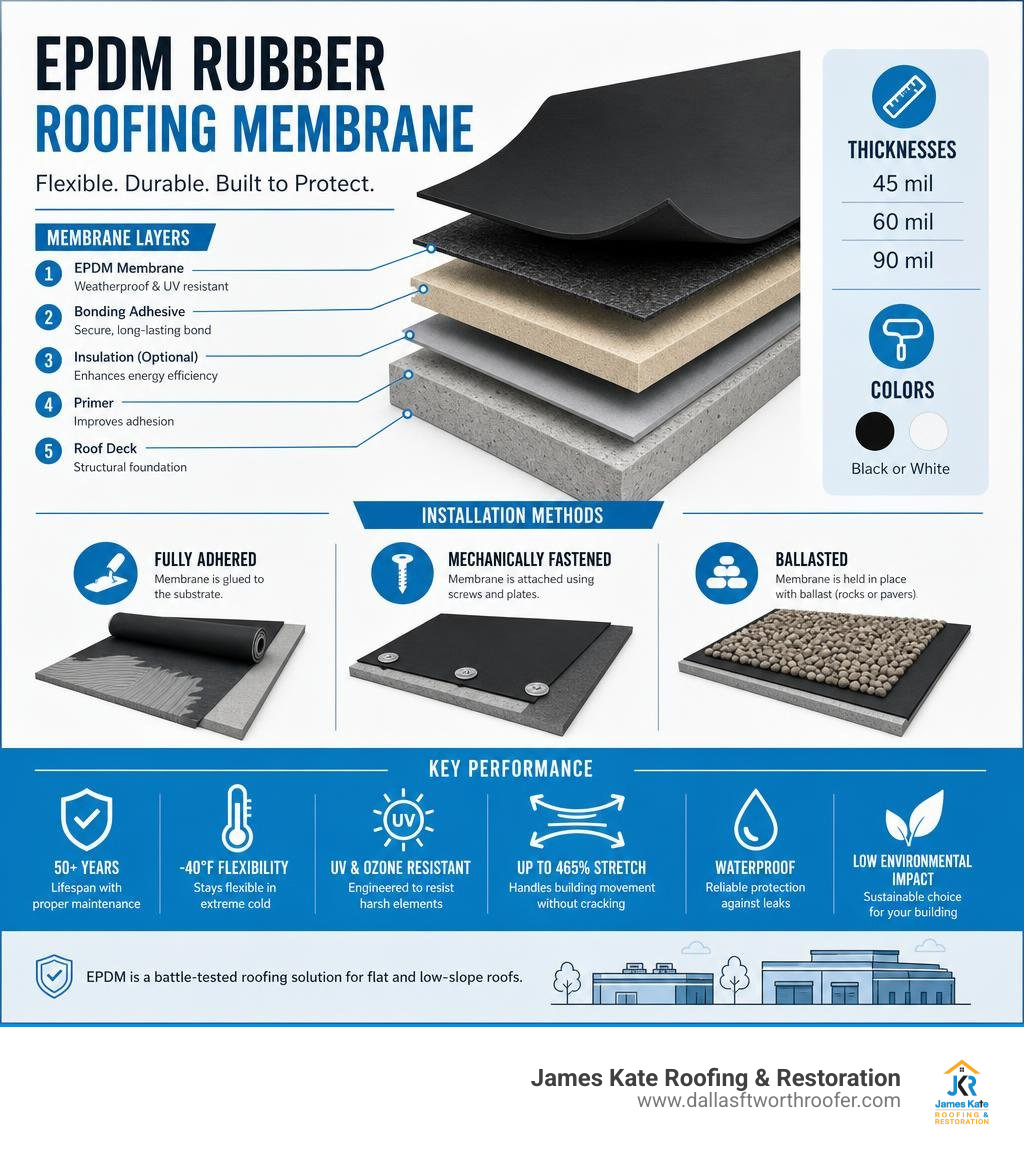
| Thicknesses | 45 mil, 60 mil, 90 mil |
| Colors | Black or white |
| Lifespan | 50+ years with proper maintenance |
| Best for | Commercial buildings, flat roofs, low-slope residential |
| Installation methods | Fully adhered, mechanically fastened, ballasted |
| Key strengths | Flexibility, weathering resistance, low environmental impact |
If you own a flat-roofed building in the DFW area, you’ve likely heard the term thrown around. But what actually is EPDM, and why does it keep showing up as the go-to recommendation for low-slope roofs?
The short answer: it’s one of the most battle-tested roofing materials available. EPDM has been used on commercial and residential flat roofs for over 60 years. It stays flexible at temperatures as low as -40°F, resists UV and ozone degradation, and can stretch up to 465% before failing — meaning it handles the kind of building movement and weather stress that would crack or split other materials.
It’s not a perfect fit for every situation, but when it is the right choice, it performs exceptionally well over the long haul.
I’m Dustin Eatman, owner of James Kate Roofing & solar, and I’ve personally inspected, installed, and repaired epdm rubber roofing membrane systems on commercial properties across the Dallas–Fort Worth area. In this guide, I’ll walk you through everything you need to make a confident, informed decision about EPDM for your property.
Epdm rubber roofing membrane terms at a glance:
What is an EPDM Rubber Roofing Membrane?
To understand why this material is so highly regarded, we have to look at what it is made of and how it is built. EPDM stands for Ethylene Propylene Diene Monomer. It is a synthetic elastomer derived from ethylene and propylene, which are sourced from oil and natural gas.
When these ingredients are chemically combined, they form an incredibly durable synthetic rubber. Unlike natural rubber, which can degrade quickly under sunlight and harsh weather, EPDM is engineered specifically to survive outdoors for decades.
Composition and Manufacturing of the EPDM Rubber Roofing Membrane
At the molecular level, the addition of a small amount of a diene monomer (usually dicyclopentadiene or ethylidene norbornene) creates a polymer chain that can be vulcanized. Vulcanization is a chemical heating process that cross-links the polymer chains. This turns the raw, gummy rubber compound into a highly stable, cured, and monolithic sheet.
During manufacturing, EPDM can be produced in two primary ways: calendering or extrusion. Calendering involves pressing the rubber compound between heavy rollers to form sheets. However, advanced manufacturers utilize extrusion. Extruded EPDM sheets produce fewer air voids and deliver a much more uniform thickness across the entire roll.
The resulting membrane is a thermoset material. This means that once it is cured during manufacturing, its chemical structure is permanently set. It cannot be melted down or reshaped by heat. This thermoset nature gives EPDM its legendary dimensional stability and heat resistance, which you can read about in detail via EPDM Roofing Systems – Johns Manville.
Available Thicknesses and Sizes
One of the greatest practical advantages of an epdm rubber roofing membrane is the sheer scale of the sheets. EPDM is manufactured in massive rolls up to 50 feet wide and 100 feet long. For many small-to-medium flat roofs, this means we can install a “one-piece” roof. By rolling out a single giant sheet, we completely eliminate seams over the main field of the roof. Fewer seams mean fewer potential leak points.
When selecting EPDM, you will typically choose from three standard thicknesses:
- 45 mil (approx. 1.14 mm): Roughly the thickness of a dime. It is a cost-effective option often used for residential projects or light commercial applications.
- 60 mil (approx. 1.52 mm): The industry standard for commercial roofs, offering an excellent balance of puncture resistance, durability, and cost.
- 90 mil (approx. 2.28 mm): A heavy-duty membrane designed for maximum toughness, severe weather exposure, and long-term performance.
For a deeper dive into the specific physical properties of these thicknesses, you can review the JM EPDM NR 45 mil Data Sheet.
Key Benefits and Performance Characteristics
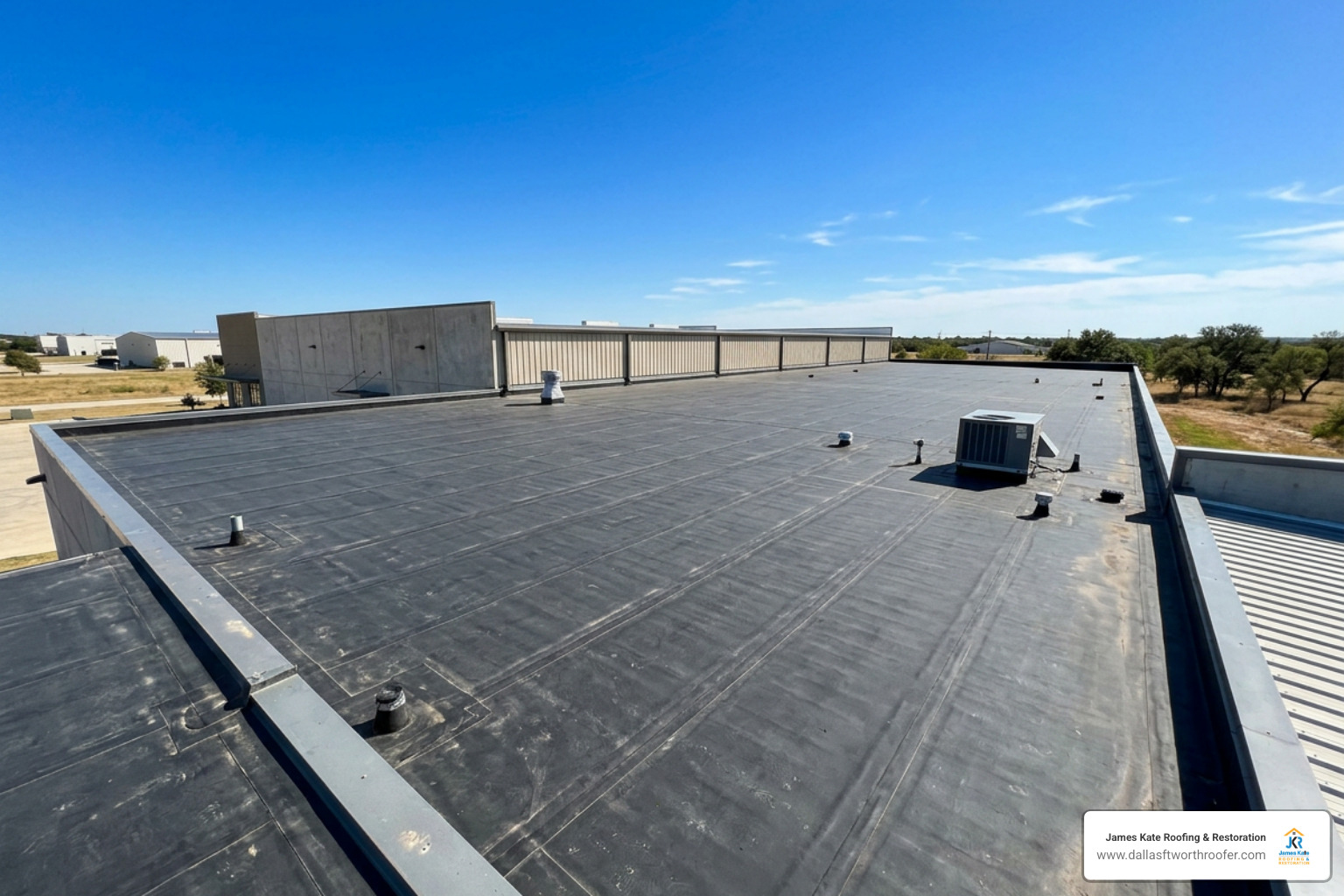
When we install a roof in Mansfield, Arlington, or Grand Prairie, we have to think about extreme weather. Our DFW summers bring blistering heat and intense UV radiation, while spring brings severe thunderstorms and giant hail. EPDM is built to handle all of it.
Weathering and Environmental Resilience
The physical resilience of EPDM is backed by impressive laboratory testing and decades of real-world exposure:
- Radiant Exposure Resistance: High-quality EPDM membranes can withstand a weathering resistance of up to 41,580 kJ/m² of total radiant exposure without showing signs of cracking, crazing, or surface degradation.
- Extreme Thermal Range: EPDM remains highly flexible in freezing temperatures down to -40°F and does not become brittle or crack. At the same time, it resists dimensional distortion in high heat.
- Superb Elongation: With an ultimate elongation of 465% (and up to 577% for certain reinforced formulations), EPDM can stretch and flex as your building settles, expands, and contracts throughout the seasons.
- Hail Resistance: Thanks to its high elasticity, EPDM acts like a shock absorber. When hail strikes, the membrane stretches and bounces back rather than puncturing or bruising like rigid materials.
Sustainability and Environmental Impact
If sustainability is a priority for your business or home, EPDM is one of the greenest single-ply choices on the market.
According to Life Cycle Assessments (LCAs) utilizing the EPA’s TRACI (Tool for the Reduction and Assessment of Chemical and other environmental Impacts) model, EPDM outperforms TPO, PVC, and Modified Bitumen in several critical environmental categories. It has the lowest contribution to smog, the lowest acid rain impact, and the lowest overall Global Warming Potential (GWP).
Additionally, because EPDM is a pure rubber compound without heavy plasticizers that leach out over time, it is highly recyclable at the end of its long service life.
EPDM Installation Methods and System Components
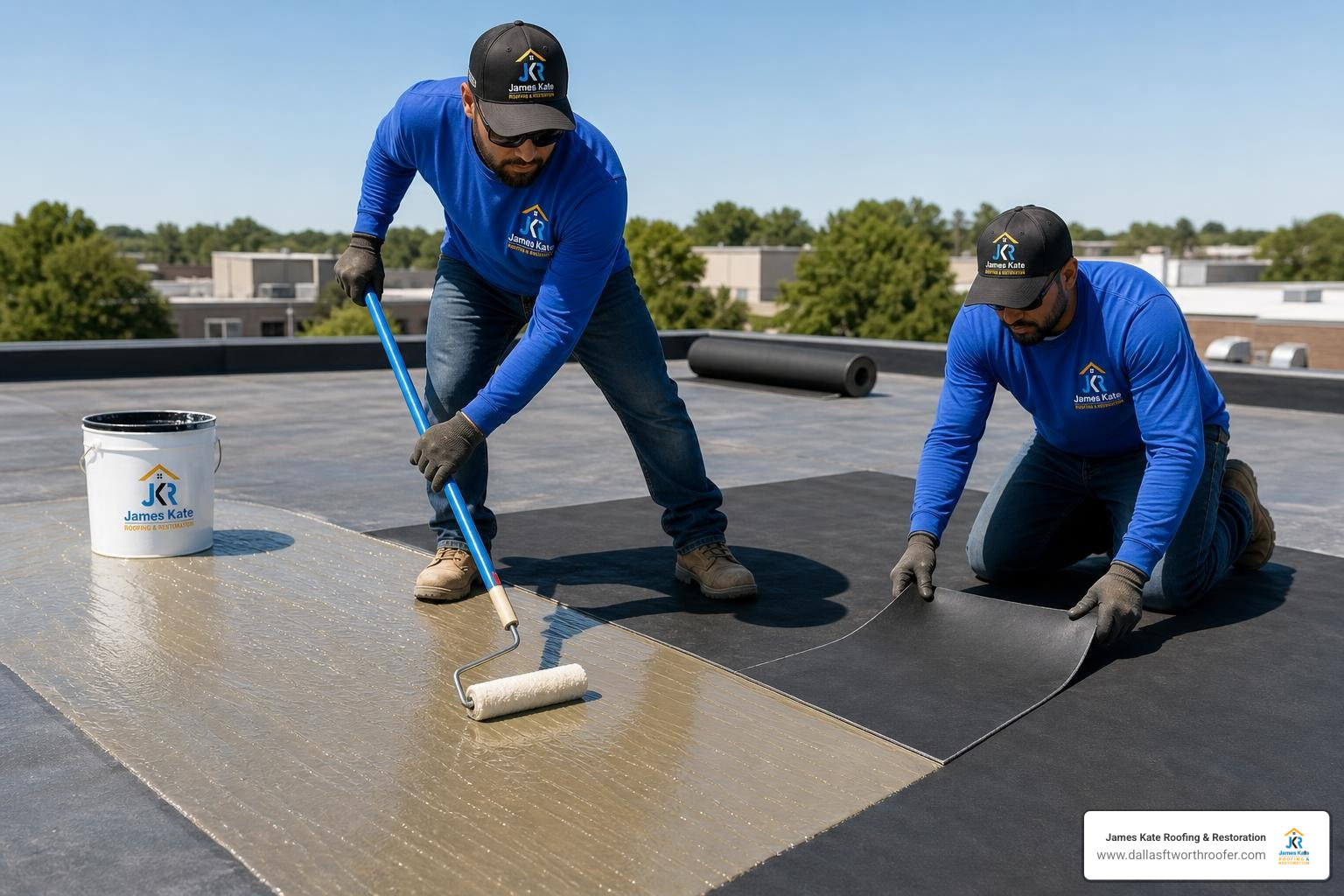
How an epdm rubber roofing membrane is secured to your building is just as important as the material itself. There are three primary installation methods used in modern commercial roofing.
Three Primary Installation Methods
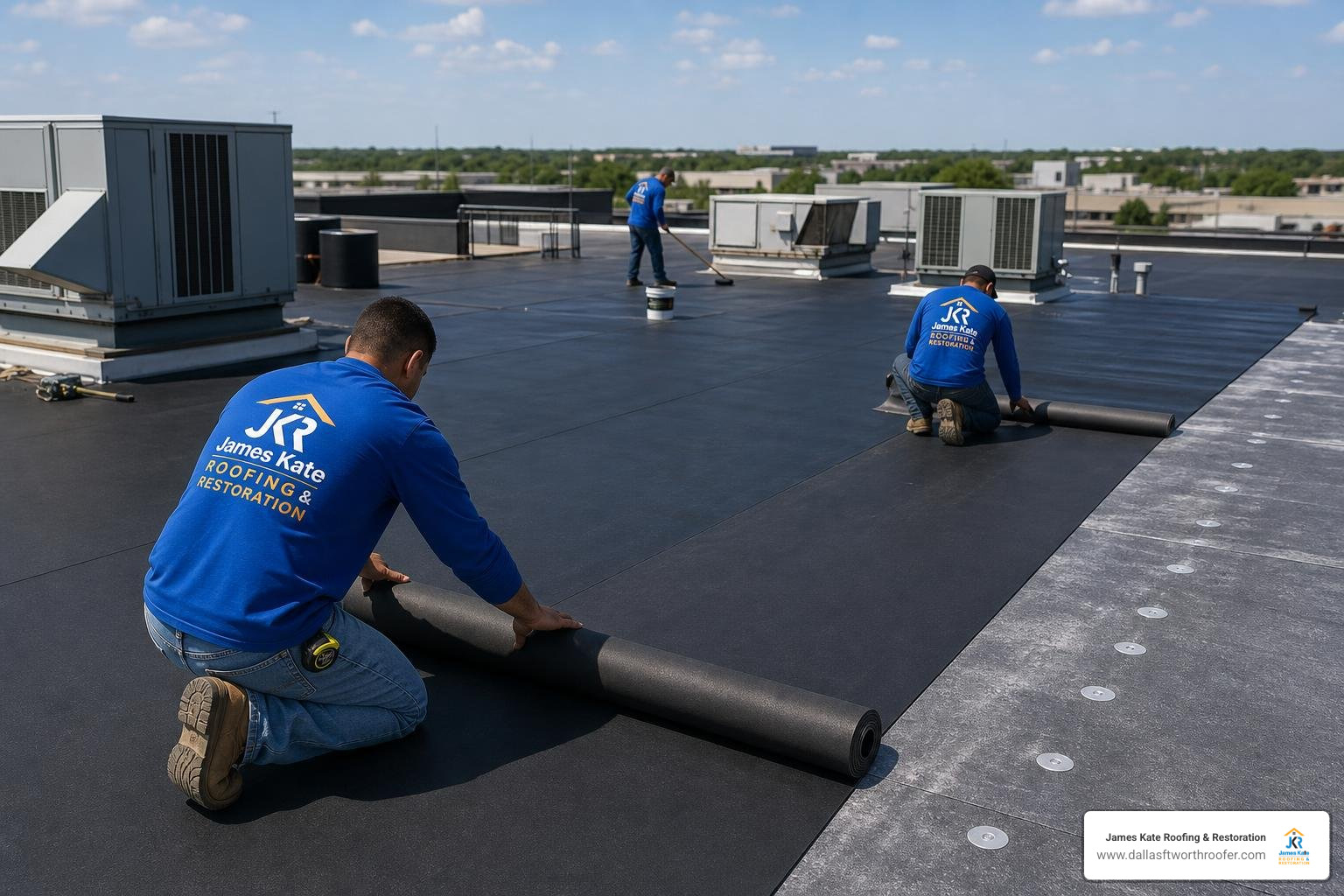
- Fully Adhered System: In this setup, the membrane is bonded directly to the substrate (usually insulation boards or a cover board) using a high-strength liquid bonding adhesive. This is the most common method in the DFW area because it provides outstanding wind uplift resistance. The membrane is held down across 100% of its surface area, eliminating billowing. You can learn more about this system structure in the EPDM Fully Adhered Roofing System guide.
- Mechanically Fastened System: Here, the EPDM sheets are rolled out and fastened to the roof deck using heavy-duty screws and targeted metal plates along the seams. The seams are then sealed over the fasteners. This method is fast and highly cost-effective, making it a popular choice for larger steel-decked warehouses.
- Ballasted System: The membrane is laid loosely over the substrate, and the seams are sealed. To keep the roof in place, a heavy layer of smooth river stone ballast or concrete pavers is placed over the EPDM. While highly economical to install, ballasted systems add massive weight to the structure and make finding leaks much more difficult.
Essential Accessories for a Complete EPDM Rubber Roofing Membrane System
An EPDM roof is only as good as its weakest detail. To ensure a watertight seal around pipes, corners, and walls, we use a specialized family of accessories:
- Primers and Seam Tapes: Because EPDM is chemically inert, standard glues won’t hold it long-term. We apply a dedicated tape primer to clean the rubber, followed by double-sided seam tape to chemically weld the overlapping sheets together.
- Flashings and Detail Tapes: Uncured EPDM flashing is highly moldable. We use it to wrap around complex shapes, inside and outside corners, and structural steel penetrations.
- Pipe Boots: Pre-molded rubber boots slide over plumbing vents and are clamped tight to create a perfect seal.
- Walkpads: In high-traffic areas (such as around HVAC units), we install heavy-duty 3/8-inch-thick solid rubber walkpads to protect the underlying membrane from dropped tools and heavy foot traffic.
For a complete breakdown of how these pieces fit into your larger roofing project, check out Your Local Guide To Commercial Roof Replacement.
Comparing EPDM to TPO and PVC Single-Ply Membranes
When choosing a single-ply roof, you will inevitably compare EPDM to TPO (Thermoplastic Polyolefin) and PVC (Polyvinyl Chloride). Understanding the core differences between these materials is vital for making the right long-term investment.
| Performance Metric | EPDM (Thermoset Rubber) | TPO (Thermoplastic) | PVC (Thermoplastic) |
|---|---|---|---|
| Material Type | Cured synthetic rubber | Plastic/rubber blend | Vinyl polymer |
| Seaming Method | Double-sided seam tape | Hot-air welded | Hot-air welded |
| Flexibility | Extreme (down to -40°F) | Moderate | Moderate |
| Puncture Resistance | Excellent (highly elastic) | Moderate to Good | Good |
| Chemical/Oil Resistance | Poor (damaged by oils) | Good | Excellent (grease resistant) |
| Average Lifespan | 30 to 50+ years | 15 to 25 years | 20 to 30 years |
| DFW Suitability | Excellent (requires white EPDM for heat) | Good (highly reflective) | Good (ideal for restaurants) |
The most fundamental difference is that EPDM is a thermoset material, while TPO and PVC are thermoplastics.
Thermoplastics can be melted and re-melted. Because of this, TPO and PVC seams are fused together using hot-air welding machines, creating a physical bond that is incredibly strong. EPDM seams, on the other hand, rely on chemical adhesive tapes. While modern factory-applied seam tapes are highly reliable, they do require meticulous installation prep to prevent premature failure.
However, EPDM easily wins when it comes to longevity and weathering. TPO and PVC contain plasticizers and stabilizers that slowly degrade under intense UV exposure, which can lead to cracking and shattering as the roof ages. EPDM contains no plasticizers; its rubber structure remains stable and flexible virtually indefinitely.
To explore single-ply choices even further, take a look at our Commercial Roof Complete Guide 2026.
Maintenance, Longevity, and solar
One of the biggest myths in commercial roofing is that flat roofs are “set it and forget it.” Even a material as tough as EPDM requires basic care to reach its full 50+ year potential.
Extending Lifespan with Regular Maintenance
In our local DFW climate, we recommend commercial roof inspections at least twice a year—ideally in the spring and fall. During these checks, our team looks for a few specific issues:
- Seam Separation: Over decades, thermal expansion and contraction can put stress on taped seams. Catching a small seam gap early prevents water from saturating your insulation boards.
- Membrane Shrinkage: Over time, EPDM can experience minor shrinkage. If the roof was not installed with proper perimeter securement (like reinforced perimeter strips), shrinkage can pull the membrane away from walls and curbs.
- Debris and Drainage: Flat roofs must drain water efficiently. We clear out leaves, twigs, and dirt that clog roof drains, preventing standing water (ponding) from sitting on the membrane for extended periods.
For a detailed look at keeping your roof in top shape, check out our Roof Maintenance Guide 2026.
EPDM Roof solar and Coatings
If your EPDM roof is reaching the end of its initial design life but the underlying insulation is still dry and structurally sound, you don’t necessarily need a costly tear-off. EPDM is an excellent candidate for roof solar.
By thoroughly cleaning the rubber and applying a high-performance liquid coating, we can seal minor imperfections, reinforce aging seams, and add another 10 to 20 years of waterproof protection.
- Silicone Coatings: Highly resistant to ponding water and UV radiation.
- Acrylic Coatings: Highly reflective and cost-effective for roofs with positive drainage.
Applying a white silicone or acrylic coating over a black EPDM roof also dramatically improves energy efficiency, transforming a heat-absorbing dark roof into a highly reflective “cool roof.”
To find out which coating is right for your property, read our guides on Dont Let It Leak Best Liquid Coatings For EPDM Roofs and The Smart Business Owners Guide To Commercial Roof solar.
Frequently Asked Questions about EPDM Roofing
How long does an EPDM roof last?
With professional installation and basic preventative maintenance, a high-quality EPDM roof can easily last 50 years or more. Its natural resistance to UV rays, ozone, and extreme temperatures makes it one of the longest-lasting flat roofing materials ever created.
Can EPDM be installed over an existing roof?
Yes, in many cases, we can perform an overlay. If your building has an aging modified bitumen or built-up roof (BUR) that is structurally sound and free of trapped moisture, we can install a thin recovery board over the old roof and adhere the new EPDM membrane directly to it. This saves you the substantial labor and disposal costs of a complete tear-off.
To see if your building is a candidate for this process, check out our resource on Getting Your Commercial Flat Roof Replaced.
Is EPDM roofing suitable for residential flat roofs?
Absolutely. EPDM is a fantastic option for residential flat or low-slope structures, such as home extensions, detached garages, carports, and porch transitions. Its clean appearance, quiet installation (no hot asphalt or open torches), and exceptional lifespan make it a favorite for homeowners in Mansfield, Arlington, and Grand Prairie who want a worry-free flat roof.
Conclusion
An epdm rubber roofing membrane is a premier long-term investment for protecting flat and low-slope properties. Its unmatched flexibility, proven durability, and excellent environmental profile make it a standout choice for commercial and residential buildings alike.
However, even the finest rubber membrane will fail if it isn’t installed with precision, honesty, and care. At James Kate Roofing & solar, we bring decades of hands-on DFW roofing experience to every job. Whether your property is in Mansfield, Arlington, Granbury, Grand Prairie, or Midlothian, TX, our family-owned team is committed to delivering top-tier craftsmanship backed by our GAF President’s Club recognition and up to a 25-year workmanship warranty.
Ready to protect your property with a flexible, long-lasting shield? Schedule a commercial roofing consultation with James Kate Roofing & solar today, and let’s build a roof that stands the test of time.
Dustin Eatman is a seasoned roofing professional with deep, hands-on expertise that spans residential and commercial roofing, insurance solar, and long-term roof asset management. As the owner of James Kate Roofing & solar in the Dallas–Fort Worth metroplex, he’s built a reputation for diagnosing roof systems accurately, communicating clearly, and executing projects with a high standard of workmanship and documentation. Dustin understands the technical details that make roofs perform—proper underlayment selection, slope and drainage considerations, ventilation strategy, flashing and penetration detailing, and manufacturer-specific installation requirements—because he’s worked through the real-world challenges that cause leaks, premature wear, and warranty issues. He’s equally fluent in the operational side of roofing: jobsite planning, quality control, safety, material ordering, crew coordination, and customer experience from inspection to closeout. In insurance-related projects, Dustin brings practical knowledge of claim workflows, adjuster meetings, scope alignment, supplements, and the importance of photo evidence and thorough records, helping property owners navigate stressful situations with confidence. For commercial clients—especially property and facility managers—he emphasizes proactive maintenance and targeted repairs that reduce disruption, extend roof life, and prevent expensive interior damage. Dustin also stays focused on doing things the right way: educating customers on realistic options, setting expectations, and prioritizing solutions that hold up over time rather than quick fixes. That blend of technical skill, field experience, process discipline, and owner-level accountability is what makes Dustin Eatman a trusted expert in the roofing industry.