
Most homeowners pay between $8,000 and $30,000 to replace siding, with the final number set by the material you choose, the size and shape of the house, and what the crew finds under the old siding. On a 2,000-square-foot home, vinyl averages $12,252 installed, while premium materials such as cedar or stone veneer cost two to more than two and a half times that. Below you’ll find the figures by material, the factors that move the price, the signs that tell you it’s time, and how to read a quote.
TL;DR
- Expect roughly $8,000 to $30,000 for a full replacement. Vinyl sits at the low end and fiber cement, cedar and stone at the high end.
- Installed prices run from about $3 to $12 per square foot for vinyl, and labor alone is often $2 to $5 per square foot.
- Tear-off, rot repair, house wrap and tall or complicated homes are the line items that push a quote up.
- Moisture inside the wall, buckling, or widespread rot point to replacement. A small damaged area on newer siding can often be repaired.
- Get at least a written, itemized estimate that says whether the per-square-foot price covers materials and labor.
Table of Contents
- What siding replacement costs on average
- Siding replacement cost by material
- What drives your total
- Siding cost for common house sizes
- Signs it’s time to replace, not repair
- Is new siding worth the money?
- How to read and compare siding quotes
- Our perspective on siding and the building envelope
- Plan siding with your roof and gutters
- Get an estimate from a North Texas contractor
- FAQ
- Sources
What siding replacement costs on average
National figures vary by publisher because each one samples different projects and defines the job a little differently. Read them as a band, not a single answer.
| Source | What it reports |
|---|---|
| This Old House, 2026 pricing | $8,000 to $30,000 for most homes; vinyl on a 2,000 sq ft home averages $12,252 |
| Consumer Reports | Average vinyl job nearly $18,000; average fiber cement job above $21,000 (JLC data) |
| NerdWallet, updated August 2025 | $3 to $12 per square foot for vinyl, $6,369 to $18,274 total, averaging $12,221 (Angi data) |
| Homewyse, May 2026 | Vinyl installation starting at $7.32 to $12.51 per square foot |
| Realtor.com, May 2025 | A rough $4 to $18 per square foot, or $8,000 to $36,000 for a 2,000 sq ft home |
The spread is wide on purpose. A single-story ranch with plain walls and a two-story house with dormers can differ by thousands of dollars even when the siding is the same.
A useful habit: ask whether any per-square-foot number you see is for the siding material alone, for installation alone, or for both. NerdWallet advises checking exactly that with each contractor, because two quotes that look far apart may simply cover different things.
Siding replacement cost by material
Material is the biggest lever. This Old House lists these average costs for a 2,000-square-foot home in its 2026 pricing:
| Material | Average cost, 2,000 sq ft home |
|---|---|
| Vinyl | $12,252 |
| Plank or shiplap | $14,210 |
| Aluminum | $14,649 |
| Board and batten | $16,870 |
| Stucco | $19,320 |
| Cedar | $23,400 |
| Stone veneer | $28,320 |
A few things sit behind those numbers.
Vinyl is the budget standard. NerdWallet puts a 2,000-square-foot home at $7,000 to $11,000 for economy vinyl and $14,000 to $26,000 for insulated vinyl. Insulated vinyl has foam backing, which accounts for the jump.
Fiber cement costs more than vinyl in most quotes. Consumer Reports reports that the average fiber cement job tops $21,000, against nearly $18,000 for vinyl. The same report says fiber cement recoups 114% of its cost at resale versus 97% for vinyl, based on the 2025 Cost vs. Value Report.
Wood and cedar carry higher material prices and ongoing upkeep. Paint or stain has to be maintained, and the surface needs to be dry before any new coating goes on. A guide to checking wood moisture before priming siding explains why a reading under 15% matters for paint adhesion.
Stucco and stone veneer are specialty installs. They require trade-specific labor, which is part of why stone veneer averages more than twice the vinyl figure.
What drives your total
Home size and shape
Siding is priced by the area of wall you cover, so a bigger house costs more. Shape matters nearly as much. Good Housekeeping notes that two- and three-story homes cost more because crews need extra ladders and scaffolding, and that turrets, dormers and other complicated shapes raise the price further.
Labor
Labor can account for up to half of a vinyl siding job, generally $2 to $5 per square foot. Homewyse lists basic vinyl installation labor at $350.25 to $485.78 per 129 square feet. Labor rises with the difficulty of the job: more corners, more windows and doors, more trim, and harder access.
Removing the old siding
Tear-off and disposal are normally part of the labor line. This Old House says removing old siding can add hundreds or thousands of dollars, and NerdWallet adds that a difficult removal takes more time and increases labor costs. Ask whether removal is in the quote or listed separately.
Repairs hidden under the old siding
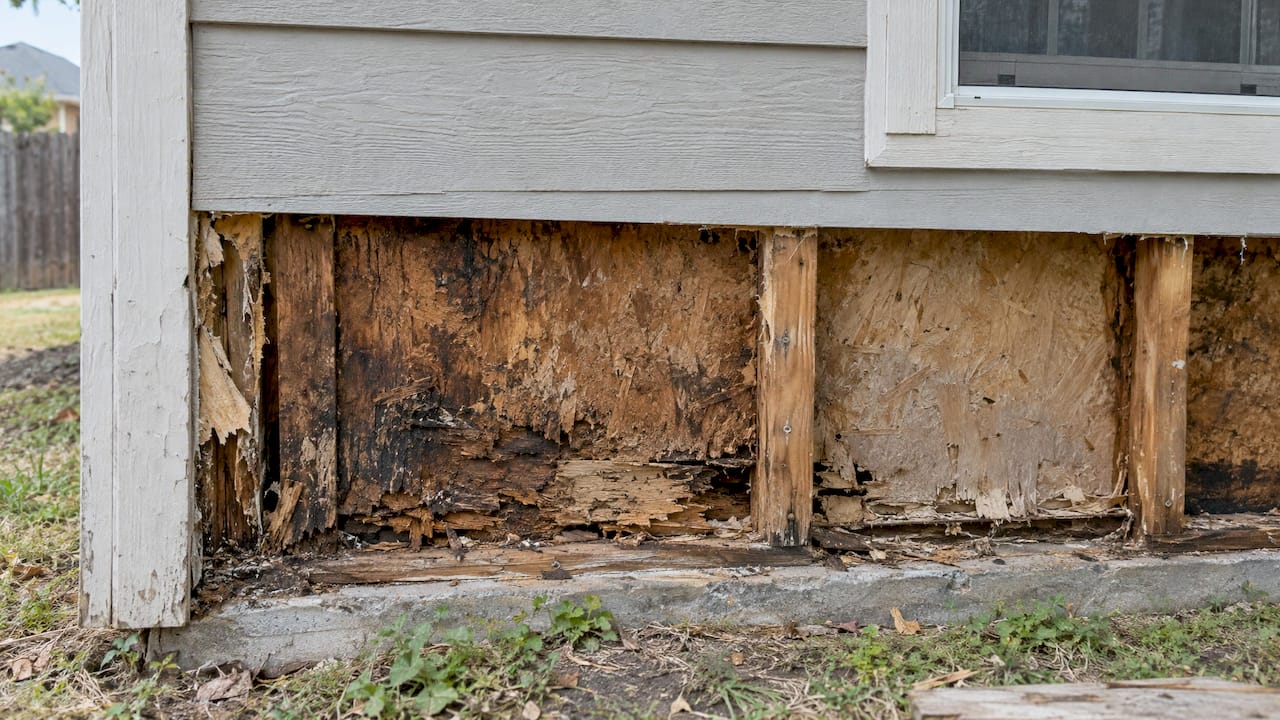
This is the line homeowners can’t predict. If the crew finds rot, mold or structural problems under the old siding, repairs push expenses up beyond the original estimate. A good contractor explains how that kind of discovery will be priced before work starts, for example per sheet of sheathing or per linear foot of replaced framing.
House wrap and moisture barriers
House wrap and moisture barriers typically run $0.50 to $1 per square foot. They are cheap relative to the whole job and they protect the wall, so treat them as a line to confirm, not to cut.
Siding cost for common house sizes
Searchers often ask about 1,500- and 2,000-square-foot houses. Keep in mind that these sizes usually refer to floor area, and the wall area to be sided depends on the stories, ceiling height and number of openings.
- 2,000 sq ft: vinyl averages $12,252, and the full material range runs up to $28,320 per the This Old House list. Realtor.com’s expert ballpark of $8,000 to $36,000 for the same size shows how much material and complexity move the result.
- 1,500 sq ft: national publishers rarely break out this size. A reasonable approach is to scale from the per-square-foot ranges above and ask each contractor to measure the actual wall area, subtracting windows and doors, rather than relying on a floor-area shortcut.
- Per 100 feet of vinyl: one square of siding covers 100 square feet of wall, so at the $3 to $12 per square foot installed range, 100 square feet of installed vinyl falls roughly between $300 and $1,200.
Signs it’s time to replace, not repair
Replacement only makes sense when repair no longer protects the house. Look for these:
- Moisture or mold behind the siding. Bob Vila’s editorial team says any sign of mold growth or moisture damage, such as bubbling paint, calls for full replacement to prevent structural problems.
- Warping and buckling. Consumer Reports notes that siding can buckle or warp, and that poor installation lets moisture seep into the structure, where it can cause mold or rot.
- Widespread cracks, chips or rot. A small damaged area on siding under 15 years old is usually a targeted repair. Damage across several walls is not.
- Age. Lifespans differ widely, per Bob Vila: wood 20 to 40 years, metal 40 to 70, fiber cement up to 50, vinyl up to 60, stucco 50 to 100, and stone 100 or more.
- Storm damage. In North Texas, hail and wind are the usual cause. Dents, cracks, loose panels and exposed sheathing after a storm should be documented before any repair. Our guides on types of storm damage and how to check, document and decide walk through the process for the roof, and the same habits of photographing and dating damage apply to walls.
Is new siding worth the money?
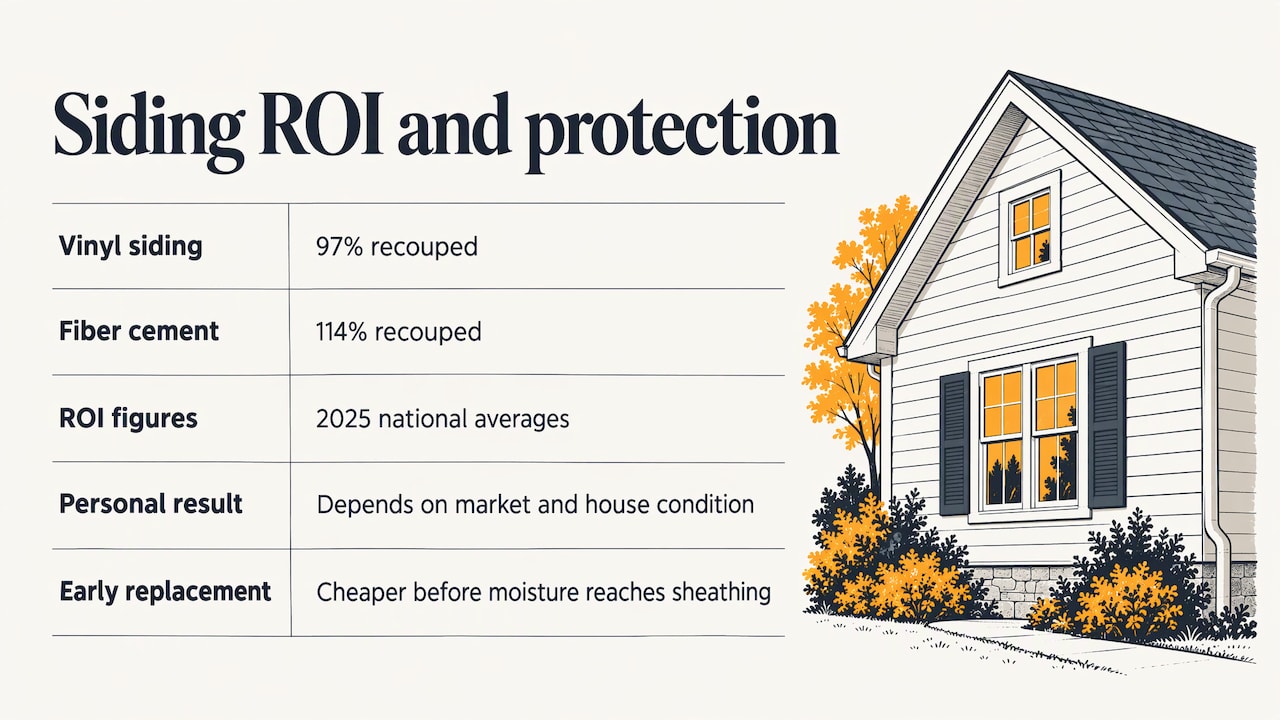
It is expensive, but it is also one of the better-returning projects. Consumer Reports says new siding can improve curb appeal instantly, and its return on investment is relatively high among remodeling jobs. The 2025 Cost vs. Value figures it cites, 97% recouped for vinyl and 114% for fiber cement, are national averages, so your own result depends on your market and the condition of the house.
The bigger payoff is protection. Siding is the outer layer that keeps water out of the wall. Replacing it before moisture reaches the sheathing is cheaper than replacing it afterward.
How to read and compare siding quotes
A quote you can compare line by line is worth more than a low total. Ask each contractor to put these items in writing:
- Scope of measurement. Total wall area and how it was measured.
- Material name and grade. Brand, product line, thickness and color, not just “vinyl.”
- Tear-off and disposal. Included or extra, and the cost if so.
- Underlayment. House wrap or barrier type, plus flashing around windows and doors.
- Trim, soffit and fascia. Whether they are replaced, wrapped or left alone.
- Rot and sheathing repair. How unexpected repairs are priced.
- Permits. Who pulls them. Rules differ by city, so ask your local building department what is required.
- Warranty. What the manufacturer covers and what the installer covers, and for how long.
- Payment schedule. Deposit, progress payments and final payment tied to completion.
If a number looks far lower than the rest, check which of those lines is missing before you celebrate.
Our perspective on siding and the building envelope
We work on the outside of North Texas homes every day, and we see the same pattern after hail and wind: the roof, gutters and siding fail together, because they are one system that sheds water. When we inspect a house, we look at how those pieces meet, since flashing at a wall-to-roof joint or a gutter that overflows onto siding can ruin a wall long before the siding itself wears out.
That’s why we like to start with a free inspection and estimate and a clear written scope. We’re a GAF Master Elite® contractor, and we offer siding, paint and gutters alongside roofing. Our approach is to diagnose first and recommend second, and to explain what we find in plain terms so you can decide with confidence rather than pressure.
If you’re deciding between repair and replacement, our advice is to settle the water-entry question first. Fix whatever lets moisture in, then choose the material that fits your budget and the way you want the house to age. One coordinated plan usually costs less than separate emergency calls.
Dustin Eatman
Plan siding with your roof and gutters
If your roof is also near the end of its life, schedule both jobs together where you can. Scaffolding, access and cleanup overlap, and the crew can flash the roof-to-wall transitions properly instead of working around old materials. Our guide to roof replacement costs and financing in DFW covers how to budget for that side of the project.
Get an estimate from a North Texas contractor
We offer free inspections and estimates for homeowners across the Dallas-Fort Worth area, including exterior work such as siding, paint and gutters, as well as storm-damage assessments and roof repair and replacement. We don’t publish set prices, because every house is different, so the estimate is where your real number comes from.

Start on our home page to request an inspection, or see our roofing services if the roof needs attention too.
FAQ
How much does it cost to side a 2,000-square-foot house?
Vinyl averages $12,252 for a 2,000-square-foot home, and other materials range up to $28,320 for stone veneer. Realtor.com’s expert ballpark for the same size is $8,000 to $36,000. Your quote depends on wall area, stories and material.
Is it expensive to replace siding on a house?
Yes, it is one of the larger exterior projects, with most jobs between $8,000 and $30,000. Consumer Reports notes, though, that resale value recouped is relatively high compared with other remodels: 97% for vinyl and 114% for fiber cement.
How long does house siding last?
It depends on the material. According to Bob Vila, wood lasts 20 to 40 years, vinyl up to 60, fiber cement up to 50 and metal 40 to 70. Moisture, storms and installation quality can shorten those numbers.
Can I repair a small damaged area instead of replacing everything?
Often, yes, when the siding is under 15 years old and the damage is small, such as a limited area of cracking or chipping. Mold or moisture damage, like bubbling paint, is a different case and usually means replacement.
Does the per-square-foot price include labor?
Not always. NerdWallet recommends confirming whether a contractor’s price covers both materials and labor, and whether removal of the old siding is included.
Sources
- Siding Replacement Cost (2026 Pricing), This Old House
- Siding Buying Guide, Consumer Reports
- Cost to Install Vinyl Siding, Homewyse
- Cost to Replace Vinyl Siding, ROI and Ways to Save, NerdWallet
- 7 Best Exterior Siding Options for Your Home, Good Housekeeping
- Siding Replacement Is Always Worth It, Realtor.com
- Signs It’s Time to Replace Your House’s Siding, Bob Vila
- Verify Under 15% Moisture Before Priming Wood Siding
Recommended

Dustin Eatman is a seasoned roofing professional with deep, hands-on expertise that spans residential and commercial roofing, insurance solar, and long-term roof asset management. As the owner of James Kate Roofing & solar in the Dallas–Fort Worth metroplex, he’s built a reputation for diagnosing roof systems accurately, communicating clearly, and executing projects with a high standard of workmanship and documentation. Dustin understands the technical details that make roofs perform—proper underlayment selection, slope and drainage considerations, ventilation strategy, flashing and penetration detailing, and manufacturer-specific installation requirements—because he’s worked through the real-world challenges that cause leaks, premature wear, and warranty issues. He’s equally fluent in the operational side of roofing: jobsite planning, quality control, safety, material ordering, crew coordination, and customer experience from inspection to closeout. In insurance-related projects, Dustin brings practical knowledge of claim workflows, adjuster meetings, scope alignment, supplements, and the importance of photo evidence and thorough records, helping property owners navigate stressful situations with confidence. For commercial clients—especially property and facility managers—he emphasizes proactive maintenance and targeted repairs that reduce disruption, extend roof life, and prevent expensive interior damage. Dustin also stays focused on doing things the right way: educating customers on realistic options, setting expectations, and prioritizing solutions that hold up over time rather than quick fixes. That blend of technical skill, field experience, process discipline, and owner-level accountability is what makes Dustin Eatman a trusted expert in the roofing industry.