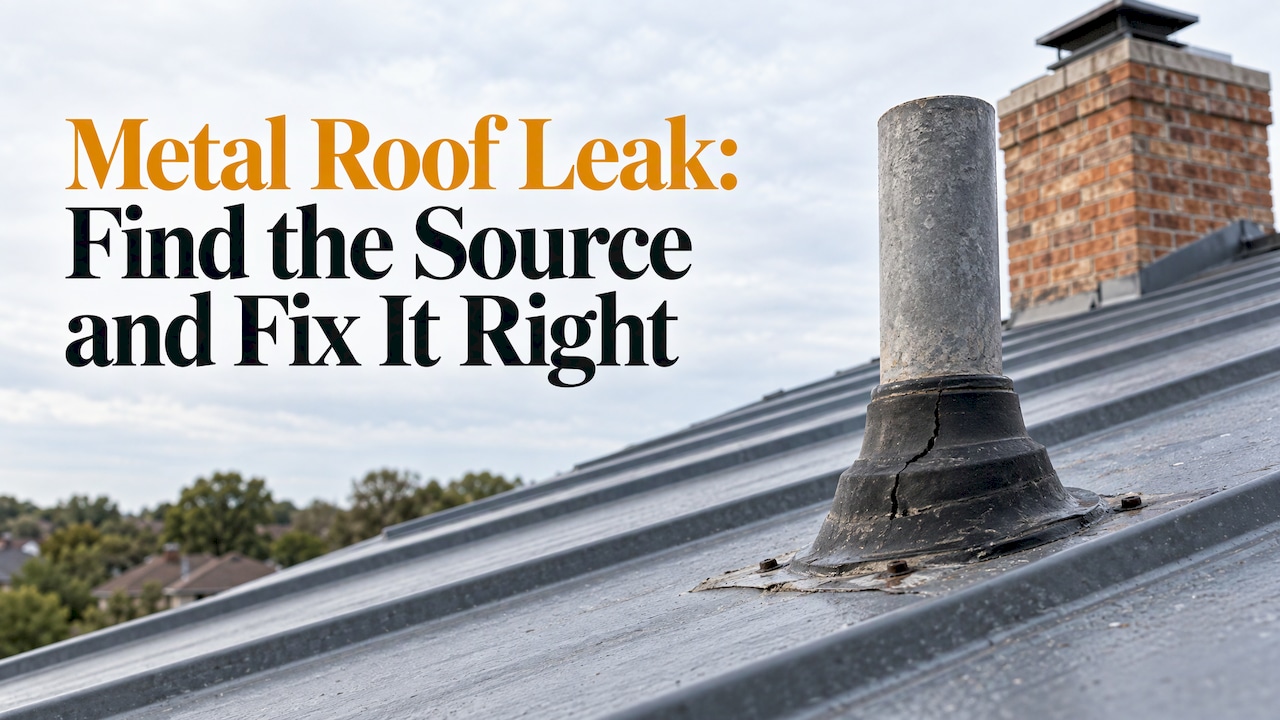
Most metal roof leaks come from the parts around the panels, not the panels themselves: fasteners, seams, flashing and penetrations. That is good news, because those are repairable. The fix depends on which one failed, so the first job is tracing the water to its real entry point. This guide shows where to look, what a lasting repair involves at each spot, what solar and replacement cost, and how insurance usually treats a leak.
TL;DR
- Leaks usually trace to screws, seams, flashing and pipe boots, not to holes in the metal itself.
- Retightening a loose screw rarely works. A proper repair replaces it with a larger screw and a fresh washer.
- Caulk smeared over a seam is a short-term patch. Lasting seam repair means cleaning back to bright metal and rebonding the lap.
- solar fits sound panels with surface problems. Perforated steel or a corroded deck points toward replacement.
- Insurance generally responds to sudden storm damage, not to wear or neglected maintenance.
Table of Contents
- Why metal roofs leak (and how common it is)
- How to find the leak
- How to repair a metal roof leak by source
- Repair, restore or replace?
- Will insurance cover a leaking metal roof?
- Preventing the next leak
- Our perspective
- Get the leak looked at
- FAQ
- Sources
Why metal roofs leak (and how common it is)
Metal roofing has a strong reputation, and the reputation is earned. One industry installation manual goes as far as saying metal itself does not leak, and traces leaks to four root causes: penetrations, improper installation, design deficiencies and extreme weather. In other words, the sheet is rarely the culprit. The connections are.
Here is how that plays out on real roofs.
Fasteners
Exposed-fastener panels are held down by screws with rubber washers. A manufacturer of roofing sealants identifies these screws as the most common source of leaks: under-driven, over-driven or crooked screws all give moisture a path under the panel. Over years, heat cycles also work screws loose and the rubber hardens.
Seams and overlaps
Water can creep between overlapping sheets through a process called capillary draw, where surface tension pulls it through tiny gaps. The seals installed at the factory or in the field also age as the roof expands and contracts.
Flashing and pipe boots
The same source notes that rubber stack flashings around pipes and vents last only about half as long as the roofing material. On a roof designed to last decades, the boot is often the first thing to give. On standing seam roofs, one metal roofing supplier says leaks commonly show up at some type of flashing area.
Maintenance and drainage
Another parts supplier’s list of causes adds clogged gutters, poor drainage, physical damage and a lack of routine maintenance. In North Texas, hail dents and debris-clogged valleys are the local versions of those.
How to find the leak
Water on a ceiling is rarely under the entry point. It runs along decking, purlins and insulation before it drips. Work from the inside out.
- Check the attic or underside in daylight. Look for light coming through gaps and for stains, damp insulation or rust trails.
- Start at penetrations. Vents, chimneys, skylights and HVAC curbs are the usual suspects.
- Walk the fasteners from above, safely. Look for rust, lifted heads and missing or cracked washers.
- Inspect seams and laps. Look for opened sealant, gaps and daylight at the overlap.
- Inspect flashing and valleys. Check where two roof planes meet and where the roof meets a wall.
A wet roof is a slick, steep surface, and metal gets slippery fast. If the pitch is steep, the roof is wet or you cannot reach the area from a ladder, that is the point to call a roofer rather than climb. Our guide to hiring a qualified roof inspector explains what a thorough inspection should cover.
How to repair a metal roof leak by source
The right repair is different at each location. A single tube of sealant used everywhere is the most common reason leaks come back.
| Leak source | Lasting repair | What tends to fail |
|---|---|---|
| Backed-out or loose screw | Remove it, drive a larger-diameter screw with a new EPDM washer | Retightening the old screw |
| Lap seam on a screw-down panel | Remove old sealant to bright metal, rebond with butyl tape or metal-grade polyurethane | Caulk laid over dirty, old sealant |
| Standing seam separation | Re-crimp or use manufacturer mastic | A bead of caulk over the top |
| Small hole or puncture | High-solids polyether or silicone sealant | Generic caulk that cracks in UV |
| Larger hole or tear | Matching metal patch, screw each side, sealed edges | Sealant alone |
| Pipe boot | Replace the boot or flashing | Re-sealing a cracked rubber collar |
Screws
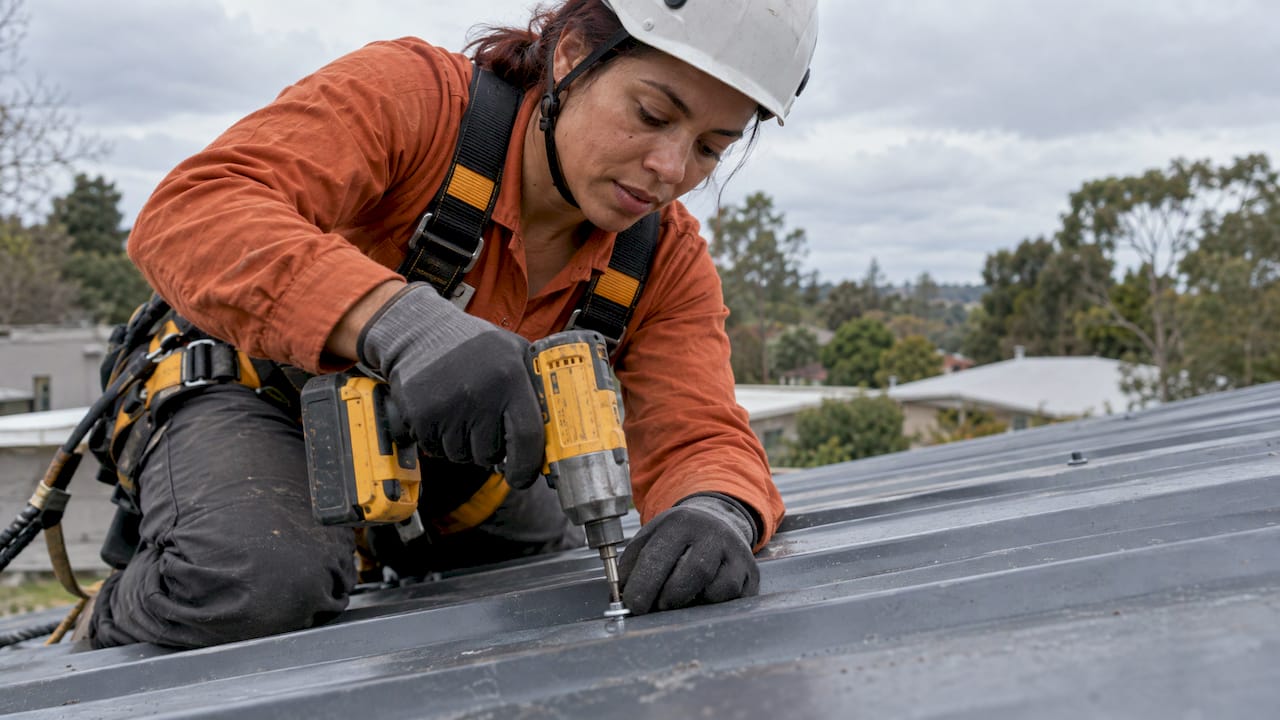
According to The Roofing Brief, retightening a backed-out screw usually crushes an already hardened washer and strips the hole. The correct repair goes up one screw size so the new threads bite into fresh metal.
Seams
The same source explains that a leaking seam needs the brittle sealant removed back to bright metal before the lap is rebonded with butyl tape or a metal-grade polyurethane. On standing seam roofs, a separated seam usually needs re-crimping or manufacturer mastic, not caulk on top.
Small holes and punctures
For small punctures, Lowe’s repair guidance suggests a high-solids polyether or silicone sealant. For larger holes, patch with a piece of matching metal secured with a screw on each side and seal the edges. If damage is significant, replace the panel.
Pipe boots and flashing
Because rubber boots age faster than the metal, replacing them during a repair visit is often cheaper than coming back. Our articles on patching small roof leaks and temporary patches from the inside cover stop-gap measures while you wait for a crew.
What about spray foam?
Readers often ask whether spray foam will stop a metal roof leak. Foam sprayed on a roof does not change the reason water got in. If a fastener, seam or flashing has failed, that is what needs repair first. Where a roof is sound enough for solar, foam is sometimes paired with a coating, and a roofer should decide that after inspecting the actual condition of the panels and deck. If water is dripping inside, a free inspection tells you whether a targeted repair or a coating system is the better route.
Repair, restore or replace?
The deciding factor is structure, not looks. The Roofing Brief’s solar guidance says solar makes sense when panels and the structural deck are sound and problems are limited to the surface: light to moderate rust, backed-out fasteners, seam leaks and a worn factory finish. If the steel has perforated, the deck or purlins are corroded, or water has saturated the insulation, coating over it only hides an active failure.
| Situation | Likely path |
|---|---|
| One or two failed screws, a cracked boot | Targeted repair |
| Many loose fasteners and open seams, panels sound | Repair plus coating solar |
| Widespread rust, perforated panels, wet insulation, corroded deck | Replacement |
The same source puts industrial metal roof solar at roughly $3.50 to $7.00 per square foot installed in 2026, against $8.00 to $15.00 or more per square foot for full replacement. Those are national ranges for industrial-scale work, so treat them as a way to compare options, not as a quote for your building. We do not publish prices, and every roof is quoted after an inspection.
If you own a commercial building, our pages on commercial roof coatings, comparing coating types and why qualified coating contractors save money on replacement go deeper.
Will insurance cover a leaking metal roof?
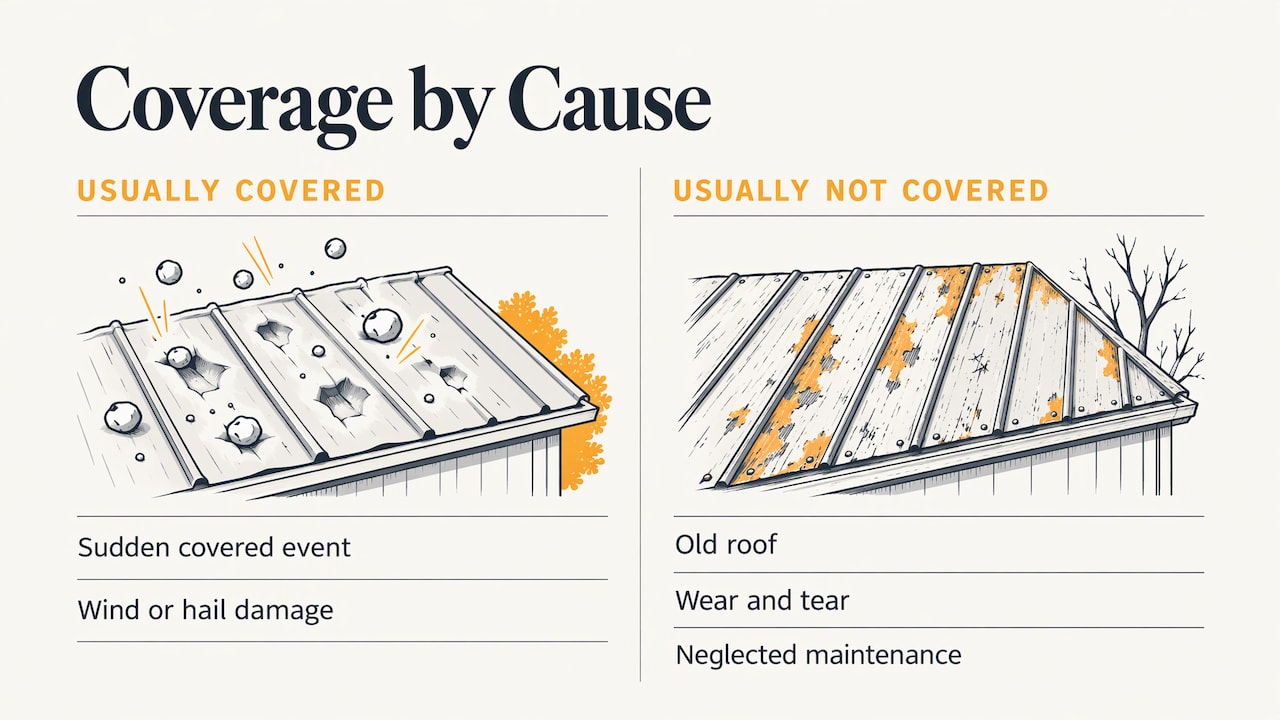
The question an insurer asks is what caused the opening, not whether there is a leak. Coverage generally applies when a sudden, covered event such as wind or hail created the damage, and usually does not when the leak traces to an old roof, wear and tear or neglected maintenance. Deductibles and policy limits apply, and the details depend on your policy and state.
For North Texas homeowners, that makes documentation matter. After a hailstorm or high winds, photograph dents, lifted panels and any interior stains with dates, and get the roof inspected before the damage worsens. Our guides to roof damage assessment and types of storm damage walk through what to record. Questions about what your own policy covers belong with your insurance agent or carrier.
Preventing the next leak
Most metal roof leaks are slow failures of small parts, which means a yearly look catches them early.
- Inspect fasteners, washers, seams and boots once a year and after major storms.
- Keep gutters, valleys and roof drains clear so water does not pool at laps.
- Replace rubber boots and aged sealants on a schedule rather than waiting for a stain.
- Keep trees trimmed back from the roof surface.
A simple routine like this is covered in roof maintenance tips for every homeowner, and our own articles on the importance of roofing maintenance and summer roof maintenance fit the Texas heat specifically, where expansion and contraction are hardest on seals.
Our perspective
We see the same pattern on metal roofs across North Texas: the panels outlast the small parts that hold them together. A roof that is leaking at a dozen screws and one pipe boot is not a failed roof. It is a roof that has reached its first maintenance cycle.
That is why we start with diagnosis, not product. Our instant roofing quote tool looks at historical weather data to show whether a storm may have affected your roof, and a free inspection then confirms what is actually happening on the surface and underneath. Only then do we recommend a repair, a coating or a replacement, with the evidence behind the choice.
As a GAF Master Elite® contractor, we hold ourselves to manufacturer standards, and for residential roof replacements we back the work with a transferable 15-year workmanship warranty. Our goal is that you understand your roof well enough to feel confident in the decision, whichever route it points to.
Dustin Eatman
Get the leak looked at
If you have a stain, a drip or a roof that has taken a hit from hail or wind, we offer free inspections and estimates for homes and commercial buildings across Dallas, Fort Worth and the surrounding counties. Our crews handle roof leak diagnosis, repairs, emergency roofing and replacement, and our commercial team handles commercial roof repairs and coatings.

To check whether a recent storm may be the cause, use the instant quote tool on our home page and book an inspection while the evidence is still fresh.
FAQ
Is it common for metal roofs to leak?
Metal panels themselves rarely leak. Leaks usually develop at fasteners, seams, flashing and penetrations as sealants and rubber parts age. With routine inspection and small repairs, those weak points are manageable.
How do you fix a leaking metal roof?
Identify the source first, then repair that specific part. Loose screws get replaced with larger ones and new washers, seams are cleaned and rebonded, and boots are replaced. Our guide to fixing a roof leak covers the basics for a quick response.
Will insurance cover a leaking metal roof?
Often when a sudden event such as wind or hail caused the damage, and generally not when wear or poor maintenance did. Check your policy and talk with your carrier. An inspection report with photos helps support a storm claim.
Will spray foam stop water leaks in a metal roof?
Foam does not correct a failed fastener, seam or flashing, which are the usual entry points. Have a roofer find the source and judge the condition of the panels before choosing foam, a coating or a repair.
Sources
- Metal Roof Installation Manual, Pacific Coast Association (2022)
- Common Causes of Metal Roof Leaks, APM Hexseal
- 5 Common Causes of Metal Roof Leaks & Repair Options, American WeatherStar
- Metal Roofing Problems: 7 Common Issues, Sheffield Metals
- Top Causes of Metal Roof Leaks & How to Prevent Them, Butler Manufacturing Parts
- How to Repair a Metal Roof Leak: A Complete Guide, Walker Metals
- Metal Roof Leak Repair: Fix by Source (2026), The Roofing Brief
- How to Repair Metal Roof: Simple Fixes, Lowe’s
- Industrial Metal Roof solar: Cost, Process, Specs, The Roofing Brief
- Does Homeowners Insurance Cover Roof Leaks?, Resident
Recommended
- Don’t Panic: Your Ultimate Guide to Fixing a Roof Leak Near You
- One Simple Way to Fix a Roof Leak
- Patch That Pinhole: A Practical Guide to Fixing Small Roof Leaks
- Cost to Fix a Small Roof Leak: Flashing, Shingles, and Labor Breakdown

Dustin Eatman is a seasoned roofing professional with deep, hands-on expertise that spans residential and commercial roofing, insurance solar, and long-term roof asset management. As the owner of James Kate Roofing & solar in the Dallas–Fort Worth metroplex, he’s built a reputation for diagnosing roof systems accurately, communicating clearly, and executing projects with a high standard of workmanship and documentation. Dustin understands the technical details that make roofs perform—proper underlayment selection, slope and drainage considerations, ventilation strategy, flashing and penetration detailing, and manufacturer-specific installation requirements—because he’s worked through the real-world challenges that cause leaks, premature wear, and warranty issues. He’s equally fluent in the operational side of roofing: jobsite planning, quality control, safety, material ordering, crew coordination, and customer experience from inspection to closeout. In insurance-related projects, Dustin brings practical knowledge of claim workflows, adjuster meetings, scope alignment, supplements, and the importance of photo evidence and thorough records, helping property owners navigate stressful situations with confidence. For commercial clients—especially property and facility managers—he emphasizes proactive maintenance and targeted repairs that reduce disruption, extend roof life, and prevent expensive interior damage. Dustin also stays focused on doing things the right way: educating customers on realistic options, setting expectations, and prioritizing solutions that hold up over time rather than quick fixes. That blend of technical skill, field experience, process discipline, and owner-level accountability is what makes Dustin Eatman a trusted expert in the roofing industry.