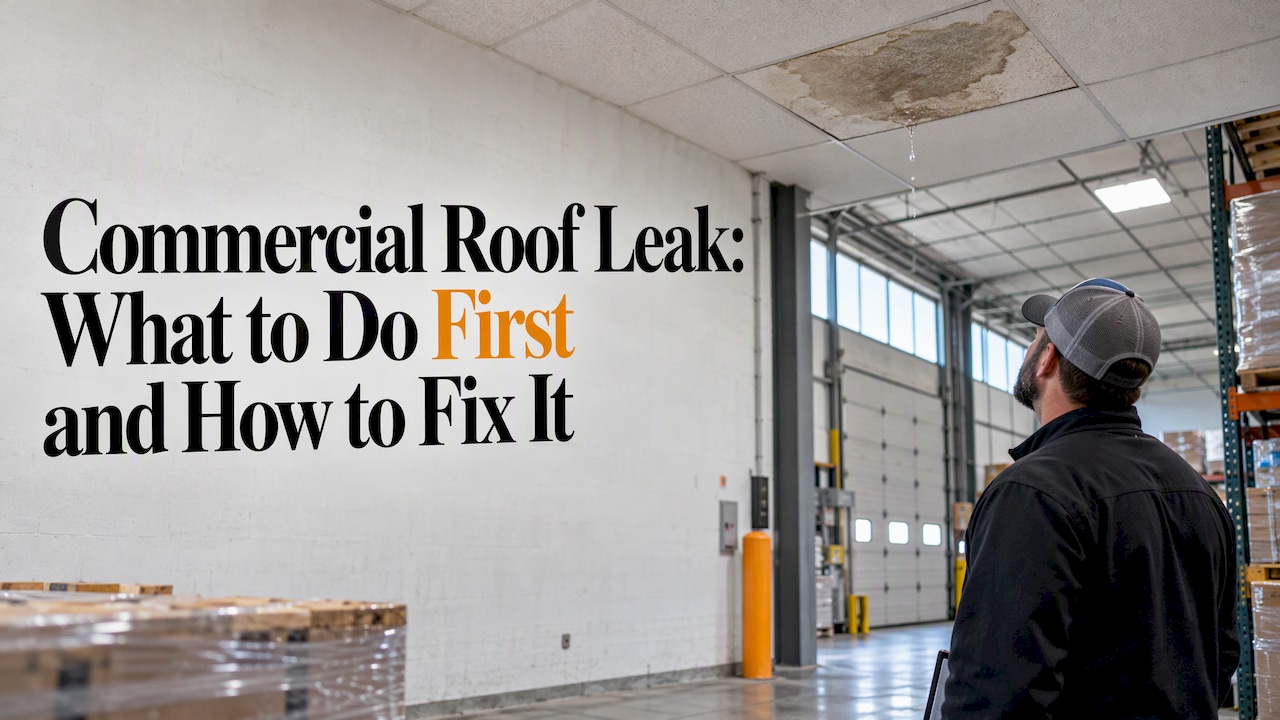
A leaking commercial roof needs three things in the first day: stop the water from spreading inside, document everything, and get a roofer on the roof to find the real source. The drip you see on the ceiling is rarely directly under the hole. Water travels along decking, insulation and seams before it shows up. Below is the order we recommend for property managers and building owners in the Dallas-Fort Worth area, what usually causes leaks, how professionals trace them, and how to keep them from coming back.
TL;DR
- Protect people, inventory and equipment first, then photograph the damage and notify your insurer promptly.
- The visible stain is seldom the entry point. Leaks are traced with moisture scans, water testing and a close look at flashings, seams and penetrations.
- Most leaks start at details (flashing, drains, penetrations, seams) rather than in the middle of a healthy membrane.
- Patching works when the roof is otherwise sound. Repeated leaks on an aging roof point toward coating or replacement.
- Inspect in spring and fall, and after every major North Texas hail or wind event.
Table of Contents
- What to do in the first hour
- Why commercial roof leaks are hard to trace
- The most common causes of commercial roof leaks
- Warning signs before the ceiling drips
- How professionals find the source
- Repair, coat or replace: how to decide
- Insurance and who pays
- How long does a commercial roof last?
- Preventing the next leak
- Perspective
- Get your roof checked before the next storm
- FAQ
- Sources
What to do in the first hour
When water is coming through a ceiling, you are managing a building, not fixing a roof yet. Work through these steps in order.
- Keep people safe. Cordon off wet floors and keep staff away from sagging ceiling tiles. If water is near light fixtures, electrical panels or outlets, have the power shut off to that area and call a licensed electrician.
- Contain the water. Move inventory, files and equipment. Place buckets or trash bins under drips, and use a wet vacuum on standing water. Puncturing a bulging ceiling tile in a controlled way can release trapped water into a bucket instead of letting it burst across the room.
- Document before you clean. Take wide and close photos and video of the stain, the drips, damaged goods and the time of day. Note the weather. Photograph the exterior too if you can do so safely from the ground.
- Call your insurer. Most commercial policies expect prompt notice of a loss, and late notice can put a claim at risk. Have your policy number and a short description of what happened ready when you call.
- Call a commercial roofer for an emergency visit. Do not send staff onto the roof. Flat roofs hide hazards like soft decking, open edges and skylights, and a fall is a far bigger problem than a leak.
- Ask for temporary protection. A qualified crew can often tarp or seal the suspect area the same day so the building is not exposed to the next storm.
If you need help right now, our emergency commercial roofing team covers the DFW area. For the building-side cleanup and business continuity, our guide to commercial water damage recovery walks through drying, documentation and getting operations moving again.
Why commercial roof leaks are hard to trace
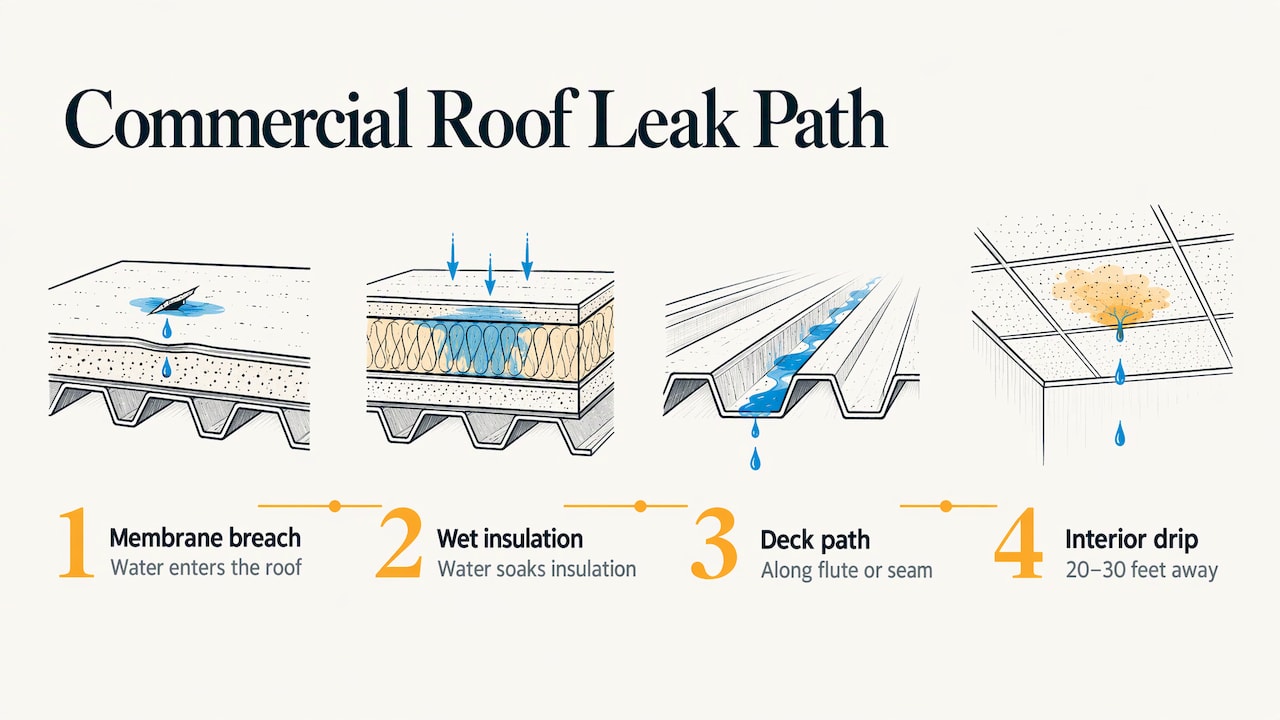
On a pitched house roof, water usually runs down and drips close to where it entered. A commercial low-slope roof is a layered system: membrane, insulation, sometimes cover board, then a deck. Water that gets through the membrane can soak into insulation, run along a steel deck flute or a seam, and drop into the building twenty or thirty feet from the opening.
That is why guessing and spot-sealing the area above the stain so often fails. A repair done in the wrong place gives you a false sense of safety until the next rain. It also means the insulation can stay wet, which keeps degrading the roof assembly long after the ceiling dries out.
The most common causes of commercial roof leaks
Roofers see the same handful of problems again and again. Knowing them helps you ask better questions when a contractor gives you a diagnosis.
Flashing failures
Flashing is the metal or membrane material at every edge, wall, curb and transition. It takes movement from heat, cold and wind, and it is where sealant dries out, fasteners back out and seams open. On many commercial roofs, details are the first place water gets in. Parapet walls add a masonry factor: failed coping, cracked mortar and loose counterflashing let water behind the wall. This practical guide on parapet repairs that last covers coping, flashing and mortar and is worth reading if your building has parapets.
Penetrations
Vents, pipes, HVAC curbs, conduit, skylights and satellite mounts each puncture the membrane. Every one is a seal that has to stay watertight for decades. Each time a trade adds or moves a unit on the roof, the risk goes up, especially when the work is done without a roofer’s involvement.
Membrane damage and open seams
TPO, PVC, modified bitumen and built-up systems all fail in different ways: heat-welded seams that separate, blisters and splits in built-up and modified bitumen, punctures from dropped tools, and surface erosion from sun and temperature swings. Hail is a particular concern in North Texas. A hail event can bruise or fracture a membrane without leaving a visible hole, and the leak may appear weeks later.
Ponding water and poor drainage
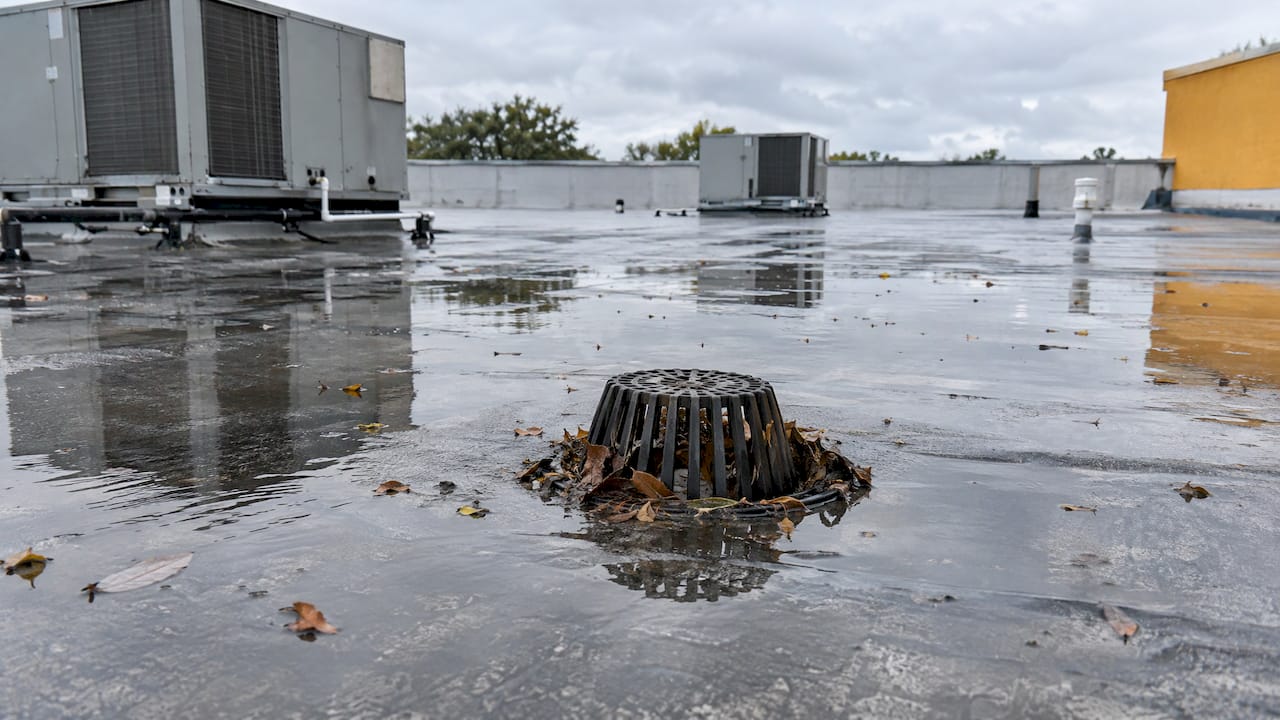
Standing water is both a cause and a symptom. The National Roofing Contractors Association (NRCA) guidance says roof water should drain or evaporate within 48 hours after rain when conditions favor drying, and that ponding beyond that can harm the roof assembly (NRCA roof slope and drainage guidance). Clogged drains, blocked scuppers and low spots from deck deflection are the usual reasons. If water is still standing two days after a storm, call for an inspection even if nothing is dripping inside yet.
Age and deferred maintenance
Every membrane has a service life, and it depends on the system, the installation quality, drainage and how well it has been maintained. When a roof is near the end of that life, leaks tend to multiply: you fix one and another appears. At that point repair costs add up, and a conversation about coating or replacement makes more sense than a seventh patch.
Foot traffic and rooftop work
Service technicians, window cleaners and contractors walking on the membrane cause more damage than most owners expect. Walkway pads to HVAC units and a rule that nobody goes on the roof without logging it are cheap protection. NRCA guidance also notes that controlling roof access, along with periodic inspection and appropriate maintenance and repair, helps optimize a roof’s service life (NRCA guidance on causes of roof problems).
Warning signs before the ceiling drips
A roof usually tells you something before it leaks into the building. Watch for:
- Brown or yellow stains on ceiling tiles or drywall, especially after rain
- Musty smell, peeling paint or bubbling wall finishes near exterior walls
- Water standing on the roof for more than 48 hours
- Blisters, wrinkles, cracks or open seams in the membrane
- Loose, lifted or missing flashing and sealant that has cracked or pulled away
- Granule loss or exposed fabric on built-up and modified bitumen surfaces
- Higher energy bills from wet, underperforming insulation
- Rust on rooftop equipment, curbs or the underside of a metal deck
If you see any of these after a storm, pair the roof visit with a damage assessment. Our roof damage assessment guide explains how to check, document and decide, and the severity checklist helps you rank what needs attention first.
How professionals find the source
A good leak investigation is methodical, and it generally combines several methods. Professional roofing literature describes visual inspection, infrared imaging, moisture meters, controlled water testing and, in some cases, test cuts (Professional Roofing on diagnosing persistent leaks). Here is how that plays out on a typical call.
| Method | What it tells the roofer | Best for |
|---|---|---|
| Visual inspection | Obvious damage at flashings, seams, drains and penetrations | First pass on every call |
| Interior review | Where stains, wet insulation or rusted deck sit relative to roof features | Narrowing the search area |
| Infrared imaging | Temperature patterns that can point to trapped moisture | Large roofs and wet insulation |
| Moisture meter | Confirms whether insulation or deck is actually wet | Verifying suspect areas |
| Controlled water testing | Reproduces the leak by wetting one zone at a time | Persistent leaks with no obvious cause |
| Test cut | Direct look at the layers under the membrane | Confirming wet insulation before repair |
Expect a contractor to ask when the leak appears: only in wind-driven rain, only after heavy rain, or even in light drizzle. Those details narrow the suspects. Wind-driven rain points to flashings and edges. A leak that follows long soaking rain often points to drains, ponding or membrane seams.
Repair, coat or replace: how to decide
Not every leak calls for the same answer. A reasonable approach looks at four things: the roof’s age and system type, how much of the insulation is wet, how many repairs the roof has already had, and the building’s plans for the next ten years.
When a repair is enough
A localized failure on an otherwise healthy roof, such as a split seam, a bad pipe boot or a failed flashing, is a repair job. Done right, it means cutting out damaged material, drying or replacing wet insulation, and installing compatible patches or flashing details. Our commercial roof repair services are built around this kind of targeted fix.
When a coating makes sense
If the membrane is sound but weathered, a solar coating can add protection and extend service life without a tear-off, provided the insulation underneath is dry. Coating choice depends on the substrate and the leak history, so it helps to compare options before deciding. See our overview of commercial roof coating types.
When replacement is the better investment
Replacement becomes the smarter move when wet insulation is widespread, repairs are frequent, the membrane is brittle or the roof is past its expected life. Spending money repeatedly on patches while interior damage continues is usually costlier than a planned reroof. Our guide to replacing a commercial flat roof explains the process, and our commercial roof replacement and installation page covers the systems we install, including TPO, PVC, modified bitumen and built-up roofing.
Insurance and who pays
Does commercial property insurance cover a roof leak?
It depends on the policy and on the cause. Property policies often respond to sudden damage from a covered event such as hail or wind, but they commonly exclude damage from wear, neglected maintenance or long-term seepage. That distinction is why documentation and a written roof report matter. A dated inspection report that ties the leak to a storm can support your claim. Read your policy for notice deadlines, deductibles (some Texas policies carry separate wind and hail deductibles) and any roof age conditions, and talk to your agent before the work starts.
Keep every damaged item, photo and invoice. Ask your roofer to record the cause, the location and the repair in writing.
Are landlords responsible for roof leaks?
Usually the lease decides. In many commercial leases the landlord handles the roof and structure, while in triple-net leases the tenant may pay a share of roof repairs or maintenance through operating expenses. Tenants should give written notice of a leak quickly, take photos and protect their own inventory. Landlords should respond promptly, because slow action can enlarge the damage and the dispute. For anything with real money at stake, have a Texas attorney read the lease language.
How long does a commercial roof last?
There is no single number. Service life depends on the membrane type, installation quality, drainage, exposure and maintenance. Single-ply systems like TPO and PVC, modified bitumen and built-up roofing are all commonly planned around two to three decades under good conditions, but a neglected roof can fail far earlier and a well-maintained one can outlast the estimate. Ask for a condition report with moisture mapping rather than relying on age alone.
Preventing the next leak
Most recurring leaks are preventable. A simple program does the following:
- Inspect twice a year. Spring and fall inspections are recommended by NRCA to catch problems early (NRCA guidance). Add an inspection after every hail or high-wind event.
- Keep drains clear. Clean drains, scuppers and gutters, especially after fall leaf drop and before spring storms.
- Control access. Keep a roof log, install walkway pads and require trades to report any penetrations they make.
- Fix small things quickly. Re-seal a lifted flashing or seam before it becomes an interior leak.
- Schedule and track the work. A recurring calendar with assigned owners keeps inspections from slipping. This walkthrough on preventive maintenance scheduling shows how field teams set that up.
- Protect the membrane. Cover boards and protected equipment areas reduce damage from dropped tools and rooftop service work.
We built a commercial roof inspection service around exactly this routine.
Perspective
Most of the commercial leaks we are called to were not sudden. The roof gave warnings: ponding after rain, a lifted flashing, a seam that had started to open. By the time water reaches a ceiling, the insulation is often already wet.
Our view is that a leak call should end with an explanation, not just a patch. We start with a thorough inspection and aim to give you data-driven recommendations tailored to your building, whether that is a targeted repair, a coating or a replacement. Our storm-damage assessments draw on historical weather data to help show whether a hail or wind event likely affected your roof, which matters for both repair planning and insurance conversations.
As a GAF Master Elite® contractor, we hold ourselves to manufacturer standards on workmanship, and we keep communication plain so property managers can report upward with confidence. Inspections and estimates from us are free.
Dustin Eatman
Get your roof checked before the next storm
If you manage a commercial property in Tarrant, Dallas, Collin, Denton or the surrounding counties, we can inspect the roof, find where the water is getting in and lay out your options in plain terms. We offer commercial roof inspections with a free estimate, repairs, coatings and full replacement for TPO, PVC, modified bitumen and built-up systems.

Have an active leak? Start with our commercial roofing services page, or use the emergency commercial roofing page to reach us quickly.
FAQ
Can I fix a commercial roof leak myself?
A bucket, a tarp from the ground and photographs are reasonable stopgaps. Climbing onto the roof is risky because of soft decking, open edges and slick membranes, and a wrong patch can trap moisture. We recommend having a commercial roofer handle the repair so the source is actually found.
How fast should a leaking commercial roof be repaired?
As soon as possible. Temporary protection can often be placed quickly, and a permanent repair follows once the source is confirmed and the area is dry enough to work on. Delay lets water soak insulation and damage interior finishes, which usually raises the final cost.
What is the most common cause of commercial roof leaks?
Failures at roof details are the usual suspects: flashings, penetrations, drains and seams. Large open areas of a healthy membrane leak far less often. That is why a thorough inspection looks at every edge, curb and pipe rather than only the area above the stain.
Should I replace or repair a leaking commercial roof?
Repair fits a localized problem on a roof with life left. Replacement fits widespread wet insulation, frequent repairs or a roof near the end of its service life. A moisture survey and a written condition report make the choice clear.
Sources
- NRCA roof slope and drainage guidance
- NRCA guidance on causes of roof problems
- Professional Roofing on diagnosing persistent leaks
Recommended
- Smart Ways to Temporarily Patch a Roof Hole From the Inside
- Patch That Pinhole: A Practical Guide to Fixing Small Roof Leaks
- Cost to Fix a Small Roof Leak: Flashing, Shingles, and Labor Breakdown
- Roof Repair DFW: 5 Warning Signs Your Roof Needs Repair
Created with BabyLoveGrowth to attract more visitors

Dustin Eatman is a seasoned roofing professional with deep, hands-on expertise that spans residential and commercial roofing, insurance solar, and long-term roof asset management. As the owner of James Kate Roofing & solar in the Dallas–Fort Worth metroplex, he’s built a reputation for diagnosing roof systems accurately, communicating clearly, and executing projects with a high standard of workmanship and documentation. Dustin understands the technical details that make roofs perform—proper underlayment selection, slope and drainage considerations, ventilation strategy, flashing and penetration detailing, and manufacturer-specific installation requirements—because he’s worked through the real-world challenges that cause leaks, premature wear, and warranty issues. He’s equally fluent in the operational side of roofing: jobsite planning, quality control, safety, material ordering, crew coordination, and customer experience from inspection to closeout. In insurance-related projects, Dustin brings practical knowledge of claim workflows, adjuster meetings, scope alignment, supplements, and the importance of photo evidence and thorough records, helping property owners navigate stressful situations with confidence. For commercial clients—especially property and facility managers—he emphasizes proactive maintenance and targeted repairs that reduce disruption, extend roof life, and prevent expensive interior damage. Dustin also stays focused on doing things the right way: educating customers on realistic options, setting expectations, and prioritizing solutions that hold up over time rather than quick fixes. That blend of technical skill, field experience, process discipline, and owner-level accountability is what makes Dustin Eatman a trusted expert in the roofing industry.