Composition Shingles vs 3-Tab: What Homeowners Need to Know
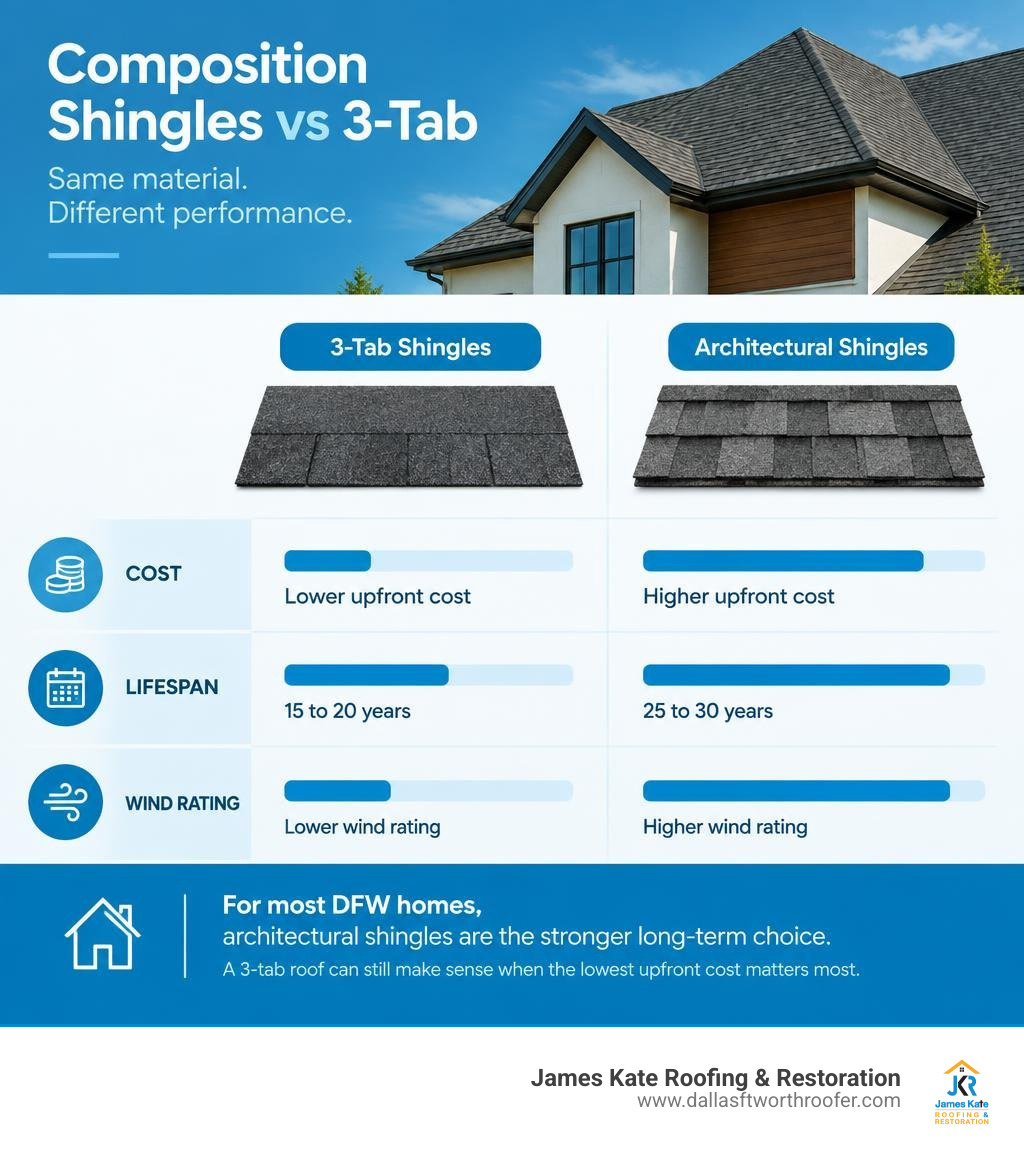
3-tab shingles are composition shingles. Both are asphalt roofing. The useful comparison is between flat, single-layer 3-tab shingles and thicker, laminated architectural composition shingles. Architectural shingles usually cost more upfront, but they typically last 25 to 30 years rather than 15 to 20 and offer higher wind ratings. For most DFW homes, they are the stronger long-term choice. A 3-tab roof can still make sense when the lowest upfront cost matters most.
I’m Dustin Eatman, owner of James Kate Roofing & solar. My hands-on work with residential roofs and storm repairs has taught me to look beyond the label when comparing composition shingles vs 3-tab roofs: the product, installation, and warranty all matter.
Key terms for composition shingles vs 3-tab:
For broader context on how asphalt roofing materials are classified, the Asphalt shingle entry provides a useful industry overview.
Composition Shingles vs 3-Tab: Key Differences in Modern Roofing
When evaluating your roofing choices, the jargon can feel overwhelming. Many homeowners ask us about the difference between “composition” and “3-tab” as if they are entirely separate materials. In reality, both belong to the asphalt shingle family. Understanding how modern laminated products differ from older strip shingles makes all the difference for your home’s long-term protection.

| Feature | Single-Layer 3-Tab Shingles | Dimensional Architectural Shingles |
|---|---|---|
| Layer Construction | Single flat layer with cutouts | Multi-layered, laminated fiberglass base |
| Weight per Square | 175 – 225 lbs | 240 – 340+ lbs (30–50% heavier) |
| Aesthetic Profile | Flat, uniform brick-like pattern | Textured, dimensional wood-shake look |
| Current Market Share | Under 20% of residential roofs | Over 80% of residential installations |
| Standard Wind Rating | 60 – 70 mph | 110 – 130 mph |
| Average Real-World Life | 15 – 20 years | 25 – 30+ years |
Modern residential roofing has shifted dramatically over the past two decades. Architectural laminated shingles now represent over 80% of all asphalt roofing installed across the country. Homeowners gravitate toward the dimensional product because its multi-layer structure handles severe weather much better while elevating exterior aesthetics.
Decoding the Terminology: Composition Shingles vs 3-Tab
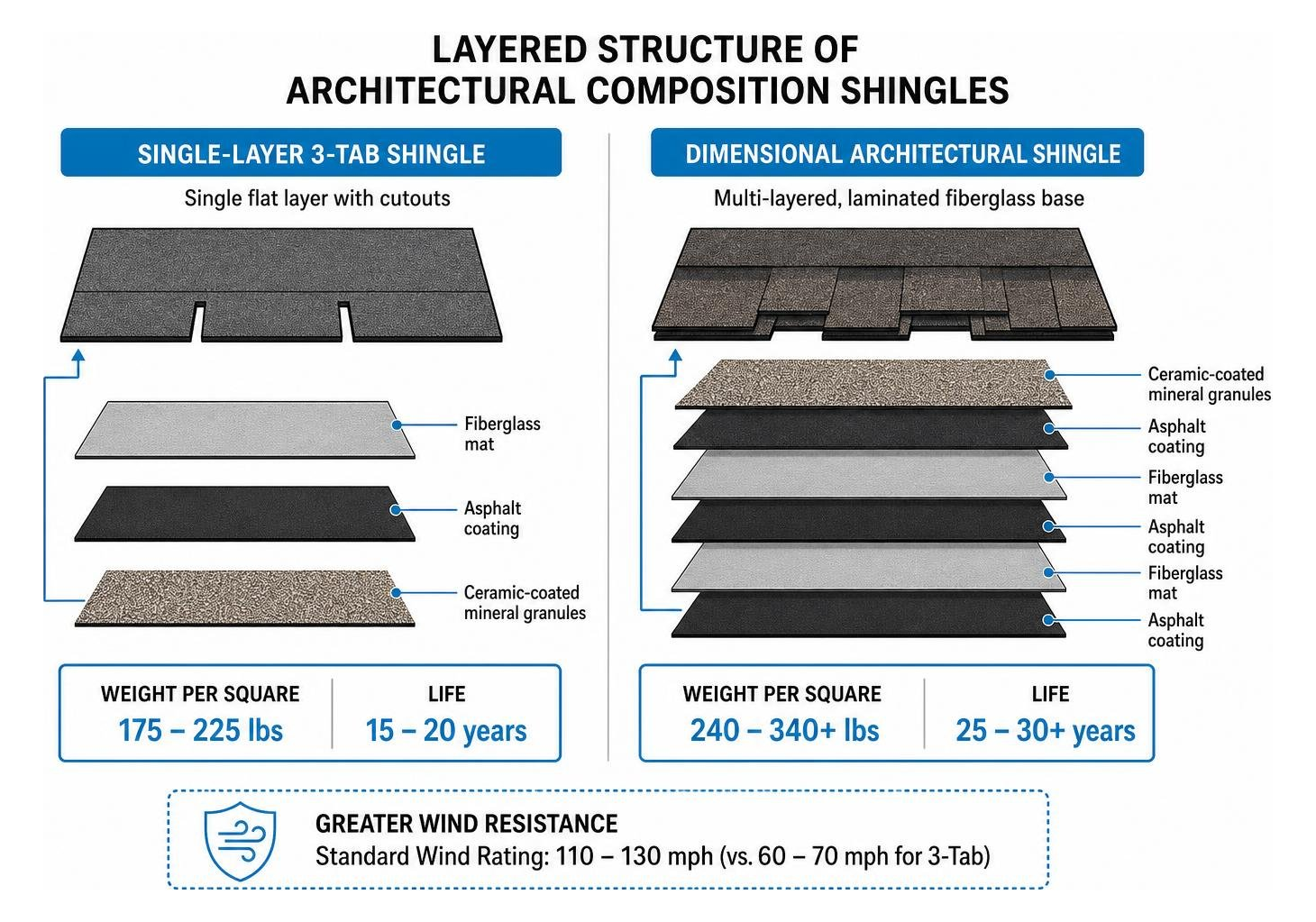
The term “composition” dates back over a century to when manufacturers engineered asphalt shingles by combining multiple elements—a base mat, refined asphalt coatings, and protective ceramic-coated mineral granules—to replace natural wood shakes and slate. Therefore, both strip shingles and multi-layer dimensional shingles are technically composition shingles.
When contractors talk about traditional 3-tab composition shingles, they refer to basic, single-layer roofing strips featuring three distinct tabs created by notches. Conversely, architectural or laminate shingles bond two or more asphalt-coated fiberglass layers together to form a rugged, textured roofing unit. For a deeper breakdown of material choices, explore our comprehensive guide to composition roofing materials.
Structural Thickness, Weight, and Visual Profile
Thickness and weight directly dictate how an asphalt roof handles physical wear and severe weather. The fundamental difference lies in manufacturing:
- Single-Layer Strips: 3-tab shingles consist of a single fiberglass mat coated in asphalt. They weigh between 175 and 225 pounds per roofing square (100 square feet).
- Laminated Multi-Layers: Architectural shingles bond multiple layers together, pushing their weight to 240 to 340 pounds per square—making them 30% to 50% heavier than 3-tab alternatives.
This extra material prevents the shingles from lifting during high winds and creates deep shadow lines across the roof plane. To see how these physical profiles differ across specific product lines, check out the various types of composition shingles available for residential properties.
A standard 3-tab shingle lays flat in a repetitive, brick-like grid. Architectural options deliver random tab patterns that closely simulate the natural texture of cedar shakes without the maintenance overhead of raw wood. To learn more about modern material developments, read our resource on the benefits of laminated composition shingles.
Performance, Wind Resistance, and Lifespan Comparison
The performance gap between single-layer and multi-layer composition shingles is most evident during severe storms. The added weight, reinforced nail tracks, and specialized sealants of architectural products provide significantly greater structural defense against wind and hail.
| Performance Metric | Standard 3-Tab Shingles | Architectural Composition Shingles |
|---|---|---|
| Wind Resistance Rating | 60 – 70 mph | 110 – 130 mph |
| Expected Lifespan | 15 – 20 years | 25 – 30+ years |
| Hail & Impact Resistance | Basic fiberglass core (standard) | Available in Class 3 and Class 4 impact ratings |
| Manufacturer Warranty | 20 to 25-year limited (prorated early) | 30-year to Lifetime limited (non-prorated initial periods) |
| Algae Resistance | Varies / Limited protection | Standard copper/zinc granule integration |
Wind Ratings and Severe Weather Durability
Wind resistance represents one of the most critical factors when comparing these materials. Standard 3-tab shingles carry a wind rating of 60 to 70 mph. In open plains or sudden storm conditions, wind can catch the exposed bottom edge of individual tabs, breaking the adhesive seal and tearing the lightweight strip clean off the deck.
In contrast, architectural shingles carry standard ratings of 110 mph, with premium product lines achieving 130 mph when installed with appropriate six-nail patterns. Because dimensional shingles are laminated without open vertical cutout slots, wind cannot easily penetrate under the tabs. For properties exposed to severe storms, choosing the best asphalt shingles for high winds and hail provides peace of mind and prevents interior storm damage. If your current roof has already suffered storm damage, review our advice on dealing with hail damaged shingles.
Expected Lifespan and Warranty Coverage
Under real-world conditions, 3-tab roofs usually reach the end of their service life in 15 to 20 years. Thermal expansion, UV radiation, and seasonal temperature swings cause single-layer shingles to curl, cup, and lose protective granules much earlier than heavier materials. Homeowners can read our complete overview regarding the expected lifespan of 3-tab shingles to see how heat accelerates asphalt breakdown.
Architectural shingles, on the other hand, reliably last 25 to 30 years or more when paired with proper attic ventilation. Because of this durability, manufacturers back architectural lines with 30-year to Lifetime limited warranties. These warranties often feature robust non-prorated coverage periods during the first 10 years, whereas 3-tab warranties quickly prorate, covering minimal material costs if a failure occurs later. Read our analysis on 25-year asphalt shingles lifespan vs warranty reality for clear facts on warranty terms.
Cost, ROI, and Aesthetic Value Breakdown
While architectural shingles require a higher initial investment, calculating the full total cost of ownership shows they are often the more economical choice over decades of homeownership.
| Financial Metric | 3-Tab Shingles | Architectural Shingles |
|---|---|---|
| Material Cost (per Square) | $90 – $120 | $120 – $160 |
| Material Cost (per Bundle) | $80 – $100 | $100 – $130 |
| Fully Installed Cost (per Sq) | $500 – $600 ($3.50 – $5.50/sq ft) | $600 – $750 ($4.50 – $7.00/sq ft) |
| Replacement Cycle (over 30 Yrs) | 2 full installations required | 1 installation required |
| Estimated 30-Year Roof Expense | $22,500 – $27,500 (2 cycles + repairs) | $10,000 – $14,500 (single cycle) |
| Impact on Home Resale Value | Neutral or slight negative | Adds 1% to 3% to perceived home value |
Upfront Material and Installation Expenses
Material prices for 3-tab shingles run between $90 and $120 per roofing square, compared to $120 to $160 per square for standard architectural lines. When factoring in professional labor, underlayment, ice and water shields, ridge caps, and disposal fees, a 3-tab installation typically costs $500 to $600 per square ($3.50 to $5.50 per square foot). Architectural shingles run $600 to $750 per square ($4.50 to $7.00 per square foot).
Understanding the true cost of asphalt shingles helps put this initial gap into perspective. On a standard 2,000-square-foot roof deck (20 squares), opting for architectural shingles generally represents an upfront difference of $2,000 to $3,000. Homeowners who want a clear breakdown of replacement expenses can review our guide on understanding asphalt roof replacement costs.
Long-Term Value: Composition Shingles vs 3-Tab
Looking at a 30-year ownership timeline reveals the true financial picture. Because 3-tab shingles last only 15 to 20 years, a homeowner relying on 3-tab will pay for two full roof replacements and multiple repair visits over 30 years. A single architectural roof installation easily spans 25 to 30 years. Over that three-decade window, choosing 3-tab shingles can cost an extra $8,000 to $13,000 in redundant labor, inflation on replacement materials, and tear-off costs.
Furthermore, architectural shingles enhance exterior aesthetics. When it comes to evaluating roof curb appeal, dimensional shingles can add 1% to 3% to a home’s resale value, while flat 3-tab roofs can cause prospective buyers to budget for an immediate roof replacement. For guidance on coordinating styles, see our guide to choosing the perfect color for your roof.
When 3-Tab Shingles Still Make Practical Sense
Despite the popularity and performance advantages of architectural shingles, 3-tab roofing remains a viable option in specific scenarios:
- Detached Garages, Sheds, and Workshops: For outbuildings or unconditioned storage sheds where aesthetic matching and high-end wind resistance are secondary, 3-tab offers an economical protective barrier.
- Short-Term Property Flips and Pre-Sale Updates: If an older home has an active leak that must be resolved to pass buyer inspection on a tight budget, 3-tab provides a brand-new roof at the lowest upfront cash outlay.
- Budget-Conscious Rental Properties: Real estate investors managing affordable rental portfolios may prioritize keeping short-term capital expenditures low.
- Severe Upfront Financial Constraints: When emergency replacements are necessary and bridging the price gap is not feasible, installing a professionally fastened 3-tab roof is far safer than living with leaks and damaged decking.
If your current roof is experiencing leaks, our technicians can evaluate whether temporary and permanent solutions for roof leaks or targeted asphalt shingle repair can keep your home secure until a full replacement fits your budget.
Frequently Asked Questions About Composition and 3-Tab Shingles
Are composition shingles the same as architectural shingles?
Yes, architectural shingles are an advanced subcategory of composition shingles. “Composition” is the broad industry umbrella term for any roofing shingle constructed from a fiberglass base mat impregnated with asphalt and coated with mineral granules. Architectural shingles (also called dimensional or laminated shingles) are multi-layered composition shingles, whereas 3-tab shingles are single-layered composition shingles.
Which shingle type offers better protection against severe storms?
Architectural shingles offer superior storm protection. Their laminated, multi-layer construction provides twice the physical thickness of 3-tab shingles, and they carry wind resistance ratings up to 130 mph compared to the 60 to 70 mph ratings typical of 3-tab products. Many architectural lines also offer Class 3 or Class 4 impact resistance, which helps prevent granule loss and mat fractures during hail events.
How does shingle choice impact home insurance coverage in 2026?
Insurance underwriters have become increasingly strict regarding roof age and material durability. Many property insurers charge higher windstorm deductibles or higher annual premiums for homes with 3-tab roofs because they are more vulnerable to wind blow-offs. Conversely, upgrading to impact-resistant architectural shingles often qualifies homeowners for premium discounts ranging from 5% to 25%, depending on the carrier and policy terms.
Conclusion
When deciding between traditional strip shingles and modern dimensional materials, architectural composition shingles deliver clear advantages in durability, weather protection, warranty terms, and curb appeal. While 3-tab shingles provide a functional, low-cost solution for budget-constrained projects or outbuildings, dimensional shingles remain the superior long-term investment for residential homes.
At James Kate Roofing & solar, we provide exceptional craftsmanship built on honesty, integrity, and Biblical principles. As a family-owned business serving Mansfield, Arlington, Granbury, Grand Prairie, and Midlothian, our work is recognized with GAF President’s Club standing and supported by up to a 25-year workmanship warranty. If you are planning a roof update, explore our composition roof replacement options and contact our team today for a comprehensive roof inspection and personalized project estimate.

Dustin Eatman is a seasoned roofing professional with deep, hands-on expertise that spans residential and commercial roofing, insurance solar, and long-term roof asset management. As the owner of James Kate Roofing & solar in the Dallas–Fort Worth metroplex, he’s built a reputation for diagnosing roof systems accurately, communicating clearly, and executing projects with a high standard of workmanship and documentation. Dustin understands the technical details that make roofs perform—proper underlayment selection, slope and drainage considerations, ventilation strategy, flashing and penetration detailing, and manufacturer-specific installation requirements—because he’s worked through the real-world challenges that cause leaks, premature wear, and warranty issues. He’s equally fluent in the operational side of roofing: jobsite planning, quality control, safety, material ordering, crew coordination, and customer experience from inspection to closeout. In insurance-related projects, Dustin brings practical knowledge of claim workflows, adjuster meetings, scope alignment, supplements, and the importance of photo evidence and thorough records, helping property owners navigate stressful situations with confidence. For commercial clients—especially property and facility managers—he emphasizes proactive maintenance and targeted repairs that reduce disruption, extend roof life, and prevent expensive interior damage. Dustin also stays focused on doing things the right way: educating customers on realistic options, setting expectations, and prioritizing solutions that hold up over time rather than quick fixes. That blend of technical skill, field experience, process discipline, and owner-level accountability is what makes Dustin Eatman a trusted expert in the roofing industry.