The right roofing contractor in Texas is one you can check before you sign: a real local address, references you can call, proof of insurance, a written contract that names the materials, and a warranty you can read. Texas storms bring out both excellent roofers and people who knock on doors the week after a hailstorm, so the choice matters more here than in most states. We are James Kate Roofing & solar, a GAF Master Elite® contractor serving North Texas, and this guide gives you the same checklist we would give a neighbor.
TL;DR
- Verify the basics before any bid: name, address, phone, references, and insurance or bond. Then collect at least three written bids, as the Texas Department of Insurance (TDI) advises after a storm.
- Texas law bars a roofer from waiving or absorbing your insurance deductible, and from acting as your public adjuster on the job they will perform.
- Sign nothing with blank spaces. The contract should name the materials, and you should keep every signed paper and warranty.
- Do not make the final payment until the work is finished and, where required, the windstorm certificate has been issued.
- Our inspections and estimates are free, and residential roof replacements carry a transferable 15-year workmanship warranty.
Table of Contents
- Why choosing a Texas roofer takes more care
- Step 1: Verify who you are dealing with
- Step 2: Understand the insurance rules before anyone talks about your claim
- Step 3: Document before you call anyone
- Step 4: Get three written bids and compare them line by line
- Step 5: Read the contract and warranty before you sign
- Step 6: Know whether a windstorm inspection applies
- Residential or commercial: what changes
- What a good first visit looks like
- Next step: a free inspection
- FAQ
- Sources
Why choosing a Texas roofer takes more care
A roof is usually the most expensive exterior repair a homeowner or property manager will approve, and it is hard to judge from the ground. Texas also gets frequent hail and wind, which means many owners shop for a roofer under pressure, with water coming in and an insurance claim open. That is exactly when mistakes happen.
The good news is that the state’s own insurance regulator publishes plain guidance on what to check. We build on that here, and we add what we would want you to ask any contractor, including us.
Step 1: Verify who you are dealing with
TDI tells Texas homeowners to confirm a contractor’s name, address, telephone number, references, and insurance or bond before hiring. In practice that looks like this:
- A physical local address. Look the business up and confirm it exists where it says it does.
- References you can call. TDI specifically warns about contractors who offer only out-of-state references. Ask for recent jobs in your county or a neighboring one, then call the owners.
- Proof of insurance. Ask for a certificate showing general liability coverage, and ask whether the company carries a bond. Some cities set their own requirements. The City of Ballinger, for example, asks roofing contractors for liability insurance and a warranty bond as part of its local process, so check your city’s rules too.
- Manufacturer credentials. Shingle manufacturers certify contractors who meet standards for installation and service. We hold GAF Master Elite® status, the GAF President’s Club Award and IKO Craftsman Premier Contractor status, and any roofer you consider should be able to tell you plainly which credentials they hold.
If you want the longer version of this checklist, our guide on how to choose a roofing contractor walks through it, and our page on choosing a Dallas County roofing contractor covers the local angle.
Red flags TDI names
TDI lists several warning signs after a storm. Be cautious of anyone who:
- solicits door to door about storm repairs;
- accepts only cash;
- has only out-of-state references;
- demands money before materials arrive;
- is unfamiliar with the Windstorm Inspections Program (all from the same TDI storm-repair guide).
We cover the scams that follow big storms in more detail in our article on avoiding a roofing contractor scam after a disaster.
Step 2: Understand the insurance rules before anyone talks about your claim
Most storm-related roofing in Texas touches an insurance claim, and this is where the law draws firm lines. According to TDI’s roofing and insurance guidance:
- A contractor may not offer to waive, rebate or absorb your property-insurance deductible.
- A contract of $1,000 or more that involves an insurance settlement must state that you, the policyholder, must pay the deductible.
- Under Insurance Code §4102.163, a contractor who performs or may perform the work cannot act as, or advertise as, a public insurance adjuster on that property.
What this means for you: a roofer who says they will cover your deductible, or who promises to recover “every dime” from your insurer, is describing something Texas does not allow. A legitimate roofer inspects the roof, documents the damage, explains what a repair or replacement involves and gives you a written estimate. The claim itself stays between you and your insurer.
Our Texas roof insurance claims guide for DFW homeowners explains how the process runs from first call to final payment.
A 2026 change worth knowing
On September 29, 2026, TDI clarified that insurers cannot decline or non-renew a home policy based solely on the age of the house or its roof. Decisions may rest on the physical condition of components such as the roof. A dated inspection report that documents your roof’s condition is a useful record to hold if your insurer ever asks.
Step 3: Document before you call anyone
Whether you manage one house or twenty buildings, record the damage before repairs begin. Houston Habitat for Humanity’s storm-repair guidance recommends photographs and notes of changes, prompt contact with your insurer, saved receipts (including temporary-living costs), and no permanent repairs until an adjuster has seen the damage. The same guidance stresses safety: check for structural problems, shut off water and electricity in affected areas, and wear sturdy shoes, gloves and eye protection.
Stay off a damaged roof. A ground-level photo set, a list of interior stains and the date of the storm are enough to start. Temporary protection, such as a tarp, is reasonable to prevent further water damage, and you should keep the receipt. Our roof damage assessment guide shows what to look for, and key signs of roof damage after a storm helps you spot what is easy to miss from the yard.
After a hail or wind event, our storm-damage assessments and hail and wind inspections are free. We also offer an instant roofing quote tool that evaluates a roof’s health using historical weather data, so you can see whether your address was affected by severe storms before anyone climbs a ladder.
Step 4: Get three written bids and compare them line by line
TDI recommends at least three written bids before you hire after a storm. A price alone tells you little. Lay the bids side by side and compare:
| What to compare | What a solid bid shows |
|---|---|
| Scope | Tear-off or overlay, decking repair, flashing, vents, drip edge, underlayment |
| Materials | Brand, product line and color named, not “standard shingles” |
| Warranty | Manufacturer terms and the contractor’s workmanship terms, in writing |
| Permits and inspections | Who pulls the permit and who arranges any required inspection |
| Payment schedule | Tied to progress, not a large deposit before materials arrive |
| Cleanup | Debris removal and magnet sweep for nails |
If one bid is far below the others, find out what it leaves out. Missing underlayment, reused flashing or an unnamed shingle line are common ways a low number gets that low. Our list of top roofing mistakes Texas homeowners make goes through the ones we see most.
Step 5: Read the contract and warranty before you sign
TDI’s contractor-scam guidance gives clear rules for the paperwork:
- Keep copies of all signed agreements and warranty terms.
- Do not sign a contract with blank spaces.
- Make sure the contract identifies the materials to be used.
- Do not sign anything that gives the contractor every dollar of your insurance proceeds, such as language agreeing to do repairs for the value of the insurance proceeds (TDI).
Two kinds of warranty
A roof usually has two layers of protection. The manufacturer covers the shingles and related products. The contractor covers the installation. Workmanship matters because most leaks trace back to how a roof was put on, not to the shingle itself. Ask for the workmanship term in years, ask what it covers, and ask whether it passes to a new owner if you sell. Our residential roof replacements come with a transferable 15-year workmanship warranty. For a deeper look at how the two differ, see roof warranty types in Texas.
Step 6: Know whether a windstorm inspection applies
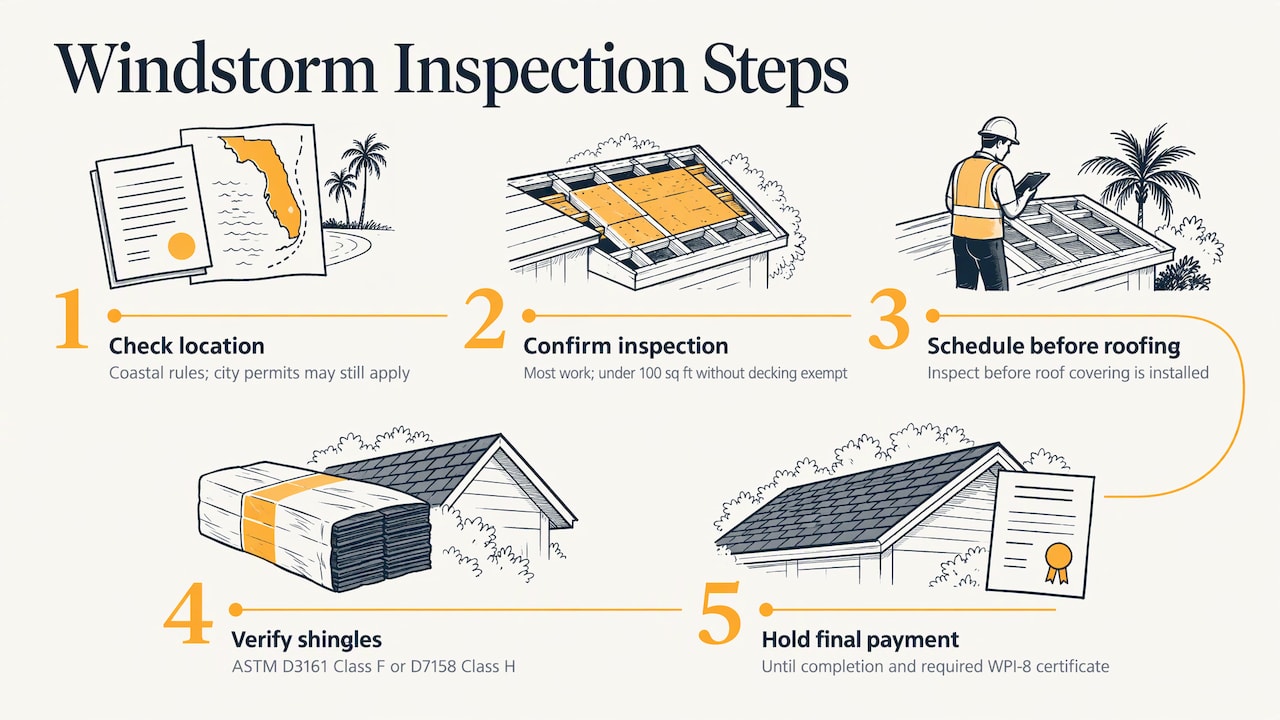
In Texas coastal windstorm-inspection areas, TDI says most new construction, roof replacements, major repairs and alterations require an inspection and a certificate of compliance for a property to be eligible for Texas Windstorm Insurance Association coverage. Roof repairs smaller than 100 square feet that do not involve decking do not need one, according to the same page. TDI also advises owners in the first row of Gulf-bordering counties, and in specified Harris County cities east of Highway 146, to ask their insurance agent whether repairs must meet the IBC or IRC and to contact the local building official.
If your property is in North Texas, the coastal program generally does not apply, but your city’s permit rules still might. Ask the contractor who pulls the permit and confirm with your city.
Where the program does apply, timing matters. Inspection during construction is far more practical than trying to document hidden work after the roof is finished. TDI’s guidance says to arrange the inspection before the roof covering is installed. On shingles, the storm-repair guidance says products in applicable windstorm work should be tested to ASTM D3161 Class F or ASTM D7158 Class H, with compliance shown on the wrapper. And TDI recommends holding the final payment until the work is complete and, where required, the WPI-8 certificate of compliance has been issued.
If you are selling a home and an inspection flags roof problems, it helps to understand your options after a failed inspection before you decide how to proceed.
Residential or commercial: what changes
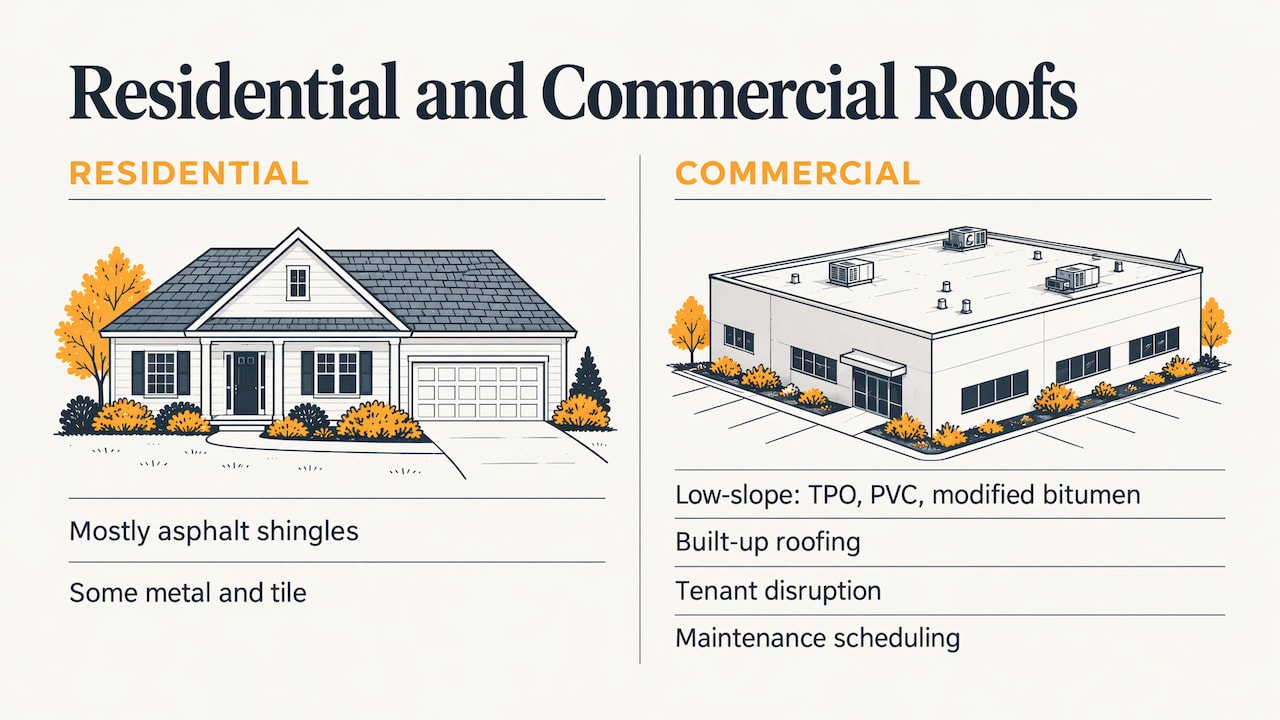
The verification steps are the same for a house and a strip center, but the roofs differ. Homes in North Texas are mostly asphalt shingle, with some metal and tile. Commercial buildings typically carry flat or low-slope systems such as TPO, PVC, modified bitumen or built-up roofing, and a property manager has added questions: tenant disruption, a maintenance schedule, and whether a coating can extend the life of an aging membrane.
We work on all of these systems. For businesses, we offer commercial roof inspections with a free estimate, commercial roof repairs, roof coatings and full replacement and installation.
What a good first visit looks like
A first visit from a trustworthy roofer is calm and specific. The inspector walks the roof or documents it, takes photos of every problem they find, explains each in plain words, and tells you which items are urgent and which can wait. You leave with a written estimate, not a sales push. You should never be told the offer expires tonight.
A few questions are worth asking at that visit:
- Who will be on my roof, employees or subcontractors, and who supervises?
- Which permits does this job need, and who handles them?
- What happens if we find rotted decking once the old roofing is off?
- How will you protect landscaping, the attic and my belongings?
- Who do I call after the job if something is wrong?
Clear answers to these are a better sign than a low price. Our free inspections and estimates are built around exactly this exchange: we show what we found, explain the options and put the scope in writing.
What we tell neighbors who ask us to pick a roofer
After a storm, people want speed, and we understand that. But the best roofing decisions we have seen were made in a calm order: document the damage, understand your policy, verify the contractor, then compare written scopes. Texas rules draw a clear line between the roofer and the insurance claim, and we think that line protects homeowners.
That is why we put our effort into what we can show: manufacturer certifications, free inspections and estimates, a roof-health check based on historical weather data, and a transferable 15-year workmanship warranty on residential replacements. We want you to feel secure in your roofing choices because you understood each step, not because we pushed.
The same applies to a commercial building. A property manager should get a clear inspection, a written scope and a maintenance plan that fits the budget.
Dustin Eatman
Next step: a free inspection
If you want a roofer who walks you through the answers to each question above, start with a free inspection and estimate. We serve homeowners and commercial property owners across Tarrant, Dallas, Collin, Denton, Johnson, Ellis, Hood and Rockwall counties, with roof inspections, repairs, emergency roofing, maintenance, and replacement and installation.

Book through our roofing services page, or start with the free home roof inspection and estimate. If you manage a building, our commercial roofing page is the place to begin. Pricing depends on the roof, so we quote after we see it.
FAQ
How many quotes should I get for a roof in Texas?
Get at least three written bids, which is what TDI advises for storm repairs. Compare the scope, named materials, warranty terms and payment schedule, not only the total.
Can a roofer cover my insurance deductible?
No. Texas law makes it illegal for a contractor to waive, rebate or absorb your deductible. Contracts of $1,000 or more that involve an insurance settlement must say you owe the deductible. A roofer who offers otherwise is breaking the rule, and you should walk away.
Can my roofer handle my insurance claim for me?
A roofer can inspect, document the damage and provide an estimate for the work. They cannot act as your public adjuster on a job they will perform. Be wary of anyone promising to negotiate your claim or recover everything you are owed.
When should I make the final payment?
Only after the work is finished and you are satisfied with it. Where a windstorm inspection applies, TDI recommends waiting until the WPI-8 certificate of compliance has been issued. Avoid paying large sums before materials arrive.
Does my insurer have to drop me if my roof is old?
No. TDI clarified on September 29, 2026 that insurers cannot decline or non-renew a home policy based solely on the age of the house or roof. They may consider the physical condition of components like the roof.
Sources
- Repairing My Roof after a Storm, Texas Department of Insurance
- Roofing and insurance: Know the law, Texas Department of Insurance
- How to avoid contracting scams, Texas Department of Insurance
- What you need to know about windstorm inspections, Texas Department of Insurance
- Making repairs after a storm, Texas Department of Insurance
- Questions to Ask Your Contractor BEFORE Roofing, Texas Department of Insurance
- Texas homeowners protected from being denied insurance, Texas Department of Insurance
- Contractor Licensing Info, City of Ballinger
- Home Repair Steps after Storm Damage, Houston Habitat for Humanity
- Failed Inspection? Your Options as a Seller
Recommended
- Useful Tips to Choose the Right Arlington Roofing Contractor
- Choosing a Dallas County Roofing Contractor in 2026
- Don’t Get Nailed: A Guide to the Best Roofing Contractor
- Roof Warranty Types in Texas | Manufacturer vs. Workmanship
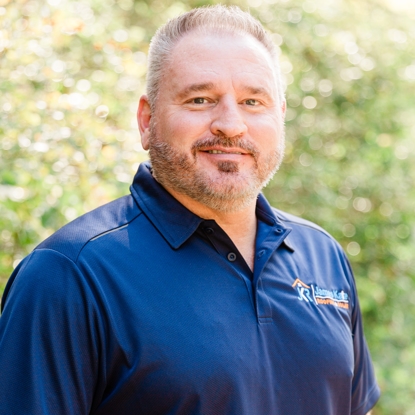
Dustin Eatman is a seasoned roofing professional with deep, hands-on expertise that spans residential and commercial roofing, insurance solar, and long-term roof asset management. As the owner of James Kate Roofing & solar in the Dallas–Fort Worth metroplex, he’s built a reputation for diagnosing roof systems accurately, communicating clearly, and executing projects with a high standard of workmanship and documentation. Dustin understands the technical details that make roofs perform—proper underlayment selection, slope and drainage considerations, ventilation strategy, flashing and penetration detailing, and manufacturer-specific installation requirements—because he’s worked through the real-world challenges that cause leaks, premature wear, and warranty issues. He’s equally fluent in the operational side of roofing: jobsite planning, quality control, safety, material ordering, crew coordination, and customer experience from inspection to closeout. In insurance-related projects, Dustin brings practical knowledge of claim workflows, adjuster meetings, scope alignment, supplements, and the importance of photo evidence and thorough records, helping property owners navigate stressful situations with confidence. For commercial clients—especially property and facility managers—he emphasizes proactive maintenance and targeted repairs that reduce disruption, extend roof life, and prevent expensive interior damage. Dustin also stays focused on doing things the right way: educating customers on realistic options, setting expectations, and prioritizing solutions that hold up over time rather than quick fixes. That blend of technical skill, field experience, process discipline, and owner-level accountability is what makes Dustin Eatman a trusted expert in the roofing industry.