
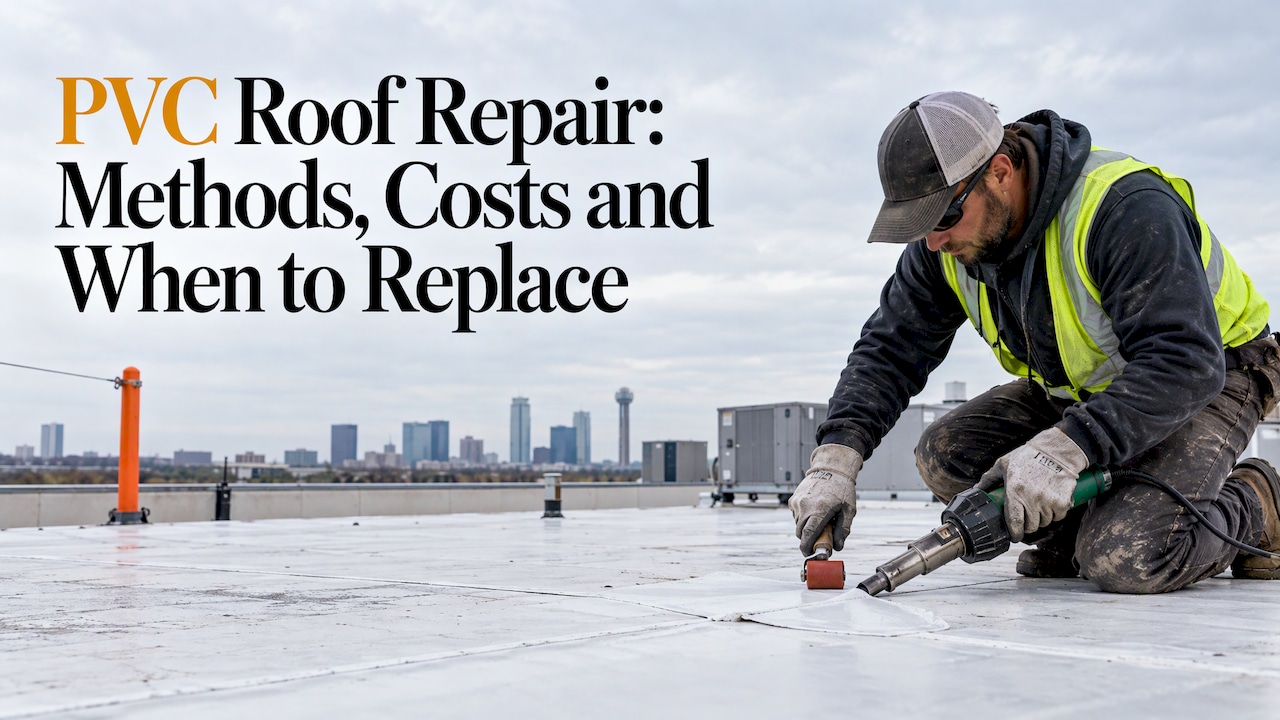
A PVC roof is repaired by heat welding, not by caulk or roof cement. The installer cleans the old membrane down to weldable vinyl, hot-air welds a rounded patch over the damage, and probes the edges once they cool. That takes the right equipment and training, which is why most property owners hire a crew. If you have a PVC roof in Dallas-Fort Worth, we start with a free inspection and estimate so you know whether you need a patch, a seam repair or a bigger plan. Our commercial roof repair team handles that work.
TL;DR
- Seams, punctures, flashing details and storm impact are the usual reasons a PVC roof leaks. Seam failure is the leading cause on single-ply roofs.
- A lasting repair is a clean, hot-air-welded patch with rounded corners, checked with a probe. Caulk and generic sealants are not the fix.
- Published US planning ranges run roughly $400 to $1,500 for a small patch and $10 to $30 per linear foot for seam welds. Scope, access and roof condition move the final price.
- Repair when the damage is local. Replace when failure is widespread, the membrane is near the end of its life, or moisture has spread through the insulation.
- Storm damage is a separate track: document it, file a claim on time and keep the manufacturer warranty intact.
Table of Contents
- What usually goes wrong with a PVC roof
- How a PVC roof repair is done, step by step
- Temporary fixes: what they can and can’t do
- What PVC roof repair costs
- Repair or replace a PVC roof?
- Storm damage and insurance
- Keeping a PVC roof out of the repair cycle
- Get your PVC roof looked at
- Our perspective
- FAQ
- Sources
What usually goes wrong with a PVC roof
PVC is a thermoplastic single-ply membrane, common on flat and low-slope commercial roofs: restaurants, warehouses, retail strips and medical buildings. It is tough, but it fails in predictable places.
Seams. Seam failure is described as the number one cause of leaks on single-ply systems, including PVC. The listed causes are wrong welding temperature, a contaminated membrane, welding in unsuitable weather and welding too fast. The same source notes that a 20,000-square-foot roof may carry 2,000 to 4,000 linear feet of seams, and each one is a possible failure point.
Impact and foot traffic. Hail, wind-borne debris, uplift and foot traffic can all damage PVC. On a Texas roof, a hailstorm followed by a service technician walking to a rooftop unit is a common path to a puncture.

Details and penetrations. Flashings around curbs, pipes, drains and equipment take the most movement and water. Weatherbond’s PVC inspection checklist tells inspectors to check curbs, penetrations and drains and then walk the field of the roof.
Age. Some PVC membranes made before about 2009 have a reputation for accelerated aging from heat and solar radiation, according to InterNACHI’s PVC inspection library. Much older, unreinforced membranes had a history of shattering or splitting, and the NRCA warned against foot traffic on PVC below 50 degrees F. In North Texas that matters on cold mornings, so keep rooftop access to a minimum in winter.
Blisters. Blisters can come from trapped air or moisture, or from too little sealant flash-off time. The same InterNACHI library says they don’t affect water-tightness and don’t need repair unless the membrane is damaged. A roofer should still look at them during an inspection.
How a PVC roof repair is done, step by step
PVC repair is a welding job. Here is the routine, what each step takes and where it goes wrong.

1. Find the actual leak
Water travels under a membrane and shows up far from the breach. A proper leak diagnosis checks seams, flashings, penetrations and punctures, and often uses moisture scanning to see how far water has spread. Patching the stain location instead of the source is the most common reason a leak comes back. Our roof leak diagnosis and repair starts here.
2. Clean to weldable vinyl
Old PVC has dirt, oxidation and plasticizer residue on its surface, and new membrane will not weld to that. The Roofing Brief says an old PVC sheet must be cleaned and prepared before new membrane will weld to it. The Canadian Roofing Contractors Association’s thermoplastic procedure calls for removing debris and ballast, scrubbing with detergent and water, rinsing and drying. Skipping or rushing this step gives a patch that looks fine and peels in a season.
3. Cut and fit the patch
The patch should extend about 4 inches past the defect, with rounded corners. Square corners lift first. The patch has to be compatible with the existing membrane, which matters for the warranty.
4. Weld it
A hot-air welder fuses the patch to the membrane. This is described as a heat weld, not a glue job, and it needs a continuous weld around the patch. The temperature, speed and weather all affect the bond, which is the same list of causes behind seam failures. The Roofing Brief rates the difficulty as moderate and says it calls for a hot-air welder and PVC-certified roofers.
5. Probe and seal the edges
Once the weld cools, the crew runs a rounded-tip probe along the edges to find any unfused spots, then applies compatible seam sealant. A probe check is the difference between a repair that was verified and one that was assumed.
6. Record the repair
Take before, during and after photos and keep the invoice. If the roof is under a manufacturer warranty, that file protects you, and warranty preservation depends on approved materials and a certified applicator. We are a GAF Master Elite® contractor, and the free inspection is where we go through your roof’s condition and any documentation you already have.
Temporary fixes: what they can and can’t do
If water is coming in tonight, a tarp or interior containment buys time. Our guides on patching a roof hole from the inside and fixing small leaks cover the stopgaps. Treat them as a bridge to a welded repair. For active leaks, our emergency roofing service is built for that situation.
On wind-damaged adhered membranes, sandbags are only a short-term measure. An IIBEC article notes UV exposure can break sandbags down, and it points to battens or plates over disbonded areas and one-way air vents as more durable approaches. It also advises gathering the roof’s type, age, manufacturer and warranty status and notifying the manufacturer and insurance carrier before choosing a repair.
What PVC roof repair costs
Prices depend on roof size, access, the number of details and whether the roof is wet underneath. Published US planning ranges from The Roofing Brief give a starting frame:
| Repair type | Planning range |
|---|---|
| Small PVC patch (under 4 sq ft) | $500 to $1,500 |
| PVC seam weld repair | $10 to $30 per linear foot |
| PVC detail or flashing repair | $400 to $1,800 per detail |
| Single TPO or PVC patch (warehouse scope) | $400 to $1,200 |
| Multi-seam failure zone with added access and fire-watch staffing | $1,500 to $4,000 |
| PVC overlay (full system) | $5 to $9 per sq ft |
These are national planning figures, not quotes. We don’t publish prices, because a real number needs someone on your roof. Our inspections and estimates are free.
Repair spending also follows a curve over a roof’s life. One capital-planning guide puts a well-maintained roof at $500 to $2,000 a year in repairs early on, $3,000 to $8,000 in the second half, and $8,000 to $15,000 a year in the last two or three years. If your repair bills are climbing, that is the signal to price a replacement.
Repair or replace a PVC roof?
The question comes down to how much of the roof is failing, and what is under the membrane.
- Repair when the damage is local: a puncture, a failed seam, a bad flashing, or a wet area confined to one spot.
- Replace a section when the deck or insulation is wet in one area.
- Replace the roof when failure is widespread or the membrane is past its service life. A common rule of thumb is about a quarter of the field, though that source also notes no code or manufacturer standard sets a fixed lifespan for any membrane.
GAF’s commercial inspection guidance frames it as value over time: if many expensive repairs would only buy a few more years, replacement is likely the wiser spend. Where issues are simpler, repair can be the right call.
Moisture findings drive the decision more than surface appearance. Wet insulation beneath a clean-looking membrane ends the case for patching, and the way moisture shows up inside the building tells you its extent. This overview of attic moisture problems and their causes shows the signs to look for on a pitched-roof structure. For flat commercial roofs, a moisture scan does the same job. Our guide on deciding to repair or replace walks through the general logic.

If you are planning a replacement and weighing membranes, see how TPO and PVC compare. We install PVC, TPO, modified bitumen, built-up and other systems, covered on our commercial roof replacement page.
Storm damage and insurance
North Texas hail is a leading cause of PVC punctures and torn flashings. Whether insurance pays depends on the cause of the damage. Texas insurance agency guidance says leaks from a sudden, covered event such as wind or hail are generally covered, while leaks from wear, aging or neglected maintenance are not. Your own policy language, deductible and roof-age terms decide the outcome, so read it or ask your insurance agent. Commercial property policies work the same way in principle, so confirm the terms with your carrier.
What helps any claim is evidence. Photograph the damage within a day or two, note the date of the storm, and keep records of any emergency repairs. Don’t let repairs wait: the Roofing Brief notes that documentation supports both insurance recovery and warranty defense. Our storm-damage assessments use historical weather data to show whether severe weather hit your roof. Our guides on roof damage assessment and insurance roof inspections explain what to document.
Keeping a PVC roof out of the repair cycle
Most PVC repairs trace back to small problems that sat unnoticed. A simple routine catches them:
- Spring: inspect for winter damage. Fall: check drainage, reseal compromised flashings and clear debris, as commercial maintenance guidance recommends.
- After every significant storm, especially hail or high wind.
- Limit foot traffic, and keep it off the roof in cold weather.
- Keep drains clear. Ponding water stresses seams and flashings.
Our roof maintenance and commercial roof inspection services are set up for this schedule, and professional inspections often save money by catching problems early. For an older PVC roof, commercial roof coatings are another way to extend service life.
Get your PVC roof looked at
We offer free inspections and estimates for commercial and residential roofs across Dallas-Fort Worth. We are a GAF Master Elite® contractor, and residential replacements carry a transferable 15-year workmanship warranty. Whether the answer is a welded patch, a seam repair or a replacement plan, you will know what the roof needs before you spend anything. Start with our commercial roof repair page or book an inspection.

Our perspective
A PVC roof rewards the right repair and punishes the quick one. Because the membrane is welded, the patch has to be welded too: clean surface, controlled heat, rounded corners, a probe check on the edges. A tube of sealant over a seam is a delay, and the leak comes back.
We think the inspection matters more than the patch. Our approach is data-driven: we look at the roof’s condition, its age and, for storm cases, the weather history, then recommend only what the findings support. Sometimes that is one patch. Sometimes it is a plan for replacement.
That is also why we put inspections and estimates at no cost. You should be able to understand your roof before you decide anything.
Dustin Eatman
FAQ
Can a PVC roof be repaired without replacing it?
Yes, when the damage is local. Punctures, failed seams and flashing problems are repaired by cleaning the membrane and hot-air welding a patch over it. Replacement becomes the better choice when failure is widespread or the insulation is wet across several areas.
How much does PVC roof repair cost?
US planning ranges run about $500 to $1,500 for a small patch and $10 to $30 per linear foot for seam welds, per The Roofing Brief’s 2026 guide. Access, roof size and hidden moisture change the total. A free inspection gives you a figure for your roof.
What are the downsides of PVC roofing?
The points to manage are seams, flashing details and impact from hail or foot traffic. Seams need quality welding, and cold-weather foot traffic should be avoided. With scheduled inspections and prompt, certified repairs, a PVC roof is built to protect a flat commercial building for years.
Does insurance cover a leaking PVC roof?
It generally depends on the cause. Sudden damage from a covered event such as hail or wind is typically covered, and wear or lack of maintenance typically is not. Check your policy, call your carrier promptly and document the damage with dated photos.
Sources
- Seam Failures on Single-Ply Roofs, Flat Roof Report
- PVC Inspection, InterNACHI Inspection Narrative Library
- PVC Rooftop Inspection Checklist, Weatherbond
- The Repair of Aged PVC, Roofing Contractor
- Thermoplastic Membranes, Canadian Roofing Reference Manual
- PVC Roof Repair: Clean, Weld and Patch Rules, The Roofing Brief
- Flat Roofing Materials Comparison, The Roofing Brief
- Warehouse Roof Repair: Patch, Weld and Cold Methods, The Roofing Brief
- Commercial Roof Repairs Cost, The Roofing Brief
- Single Membrane Roof Repair: Patch, Coat or Replace, The Roofing Brief
- Detection and Repair of Uplift-Compromised Adhered Membranes, IIBEC
- Inspecting a Commercial Roof: Repair or Replacement, GAF
- Capital Planning and Roof Reserves, Flat Roof Report
- Commercial Roof Maintenance Guide
- Does Home Insurance Cover Roof Damage or Roof Leaks?
Recommended
- TPO vs. PVC: Which is better?
- Roof Repair: 10 Rip-Offs Exposed!
- Steps for Effective Roof Repair Services
- Cost to Fix a Small Roof Leak: Flashing, Shingles, and Labor Breakdown

Dustin Eatman is a seasoned roofing professional with deep, hands-on expertise that spans residential and commercial roofing, insurance solar, and long-term roof asset management. As the owner of James Kate Roofing & solar in the Dallas–Fort Worth metroplex, he’s built a reputation for diagnosing roof systems accurately, communicating clearly, and executing projects with a high standard of workmanship and documentation. Dustin understands the technical details that make roofs perform—proper underlayment selection, slope and drainage considerations, ventilation strategy, flashing and penetration detailing, and manufacturer-specific installation requirements—because he’s worked through the real-world challenges that cause leaks, premature wear, and warranty issues. He’s equally fluent in the operational side of roofing: jobsite planning, quality control, safety, material ordering, crew coordination, and customer experience from inspection to closeout. In insurance-related projects, Dustin brings practical knowledge of claim workflows, adjuster meetings, scope alignment, supplements, and the importance of photo evidence and thorough records, helping property owners navigate stressful situations with confidence. For commercial clients—especially property and facility managers—he emphasizes proactive maintenance and targeted repairs that reduce disruption, extend roof life, and prevent expensive interior damage. Dustin also stays focused on doing things the right way: educating customers on realistic options, setting expectations, and prioritizing solutions that hold up over time rather than quick fixes. That blend of technical skill, field experience, process discipline, and owner-level accountability is what makes Dustin Eatman a trusted expert in the roofing industry.