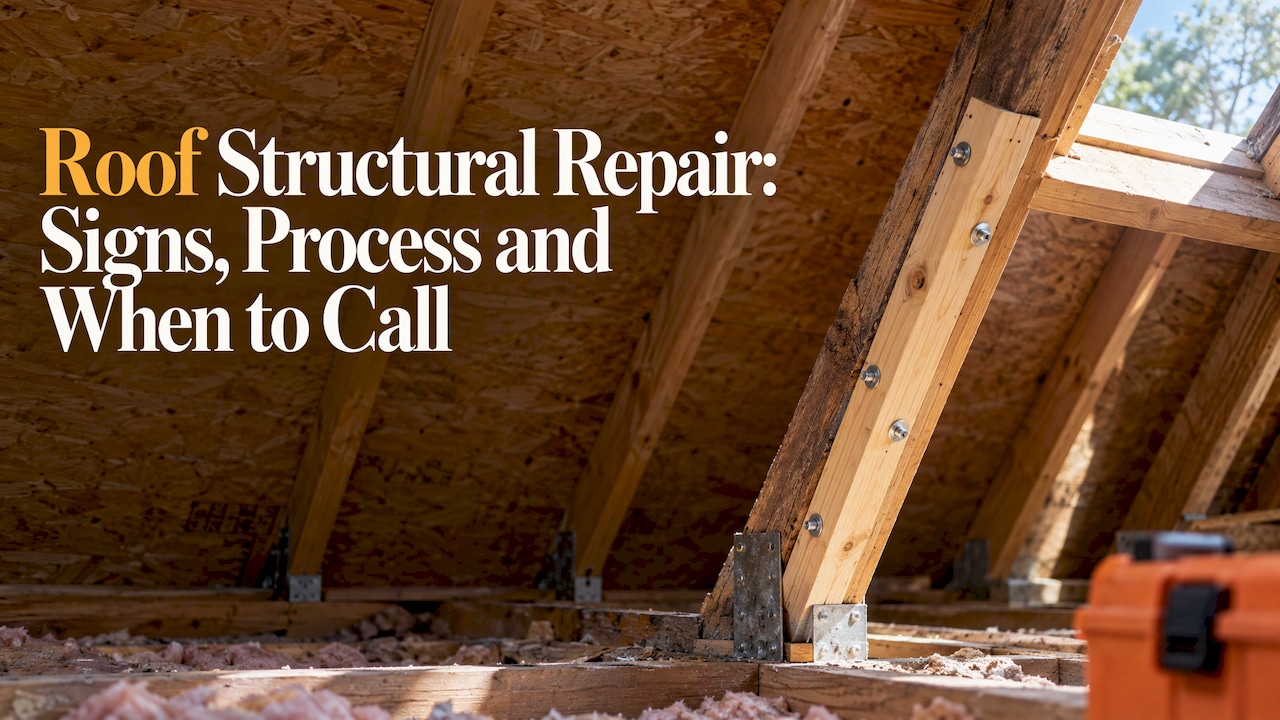
Structural roof repair fixes the parts that hold the roof up: the decking (also called sheathing), rafters, trusses and the connections between them. Shingle and flashing work is a different job. If you see sagging, soft decking or the same leak coming back, have a roofer inspect the framing before you pay for surface repairs. We offer free inspections and estimates across the Dallas-Fort Worth area, and our storm-damage assessments include a look at what is under the shingles.
TL;DR
- Structural repair deals with decking, rafters, trusses and their connections. Missing shingles and a cracked vent boot are surface problems.
- The warning signs are a sagging roofline, soft or spongy decking, dark damp sheathing in the attic, split or bowed framing, and repeated leaks in the same spot.
- After a storm, wind damage often starts at the roof edges and can be hidden, so a surface check is not enough.
- Repair or replacement depends on how far the damage reaches, and the framing must carry the load of whatever roof goes on top.
- Take photos, cover openings and keep receipts before any structural work begins, especially if you plan to file an insurance claim.
Table of Contents
- What counts as structural roof repair
- Signs the damage may be structural
- What causes structural roof damage
- How a structural assessment works
- How structural repairs are made
- Repair or replace the roof
- What structural repair costs
- What to do before repairs begin
- Get the framing checked first
- Our view on structural problems
- FAQ
- Sources
What counts as structural roof repair
A roof has two layers of work. The covering (shingles, metal, tile, or a membrane on a flat roof) keeps water out. The structure underneath carries the weight of the covering, snow, wind and people on the roof. That structure is the decking, the rafters or engineered trusses, the ridge beam and the fasteners or connectors that tie them together and to the walls.
Not every faulty roof is a structural problem. Missing shingles, cracked sealant or a damaged vent boot are surface-level when caught early. They turn structural when water or force reaches the wood and the wood loses strength. That is why a small leak left alone for years can end up as a framing job.
In practice, structural repair usually means one or more of these:
- Replacing sections of rotted or damaged decking.
- Sistering (bolting a new board alongside) or replacing cracked rafters.
- Repairing or replacing damaged trusses and their connections.
- Restoring connections between the roof and the walls.
- Correcting sagging or over-spanned areas that make the roof surface look wavy.
On commercial flat roofs the same logic applies: a wet or collapsed insulation and deck area under a TPO, PVC, modified bitumen or built-up membrane is a structural concern, not just a patch job.
Signs the damage may be structural
You can check many of these without climbing on the roof. Stay on the ground and in the attic with a flashlight.
From outside
- A sagging roofline or a swayback ridge. Home inspectors are trained to report a swayback ridge beam and other visible deficiencies in the underlying structure.
- A wavy roof surface, which the same inspection guide links to thin, over-spanned sheathing.
- Cracked shingles or tiles directly above a structural defect.
- Ridge and eaves that are no longer straight, or walls that no longer look vertical. Extension engineers at North Dakota State University advise checking whether the ridge and eaves are straight and whether the building has shifted on its foundation after a storm.
From the attic
- Dark, damp or deteriorated sheathing, and soft or spongy decking.
- Cracked, bowed or separated rafters, and damaged trusses or framing connectors.
- Crushed, split or broken wood, gaps at truss joints, deformed metal gusset plates and elongated nail holes, the same list the NDSU guidance gives for post-storm checks.
- Long-term moisture or signs of wood decay.
From inside the living space
- A ceiling that sags below a leak.
- Repeated leaks in the same area after you have already had it patched.
One sign alone, such as a single stain, may be a surface leak. Several together point to the frame. NDSU’s guidance is to consult a building contractor or engineer if several signs of damage are present.
If the roof is actively leaking, our guide on what to do if your roof is leaking covers the first steps. Do not walk on a roof you suspect is sagging or soft.
What causes structural roof damage
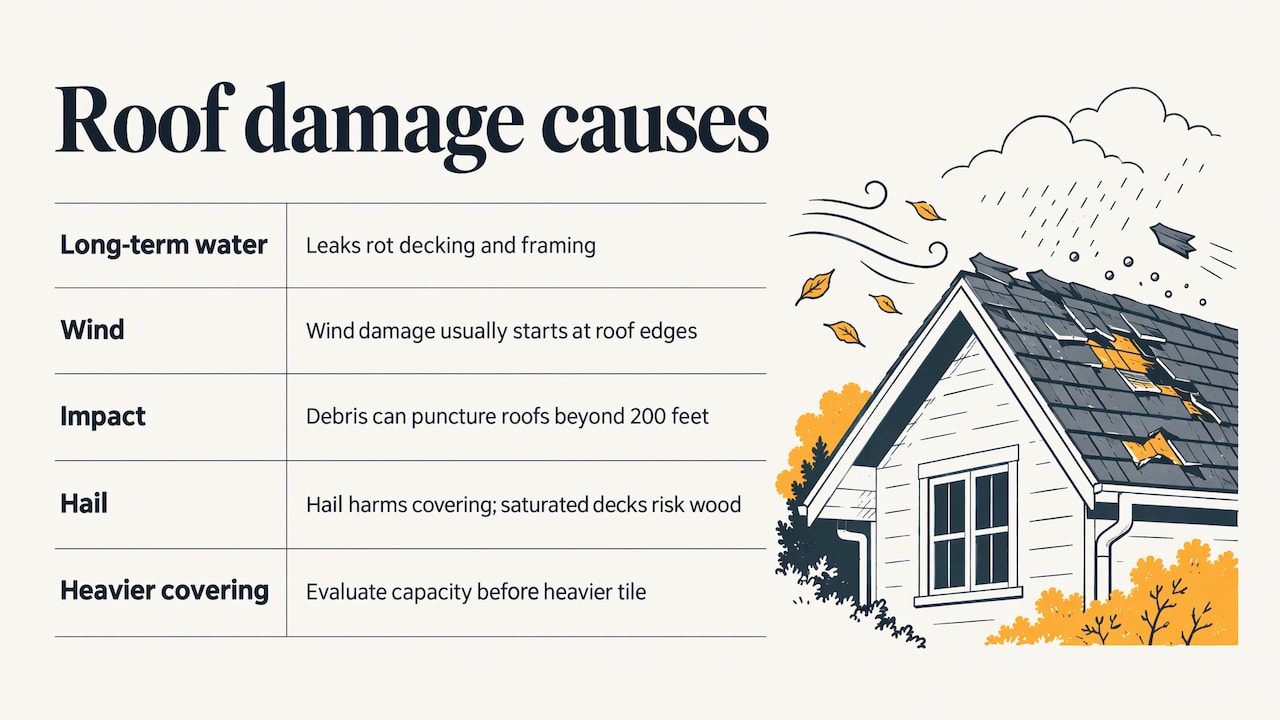
Long-term water. A slow leak soaks decking and framing until the wood rots. This is the most common route from a small repair to a structural one, and it is why repeated leaks in one spot deserve a closer look.
Wind. The National Roofing Contractors Association (NRCA) explains that wind damage is incremental and directional: suction lifts the roof covering while pressure pushes on it, which is why most damage starts at the roof edges. Repeated wind cycles make it worse. Windblown debris can also strike the roof. Our pages on protecting a roof from wind damage and repairing wind damage explain the early signs.
Impact. Fallen trees and large limbs can crack rafters and decking. Wind-borne debris can travel more than 200 feet with enough momentum to puncture roofs, according to a damage-assessment protocol by roofing consultant Thomas L. Smith.
Hail and storms. North Texas sees hard hail and straight-line winds. Hail mostly harms the covering, but a hard hit combined with saturated decking can reach the wood. A storm-damage assessment checks for both.
Age, overloading and design. A structure built for asphalt shingles may not carry a heavier covering. The NRCA’s reroofing guidelines say the existing structure’s load capacity must be evaluated before a heavier covering such as clay or concrete tile goes on.
Pests. Termites and wood decay can weaken framing from the inside, and they often show up alongside moisture.
How a structural assessment works
A good assessment looks beyond the spot that is visibly damaged. Smith’s protocol recommends evaluating roof areas outside the visibly damaged periphery before choosing repair over replacement. It calls for walking the perimeter at intervals no more than 4 feet apart and the field of the roof at intervals not exceeding 20 feet, as described in his published method.
A thorough inspection usually covers:
- Exterior. Ridge and eave lines, roof planes, flashing, penetrations and the covering itself.
- Attic. Sheathing underside, rafters, trusses, connectors, insulation moisture and any daylight.
- Interior. Ceiling stains, sagging and cracks that follow the framing.
- Documentation. Photos and notes tied to locations on the roof, so the scope of repair is clear and an insurer can follow it.
We do this as part of our roof inspections, and our roof damage assessment guide walks through how to check, document and decide. Our inspections and estimates are free.
When the damage compromises the home’s structural integrity, the U.S. Department of Energy’s technical brief says to consult a professional engineer. Design changes such as stiffening, truss or beam redesign are engineering decisions. The University of Texas at San Antonio’s Disaster-Proof Texas program assigns that work to engineers and architects. A roofer handles the repair that follows, and we coordinate the roofing side of that work.
If you want to understand how load paths and connections tie a roof to the walls, this explanation of roof diaphragm connections and load paths is a clear technical reference.
How structural repairs are made
The method depends on what failed.
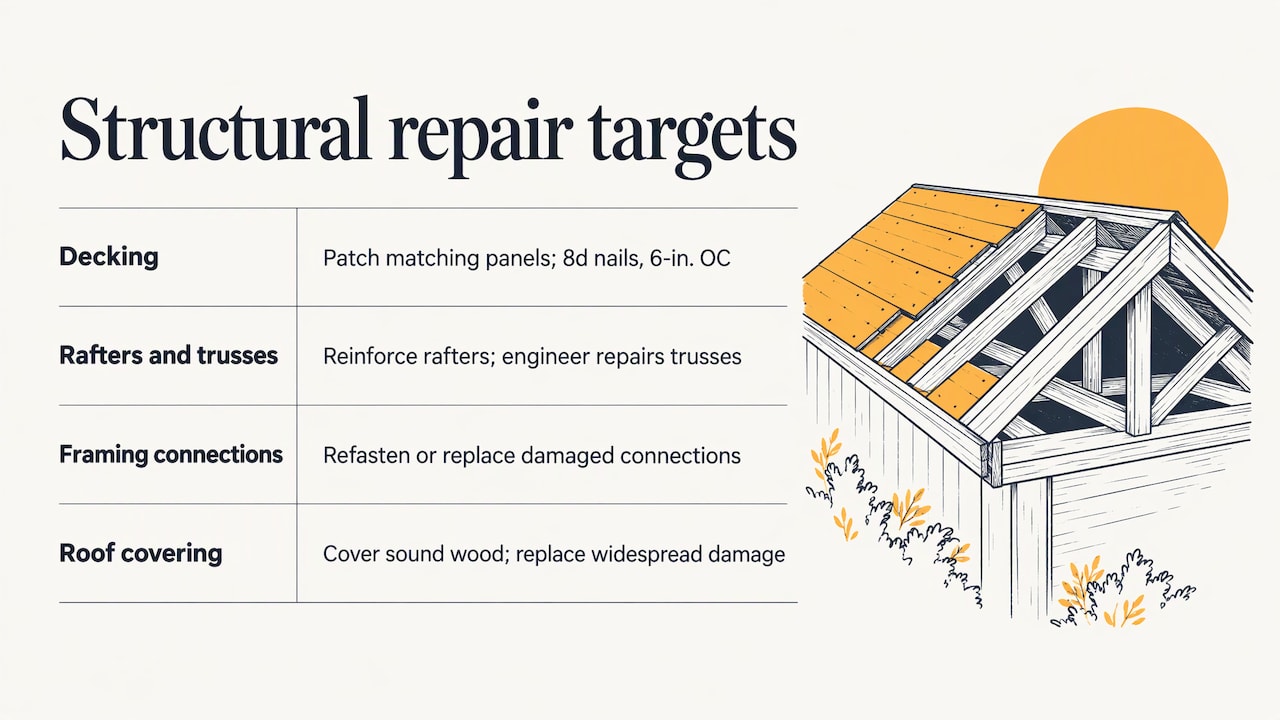
Decking. For localized damage, the Department of Energy brief says to patch with panels of the same thickness, nailed with 8d ring-shank nails at 6 inches on center. When the whole deck is replaced, it suggests considering 32/16-rated plywood or OSB at least 5/8 inch thick, closer nail spacing near gable ends, hurricane clips between sheets and self-adhered tape at the joints. Those are guidance figures for a specific building type, so your local code and the roof design decide the actual spec.
Rafters and trusses. Cracked rafters are typically reinforced or replaced. Trusses are engineered, so damaged ones are generally repaired to an engineer’s detail rather than improvised.
Connections. Loose or damaged framing connections are re-fastened or replaced so loads travel from roof to walls as designed.
Covering on top. Once the wood is sound, the new covering goes on. This is where a repair stops being a patch: if the deck and covering are both compromised across a large area, replacement is the sounder route. Our article on recovering versus tear-off explains why a tear-off lets the crew see and fix the deck.
Never reuse storm-damaged material that will not dry before it is covered again. The Department of Energy warns this can bring structural problems, mold issues and buckling later.
Repair or replace the roof
The NRCA says a roof should be replaced or re-covered when repairs can no longer prevent recurrent leakage or extend service life. The triggers it lists include excessive repair spending, intolerable leakage and damage to structural components.
| Situation | Usually points to |
|---|---|
| One damaged area, dry framing, covering otherwise sound | Targeted repair |
| Rot or damage confined to a few decking sheets | Deck patch plus new covering over that area |
| Repeated leaks despite earlier patches | Full assessment, likely replacement |
| Widespread soft decking or sagging planes | Replacement with deck and framing repairs |
| Damaged trusses or rafters | Engineer-directed repair, then covering |
Our guide to repair or replace decisions goes deeper. If replacement is the answer, our roof replacement and installation covers asphalt shingle, metal and tile systems, and residential replacements carry a transferable 15-year workmanship warranty.
What structural repair costs
There is no honest single price, because the scope is unknown until the framing is opened and inspected. We do not publish prices for repairs, and a written estimate after an inspection is the right way to get a number for your roof.
For context on materials, This Old House reports that roof truss materials cost $1.50 to $4.50 per square foot, with a complete truss system for a 2,000-square-foot house averaging $7,500 to $12,000. The same page puts labor at $20 to $75 per hour and crane rental at $200 to $700 per day. Its 2026 roofing survey found that hidden damage affected about 24% of projects, which is why a scope can grow once the old covering comes off. Those are national figures, so Texas bids will differ.
What to do before repairs begin
After a storm, the order of steps matters, especially for a claim.
- Stay safe. Do not go on a damaged roof or into an attic with obvious sagging.
- Cover openings. The NRCA advises temporary tarps over openings and keeping receipts, since temporary repairs are often reimbursable.
- Photograph everything. Exterior, attic and interior, with dates.
- Call your insurer before repair work. The Department of Energy brief tells owners to consult an insurance agent before doing repair work if they are filing a claim, and to save unrecoverable materials until the adjuster confirms losses.
- Get a roofer’s written findings. If the adjuster and contractor disagree, the NRCA says to request a reinspection.
If you want to understand how builder’s risk and property coverage relate to repair costs, this overview of insurance and project value gives useful background for owners who rehab property. Our own pages on dealing with roof storm damage and insurance roof inspections cover the claim side.
Get the framing checked first
Our instant roofing quote tool assesses a roof’s health using historical weather data, so you can see whether severe storms have hit your address. From there, we offer free inspections and estimates for homes, and commercial roof inspections and commercial roof repairs for property managers. For residential work, roof repairs and emergency roofing are available across Dallas, Tarrant, Collin, Denton and neighboring counties. We are a GAF Master Elite® contractor.

Start at our roofing services page to book an inspection.
Our view on structural problems
Most structural roof repairs we would want to prevent start as small surface problems that were patched without anyone looking underneath. A roof inspection that stops at the shingles answers only half the question.
That is why we put the attic and the decking into every assessment, and why we explain what we find in plain terms with photos you can keep. Our approach is data-driven: we look at the roof’s condition alongside storm history so you know whether weather is the cause.
Our advice is simple. If you see sagging, soft spots or repeat leaks, get a written inspection early. A free inspection costs you an hour. A framing repair found late costs a great deal more.
Dustin Eatman
FAQ
Is a faulty roof a structural issue?
Not always. Missing shingles, cracked sealant and damaged vent boots are surface problems when caught early. It becomes structural when the decking, rafters, trusses or connections are damaged, rotted or displaced, which is why sagging and repeat leaks need a closer look.
Can I repair a sagging roof myself?
We do not recommend it. A sagging roof may be carrying hidden damage and is unsafe to walk on. The NRCA advises homeowners not to attempt most wind-related repairs themselves. Have a roofing contractor inspect it, and an engineer if the structure itself is compromised.
Do I need an engineer or a roofer?
For roof covering, decking and most repairs, a roofer. When damage compromises the home’s structural integrity, or truss and beam redesign is needed, an engineer specifies the fix. We handle the roofing work and the inspection findings that go with it.
Will insurance cover structural roof repair?
It depends on your policy and the cause of damage. Storm damage is often claimed, so document it and speak with your insurer before work begins. Keep receipts for temporary repairs, and ask for a reinspection if the adjuster’s and contractor’s findings differ.
How do I know whether to repair or replace?
Look at how far the damage spreads and how often the roof has leaked. If repairs no longer stop leaks or structural parts are damaged, replacement is usually the better route, according to the NRCA’s reroofing guidelines.
Sources
- How to Tell If Roof Damage Is Structural
- How to Perform Roof Inspections, 3rd edition
- Determine Full Extent of Structural Damage from Storms, NDSU
- Roof Structure: Resilience Treatments and Priorities, UTSA
- Preliminary protocol by Thomas L. Smith, Professional Roofing
- Roof Repair After Strong Winds, NRCA
- Repairing Roofs and Ceilings, U.S. Department of Energy
- NRCA reroofing guidelines
- How Much Does a Roof Truss Cost?, This Old House
Recommended
- Steps for Effective Roof Repair Services
- Signs: Roof Needs Repair
- Roofing Decisions – To Repair or Replace?
- Roof Repair Tips and Techniques

Dustin Eatman is a seasoned roofing professional with deep, hands-on expertise that spans residential and commercial roofing, insurance solar, and long-term roof asset management. As the owner of James Kate Roofing & solar in the Dallas–Fort Worth metroplex, he’s built a reputation for diagnosing roof systems accurately, communicating clearly, and executing projects with a high standard of workmanship and documentation. Dustin understands the technical details that make roofs perform—proper underlayment selection, slope and drainage considerations, ventilation strategy, flashing and penetration detailing, and manufacturer-specific installation requirements—because he’s worked through the real-world challenges that cause leaks, premature wear, and warranty issues. He’s equally fluent in the operational side of roofing: jobsite planning, quality control, safety, material ordering, crew coordination, and customer experience from inspection to closeout. In insurance-related projects, Dustin brings practical knowledge of claim workflows, adjuster meetings, scope alignment, supplements, and the importance of photo evidence and thorough records, helping property owners navigate stressful situations with confidence. For commercial clients—especially property and facility managers—he emphasizes proactive maintenance and targeted repairs that reduce disruption, extend roof life, and prevent expensive interior damage. Dustin also stays focused on doing things the right way: educating customers on realistic options, setting expectations, and prioritizing solutions that hold up over time rather than quick fixes. That blend of technical skill, field experience, process discipline, and owner-level accountability is what makes Dustin Eatman a trusted expert in the roofing industry.