How to Choose a Commercial Roof Sealant
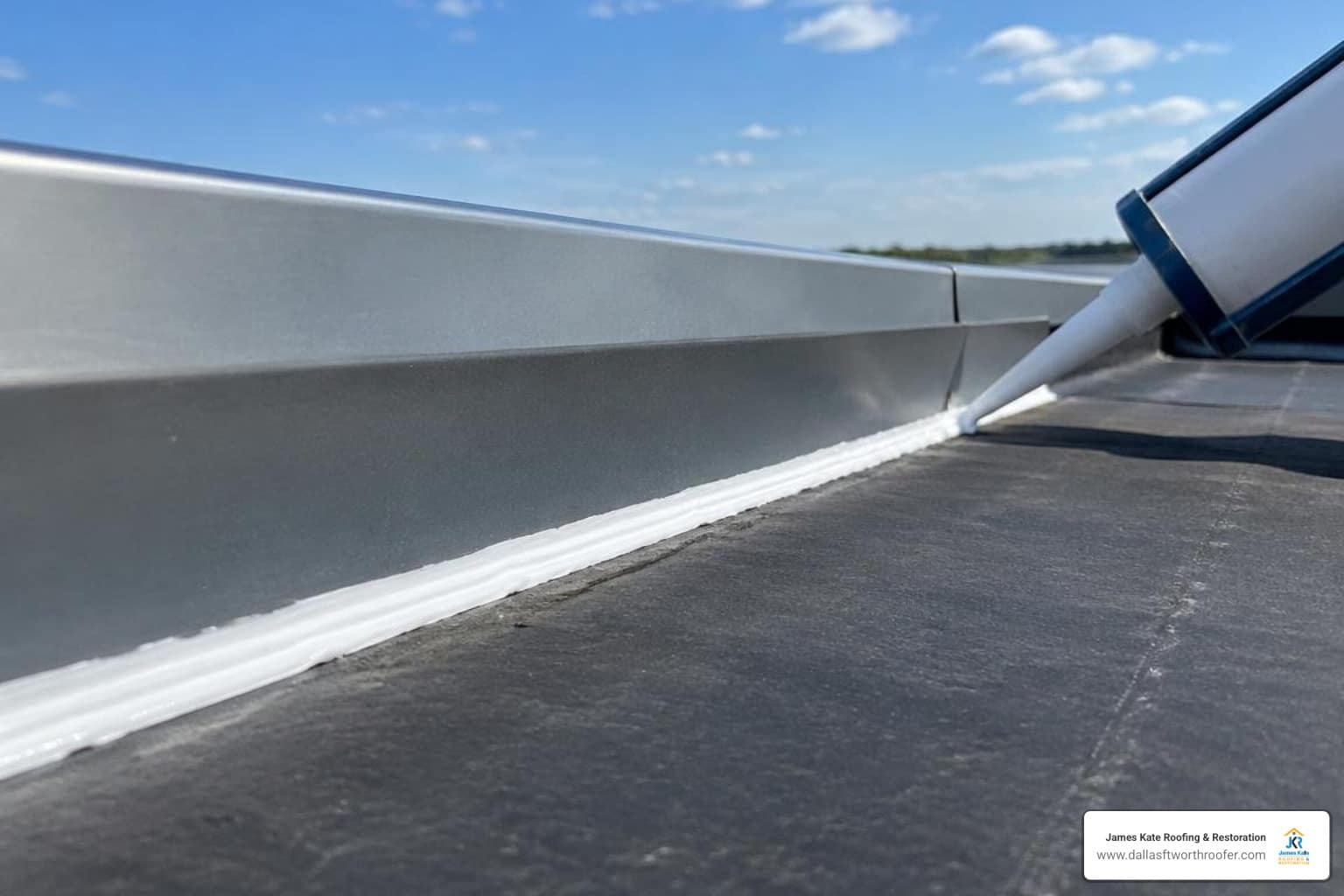
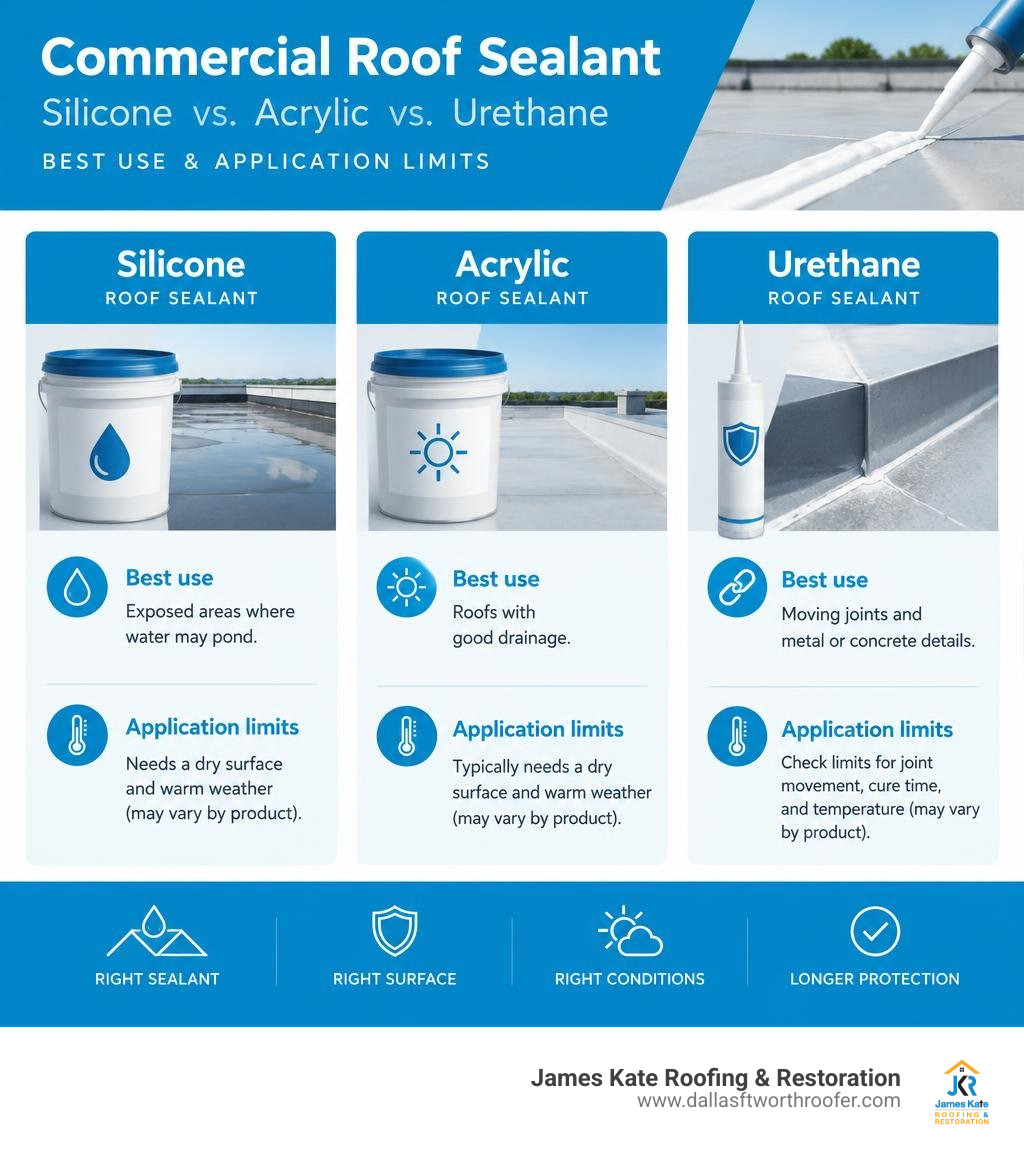
Choose by roof surface and repair type, not just by brand. Silicone coatings are often a fit for exposed areas where water may pond, but only if the product is rated for that use. Acrylic coatings work best on roofs with good drainage. Urethane sealants suit many moving joints and metal or concrete details. For EPDM, TPO, or PVC, check the membrane maker’s approved repair products before applying any sealant.
Application conditions matter, too. Some products need a dry surface and warm weather; others can be applied to damp surfaces or in the cold. Check those limits, along with joint movement and cure time, before work starts.
I’m Dustin Eatman, owner of James Kate Roofing & solar. My commercial roofing work includes finding leaks, planning targeted repairs, and checking whether a commercial roof sealant fits the roof system and the job.
Glossary for commercial roof sealant:
Commercial Roof Sealant Chemistries: Silicone, Urethane, and Hybrid Formulations Compared
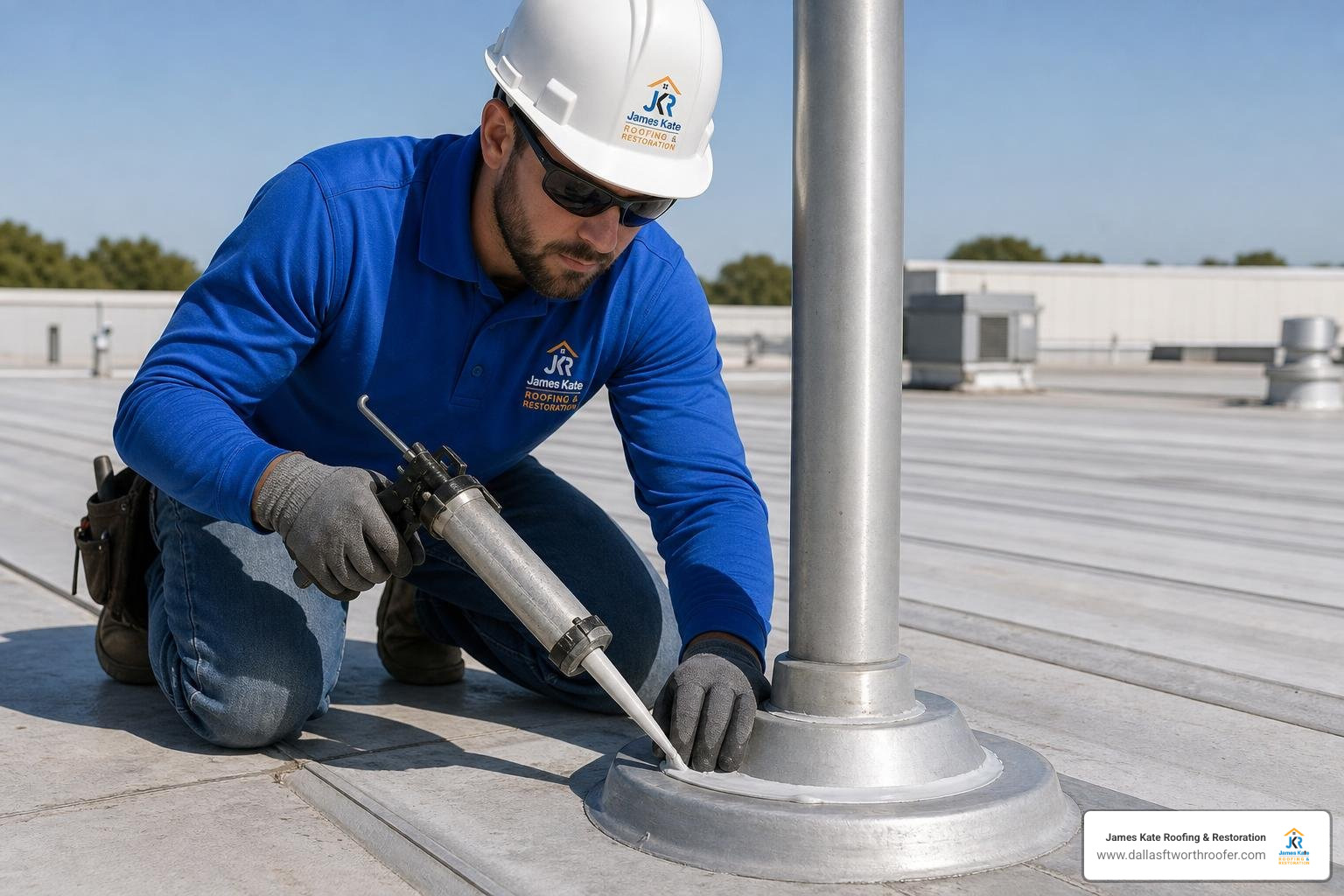
Selecting the right chemistry is the foundation of any long-lasting roof repair. Roofs endure intense thermal expansion, ultraviolet degradation, and mechanical vibration. A formula designed for static masonry gaps will quickly fail if applied to a moving metal roof reglet.
Modern roof maintenance relies on several distinct chemical families, ranging from moisture-curing urethanes and hybrid polymers to solvent-based synthetic rubbers and pre-formed elastomeric tapes. When combined with protective commercial roof coatings, these sealants form an impervious barrier against driving rain and severe weather across Texas facilities.
| Sealant Type | Primary Chemistry | Key Strengths | Movement Capability | Typical Cure Time |
|---|---|---|---|---|
| Polyurethane | Polyurethane prepolymer | High tensile strength, excellent tear resistance, paintable | $\pm 25\%$ to $\pm 50\%$ | 24–48 hours (tack-free: 6–8 hrs) |
| Hybrid Polymer (MS/STPE) | Silyl-modified polyether | Zero shrinkage, 100% solids, damp-surface adhesion, solvent-free | $\pm 25\%$ | 24 hours (skin: 5 mins) |
| Rubberized Sealant | Synthetic rubber / Block copolymer | Crystal-clear aesthetics, extreme low-temperature flexibility | $\pm 25\%$ | 24–48 hours (immediate rain-ready) |
| MicroSealant Tape | Synthetic resins & non-curing rubber | Zero cure time, self-priming, permanent elastomeric barrier | High ($\approx 700\%$ elongation) | Instant mechanical bond |
Polyurethane and Urethane Sealants
Polyurethane sealants are the workhorses of commercial roof construction. Formulated as single-component, moisture-curing compounds, they react with ambient humidity to form tough, flexible rubber seals.
Industrial options like TremSEAL offer a medium modulus with an exceptional joint movement capability of $\pm 50\%$. With a tensile strength ranging from 350 to 450 psi and elongation values between 800% and 900%, polyurethane easily accommodates the heavy structural shifts found in perimeter parapets and coping caps.
Polyurethanes meet stringent industry standards such as ASTM C920 Type S and Federal Specification TT-S-00230C. However, they require careful top-coating coordination: they must be top-coated within a specific window (typically within 72 hours of cure) to ensure coating adhesion without needing a secondary primer.
Hybrid Polymers and MS Formulations
Modified Silane (MS) polymers and Silyl-Terminated Polyethers (STPE) combine the weather resistance of silicones with the mechanical toughness and paintability of polyurethanes. Formulations such as EVOSEAL MS and Seal Bond® 490 deliver 100% solids content with zero shrinkage, meaning the volume applied wet is the exact volume retained once cured.
These hybrid chemistries are completely free of solvents and isocyanates, keeping VOC levels low (EvoSeal MS sits at 19 g/L, and Seal Bond 490 measures 20.7 g/L). Hybrid polymers provide exceptional UV stability without yellowing or chalking, and their rapid skin-over time (often under 5 minutes) prevents dirt pickup on busy commercial jobsites.
Rubberized Liquid Sealants and Self-Priming Tapes
When immediate water resistance or extreme clarity is required, rubberized synthetic formulas and self-priming tape systems provide immediate protection. Products like ULTRA CLEAR ROOF Waterproof Rubberized Sealant | DAP Global utilize specialized elastomeric copolymers that stay crystal clear while delivering high cold-temperature flexibility under ASTM 793 testing.
For active roof seams and split membranes, pre-formed tape systems such as EternaBond® RoofSeal™ – H.B. Fuller utilize advanced MicroSealant technology. Composed of 100% solids synthetic resins and non-curing rubber backing, these tapes deliver 700% strain-at-break elongation and require no chemical cure time, bonding permanently through mechanical pressure.

Technical Specifications and Performance Criteria for Roof Joints
Evaluating a sealant requires looking beyond marketing claims to verify certified laboratory data. When addressing localized commercial roof repairs, matching the physical properties of the sealant to joint dimensions ensures long-term building envelope integrity.
Critical Performance Metrics for Commercial Roof Sealant Selection
Key technical metrics dictate how a sealant responds to continuous weather cycles:
- Joint Movement Capability: Measured under ASTM C920, this percentage reflects how much a joint can expand or compress without adhesive or cohesive failure. Polyurethanes like TremSEAL Pro manage $\pm 50\%$, while versatile options like McGuire Flexbond Universal Sealant – McGuire Roofing Products and EvoSeal MS provide $\pm 25\%$.
- Tensile Strength & Elongation: Tensile values describe mechanical holding force under tension (McGuire Flexbond achieves 700 psi; Seal Bond 490 provides 190 psi for flexible liquid flashing). Elongation measures total stretch before rupture, ranging from 212% up to 1000%.
- Operating Temperature Range: Roof surface temperatures routinely exceed ambient air levels. Standard service limits range from $-40^\circ\text{F}$ up to $200^\circ\text{F}$ (or $-75^\circ\text{F}$ to $220^\circ\text{F}$ for EvoSeal MS), ensuring resilience against sudden freeze-thaw cycles.
- Environmental Compliance & VOCs: Low-VOC formulations protect indoor air quality around HVAC intakes and help projects qualify for LEED V4 EQ Material Resource Credit 4.1.
Material Incompatibilities and Substrate Boundaries
Even premium sealants fail when placed in incompatible environments.
- Silicone Contamination: Silicone residues leave an inert, low-energy layer that chemically prevents polyurethanes, hybrids, and tapes from adhering.
- Continuous Submersion: Most gun-grade sealants are engineered for shedding water rather than permanent underwater immersion. Low spots must be leveled or treated with specialized high-solids systems to avoid premature breakdown.
- Three-Point Adhesion: Sealants must only bond to the two opposing parallel surfaces of a joint. If the sealant adheres to the bottom of the joint channel as well, movement stresses concentrate unevenly, tearing the bead. Applicators must install closed-cell polyethylene backer rods to prevent bottom bonding and maintain proper width-to-depth ratios.
Substrate Compatibility and Environmental Application Factors
A successful seal depends on proper adhesion to specific commercial roofing systems. Different roof coverings expand and contract at different rates, requiring specific surface preparations.
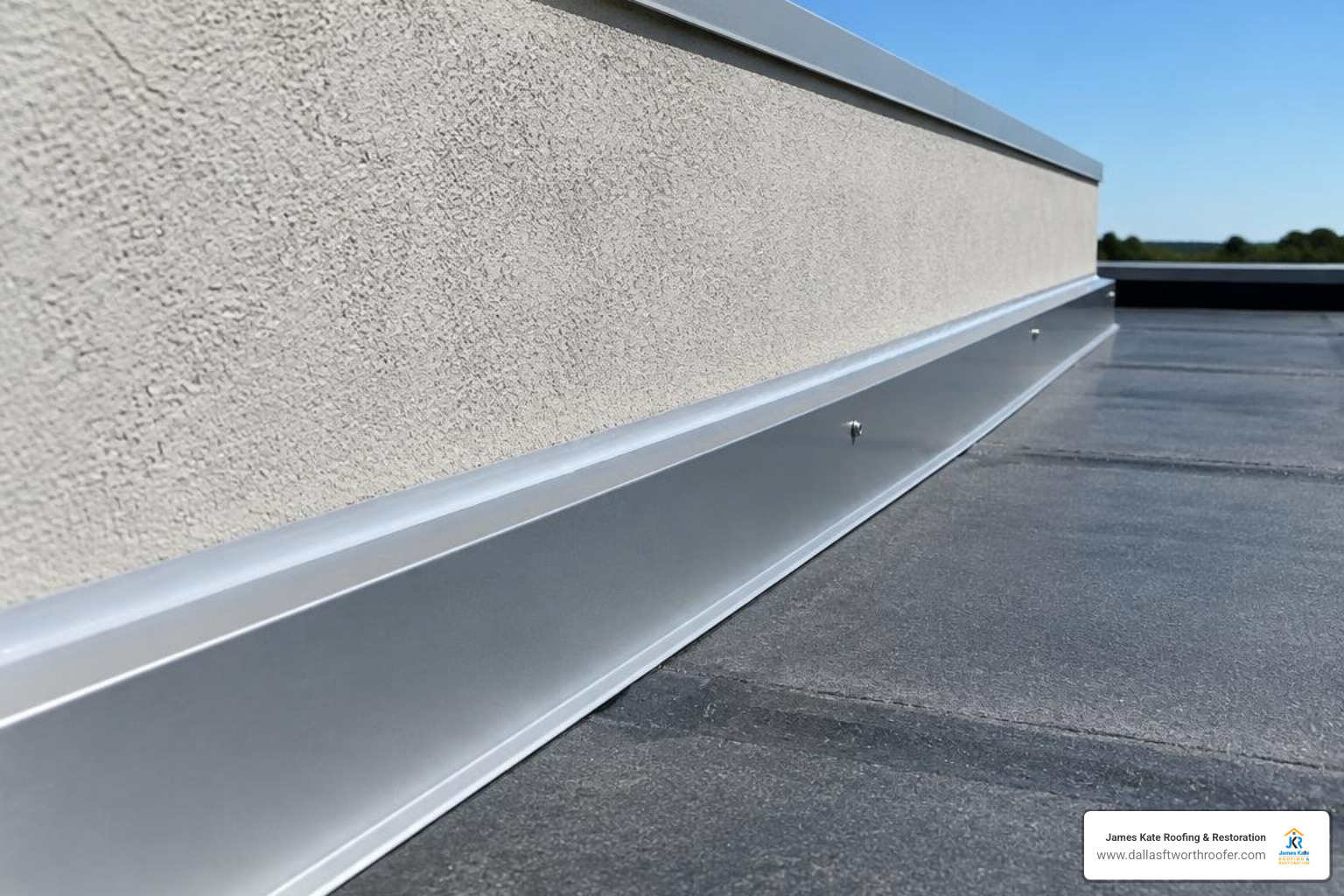
Substrate Matching Across EPDM, TPO, PVC, and Metal
- EPDM Membranes: Rubber membranes contain plasticizers that require compatible hybrid MS polymers or synthetic tape systems with integrated primers.
- TPO & PVC Single-Ply: Thermoplastics often have slick, non-porous surfaces. While hybrid sealants bond to primed TPO, solvent-wiped surfaces and specialized liquid flashings provide the highest peel strength.
- Metal Roofing (Steel, Aluminum, Kynar): High thermal expansion requires high-tensile, high-movement polyurethanes or MS polymers that grip factory-finished Kynar and galvanized metals without lifting.
- Concrete Copings & Masonry: Porous concrete surfaces benefit from medium-modulus polyurethanes or non-sag hybrid polymers that penetrate surface pores without staining the facade.
Commercial Roof Sealant Application on Wet Surfaces and Cold Weather
Inclement weather frequently causes emergency roof leaks. Standard polyurethanes require dry surfaces and ambient temperatures above $40^\circ\text{F}$ ($5^\circ\text{C}$). However, specialized formulas allow for emergency winter installations:
- Wet & Damp Surface Application: Hybrid MS polymers and rubberized sealants (like DAP Ultra Clear) displace standing moisture, adhering directly to damp substrates during rain events.
- Sub-Freezing Installations: Winter-grade caulks and specialized rubberized sealants can be applied down to $0^\circ\text{F}$ ($-18^\circ\text{C}$), remaining flexible without freezing in the cartridge or cracking on cold roof decks.
- Routine Inspection: Scheduling a regular commercial roof inspection before cold weather sets in ensures vulnerable penetrations and flashings are identified before winter storms arrive.
Curing Timelines, Tooling Workflows, and Maintenance Schedules
Understanding cure mechanics ensures smooth jobsite workflows and prevents premature exposure to foot traffic or chemical washouts.
During installation, mechanics must tool the bead within 10 to 20 minutes to eliminate internal voids and ensure complete wet-out against the joint walls. Hybrid polymers skin over in as little as 5 minutes, reaching tack-free status within an hour, while heavy polyurethanes typically require 6 to 8 hours before resisting dirt pickup.
Latex-based coatings can generally be applied over hybrid sealants within 2 to 24 hours, whereas oil-based coatings require a full 24-hour cure. Commercial joint assemblies should be audited every five years to spot micro-fissuring, primer degradation, or building movement beyond initial design limits.
Frequently Asked Questions About Commercial Roof Sealants
Can roof sealants be applied over existing silicone caulk?
No. New sealants will not bond reliably to cured silicone. Silicone oil migrates into adjacent pores, creating a low-energy surface that causes adhesion failure. All old silicone must be mechanically scraped away, abraded, and solvent-cleaned before applying a new polyurethane, hybrid, or tape sealant.
How does cold weather affect sealant cure times and flexibility?
Moisture-cure sealants (like standard urethanes) rely on absolute atmospheric humidity, which drops significantly in cold temperatures, slowing the curing process. While cure rates slow down, elastomeric sealants meeting ASTM 793 retain low-temperature flexibility down to $-40^\circ\text{F}$ or lower, preventing brittle cracking during freeze-thaw cycles.
What is the difference between rain-ready and damp-surface sealant?
A damp-surface sealant can form a strong bond to a substrate that is wet to the touch. A rain-ready sealant skins over rapidly and resists wash-off from sudden downpours immediately following placement. Premium hybrid polymers and rubberized sealants provide both capabilities for wet-weather emergency repairs.
Conclusion
Choosing the right commercial roof sealant requires matching product chemistry to your specific membrane, movement requirements, and seasonal installation conditions. Whether utilizing high-elongation polyurethanes for dynamic coping joints, zero-shrink hybrid polymers for HVAC penetrations, or self-priming tapes for membrane seam reinforcement, using verified ASTM-rated solutions protects your structural investment.
For property owners throughout Arlington, Mansfield, Grand Prairie, and surrounding North Texas communities, proactive joint maintenance and protective elastomeric roof coating solutions provide long-term, weather-tested defense for your commercial facility. Contact our team at James Kate Roofing & solar to evaluate your roof system and ensure your building stays watertight across every season.
Dustin Eatman is a seasoned roofing professional with deep, hands-on expertise that spans residential and commercial roofing, insurance solar, and long-term roof asset management. As the owner of James Kate Roofing & solar in the Dallas–Fort Worth metroplex, he’s built a reputation for diagnosing roof systems accurately, communicating clearly, and executing projects with a high standard of workmanship and documentation. Dustin understands the technical details that make roofs perform—proper underlayment selection, slope and drainage considerations, ventilation strategy, flashing and penetration detailing, and manufacturer-specific installation requirements—because he’s worked through the real-world challenges that cause leaks, premature wear, and warranty issues. He’s equally fluent in the operational side of roofing: jobsite planning, quality control, safety, material ordering, crew coordination, and customer experience from inspection to closeout. In insurance-related projects, Dustin brings practical knowledge of claim workflows, adjuster meetings, scope alignment, supplements, and the importance of photo evidence and thorough records, helping property owners navigate stressful situations with confidence. For commercial clients—especially property and facility managers—he emphasizes proactive maintenance and targeted repairs that reduce disruption, extend roof life, and prevent expensive interior damage. Dustin also stays focused on doing things the right way: educating customers on realistic options, setting expectations, and prioritizing solutions that hold up over time rather than quick fixes. That blend of technical skill, field experience, process discipline, and owner-level accountability is what makes Dustin Eatman a trusted expert in the roofing industry.