Key Factors That Determine the Cost of Fixing Hail Damage on Car Panels
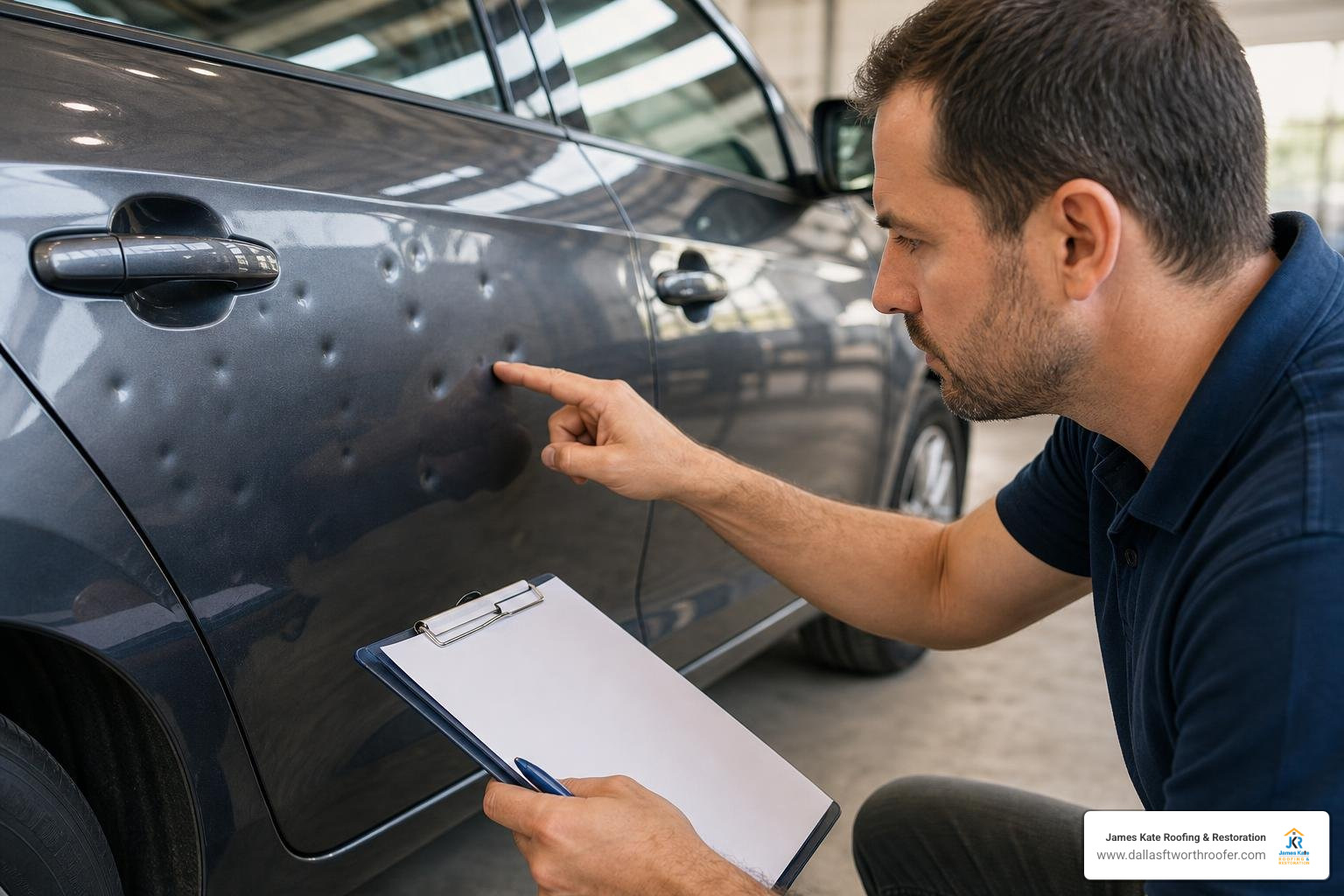
The cost of fixing hail damage on car panels generally ranges from $300 to $1,500 for minor dings, $1,500 to $4,500 for moderate multi-panel damage, and $4,500 to $8,500 or more for severe storm impacts. When a storm rolls through communities like Arlington, Mansfield, or Grand Prairie, hailstones rarely distribute their force evenly across your car, and the same system that pounds your vehicle in the driveway almost always leaves marks on your roofline as well. Calculating the true scope of storm damage requires looking far beyond a quick glance across your hood. Auto solar professionals rely on several technical variables to establish an accurate quote, and as a local roofing and solar company that inspects storm-battered homes every season, we know how closely vehicle and property damage assessments mirror one another.
A thorough estimate examines four critical factors:
- Dent density and distribution: How many impacts exist across each distinct panel.
- Substrate composition: Whether the panel is made of standard sheet steel, high-strength alloy, or aluminum.
- Clearcoat and paint integrity: Whether the factory finish is completely unbroken or shows micro-cracking and deep chipping.
- Structural accessibility: How easily technicians can access the backside of each dent without extensive vehicle disassembly.
Properly eliminating storm dents involves balancing these structural variables to choose between non-invasive metal massaging and traditional body solar.
Dent Size, Depth, and Total Impact Count
The sheer volume and geometry of impacts drive labor time. Dings caused by pea-sized hail leave shallow depressions that are simple to manipulate back into place. However, golf-ball-sized or baseball-sized hail causes high-velocity impacts that stretch the metal substrate beyond its natural elastic limits.
When metal stretches significantly or forms sharp creases along curved body lines, restoring the original shape takes considerably more precision. In severe cases, stretched metal cannot be massaged flat without panel replacement or conventional body filler. As outlined in the Hail Damage Repair Cost: 2026 National Guide, pricing rises sharply as dent depth increases and impact density exceeds dozens of hits per panel.
Steel vs. Aluminum and Vehicle Substrates
Vehicle materials play a major role in your final estimate. Traditional mild steel possesses natural “metal memory,” making it relatively straightforward for skilled technicians to reform into its original shape.
In contrast, aluminum panels—frequently used on modern pickup trucks, SUVs, and luxury electric vehicles—lack this elasticity. Aluminum is stiffer, work-hardens more quickly during manipulation, and demands specialized tools and heating techniques to avoid cracking. Because of this added technical complexity, repair facilities routinely apply a 30% to 50% labor surcharge for aluminum body panels.
Panel Location and Labor Accessibility
The cost to repair a dent also depends heavily on where it landed on your vehicle. An open flat panel like an easily accessible hood requires far less labor than a dent located on a roof rail, quarter panel, or door frame.
Technicians must access the backside of the metal to push dents out. For a roof, this means carefully dropping the interior headliner, removing pillar trim, and disconnecting delicate wiring harnesses without damaging side curtain airbags. Double-walled panels, internal reinforcement braces, and tailgate assemblies add significant labor time just for panel access. You can find helpful hood hail repair budgeting tips to see how accessibility changes overall repair costs.
Pricing Tiers: Understanding Real-World Repair Estimates
Professional auto body facilities use structured pricing matrices rather than arbitrary guesswork. These standardized charts evaluate dent count, dent diameter, and panel difficulty to produce an itemized quote.
Average Cost of Fixing Hail Damage on Car: Minor vs. Moderate vs. Severe
To help you understand where your vehicle stands after a severe storm, the table below outlines typical pricing tiers, dent counts, repair costs, and estimated turnaround times across the automotive repair industry.
| Damage Severity Tier | Typical Dent Count per Vehicle | Affected Panels | Average Cost Range | Typical Turnaround Time | Primary Repair Method |
|---|---|---|---|---|---|
| Minor / Light | 15–50 dents | 1–3 panels | $300 – $1,500 | 1–3 business days | Pure Paintless Dent Repair (PDR) |
| Moderate | 50–150 dents | 4–6 panels | $1,500 – $4,500 | 3–6 business days | PDR / Light R&I (Remove & Install) |
| Heavy / Severe | 150–300+ dents | 7–10+ panels | $4,500 – $8,500 | 1–2 weeks | PDR + Blended Refinishing |
| Catastrophic | 300+ deep dents / paint cracked | Full vehicle body | $8,000 – $15,000+ | 2–3+ weeks | Panel Replacement & Full Paint |
Per-Dent and Per-Panel Pricing Breakdown
When estimating smaller, localized damage, shops often calculate estimates using per-dent or per-panel benchmarks:
- Individual Dent Rates: Standalone dent removal generally ranges from $30 to $75 for small dings, while complex creases run between $75 and $150 per impact, as detailed in the Hail Damage Repair Cost in 2026: DMV Per-Dent Pricing guide.
- Per-Panel Averages: Lightly peppered panels cost roughly $150 to $400 each. Moderate damage runs $350 to $800 per panel, and heavily damaged panels requiring extensive access labor range from $700 to $1,500.
- Full-Vehicle Storm Hits: A car with moderate damage across eight panels commonly totals between $2,000 and $4,000 in professional repair costs.
Repair Methods: Paintless Dent Repair (PDR) vs. Conventional Body Shops
Choosing the right repair method is critical for protecting both your wallet and your car’s resale value. Today, the collision industry relies on two primary approaches: Paintless Dent Repair (PDR) and traditional body shop reconstruction.
Comparing the Cost of Fixing Hail Damage on Car Panels: PDR vs. Traditional Body Work
Paintless Dent Repair is the preferred industry standard whenever the factory paint remains intact. Highly trained technicians use specialized metal rods, hand picks, and LED reflection boards to systematically massage the dented sheet metal back to its original contour from behind the panel.
Conventional repair, on the other hand, involves grinding away the clearcoat and paint, applying plastic body filler (bondo), priming, sanding, and completely repainting the affected surfaces in a spray booth.
Understanding what to expect during PDR hail damage repair helps clarify why non-invasive dent removal is the superior choice whenever your finish is intact.
| Comparison Factor | Paintless Dent Repair (PDR) | Traditional Body Shop Repair |
|---|---|---|
| Average Cost | 40% to 70% less expensive | Significantly higher (materials + booth labor) |
| Factory Paint | 100% preserved (retains OEM e-coat) | Stripped, filled, and resprayed |
| Turnaround Time | 2 to 5 business days | 1 to 3+ weeks |
| Carfax / Resale Impact | No negative impact reported | Reported as paint/bodywork repair |
| Best Use Cases | Unbroken paint, round dents, accessible metal | Cracked clearcoat, torn metal, sharp body creases |
Repair Timelines and Vehicle Turnaround
Turnaround times depend on repair complexity and seasonal demand. Following major hail events in North Texas communities like Granbury or Midlothian, local body shops quickly face multi-week backlogs.
Pure PDR repairs on lightly damaged vehicles can often be wrapped up in 24 to 72 hours. In contrast, conventional body shop repairs require paint curing, multi-stage sanding, and clearcoat buffing, extending turnaround times to 10–15 business days. Factor these timelines into your decision if your policy does not provide rental car reimbursement.
Insurance Claim vs. Out-of-Pocket: Running the Deductible Math
Deciding whether to file a claim with your auto insurance carrier or pay cash out of pocket comes down to simple math and policy terms.
Comprehensive Coverage and Deductible Breakeven
Hail damage falls under your policy’s Comprehensive coverage (sometimes listed as “Other Than Collision”), not Collision coverage. Comprehensive claims are classified as no-fault “Acts of God.”
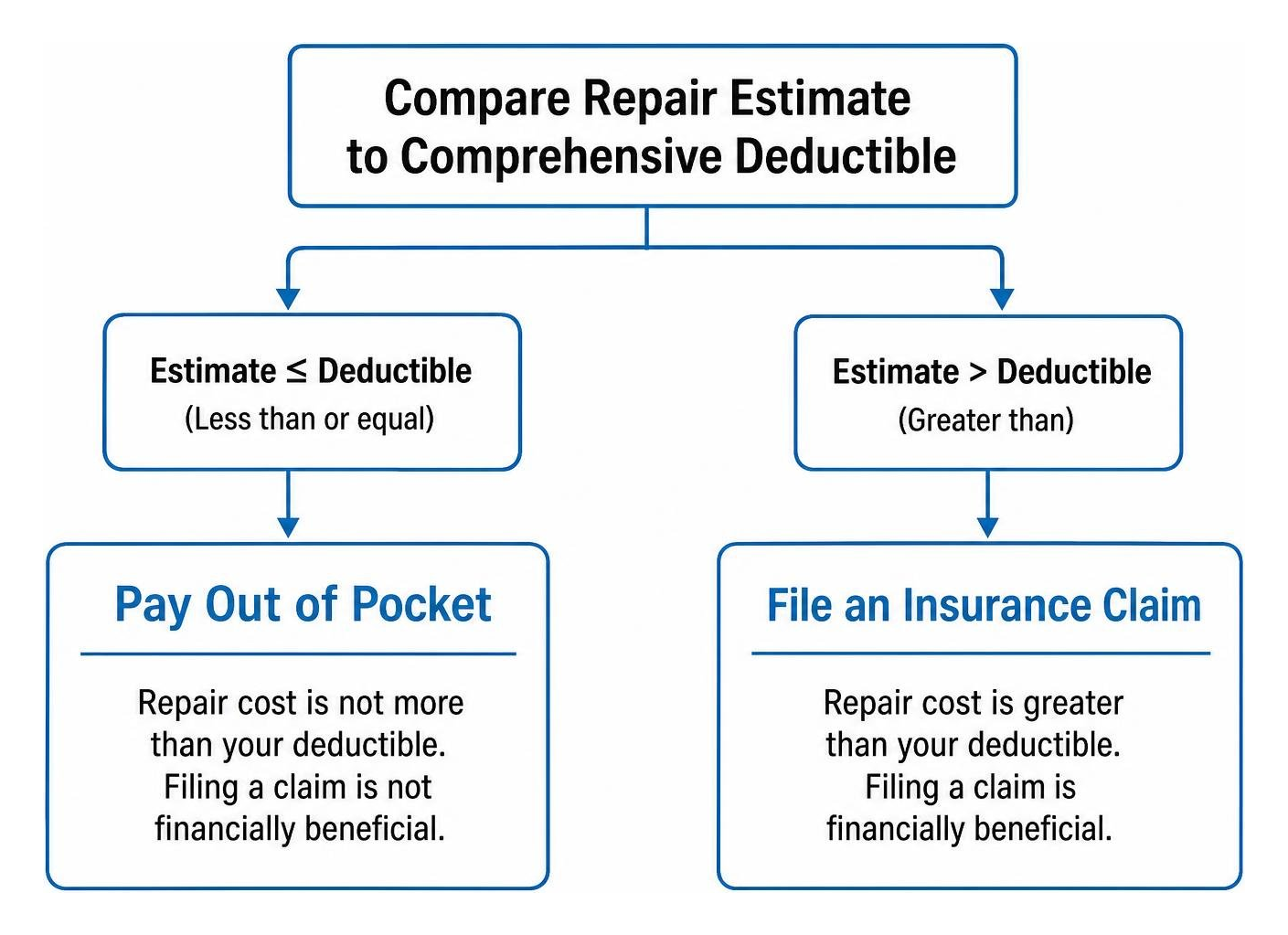
To decide whether to file a claim, compare your written repair estimate to your deductible:
- Estimate is lower than your deductible: Pay out of pocket. For example, if your estimate is $450 and your deductible is $500, your insurer pays $0.
- Estimate is 1.5x to 2x your deductible: Paying cash is often wise. If the repair bill is $850 and your deductible is $500, paying out of pocket avoids an unnecessary claim entry on your vehicle history.
- Estimate exceeds 3x to 5x your deductible: File a comprehensive claim. If widespread storm damage totals $3,800, paying your $500 deductible saves you $3,300 in out-of-pocket expenses.
Because comprehensive claims are no-fault, a single hail claim typically will not raise your individual insurance premium, though insurers may adjust regional base rates across entire ZIP codes after major storms.
Total Loss Thresholds and Depreciation Risks
When severe hailstorms strike, widespread damage across roof skins, hoods, and quarter panels can push repair estimates past the vehicle’s market value.
Insurers declare a vehicle a total loss when repair expenses exceed a specific percentage of its Actual Cash Value (ACV). While some states set statutory thresholds between 70% and 80%, other states use a Total Loss Formula (Repair Cost + Salvage Value ≥ ACV). Reviewing how hail damage affects car resale value helps explain why heavy cosmetic damage on older vehicles frequently leads to a total-loss settlement.
Protecting Your Investment: Avoiding Scams and Untreated Damage Risks
Severe weather brings out opportunistic, transient repair operations commonly known as “storm chasers.” Protecting your investment means working only with established, reputable businesses.
Spotting Storm Chaser Scams and Red Flags
After a major weather event, transient dent teams travel from state to state, setting up temporary tents in empty parking lots. While some are skilled subcontractors, many perform low-quality work and skip town before defects appear.
Watch out for these common warning signs:
- “We’ll cover your entire deductible”: Offering to illegally inflate estimates to absorb your deductible violates Texas insurance fraud statutes.
- No permanent physical address: Avoid pop-up operators who cannot provide a verifiable local shop location or permanent business presence.
- High-pressure immediate signing: Never sign an authorization contract or power of attorney before receiving an itemized quote.
- No written warranty: Reputable repair centers provide a written lifetime warranty covering metal movement and clearcoat stability.
Finding a dependable local professional requires following proven steps for identifying trusted hail repair professionals in your area.
The Long-Term Costs of Delaying Auto Hail Repairs
Ignoring hail dents might feel like an easy way to save money, but postponing repairs introduces costly long-term issues:
- Clearcoat failure and oxidation: Deep impacts create micro-fissures in the clearcoat, allowing moisture and UV rays to penetrate, oxidize the paint, and blister the finish.
- Body panel rust: Once ambient moisture reaches the bare metal beneath cracked paint, rust quickly spreads beneath the surface.
- Severe trade-in penalties: Dealerships and private buyers heavily discount dented vehicles, often deducting $2,000 to $4,000 below clean market value.
- Pre-existing damage claim denials: If your vehicle is hit by a second storm, insurers will document and deduct the prior unrepaired damage from your new claim check.
Frequently Asked Questions About Hail Damage Repair Costs
Can I fix hail dents myself with a DIY kit or heat techniques?
Using DIY glue-pull kits, slide hammers, or heat guns with dry ice is rarely successful on modern automotive sheet metal. These methods often stretch the metal, pull high spots, or crack delicate clearcoats. Weighing DIY dent removal vs hiring a pro makes it clear that professional PDR tools and calibrated reflection boards are essential for clean, undetectable repairs.
Is it worth fixing hail damage on an older or low-value vehicle?
If the repair estimate approaches or exceeds the car’s market value, fixing cosmetic blemishes may not make financial sense. If you carry comprehensive coverage on an older vehicle, your insurer may issue an Actual Cash Value settlement. You can choose to retain the vehicle with a payout, though the title may be branded depending on your state’s salvage thresholds.
Will filing an auto hail damage claim increase my insurance premiums?
Generally, no. Hail damage is classified under comprehensive coverage as an act of nature outside your control. Unlike at-fault collision accidents, a single comprehensive claim rarely triggers an individual surcharge. However, insurers may adjust regional risk ratings across entire counties or ZIP codes following widespread catastrophic weather.
Conclusion
Handling the aftermath of a severe storm can feel overwhelming, but you do not have to navigate the recovery process blindly. By counting damaged panels, checking paint integrity, and running the math against your comprehensive deductible, you can make confident, cost-effective decisions for your vehicle.
Severe weather that leaves dents in your vehicle rarely spares your home. As a family-owned company rooted in honesty, integrity, and Biblical principles, we bring the same careful approach to your home’s exterior. If severe hail recently swept across your neighborhood, take time for inspecting home and roof storm damage alongside your vehicle inspection.
When you need an honest property assessment backed by GAF President’s Club recognition and up to a 25-year workmanship warranty, contact James Kate Roofing & solar to ensure your home remains safe, dry, and fully protected.
Dustin Eatman is a seasoned roofing professional with deep, hands-on expertise that spans residential and commercial roofing, insurance solar, and long-term roof asset management. As the owner of James Kate Roofing & solar in the Dallas–Fort Worth metroplex, he’s built a reputation for diagnosing roof systems accurately, communicating clearly, and executing projects with a high standard of workmanship and documentation. Dustin understands the technical details that make roofs perform—proper underlayment selection, slope and drainage considerations, ventilation strategy, flashing and penetration detailing, and manufacturer-specific installation requirements—because he’s worked through the real-world challenges that cause leaks, premature wear, and warranty issues. He’s equally fluent in the operational side of roofing: jobsite planning, quality control, safety, material ordering, crew coordination, and customer experience from inspection to closeout. In insurance-related projects, Dustin brings practical knowledge of claim workflows, adjuster meetings, scope alignment, supplements, and the importance of photo evidence and thorough records, helping property owners navigate stressful situations with confidence. For commercial clients—especially property and facility managers—he emphasizes proactive maintenance and targeted repairs that reduce disruption, extend roof life, and prevent expensive interior damage. Dustin also stays focused on doing things the right way: educating customers on realistic options, setting expectations, and prioritizing solutions that hold up over time rather than quick fixes. That blend of technical skill, field experience, process discipline, and owner-level accountability is what makes Dustin Eatman a trusted expert in the roofing industry.