PDR Hail Damage: A Fast Way to Restore Your Vehicle
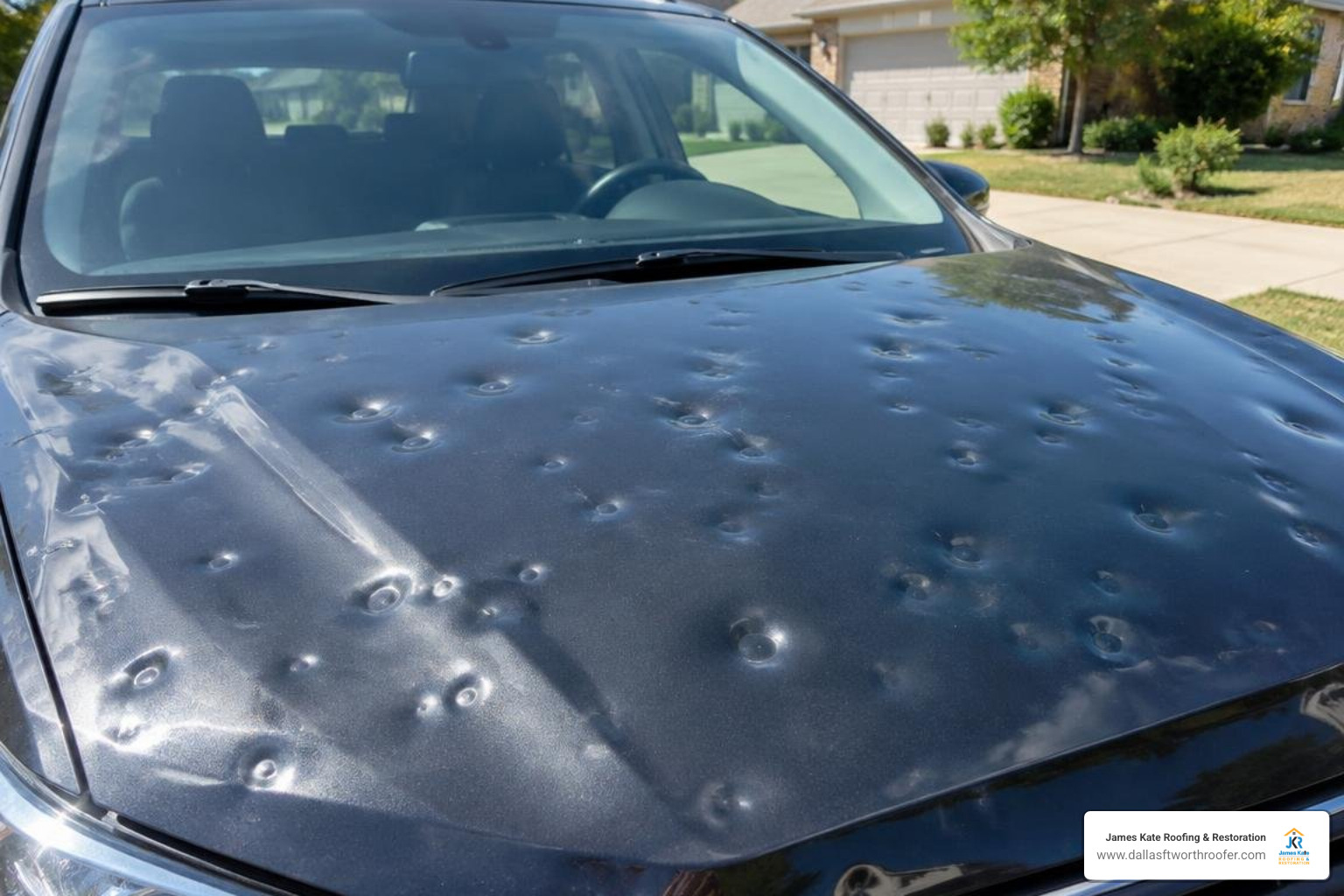
PDR hail damage repair removes many hail dents without sanding, filler, or repainting. If the paint is still intact, a trained technician can assess each panel, map the dents, and carefully return the metal toward its original shape using specialized tools.
After a hailstorm, take these steps:
- Photograph dents, chipped paint, cracked glass, and damaged trim before cleaning or repairing anything.
- File a comprehensive insurance claim if you carry that coverage, then confirm your deductible.
- Get a panel-by-panel inspection. Shallow, rounded dents with unbroken paint are often good PDR candidates.
- Use traditional body repair instead when paint is cracked, metal is sharply creased or stretched, or a panel cannot be safely accessed.
PDR protects the factory finish, which is often the best outcome for appearance and resale value. But it is not a one-size-fits-all fix: deep dents, panel edges, prior body filler, and some aluminum-panel damage may require a different repair plan.
I am Dustin Eatman, owner of James Kate Roofing & solar, with hands-on experience in DFW storm solar, damage documentation, and insurance claim workflows. While my work centers on property solar, I understand how PDR hail damage fits into a complete, well-documented recovery after a severe storm.
Must-know pdr hail damage terms:
What Is PDR Hail Damage Repair and How Does It Work?
Paintless Dent Repair (PDR) is an art and science that manipulates distorted metal back into its factory shape without disturbing the original exterior paint coating. When hail strikes a vehicle, it causes localized metal deformation. Fortunately, modern automotive sheet metals possess an inherent elastic property often called “metal memory.” As long as the metal has not been stretched past its plastic limit and the paint remains unbroken, the panel can be massaged back into position.
Unlike traditional methods that grind down paint, fill depressions with body plastic (bondo), and respray the entire panel, PDR respects the vehicle’s original assembly-line integrity. Technicians accomplish this using two primary techniques:
- Specialized Metal Rods (Pushing from Behind): Long, custom-shaped stainless steel and carbon rods are navigated through structural access channels, window openings, or inner panel cutouts. By applying gradual micro-pressures (often 20 to 40 delicate pushes per dent), technicians slowly lift the center and shoulders of the crater.
- Glue Pulling Tabs (Working from the Outside): When the backside of a panel is obstructed by structural bracing or double-walled frames (common on roof rails and quarter panels), technicians use high-tensile hot glue and specialized polymer tabs. Once bonded to the dent’s center, a mechanical lifter gently draws the low spot upward from the exterior face.
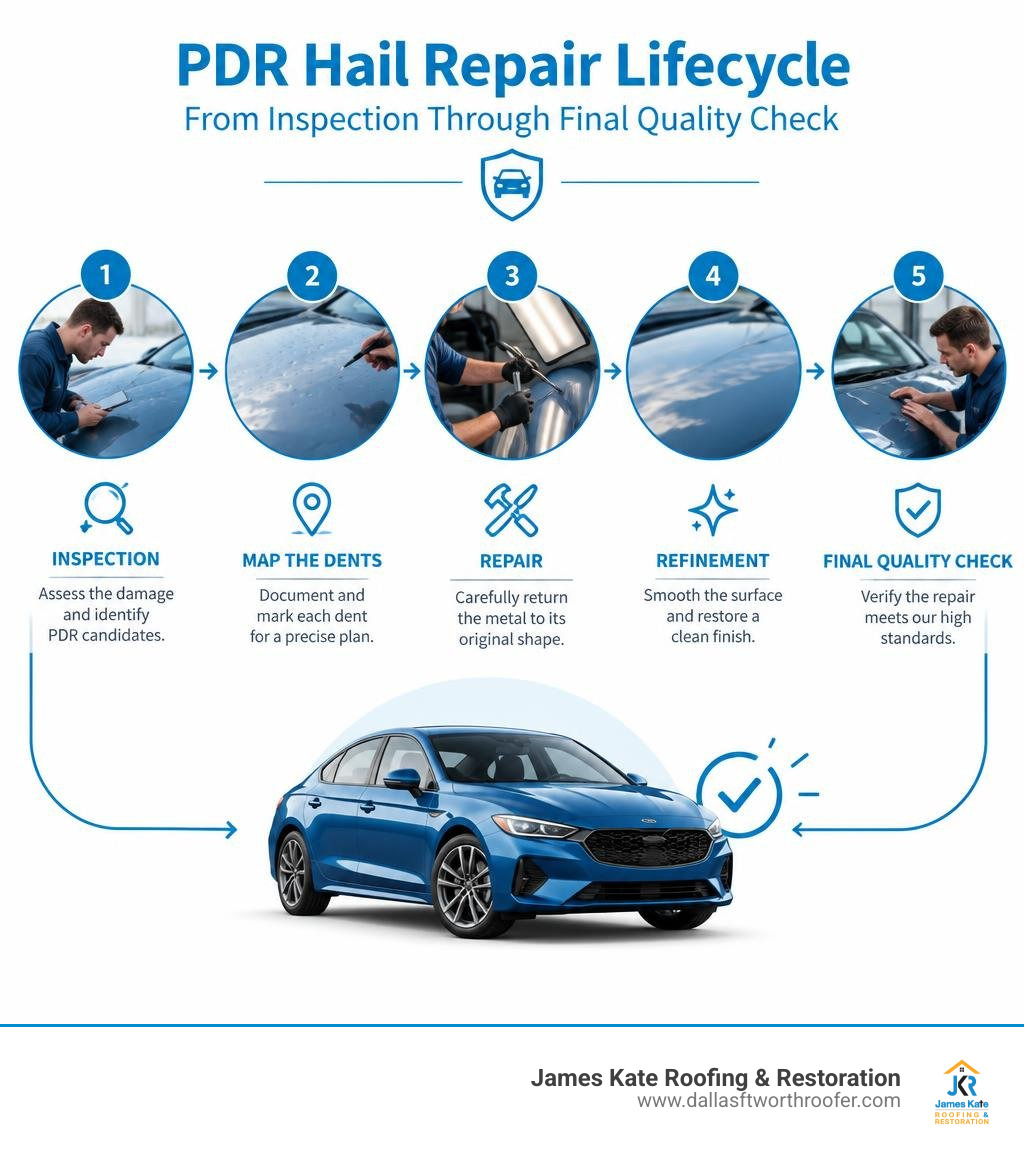
Following a certified Hail Damage PDR Workflow ensures that each impact point is systematically tracked, addressed, and cross-checked against strict quality standards.
The 5-Factor Qualification for PDR Hail Damage
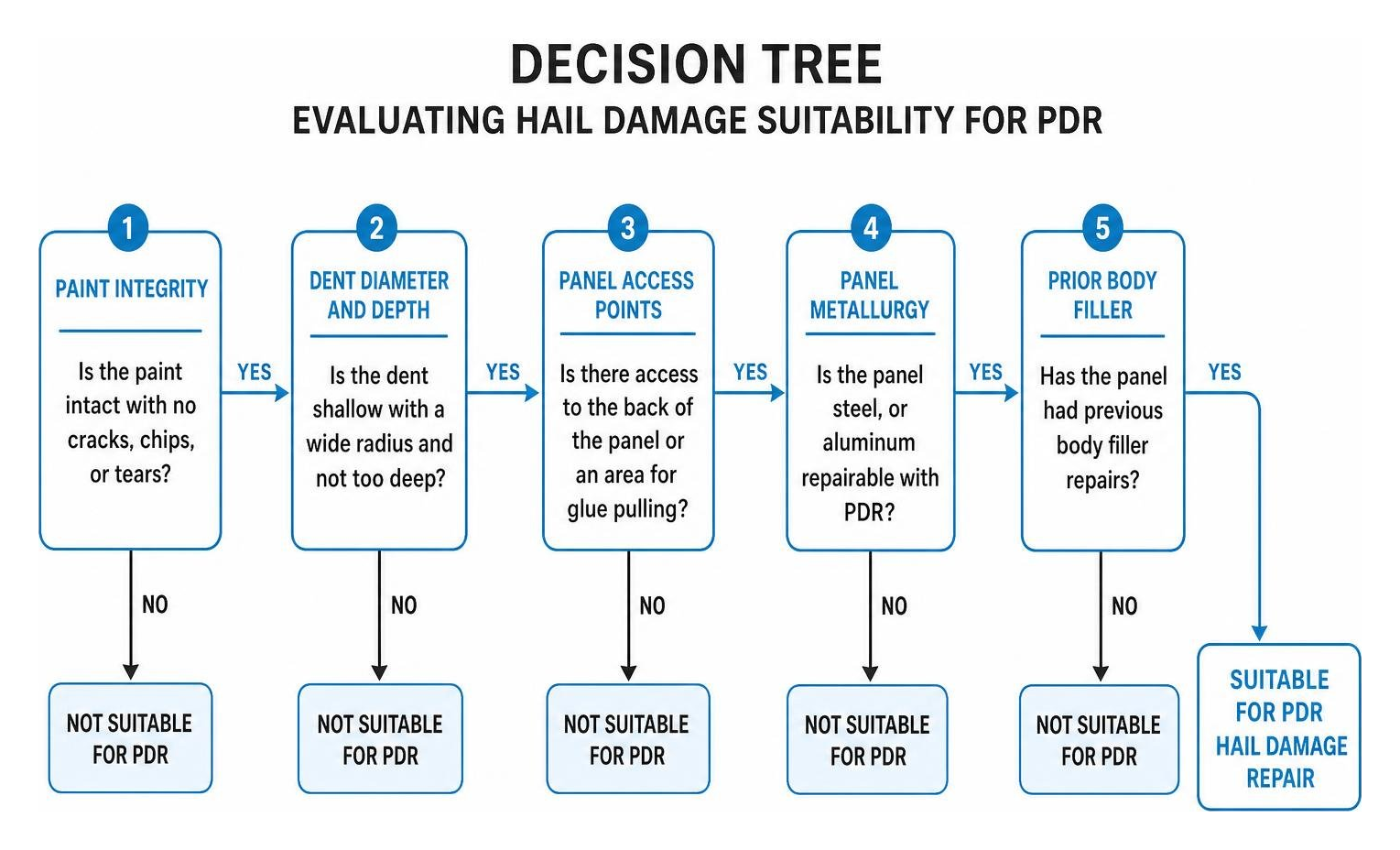
Not every storm impact can be resolved with paintless methods. Before any work begins, a certified technician evaluates every individual panel against five core criteria:
- Paint Integrity: The automotive clear coat and base coat must be completely flexible and free from micro-fissures, chips, or tears. If the paint cracked under hail impact, PDR cannot reseal the finish; moisture will seep into the substrate, initiating rust.
- Dent Diameter and Depth: Shallow, wide-radius impacts respond best to PDR. Extremely sharp, deep depressions—resembling pointed punctures—indicate excessive metal stretching where the material has exceeded its elastic limits.
- Panel Access Points: Technicians must have safe, uninhibited access to the backside of the dented sheet metal or an unobstructed surface for exterior glue pulling.
- Panel Metallurgy (Aluminum vs. Steel): Aluminum panels are increasingly popular on modern hoods, roofs, and tailgates due to weight savings. However, aluminum is stiffer, thicker, and possesses substantially less natural shape memory than mild steel. While aluminum can certainly be repaired via PDR, it requires specialized high-pressure tools, more technical exertion, and a narrower tolerance for deep dents.
- Prior Body Filler Detection: Panels that have undergone previous traditional collision repairs involving body filler cannot be repaired with PDR. The structural rigidity of aftermarket filler will shatter or delaminate under rod pressure or glue pulling.
Step-by-Step PDR Hail Damage Workflow
A complete paintless solar requires a surgical, multi-stage workflow:
- Panel Cleaning and Surface Decontamination: Road film, wax, and debris are completely removed to reveal subtle surface textures and protect the paint finish during repair.
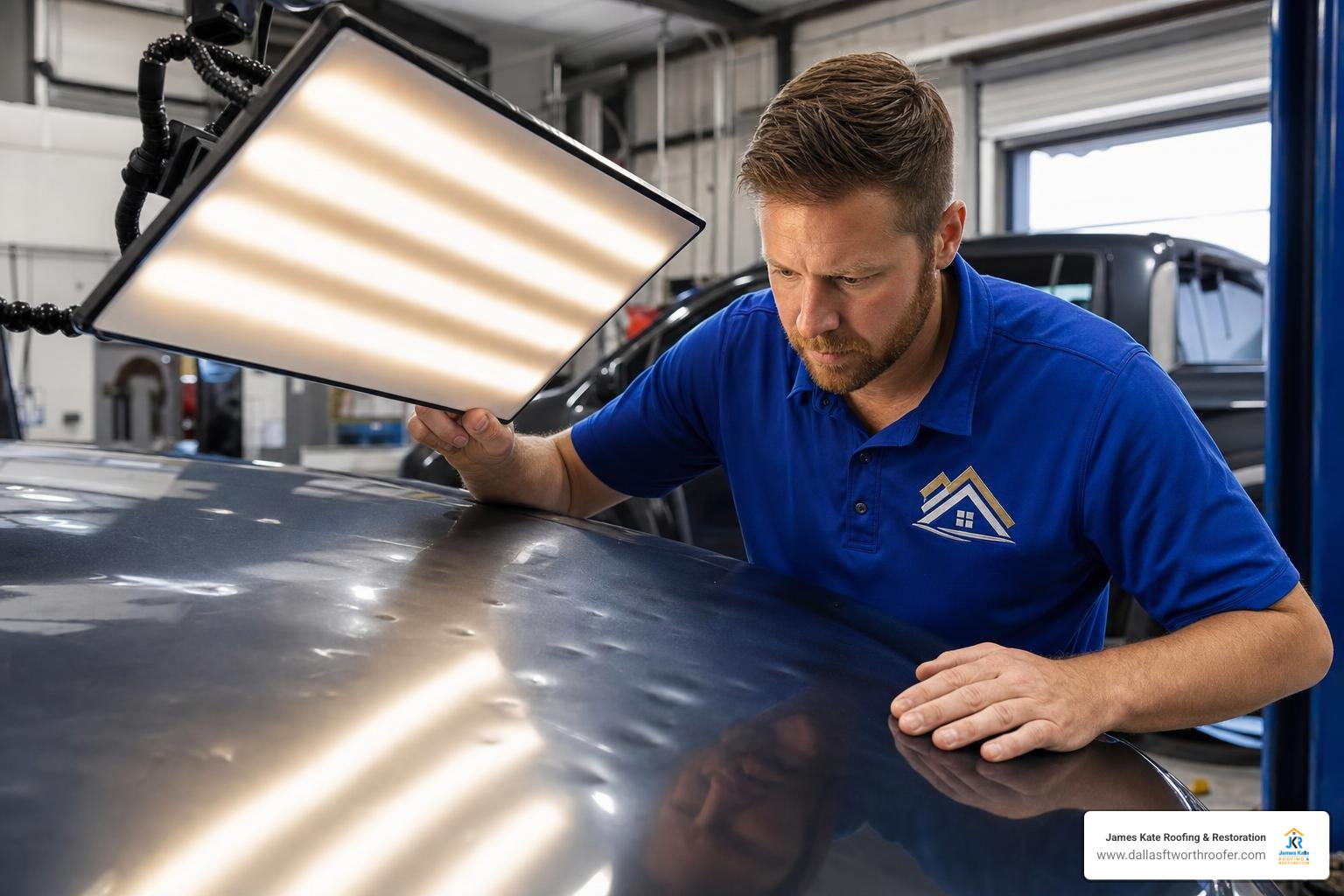
- High-Definition Reflection Board Mapping: Using optical LED line or shadow boards, technicians project parallel light bars across the panels. Dents distort these reflected lines, making even micro-dents visible to the naked eye. Every dent is marked with a water-soluble grease pencil.
- Interior Trim and Liner Disassembly: Technicians carefully detach hood insulation pads, trunk liners, taillights, or drop vehicle headliners to gain clear leverage behind the metal panels.
- Precision Metal Massaging & Glue Extraction: The technician applies steady, calculated pressure from behind with specialized rods, or leverages exterior glue pulling kits on obstructed panels.
- Knockdown and High-Spot Blending: Lifting metal can occasionally create subtle outward tension ridges (high spots). The technician uses precision-machined polymer or wood knockdown punches paired with light tap hammers to blend the raised metal perfectly flush with the factory contour.
- Final Reflection Quality Assurance: The vehicle is inspected under cross-angled reflection boards to ensure every panel displays continuous, undistorted reflection lines across all sight angles.
PDR vs. Traditional Auto Body Repair: Key Differences
When deciding between paintless solar and a conventional body shop repair, understanding the functional differences helps vehicle owners protect both their wallet and their vehicle’s long-term resale value.
| Comparison Factor | Paintless Dent Repair (PDR) | Traditional Auto Body Repair |
|---|---|---|
| Primary Method | Mechanical metal massage & glue pulling | Sanding, body filler/bondo, primer, repainting |
| Factory Paint | 100% Preserved original OEM finish | Removed and replaced with aftermarket respray |
| Average Turnaround | 2 to 5 business days | 1 to 3+ weeks (waiting on paint cure & parts) |
| Typical Cost Range | $50 – $150 per dent (matrix-based) | $500 – $1,500+ per individual panel |
| Resale Value Impact | Retains full trade-in value | Potential 10–20% decrease due to repainted panels |
| Color Match Risk | Zero (no paint is mixed or sprayed) | Risk of orange peel texture or mismatched shades |
| Vehicle History Impact | Minimal impact on vehicle history reports | Flags paint/bodywork history on vehicle checks |
Preserving your original factory paint is worth real money. Dealerships and prospective buyers frequently utilize electronic paint depth meters during pre-purchase trade appraisals. Factory paint typically measures between 4.0 to 6.0 mils in thickness with uniform consistency across every body panel.
When a traditional collision center grinds, fills, and sprays a panel, that measurement jumps significantly to 9.0–15.0+ mils. This thickness disparity reveals structural paintwork immediately, often sparking buyer concerns regarding hidden collision history and triggering trade-in deductions ranging from 10% to 20%.
The Risks of DIY Hail Repair Kits
With retail DIY suction kits and bridge pullers widely available online for $17 to $86, many car owners consider fixing hail dimples at home over the weekend. However, attempting DIY paintless repair on hail damage without extensive training carries severe risks:
- Over-Pulling and “Volcano” High Spots: Amateur pulling frequently draws the center of the dent too far outward, creating permanent outward pimples or crown ridges. These “volcanoes” are substantially more difficult and expensive for a professional to repair than the original depression.
- Severe Metal Stretching: Metal is malleable, but aggressive, untrained tool leverage permanently thins and stretches the structural grain of the steel or aluminum. Once sheet metal is over-stretched beyond its memory threshold, PDR becomes impossible, forcing an expensive body-shop panel replacement.
- Clear Coat Delamination: Pulling with excessive glue tension or failing to use proper thermal pre-heating on cold panels can rip the factory clear coat straight off the primer. Once the paint lifts, the entire panel must be chemically stripped, sanded, and repainted.
A simple $50 dent can rapidly turn into a $1,200 panel replacement due to DIY mistakes.
Estimating Costs, Insurance Claims, and Timelines
Professional hail estimating relies on a standardized, industry-wide metric known as matrix pricing. Rather than estimating arbitrary labor hours, repair costs are calculated by counting the total number of impacts per panel and measuring their individual diameter class:
- Dime-sized: Under 0.5 inches
- Nickel-sized: 0.5 to 0.75 inches
- Quarter-sized: 0.75 to 1.0 inch
- Half-dollar-sized: 1.0 to 1.25 inches
- Golf-ball-sized: 1.5+ inches
For an in-depth breakdown of standard valuation matrices, review this Hail Damage Estimating Guide – PDR University.
On average, individual hail dents cost between $50 and $150 each to repair via PDR. A vehicle with light storm damage (20 to 40 minor dents) typically totals between $750 and $1,500, whereas moderate to severe hail events (50 to 200+ impacts across multiple panels including hoods, roofs, and trunk lids) typically range from $2,500 to $6,000+.
Hail damage is filed under your policy’s Comprehensive Coverage, which protects against environmental hazards, weather strikes, falling objects, and theft. Because hail is an unpredictable act of nature, insurance providers classify it as a no-fault weather event.
When filing a claim:
- Contact your carrier immediately after the storm to open a claim ticket.
- An insurance adjuster will either inspect the vehicle or review detailed photographic mapping provided by your chosen repair facility.
- If hidden damage or supplemental access requirements (such as labor for dropping a complex panoramic roof headliner) are discovered during disassembly, the technician will submit a supplemental itemized matrix directly to your insurance company.
- Under Texas consumer law, you maintain the legal right to choose any certified repair shop you trust.
How to Choose a Certified Technician and Avoid Storm Scams
Severe hailstorms attract transient repair operations—frequently referred to as “storm chasers.” These pop-up outfits roll into town following severe weather, rent temporary parking lot space, rush repairs using aggressive techniques, and pack up before local owners notice hidden problems like broken interior panel clips, cracked paint rims, or rattles.
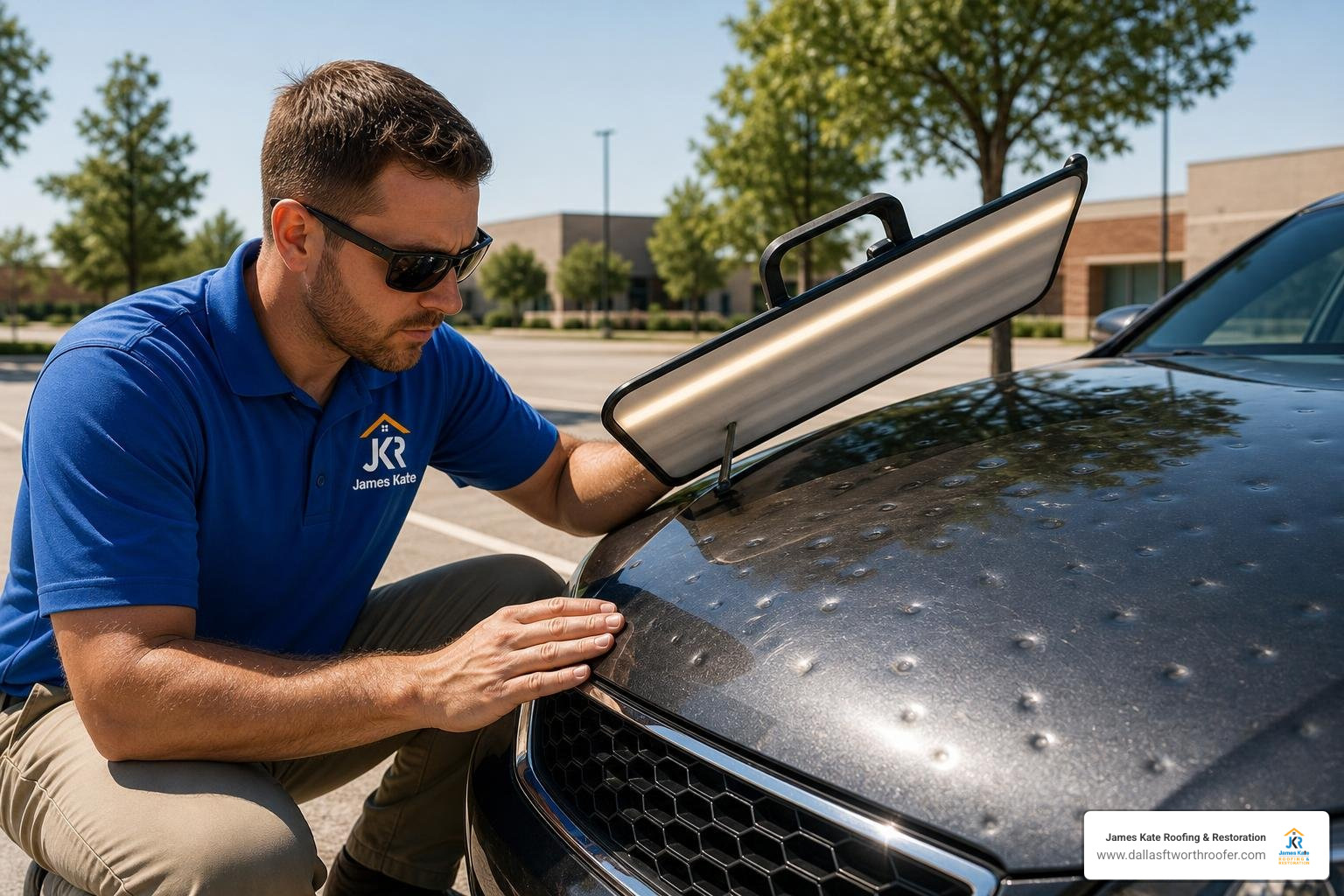
When selecting a trusted paintless dent repair facility, look for these key standards:
- Physical Local Presence: Partner with established shops operating within your local region (such as Mansfield, Arlington, Grand Prairie, Midlothian, or Granbury, TX). Established facilities stand behind their craft long after storm season passes.
- Written Lifetime Workmanship Warranty: Reputable shops provide clear, written warranties covering their dent solar and paint integrity for as long as you own the vehicle.
- Insurance Direct-Billing Capability: Trustworthy professionals handle all communication, supplemental line items, and payout arrangements with your insurance provider directly.
- Advanced Tooling & Controlled Reflection Facilities: High-caliber PDR requires dedicated interior light tunnels, optical reflection boards, and specialized tooling designed specifically for modern high-strength steels and aluminum alloys.
Frequently Asked Questions About Hail Dent Repair
Will filing a hail claim increase my auto insurance premiums?
No. Comprehensive hail claims are classified as zero-fault acts of nature. Unlike collision claims where driver negligence is assigned, weather-related comprehensive claims do not add risk points to your personal driving record. However, overall regional insurance rates can adjust over time across an entire zip code if massive catastrophic storms impact thousands of homes and vehicles in a single season.
How long does a full-vehicle hail repair take?
A typical vehicle with moderate hail damage repaired via PDR takes 2 to 5 business days. This includes initial reflection mapping, interior trim removal, dent manipulation, and final detailing. By contrast, a conventional auto body shop often requires 1 to 3 weeks or more, as they must schedule panel sanding, bondo cure times, paint booth cycles, and clear coat baking.
Can hail dents return after paintless dent removal?
No. Once the sheet metal is permanently massaged back to its original equilibrium point, the repair is permanent. Because automotive steel and aluminum possess structural elastic memory, relieving the mechanical stress in the dent locks the metal back into its factory shape. Temperature swings, direct summer heat, or cold winter snaps will not cause repaired dents to “pop back out.”
Conclusion
A destructive hailstorm can leave hundreds of unsightly dimples across your car’s hood, roof, and side panels. Opting for paintless dent repair is the fastest, most effective way to restore your vehicle to its pre-storm appearance while protecting its original factory paint and long-term resale value.
Just as a severe storm damages your vehicle, those same hailstones pound away at the roofing system, gutters, and siding of your home. When severe weather sweeps through your neighborhood, coordinating your property recovery with an honest, family-owned contractor makes all the difference. For complete peace of mind, reach out to James Kate Roofing & solar for a comprehensive Dallas-Fort Worth storm damage inspection to ensure your property remains protected and fully restored.
Dustin Eatman is a seasoned roofing professional with deep, hands-on expertise that spans residential and commercial roofing, insurance solar, and long-term roof asset management. As the owner of James Kate Roofing & solar in the Dallas–Fort Worth metroplex, he’s built a reputation for diagnosing roof systems accurately, communicating clearly, and executing projects with a high standard of workmanship and documentation. Dustin understands the technical details that make roofs perform—proper underlayment selection, slope and drainage considerations, ventilation strategy, flashing and penetration detailing, and manufacturer-specific installation requirements—because he’s worked through the real-world challenges that cause leaks, premature wear, and warranty issues. He’s equally fluent in the operational side of roofing: jobsite planning, quality control, safety, material ordering, crew coordination, and customer experience from inspection to closeout. In insurance-related projects, Dustin brings practical knowledge of claim workflows, adjuster meetings, scope alignment, supplements, and the importance of photo evidence and thorough records, helping property owners navigate stressful situations with confidence. For commercial clients—especially property and facility managers—he emphasizes proactive maintenance and targeted repairs that reduce disruption, extend roof life, and prevent expensive interior damage. Dustin also stays focused on doing things the right way: educating customers on realistic options, setting expectations, and prioritizing solutions that hold up over time rather than quick fixes. That blend of technical skill, field experience, process discipline, and owner-level accountability is what makes Dustin Eatman a trusted expert in the roofing industry.