When a Built-Up Roof Coating Makes Sense
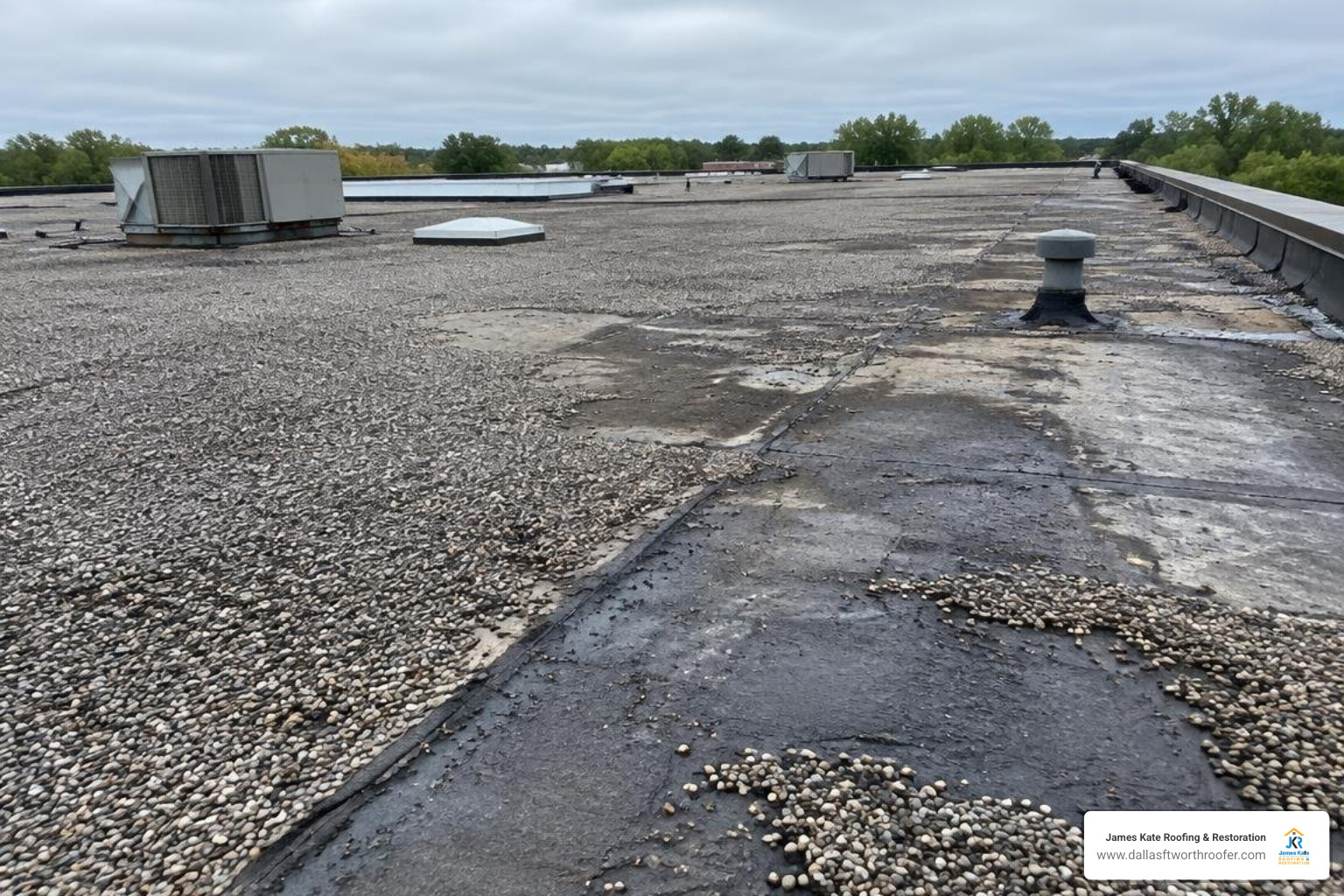
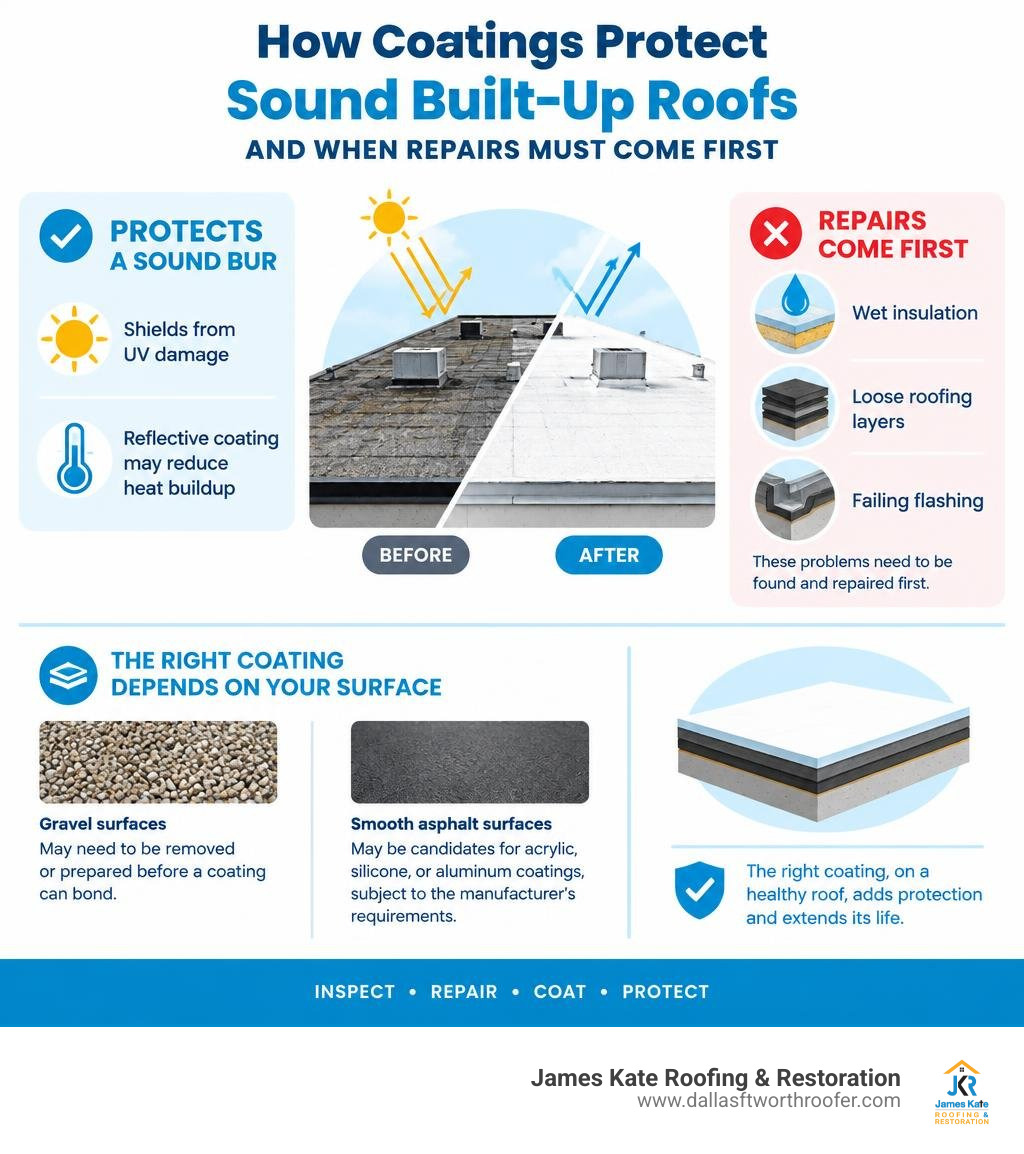
A coating can protect a built-up roof (BUR) that is still sound. It shields the roof from UV damage, and a reflective coating may help reduce heat buildup. But applying a roof coating will not fix wet insulation, loose roofing layers, or failing flashing. Those problems need to be found and repaired first.
The right coating depends on the roof’s surface. Gravel may need to be removed or prepared before a coating can bond. Smooth asphalt surfaces may be candidates for different roof coating types, including acrylic, silicone, or aluminum coatings, subject to the manufacturer’s requirements. When evaluating the average cost to coat a roof, a fluid roof coating built up across multiple protective layers can extend the service life of a sound BUR assembly without the cost and disruption of a full tear-off.
I’m Dustin Eatman, owner of James Kate Roofing & solar. My commercial roofing work helps me guide owners through repairs and decisions about whether installing a roof coating built up over their existing assembly is a good fit for their facility.
Understanding Built-Up Roofing (BUR) Systems and Surfacing Options
Built-up roofing has protected commercial facilities across North Texas for over a century. In the realm of commercial roofing, BUR is renowned for its durability. Often referred to simply as traditional tar and gravel, a standard BUR assembly is composed of alternating layers of bitumen (either asphalt or coal-tar pitch) and reinforcing plies such as fiberglass felts or organic fabrics.
The primary strength of a built-up assembly lies in its multi-layer redundancy. While a single-ply membrane provides only one protective sheet between the weather and your deck, a four-ply BUR provides four separate waterproofing barriers. This layered design gives BUR exceptional puncture resistance and tolerance against heavy foot traffic around rooftop HVAC equipment.
Bitumen chemistry plays a critical role in how the roof performs:
- Asphalt BUR: Built with oxidized petroleum asphalt. It is the most common BUR type, offering dependable waterproofing when proper drainage is maintained.
- Coal-Tar Pitch BUR: Formed from coal-tar pitch, this assembly features natural self-healing properties in warm temperatures and offers superior tolerance to ponding water. However, it produces a strong odor during hot-mopping and presents specific chemical compatibility considerations when selecting solar coatings.
A comprehensive Built-Up Roofing (BUR) Guide (2026) | Commercial Roof Guide highlights that these systems can easily deliver a service life of 20 to 30 years—and often exceed 40 years when maintained properly.
| Surfacing Option | Typical Weight per 100 sq ft | Expected Base Lifespan | Recoatability & solar |
|---|---|---|---|
| Gravel / Aggregate | 400 to 700 lbs | 25 to 35+ years | Requires aggregate removal / spudding before liquid coatings apply |
| Mineral Cap Sheet | 70 to 100 lbs | 15 to 25 years | Direct application with compatible acrylic or silicone primers |
| Smooth Asphalt / Flood Coat | 30 to 60 lbs | 10 to 20 years | Excellent candidate for fluid-applied coatings after standard cleaning |
| Reflective Fluid-Applied | 20 to 40 lbs | 10 to 20 years (renewable) | Readily recoatable at end of coating lifecycle without tear-off |
Surfacing Types and Their Impact on Coating Feasibility
The surfacing layer determines how easily you can apply a fluid-applied coating to a built-up roof:
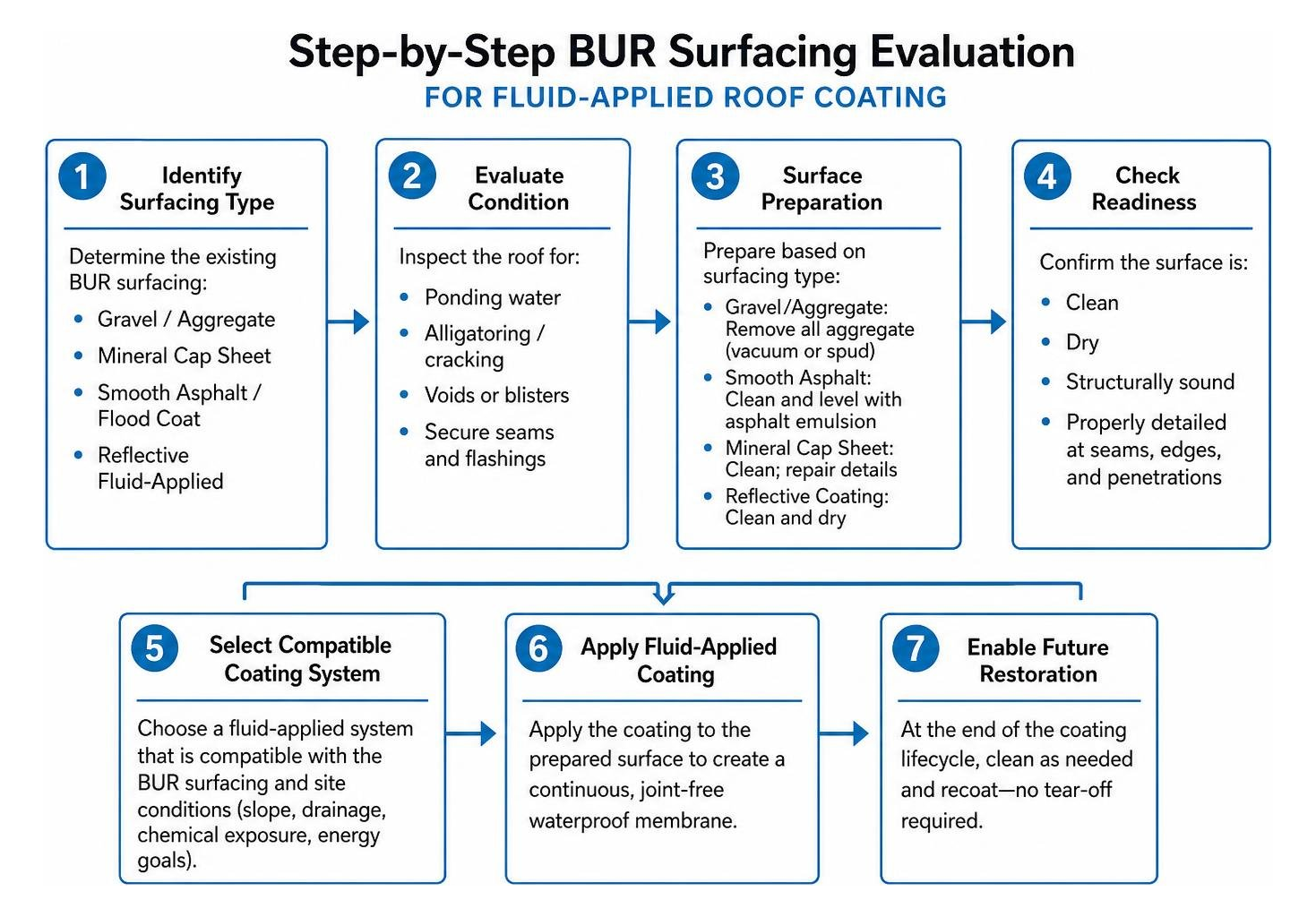
- Gravel/Aggregate Surfaces: The loose and embedded aggregate shields the underlying bitumen from ultraviolet radiation and offers strong impact resistance. However, applying a fluid-applied coating requires removing all loose aggregate by power vacuuming or mechanical spudding down to the flood coat. Skipping aggregate preparation creates voids and prevents proper mechanical adhesion.
- Smooth Flood Coats: A flood coat of hot asphalt without gravel provides a continuous substrate. Over time, UV rays oxidize the surface, leading to “alligatoring” (micro-cracking resembling reptile skin). Smooth flood coats must be cleaned and often leveled with an asphalt emulsion prior to coating application.
- Mineral Granule Cap Sheets: Modified bitumen cap sheets or mineral-surfaced roll roofing can receive fluid coatings directly, provided seams and flashings are securely detailed.
Roof Coating Built Up Systems: Options and Performance

When an existing BUR membrane is structurally sound and dry, applying a fluid solar system is a cost-effective alternative to a full replacement. Choosing between commercial roof coating types requires evaluating your roof’s slope, drainage, chemical exposure, and energy goals. Modern elastomeric coating alternatives create a continuous, joint-free membrane that bonds directly to the underlying plies.
As outlined in technical guidelines on roof coating for built-up roofs, selecting an engineered fluid system requires matching the chemistry of the coating to the bitumen substrate below.
Acrylic and Elastomeric Coatings
Water-based acrylic elastomeric coatings are widely used for commercial roof solar across Mansfield, Arlington, and Grand Prairie.
- Sunlight Reflectivity: Premium bright white acrylics reflect up to 85% of sunlight. Delivering verified cool roof reflective performance, an acrylic coating can lower roof surface temperatures by up to 50°F during hot Texas summers, reducing thermal shock and building cooling demands.
- Standards: Formulated to meet ASTM D6083 standards, high-grade elastomeric coatings offer balanced tensile strength and elongation, allowing the coating to expand and contract across seasonal temperature swings.
- Application Parameters: Acrylics cure by water evaporation, meaning they must be applied during dry weather windows. Industry standards require a minimum dry film thickness (DFT) of 20 to 30 mils across two separate coats to ensure adequate durability and crack-bridging. Acrylics perform best on roofs with positive drainage, as prolonged ponding water can cause the cured film to soften.
Silicone Roof Coatings
Silicone coatings provide unmatched moisture resistance for low-slope roofs with minimal slope:
- Ponding Water Resistance: Because silicone is an inorganic, moisture-cured polymer, it does not soften or degrade under standing water.
- High Solids Formulations: High-solids silicone coatings (often exceeding 90% solids by volume) deposit nearly all their wet thickness as cured rubber. A premium product like Henry 887 Tropi-Cool White 100% Silicone Reflective Roof Coating creates a seamless, flexible barrier that resists UV degradation and natural weathering over long service intervals.
- Considerations: Silicone coatings have lower tear resistance than urethanes and can collect airborne dust over time, which slightly reduces initial sunlight reflectance. They also require specific silicone-compatible materials if recoated in the future.
Aluminum and Asphalt-Based Coatings
For building owners seeking cost-effective protection, asphaltic and metallic coatings remain dependable workhorses:
- Aluminum-Pigmented Coatings: Meeting aluminum roof coating standards (ASTM D2824), non-fibered and fibered aluminum coatings suspend pure aluminum flakes in an asphalt base. When applied, the flakes rise to the surface (“leafing”), forming a metallic barrier that provides roughly 50% sunlight reflectance. Products such as TRI-BUILT Non-Fibered Aluminum Roof Coating cover approximately 200 square feet per gallon, shielding the underlying asphalt from UV oxidation.
- Asphalt Emulsions: Mineral-fortified clay emulsions (such as Henry 107 Asphalt Emulsion Sealer) are water-based, odorless solutions used to smooth alligatored surfaces and build base thickness before applying acrylic or silicone topcoats.
Engineering and Application Best Practices
Restoring a built-up roof with a liquid system requires strict adherence to technical standards. Cutting corners on substrate testing, cleaning, or primer application can lead to delamination and moisture entrapment.
To avoid premature coating failure, review our complete guide to roof coatings before initiating field work.
Surface Preparation for Roof Coating Built Up Assemblies
Every long-lasting fluid solar depends directly on substrate preparation:
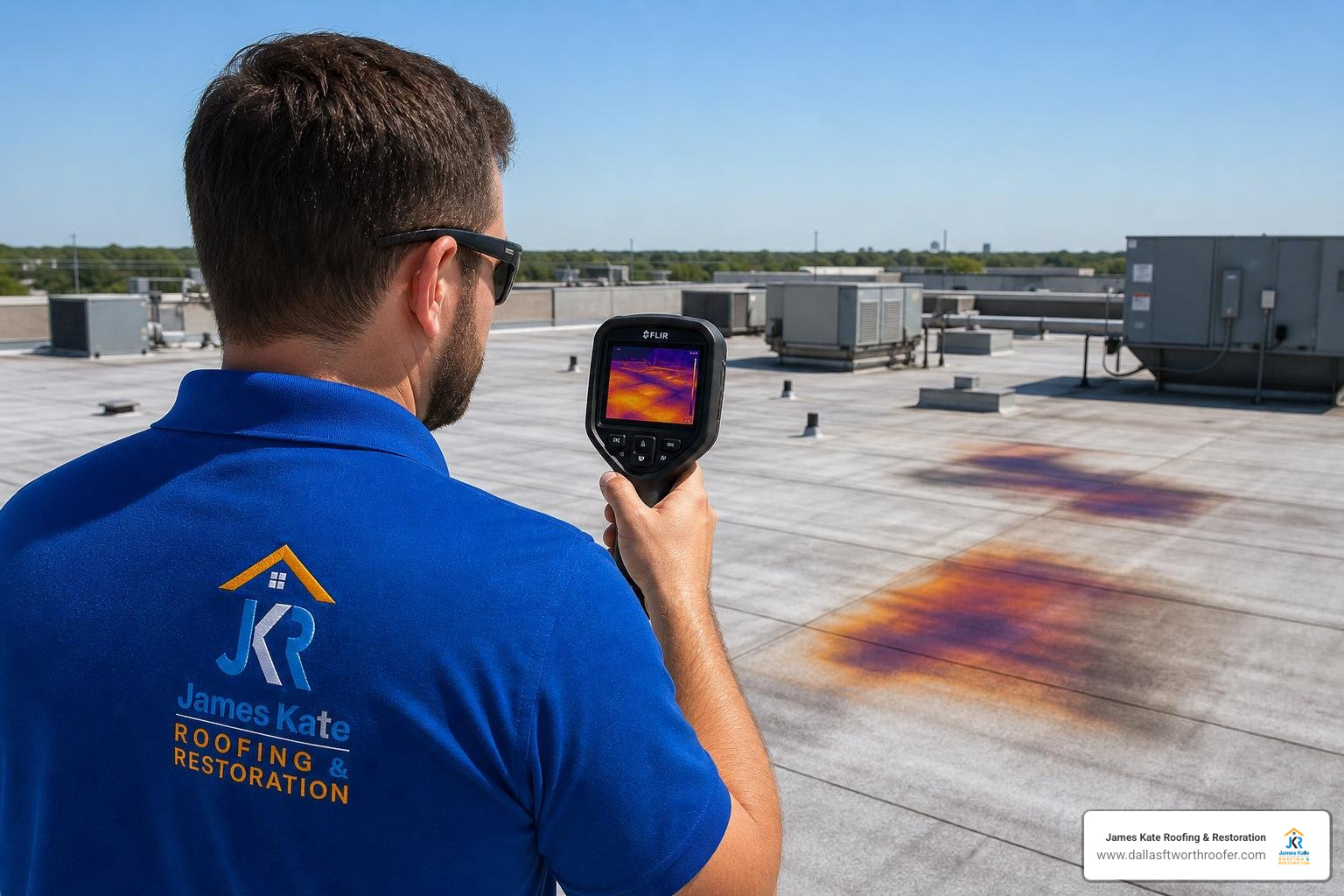
- Substrate Moisture Verification: The moisture content within the roofing plies and underlying insulation board must register below 0.5%. We conduct non-destructive infrared thermography or nuclear moisture surveys to map any trapped moisture. Wet insulation cannot be coated over; all wet areas must be cut out and replaced with dry, matched materials prior to coating.
- Surface Cleaning: Smooth roofs must be power washed with appropriate biodegradable cleaners to eliminate oils, dirt, chalking, and environmental contaminants.
- Aggregate Spudding: On gravel BUR roofs, loose rock must be removed by industrial vacuuming, and remaining embedded gravel must be mechanically sheared flat with a motorized spudding machine.
- Flashing and Defect Repairs: Inspect all penetrations, flashings, parapets, drains, and splits. Reinforce critical transitions with a three-course detail consisting of asphalt-compatible elastomeric mastic embedded with polyester scrim fabric.
- Bleed-Blocking Primers: Asphalt contains volatile oils that can migrate into topcoats, causing yellowing and loss of adhesion (known as “asphalt bleed-through”). Applying a dedicated bleed-blocking acrylic or epoxy primer ensures proper adhesion and maintains topcoat reflectivity.
Application Methods and Dry Film Thickness Standards
Proper application ensures the cured coating forms a uniform, defect-free membrane across the entire roof deck:
- Application Equipment: Coatings can be applied using heavy-duty commercial airless spray rigs (operating at 3,000+ PSI with flow rates of 2 to 3 gallons per minute), heavy-nap rollers (3/4″ to 1-1/4″), or specialized squeegees.
- Multi-Pass Application: Elastomeric coatings should be applied in a minimum of two contrasting coats (e.g., a gray base coat followed by a white top coat). This ensures even coverage and helps the crew visually confirm that no pinholes or thin spots remain.
- Thickness Verification: Field crews use wet mil gauges during application to confirm coverage rates, ensuring the system cures to the manufacturer’s specified dry film thickness (typically 20 to 40 mils depending on warranty requirements).
- Environmental Conditions: Application must occur when ambient and surface temperatures are at least 50°F and rising, with relative humidity below 85%. Never apply water-based coatings within 24 to 48 hours of forecast rain, dew, or freezing temperatures.
Evaluating Economics: solar vs. Full Tear-Off
When commercial property managers in Midlothian or Granbury evaluate an aging built-up roof, the central financial decision is whether to restore the existing assembly or complete a full tear-off and replacement.
| Project Factor | Fluid-Applied BUR Coating solar | Full BUR Tear-Off & Replacement | Single-Ply Recover (Overlay) |
|---|---|---|---|
| Typical Cost / sq ft (2026) | $2.50 to $5.50 | $7.00 to $10.00 (Standard) / $12.00+ (Asbestos) | $4.50 to $7.00 |
| Business Disruption | Minimal (no interior noise, fumes, or debris) | High (fumes, kettle odors, structural noise) | Moderate (fasteners, board handling) |
| Landfill Waste (20,000 sq ft) | Near zero (< 2 tons patching waste) | 150 to 250 tons of heavy debris | Low to moderate |
| Structural Dead Load Impact | Negligible (adds ~0.2 to 0.4 lbs/sq ft) | Removes old load, resets baseline | Adds 1.0 to 2.0 lbs/sq ft to roof deck |
| Tax Treatment | Often expensed fully in Year 1 (maintenance) | Capitalized and depreciated over 39 years | Capitalized asset |
Choosing a Roof Coating Built Up solar vs. Full Tear-Off
Restoring an existing built-up roof with an engineered coating system yields substantial operational and financial benefits:
- Direct Cost Savings: Coating solar generally costs between $2.50 and $5.50 per square foot, saving building owners 30% to 50% compared to a full tear-off and replacement.
- Eliminating Landfill and Disposal Fees: A four-ply gravel-surfaced BUR weighs roughly 5 to 7 pounds per square foot (500 to 700 lbs per roofing square). Tearing off a 20,000-square-foot roof generates between 150 and 250 tons of heavy aggregate and asphalt waste. Fluid solar diverts this material from landfills and avoids high roll-off and tipping fees.
- Asbestos Risk Mitigation: In commercial structures built prior to 1985, BUR felts, flood coats, or flashing mastics may contain encapsulated asbestos fibers. While intact BUR poses no health hazard, mechanical demolition requires full environmental containment and abatement, driving tear-off costs up to $5.00–$10.00 per square foot. Coating encapsulates the existing substrate in place, eliminating abatement costs.
- Business Continuity: High-profile commercial facilities, schools, and medical offices avoid hot asphalt fumes, loud roof-loading equipment, and the risk of interior water damage during open-roof demolition.
Frequently Asked Questions About Built-Up Roof Coatings
How long does a fluid-applied coating extend the lifespan of a built-up roof?
When applied over a dry, sound substrate at the proper dry film thickness, a professional fluid coating system extends the life of a built-up roof by 10 to 20 years. These systems are renewable: before the warranty period expires, the surface can be cleaned and recoated with a fresh top layer to extend the roof’s service life for another decade without tearing off the base membrane.
Can you apply a reflective coating directly over a gravel-surfaced BUR?
No, liquid coatings cannot be applied directly over loose gravel. The aggregate creates an uneven surface, harbors dirt, and prevents the coating from forming a continuous, watertight membrane. To restore a gravel BUR, loose aggregate must be vacuumed off and embedded gravel spudded smooth down to the asphalt flood coat. An asphalt emulsion or leveling base coat is then applied before installing the reflective topcoat.
What is the average cost to coat a commercial built-up roof?
In 2026, professional commercial roof coating applications generally range from $2.50 to $5.50 per square foot, depending on the coating chemistry (acrylic, silicone, or aluminum), roof accessibility, surface preparation requirements (such as gravel spudding), and selected warranty terms. This represents a substantial savings compared to complete tear-offs, which typically start at $7.00 to $10.00+ per square foot.
Conclusion
Commercial built-up roofing assemblies are among the most rugged low-slope systems ever built. However, decades of ultraviolet radiation, thermal movement, and severe Texas weather will eventually degrade the protective bitumen surfacing. Applying an engineered, fluid-applied roof coating allows property owners to eliminate leaks, enhance energy efficiency, and protect their physical asset—all without the disruption, cost, and waste of a structural tear-off.
At James Kate Roofing & solar, we operate across Mansfield, Arlington, Granbury, Grand Prairie, and Midlothian with a steadfast commitment to honesty, integrity, and Biblical principles. Recognized with the GAF President’s Club award and backing our work with up to 25-year workmanship warranties, our experienced team provides thorough, honest roof evaluations.
Schedule your commercial roof inspection today to discover how our James Kate Roofing & solar elastomeric roof coating solutions can extend the life of your commercial building.
Dustin Eatman is a seasoned roofing professional with deep, hands-on expertise that spans residential and commercial roofing, insurance solar, and long-term roof asset management. As the owner of James Kate Roofing & solar in the Dallas–Fort Worth metroplex, he’s built a reputation for diagnosing roof systems accurately, communicating clearly, and executing projects with a high standard of workmanship and documentation. Dustin understands the technical details that make roofs perform—proper underlayment selection, slope and drainage considerations, ventilation strategy, flashing and penetration detailing, and manufacturer-specific installation requirements—because he’s worked through the real-world challenges that cause leaks, premature wear, and warranty issues. He’s equally fluent in the operational side of roofing: jobsite planning, quality control, safety, material ordering, crew coordination, and customer experience from inspection to closeout. In insurance-related projects, Dustin brings practical knowledge of claim workflows, adjuster meetings, scope alignment, supplements, and the importance of photo evidence and thorough records, helping property owners navigate stressful situations with confidence. For commercial clients—especially property and facility managers—he emphasizes proactive maintenance and targeted repairs that reduce disruption, extend roof life, and prevent expensive interior damage. Dustin also stays focused on doing things the right way: educating customers on realistic options, setting expectations, and prioritizing solutions that hold up over time rather than quick fixes. That blend of technical skill, field experience, process discipline, and owner-level accountability is what makes Dustin Eatman a trusted expert in the roofing industry.