When the Wind Picks Up, Your Shingles Are the First Thing at Risk
Choosing the best shingles for high winds is one of the most important decisions you’ll make as a homeowner — especially in storm-prone areas like North Texas.
Here’s a quick answer if you’re comparing options:
| Shingle | Wind Rating | Impact Class | Best For |
|---|---|---|---|
| GAF Timberline HDZ | Unlimited (with LayerLock) | Class 4 (ArmorShield II) | All-around storm protection |
| Owens Corning Duration Storm | 130 mph | Class 4 | Gulf Coast, high-wind zones |
| Atlas StormMaster Shake | 150 mph | Class 4 | Extreme wind regions |
| TAMKO StormFighter FLEX | 160 mph | Class 4 | Hail + wind combined risk |
| CertainTeed Landmark | 110–130 mph | Class 3–4 | Moderate wind zones |
Standard shingles typically fail somewhere between 60 and 90 mph. In a strong Texas thunderstorm — or worse, a hurricane — that’s simply not enough.
The difference between a roof that survives a storm and one that doesn’t often comes down to what shingles were installed and how they were put on. Wind gets under loose edges, lifts shingles, and once that starts, water follows fast.
I’m Dustin Eatman, owner of James Kate Roofing & solar in the DFW area, and I’ve spent years helping homeowners navigate the exact choices covered in this guide — from selecting the best shingles for high winds to making sure they’re installed in a way that actually holds up when severe weather hits. In this guide, I’ll walk you through everything you need to know to make a confident, informed decision.
The Science of Wind Resistance and Testing Standards
Wind resistance is not just a marketing phrase. It comes down to engineering, testing, and installation details that all have to work together.
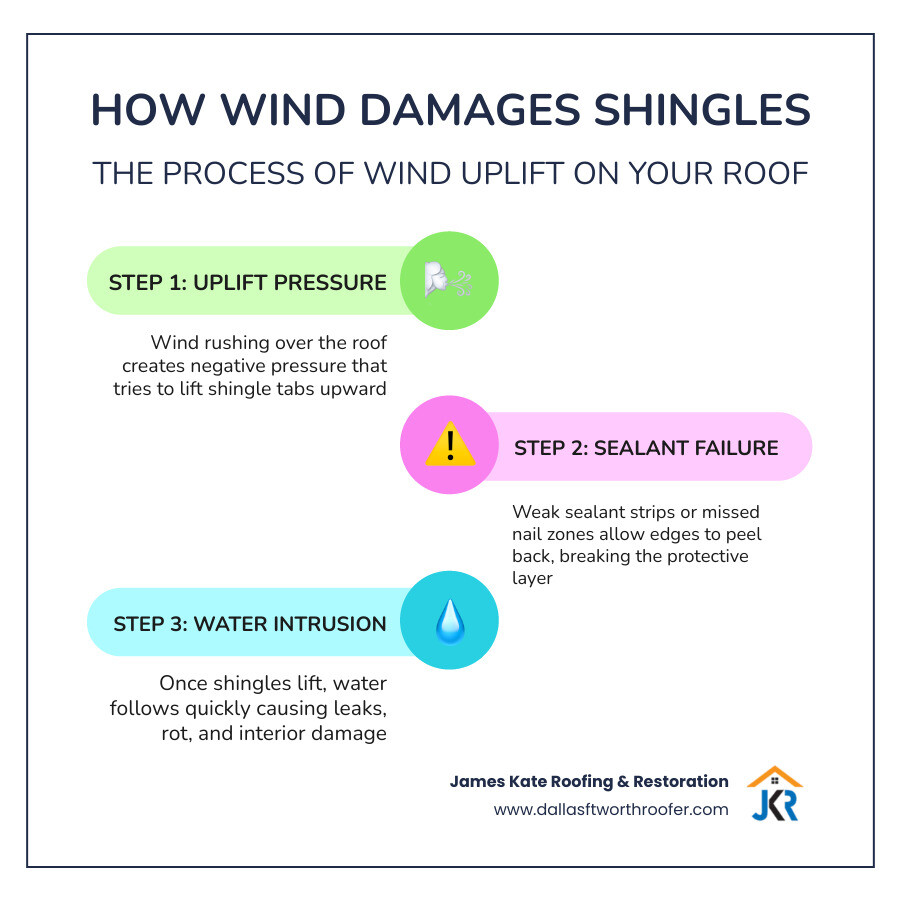
When wind moves across a roof, it creates uplift pressure. Think of it like an airplane wing in reverse: air rushing over the roof can try to pull shingle tabs upward. If the sealant strip is weak, the nailing zone is missed, or the shingles are too light, the wind starts peeling materials back one section at a time.
The main things that make a shingle more wind resistant are:
- Strong adhesive sealant strips
- Reinforced nailing zones
- Heavier laminated construction
- Better tear resistance
- Improved nail pull-through strength
- Matching starter strips and ridge components
That is one reason architectural shingles usually outperform basic 3-tab shingles. If you want a helpful primer on material basics, our guide on asphalt composite shingles is a good place to start.
How shingles are tested
Two key test standards show up again and again in product data sheets:
| Standard | What it measures | Common class | Typical meaning |
|---|---|---|---|
| ASTM D3161 | Fan-induced wind resistance | Class F | Up to 110 mph |
| ASTM D7158 | Uplift resistance based on force | Class H | Up to 150 mph |
ASTM D3161 looks at how shingles hold up under sustained wind exposure. Class F is the level most people want in storm-prone areas because it indicates resistance around 110 mph.
ASTM D7158 is often more useful when comparing premium products because it focuses on uplift forces. Class H is the highest commonly referenced category and indicates resistance up to 150 mph.
That difference matters. A shingle may carry one test classification, one warranty number, and one marketing label. Those are related, but not always identical. We always recommend reading the actual product specifications and installation requirements, not just the big number on the brochure.
Why sealant strips and nailing zones matter so much
Even the best shingle can fail if it is not fastened where the manufacturer designed it to be fastened. Wind-resistant shingles often include:
- Wider nailing zones for more accurate installation
- Reinforced fabric or polymer strips in the nail line
- Aggressive sealants that bond tabs more tightly
- Multi-layer laminate designs that resist edge lifting
In plain English: the shingle needs to stay stuck down and stay anchored when wind starts tugging at it. If either part fails, the roof gets tested in a hurry.
The Best Shingles for High Winds: Top Rated Products for 2026
For most homes in Mansfield, Arlington, Granbury, Grand Prairie, and Midlothian, architectural shingles are the sweet spot between cost, appearance, and storm performance. Premium storm-rated shingles raise the bar even more.
If you want a deeper look at storm-focused options, see our guide to the best asphalt shingles for high winds and hail.
Here is the big-picture ranking for 2026:
- 110 mph: acceptable for moderate risk areas
- 130 mph: a strong target for many North Texas homeowners
- 150 mph: premium storm protection
- 160 mph or unlimited warranty language: top-tier products with strict installation requirements
Comparing the Best Shingles for High Winds by Brand
Below is a practical comparison of the products homeowners ask us about most often.
| Product | Wind rating | Notable technology | Impact rating | Best fit |
|---|---|---|---|---|
| GAF Timberline HDZ | Unlimited wind warranty with qualifying system | LayerLock | Standard HDZ varies; ArmorShield II is Class 4 | Homeowners wanting a top system-based warranty |
| Owens Corning Duration | Up to 130 mph | SureNail | Duration line varies; STORM is Class 4 | Strong all-around performance |
| Atlas StormMaster Shake | Up to 150 mph | Polymer-modified design | Class 4 | Higher-end severe weather protection |
| TAMKO StormFighter FLEX | Up to 160 mph with qualifying system | ForceFX and AnchorLock | Class 4 | Combined hail and wind exposure |
| CertainTeed Landmark | 110 mph standard, 130 mph enhanced | Laminated construction | Product dependent, often Class 3 or 4 variants | Moderate to strong wind zones |
A few notes on each:
GAF Timberline HDZ
This is one of the most talked-about shingles for wind performance because of the LayerLock system and its no-maximum-wind-speed warranty language when installed as a qualifying system. That is impressive, but the fine print matters. The warranty depends on using the required accessories and installation method. It is not a magic shingle that ignores physics.
For homeowners who also want impact resistance, Timberline ArmorShield II adds Class 4 impact performance along with strong wind classifications.
Owens Corning Duration and Duration STORM
Duration shingles are popular because the SureNail strip improves nail placement and pull resistance. That extra reinforcement is not just branding fluff; it directly supports wind performance. Standard Duration products reach up to 130 mph, while Duration STORM pairs that wind rating with Class 4 impact resistance.
If you want a product-specific breakdown, this Owens Corning review covers the 2026 lineup well.
Atlas StormMaster Shake
Atlas StormMaster Shake is one of the premium options homeowners look at when they want very high wind resistance, with ratings up to 150 mph. It is often chosen by people who want a heavier-duty architectural look without stepping into metal or tile pricing.
TAMKO StormFighter FLEX
This shingle stands out because it combines Class 4 impact resistance with a wind warranty up to 160 mph when installed to specification. It uses a polymer-modified design intended to stay more flexible in rough weather. You can review the manufacturer details here: TAMKO StormFighter FLEX.
CertainTeed Landmark
Landmark remains a well-known option because it offers 110 mph wind resistance as standard and can be upgraded to 130 mph with enhanced installation. It is often a practical middle ground for homeowners who want better protection than entry-level shingles without jumping to the highest premium tier.
Impact Resistance and Class 4 Ratings
Wind and impact are not the same thing, but in North Texas they often show up at the same party.
A shingle can have a good wind rating and still be vulnerable to hail. That is why impact resistance matters. The main standard here is UL 2218, which uses steel balls dropped onto the shingle to simulate hail strikes.
The classes work like this:
- Class 1: 1.25-inch steel ball
- Class 2: 1.5-inch steel ball
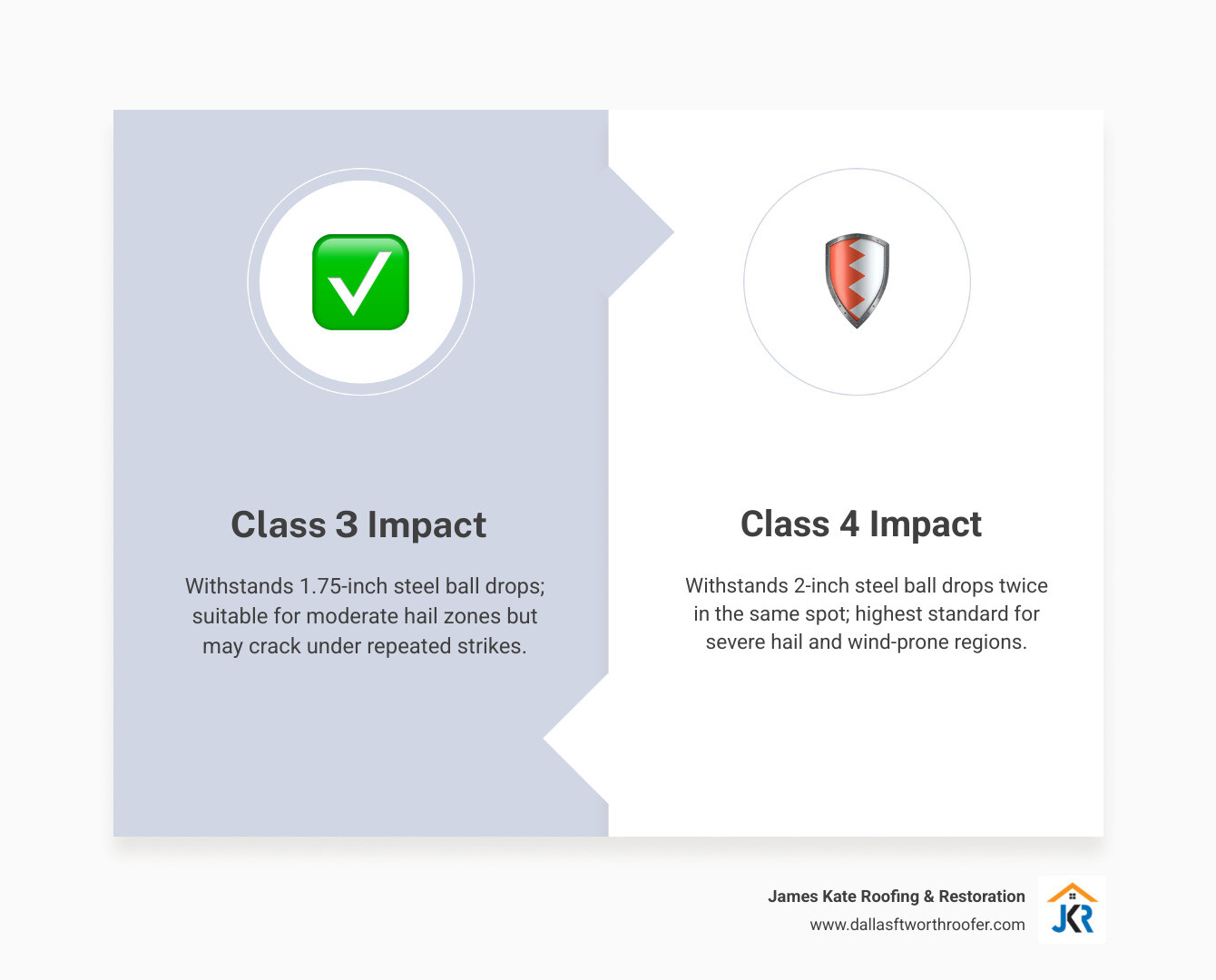
- Class 3: 1.75-inch steel ball
- Class 4: 2.0-inch steel ball
To earn Class 4, the shingle must withstand a 2-inch steel ball dropped twice in the same spot without cracking. That is the highest commonly available impact rating.
How Class 3 vs Class 4 relates to wind resistance
Impact resistance does not automatically equal higher wind resistance, but premium storm shingles often improve both at the same time because they use stronger materials and better reinforcement.
In practical terms:
- Class 3 can be a good upgrade over standard shingles
- Class 4 is the best choice for hail-prone parts of DFW
- Polymer-modified or SBS-modified shingles often stay more flexible and resist cracking better
- Many Class 4 products also come with stronger wind ratings, commonly around 130 mph or more
Another nice bonus: many insurers recognize Class 4 roofing as a risk-reducing upgrade.
Pros and cons of wind-resistant shingles
Pros:
- Better protection against shingle blow-off
- Lower chance of leaks after severe storms
- Longer service life in rough weather
- Possible insurance discounts
- Usually better overall construction than budget shingles
Cons:
- Higher upfront material cost
- Some premium warranties require full system installation
- Benefits can disappear if installed poorly
- Not every “storm” shingle has the same real-world value
So yes, upgrading is usually worth it in North Texas. But only if the product and installation are both solid. A sports car with flat tires is still not winning the race.
Maximizing Roof Longevity in Storm-Prone Areas
Choosing the shingle is only part of the job. Long roof life depends on whether the whole assembly is suited to your house, your neighborhood, and our local weather.

If you want a broader durability overview, read Your Guide to Asphalt Shingles Types, Benefits and Durability.
What else matters besides the shingle itself?
Roof pitch
Steeper roofs can experience wind differently than lower-slope roofs. Very steep sections may be more exposed to uplift at edges and ridges. Lower slopes may hold water differently during wind-driven rain. Neither is automatically better; both require the right product and installation details.
Roof shape and complexity
Valleys, dormers, hips, ridges, and roof-to-wall transitions are common weak points. The more complex the roof, the more important proper flashing, starter installation, ridge treatment, and accessory matching become.
Local climate in DFW
We are not writing for beachfront homes here. In Mansfield, Arlington, Granbury, Grand Prairie, and Midlothian, the real issue is usually severe thunderstorms, hail, strong straight-line winds, and the occasional tornado threat. That makes 130 mph-class products and Class 4 impact resistance especially attractive for many homeowners.
Warranty terms
Some warranties sound huge until you read the conditions. Look for:
- The actual wind-speed coverage
- Whether enhanced installation is required
- Whether starter and ridge products must match
- Whether the warranty is prorated
- Whether workmanship coverage is separate from manufacturer coverage
Installation Secrets for the Best Shingles for High Winds
This is the part homeowners underestimate most.
A top-tier shingle installed carelessly can perform worse than a mid-tier shingle installed perfectly. Wind warranties depend on following the manufacturer’s instructions exactly.
The key installation details include:
- Using roofing nails, not staples
- Hitting the manufacturer’s designated nailing zone
- Using the correct number of nails
- Installing starter strips at eaves and rakes
- Properly aligning shingles so sealant strips bond correctly
- Using matching hip and ridge components where required
FEMA guidance has long favored nails over staples in high-wind areas, and for 3-tab shingles they recommend six nails per shingle in high-wind or hurricane-risk conditions. Even when a laminated shingle can qualify at four nails, we still evaluate whether local exposure and manufacturer instructions call for more robust fastening.
Why nailing pattern matters
Nails that are too high, too low, angled, overdriven, or underdriven weaken the entire roof system. That is how blow-offs start. Reinforced nailing strips like SureNail or LayerLock help, but they do not fix bad workmanship.
Fastener holding power and nail pull resistance are huge factors in wind performance. Premium shingles often improve these, but only when the nails actually go where they belong.
Underlayment, starter strips, and ventilation
These are not glamorous topics, but roofs do not care about glamour.
- Starter strips help lock down the first course against wind at the roof edge
- Underlayment adds a secondary moisture barrier if shingles are damaged
- Balanced attic ventilation helps control heat buildup and moisture, both of which affect shingle life
For more on basic shingle construction and performance, these internal resources may help:
- Asphalt shingle types, benefits and durability
- Composition shingle types ultimate guide
- Architectural vs 3-tab shingles
- The benefits of laminated composition shingles
- How long 3-tab shingles last
Frequently Asked Questions about Wind-Resistant Roofing
What wind speed rating do I need for a hurricane-prone area?
For true hurricane-prone coastal conditions, homeowners typically look for shingles rated from 130 to 150 mph or better, often with ASTM D7158 Class H performance. In our DFW service area, the goal is usually not “hurricane roofing” but “severe thunderstorm and hail roofing.” That still makes 130 mph a smart benchmark for many homes, with 150 mph or better worth considering if you want premium protection.
As a simple rule of thumb:
- 60-90 mph: standard shingles, usually not enough for storm-prone North Texas
- 110 mph: entry point for better wind resistance
- 130 mph: strong choice for many DFW homes
- 150-160 mph: premium severe-weather tier
Do wind-resistant shingles qualify for insurance discounts?
Sometimes, yes. The biggest discounts are usually tied to impact resistance rather than wind resistance alone. Class 4 shingles are the most likely to qualify.
Based on the research, homeowners may save anywhere from 5% to 35% annually on homeowners insurance, depending on the carrier and policy. Some insurers advertise more typical storm-roof discounts in the 10% to 20% range. The only way to know your number is to ask your provider before installation and confirm what documentation they require.
We recommend:
- Ask your insurer whether UL 2218 Class 4 qualifies.
- Verify whether the discount is available in your ZIP code.
- Keep the product data sheet and final invoice.
- Have the roof inspected after major hail events, even if damage is not obvious.
Are metal roofs better than asphalt shingles for high winds?
In pure wind-resistance terms, metal roofing often has the edge. Properly designed metal systems commonly outperform asphalt shingles and can resist winds in the 140-150 mph range or better. That makes metal a strong option for extreme wind zones.
But “better” depends on the whole project.
Metal roof pros:
- Excellent wind performance
- Long lifespan
- Strong fire resistance
- Lower chance of shingle-style blow-off
Metal roof cons:
- Higher upfront cost
- Different appearance, which some homeowners do not want
- More noise concerns unless properly assembled
- Not always the best fit for every budget or home style
Clay tile and slate can also perform very well in wind when expertly installed, and both can last a very long time. But they are heavy, expensive, and require the right structural support. Tile also introduces a unique concern: if pieces break loose, they are much more dangerous than asphalt shingles in a storm.
For most homes in our North Texas service area, premium architectural asphalt shingles remain the most practical balance of cost, wind resistance, hail performance, and appearance.
Conclusion
If you are comparing the best shingles for high winds, here is the bottom line: look for strong wind testing, Class 4 impact resistance when possible, and an installation team that follows the manufacturer specs without cutting corners.
For many North Texas homeowners, that means focusing on laminated architectural shingles with at least a 130 mph rating, paired with proper starter strips, correct nail placement, and a complete roofing system. If your budget allows, premium storm shingles can add another layer of protection against the kind of wind and hail we see across DFW.
At James Kate Roofing & solar, we help homeowners make those choices with honesty, integrity, and straightforward advice. As a family-owned DFW company, we serve Mansfield, Arlington, Granbury, Grand Prairie, and Midlothian with residential roofing, storm solar, and related services backed by strong workmanship protection. We are proud of our GAF President’s Club recognition, but even more proud when a roof we install comes through a storm the way it should.
If you want expert guidance on shingle options, storm damage, or a full roof replacement, schedule a high-wind roof inspection today.
You can also explore more of our services here:

Dustin Eatman is a seasoned roofing professional with deep, hands-on expertise that spans residential and commercial roofing, insurance solar, and long-term roof asset management. As the owner of James Kate Roofing & solar in the Dallas–Fort Worth metroplex, he’s built a reputation for diagnosing roof systems accurately, communicating clearly, and executing projects with a high standard of workmanship and documentation. Dustin understands the technical details that make roofs perform—proper underlayment selection, slope and drainage considerations, ventilation strategy, flashing and penetration detailing, and manufacturer-specific installation requirements—because he’s worked through the real-world challenges that cause leaks, premature wear, and warranty issues. He’s equally fluent in the operational side of roofing: jobsite planning, quality control, safety, material ordering, crew coordination, and customer experience from inspection to closeout. In insurance-related projects, Dustin brings practical knowledge of claim workflows, adjuster meetings, scope alignment, supplements, and the importance of photo evidence and thorough records, helping property owners navigate stressful situations with confidence. For commercial clients—especially property and facility managers—he emphasizes proactive maintenance and targeted repairs that reduce disruption, extend roof life, and prevent expensive interior damage. Dustin also stays focused on doing things the right way: educating customers on realistic options, setting expectations, and prioritizing solutions that hold up over time rather than quick fixes. That blend of technical skill, field experience, process discipline, and owner-level accountability is what makes Dustin Eatman a trusted expert in the roofing industry.