What Is Roof Coating — and Is It Right for Your Roof?
A roof coating is a fluid-applied, fully adhered membrane that bonds directly to your existing roof surface to protect it from water, UV rays, and weather damage.
Quick answer: Here’s what you need to know about roof coatings at a glance:
| Question | Answer |
|---|---|
| What is it? | A liquid membrane sprayed or rolled onto an existing roof |
| Best roof types | Flat, low-slope, metal, TPO, EPDM, modified bitumen |
| Key benefits | Stops leaks, reflects heat, extends roof life up to 25 years |
| Energy savings | Can reduce HVAC energy use by up to 50% |
| Cost vs. replacement | Typically one-third to one-half the cost of a full reroof |
| Main types | Silicone, acrylic, elastomeric, polyurethane |
| DIY or professional? | Both possible — but professional application is recommended for larger roofs |
When a roof starts showing its age, most property owners assume they face one option: a full, expensive replacement. But for many roofs — especially low-slope and flat commercial roofs — a high-quality coating can stop leaks, slash energy bills, and add decades of service life without tearing off a single layer.
That said, roof coatings aren’t a fix for everything. Knowing when they work, which type to choose, and how they’re applied makes the difference between a 20-year solution and a costly mistake.
I’m Dustin Eatman, owner of James Kate Roofing & solar, and I’ve evaluated and managed hundreds of roof coating projects across the Dallas–Fort Worth area for both residential and commercial properties. In this guide, I’ll walk you through everything you need to make a confident, informed decision.
Understanding Roof Coating: Definition and Core Functions
At its core, a roof coating is not just a thick layer of paint. It is a monolithic, fully adhered, fluid-applied roofing membrane. “Monolithic” simply means it is entirely seamless. Because it is applied as a liquid, it fills in micro-cracks, seals around fasteners, and wraps perfectly around complex roof penetrations like pipes, vents, and HVAC curbs.
Once cured, these coatings exhibit elastomeric properties. This means they can stretch and contract alongside your building. As the Texas sun beats down on a hot summer afternoon in Mansfield or Arlington, your roof expands. At night, as temperatures cool, it contracts. Standard roofing materials can crack under this constant physical stress, but an elastomeric roof coating stretches and snaps back into shape without losing its waterproof seal.
The thickness of this protective shield is measured in “mils” (thousandths of an inch). A typical dry film thickness (DFT) can range from 3 dry mils (0.075 mm) for basic protective coats to more than 40 dry mils (1 mm) for high-performance, multi-layered waterproof membranes.
To ensure the coating functions correctly, substrate compatibility is key. Whether your property has a metal roof in Grand Prairie, a TPO membrane in Midlothian, or a modified bitumen roof in Granbury, the coating must be chemically compatible with the underlying material. Applying the wrong product can lead to adhesion failure, peeling, and wasted capital. For a broader look at keeping your roof in peak condition, check out our roof maintenance guide 2026.
Key Benefits of Coating Your Roof
Opting for a professional roof coating installation provides a suite of immediate and long-term benefits that extend far beyond simple aesthetics.
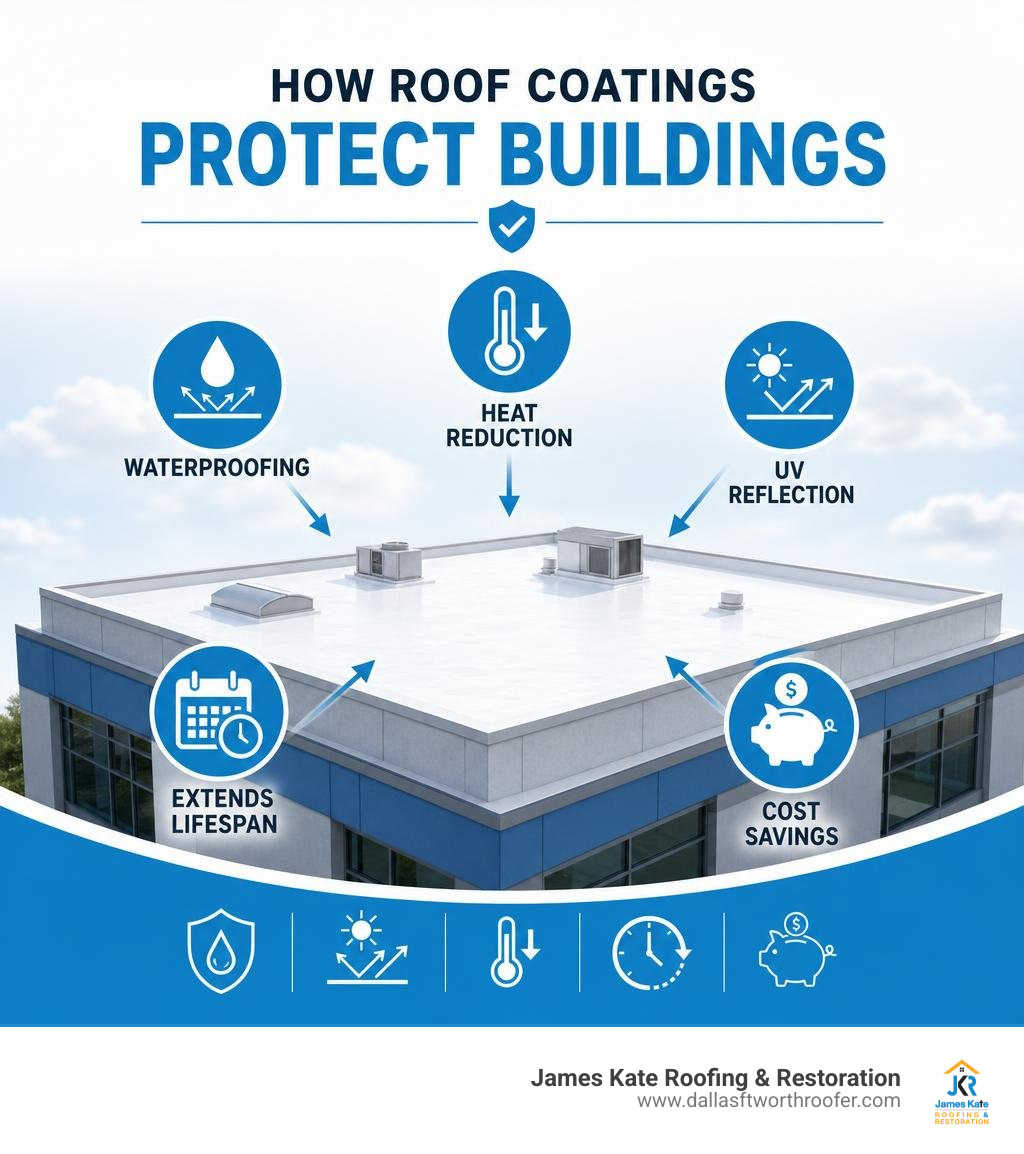
- A Seamless Barrier: By eliminating seams—the number one location for roof leaks—coatings create an impenetrable shield against rain and wind.
- Leak Prevention: It proactively seals vulnerable areas before water can find its way into your decking, insulation, or building interior.
- Landfill Waste Reduction: Traditional roof tear-offs generate millions of tons of waste annually. Because coatings are applied directly over your existing roof, they keep old roofing materials out of local DFW landfills.
- Service Life Extension: Field-applied coatings can add up to 25 years to the useful service life of a structurally sound roof, deferring capital replacement costs for decades.
Energy Savings and Cool Roof Ratings
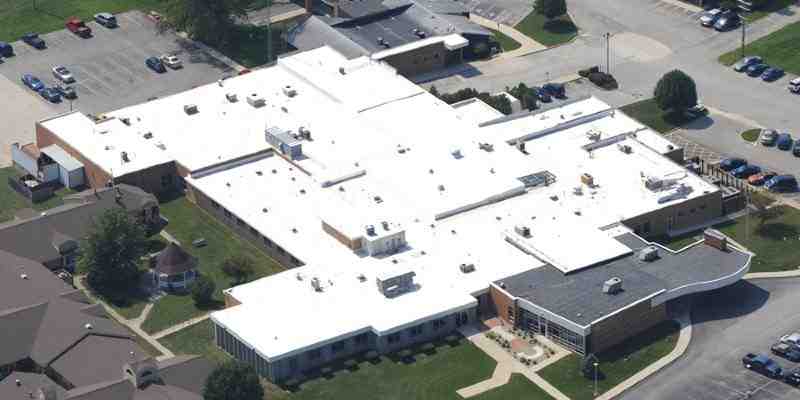
One of the most immediate financial returns on a roof coating investment is the “cool roof” effect. Standard dark roofs absorb solar radiation, baking the building below. A white, highly reflective roof coating acts like a mirror, reflecting up to 90%+ of the sun’s rays back into the atmosphere.
This high reflectivity, combined with high thermal emissivity (the material’s ability to release absorbed heat), dramatically lowers rooftop temperatures. In field studies, an uncoated section of a modified bitumen roof reached a blistering 79°C (174°F), while a section coated with a white reflective formula measured just 26°C (79°F)—a massive 35°C (95°F) heat reduction!
By keeping the roof surface cool, you drastically reduce the heat transferring into your building. This lowers the HVAC load, cutting commercial air conditioning energy bills by up to 35% to 50%. To understand why reflective surfaces are dominating modern roofing designs, read our article on Energy Saving Roof Coating: Why White Is the New Green.
Leak Prevention and Lifespan Extension
Water is a roof’s greatest enemy. Over time, UV exposure degrades asphalt, single-ply membranes, and metal panels, causing them to become brittle, rust, or crack. A premium roof coating acts as a sacrificial wear layer. It absorbs the brunt of UV radiation and weather abuse, preserving the underlying structural roof.
Furthermore, by reducing the roof’s daily temperature swings, coatings prevent “thermal shock”—the rapid expansion and contraction that loosens fasteners and tears seams. Protecting your roof from these physical forces ensures it remains watertight for years to come. For more insights on maximizing your system’s longevity, explore our guide on beyond the warranty and roof lifespan.
Main Types of Coatings and Their Differences
No single roof coating is perfect for every situation. Choosing the right material depends on your roof’s material, slope, local weather patterns, and budget.
Silicone Roof Coating Systems
Silicone is the gold standard for flat roofs or roofs with drainage issues. Unlike other materials, silicone coatings are completely unaffected by ponding water. They will not degrade, soften, or lose adhesion even if submerged under standing water for weeks.
- Key Features: Exceptional UV stability, highly flexible, and high solids formulation (often 90% or higher).
- Best For: Flat commercial roofs, low-slope systems, and areas prone to pooling water.
- Product Example: Premium options like Silicone Roof Coating – Durable, Waterproof Protection – Liquid Rubber offer excellent waterproofing and a user-friendly, high-durability finish.
Acrylic and Elastomeric Roof Coating Options
Acrylic coatings are highly popular, water-based solutions that offer fantastic value. They are incredibly easy to apply, highly breathable, and environmentally friendly with very low VOC levels.
- Key Features: Excellent dirt pick-up resistance (keeping the roof whiter and more reflective for longer), easy water cleanup, and cost-effective pricing.
- Best For: Sloped metal roofs, weathered single-ply membranes, and concrete roofs with positive drainage.
- Product Example: Professional-grade acrylics like Solargard® 6083 | Tremco meet or exceed the rigorous ASTM D 6083 standard for liquid-applied acrylic coatings, ensuring long-term low-temperature flexibility and weather resistance.
Polyurethane and Other Specialty Coatings
Polyurethane coatings are solvent-based and incredibly tough. They offer superior impact resistance and chemical resistance, making them the ideal choice for roofs that experience heavy foot traffic, hail storms, or exposure to grease and chemicals.
- Key Features: High tensile strength, extreme durability, and excellent adhesion.
- Best For: Roofs with heavy maintenance traffic, mechanical equipment areas, or locations prone to hail.
- Product Example: Specialty systems such as ICE Coating | Tremco utilize nanotechnology-engineered acrylic latex polymers to deliver high-solids, asbestos-free elastomeric protection over smooth asphalt, modified bitumen, and SPF roofs.
solar vs. Traditional Roof Replacement
Many building owners assume that a leaking or aging roof must be completely torn off and replaced. However, roof solar using a roof coating is often a far smarter financial and operational decision.
| Comparison Factor | Roof solar (Coating) | Traditional Roof Replacement |
|---|---|---|
| Average Cost | 1/3 to 1/2 of replacement costs | Full capital expense (high material & labor costs) |
| Installation Time | Very fast (typically completed in days) | Slow (can take weeks depending on size) |
| Business Disruption | Minimal (no loud tearing, low odor options) | High (loud noise, safety hazards, open roof risks) |
| Tax Treatment | Can often be deducted as a maintenance expense | Capitalized and depreciated over 39 years |
| Landfill Waste | Near zero | Highly destructive; tons of debris sent to landfills |
Choosing between these two paths requires a professional evaluation of your roof’s structural integrity. If your roof insulation is completely saturated or the decking is structurally compromised, a coating cannot save it. However, if the roof is structurally sound but reaching the end of its design life, solar is the superior option.
To dive deeper into this decision-making process, read The Great Roof Debate: When to Replace and What to Expect and check out our comprehensive commercial roof solar guide.
Application, Surface Preparation, and Maintenance
A roof coating is only as good as the preparation that precedes it. In fact, about 80% of coating failures are caused by poor surface preparation or improper application techniques.
Surface Preparation and Priming
Before a single drop of liquid coating is applied, the roof must be meticulously prepared:
- High-Pressure Washing: The entire roof surface must be pressure washed to remove dirt, mold, algae, and loose debris. Any residual oil or grease must be scrubbed with specialized detergents.
- Adhesion Testing: We perform field adhesion tests to ensure the selected coating bonds securely to the existing substrate.
- Seam and Detail Sealing: All seams, joints, flashing, and penetrations must be reinforced. This typically involves applying a heavy-duty elastomeric flashing cement or seam tape.
- Primer Selection: Depending on the substrate (such as EPDM, rusted metal, or asphalt), a specialized primer may be applied to guarantee maximum adhesion and prevent asphalt oils from bleeding through and staining the new white coating.
Professional Application Methods
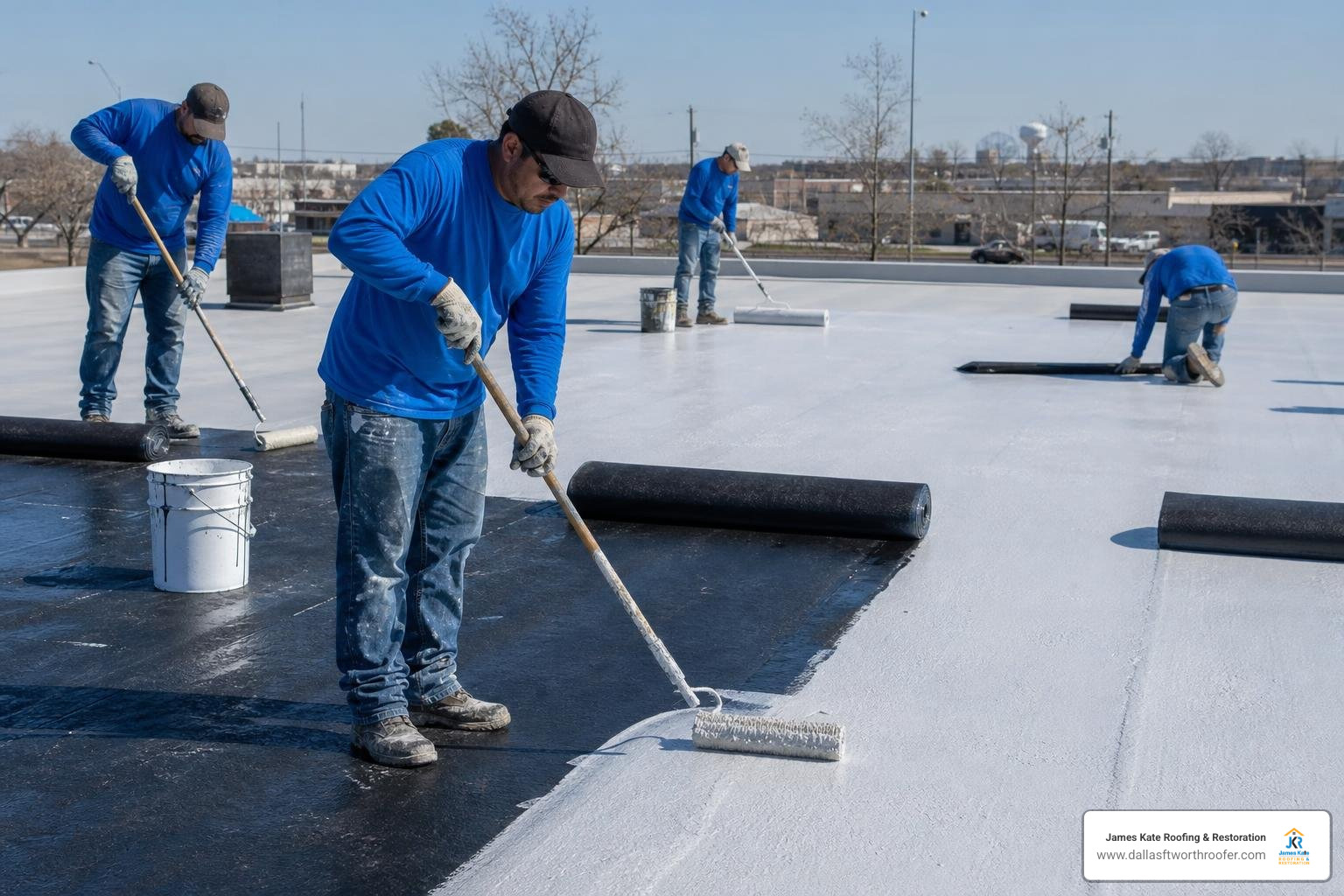
Once prepped, the coating is applied using professional high-pressure airless spray equipment or heavy-nap rollers.
To achieve the manufacturer-specified dry mil thickness, we carefully monitor the wet mil thickness during application. For example, to achieve a 20-mil dry thickness, a product might need to be applied at 28 wet mils.
We typically apply coatings in two distinct, perpendicular coats (for example, a north-south pass followed by an east-west pass). This cross-hatch technique guarantees complete, uniform coverage without pinholes or thin spots. Furthermore, weather conditions must be carefully monitored; we do not apply water-based coatings when temperatures are below 50°F or if rain or heavy dew is expected before the product can fully cure.
Long-Term Maintenance and Re-coating Schedules
While a coated roof is highly durable and low-maintenance, it is not “no-maintenance.” To protect your warranty and keep the system performing at its peak, you should establish a routine care schedule.
- Bi-Annual Inspections: Inspect the roof in the spring and fall to check for physical damage from storms or third-party HVAC contractors.
- Debris Removal: Keep drains, gutters, and scuppers clear of leaves, dirt, and debris to prevent unnecessary water pooling.
- Re-Coating Intervals: Every 10 to 15 years, as the coating naturally wears down, the roof can simply be cleaned and re-coated with a new topcoat. This resets the clock on your warranty and protection without ever requiring a tear-off.
For a complete breakdown of professional care, read our roof maintenance services complete guide.
Frequently Asked Questions
Can coatings be applied to asphalt shingles?
Generally, no. We do not recommend applying a liquid roof coating over residential asphalt shingles. Shingles are designed to overlap and breathe; sealing them with a continuous liquid membrane can trap moisture underneath, leading to wood rot in your decking, mold growth, and premature shingle failure. Most major shingle manufacturers warn against this practice, and doing so will void your shingle warranty.
How long does a typical solar last?
A professionally installed roof coating system typically lasts between 10 to 20 years, depending on the thickness of the application and the type of material used. The best part? Before the original coating completely wears away, the roof can be washed and re-coated, extending its life for another 10 to 15 years indefinitely.
What is the difference between a roof and deck coating?
While both are fluid-applied membranes, they serve completely different purposes. A roof coating is highly elastomeric and formulated to handle extreme weather, UV exposure, and thermal movement, but it is not designed to handle foot traffic or physical abrasion. A deck coating, on the other hand, is a rigid, traffic-bearing material engineered with slip-resistant aggregates to withstand heavy pedestrian traffic, outdoor furniture, and physical wear.
Conclusion
A high-quality roof coating is one of the smartest investments you can make for your commercial or low-slope residential property in the Dallas–Fort Worth metroplex. It stops leaks, lowers your energy bills by up to 50%, and extends the life of your existing roof structure by decades—all at a fraction of the cost of a traditional replacement.
At James Kate Roofing & solar, we bring years of local expertise to every project. As a family-owned business built on honesty, integrity, and exceptional craftsmanship, we are proud to be recognized as a GAF President’s Club contractor. Whether your property is in Mansfield, Arlington, Granbury, Grand Prairie, or Midlothian, we back our work with up to a 25-year workmanship warranty to give you ultimate peace of mind.
Ready to see if your roof is a candidate for a money-saving solar? Contact our expert team today to schedule your comprehensive roof evaluation, or explore our professional commercial roofing services to learn more.
Dustin Eatman is a seasoned roofing professional with deep, hands-on expertise that spans residential and commercial roofing, insurance solar, and long-term roof asset management. As the owner of James Kate Roofing & solar in the Dallas–Fort Worth metroplex, he’s built a reputation for diagnosing roof systems accurately, communicating clearly, and executing projects with a high standard of workmanship and documentation. Dustin understands the technical details that make roofs perform—proper underlayment selection, slope and drainage considerations, ventilation strategy, flashing and penetration detailing, and manufacturer-specific installation requirements—because he’s worked through the real-world challenges that cause leaks, premature wear, and warranty issues. He’s equally fluent in the operational side of roofing: jobsite planning, quality control, safety, material ordering, crew coordination, and customer experience from inspection to closeout. In insurance-related projects, Dustin brings practical knowledge of claim workflows, adjuster meetings, scope alignment, supplements, and the importance of photo evidence and thorough records, helping property owners navigate stressful situations with confidence. For commercial clients—especially property and facility managers—he emphasizes proactive maintenance and targeted repairs that reduce disruption, extend roof life, and prevent expensive interior damage. Dustin also stays focused on doing things the right way: educating customers on realistic options, setting expectations, and prioritizing solutions that hold up over time rather than quick fixes. That blend of technical skill, field experience, process discipline, and owner-level accountability is what makes Dustin Eatman a trusted expert in the roofing industry.