Why Knowing Your Roof Damage Severity Can Save You Thousands
Roof damage is one of the most stressful — and costly — problems a homeowner can face. And in the Dallas–Fort Worth area, it happens more often than most people expect.
Here’s a quick snapshot of what you need to know:
| Damage Type | Common Signs | Covered by Insurance? |
|---|---|---|
| Wind | Missing/lifted shingles, creased flashing | Usually yes (sudden event) |
| Hail | Granule loss, soft bruising, dented metal | Usually yes (1″+ hail) |
| Water intrusion | Ceiling stains, wet insulation, attic leaks | Yes, if caused by covered peril |
| Wear and tear | Curling, cracking, aging shingles | No |
| Moss/algae | Dark streaks, surface decay | No |
| Flood | Water rising from ground level | Only with separate flood policy |
The most important thing to know: Homeowners insurance typically covers sudden damage from wind, hail, fire, and falling trees — but not gradual deterioration or flooding. Wind and hail claims occurred at a rate of 2.80 per 100 insured homes between 2019 and 2023, making storm damage the most common roof claim by far.
The tricky part? A lot of roof damage hides. Hail can bruise shingles and knock off protective granules without causing a visible leak for 12 to 18 months. Wind can lift and crease shingles in ways that aren’t obvious from the ground. By the time water shows up on your ceiling, the damage underneath is often far worse than it first appears.
That’s why knowing how to assess the severity — quickly, safely, and thoroughly — matters so much. A $400 repair can easily become a $4,000 problem if you wait too long.
I’m Dustin Eatman, owner of James Kate Roofing & solar, and I’ve spent years inspecting, documenting, and restoring roofs across the DFW area after storm events — including navigating the insurance claim process to make sure homeowners get the full scope of roof damage covered. In this guide, I’ll walk you through everything you need to assess your roof’s condition, understand your options, and make confident decisions.
Identifying the Core Signs of Storm-Induced Roof Damage
When a severe storm rolls through the Dallas–Fort Worth metroplex, it brings a cocktail of high winds, pounding hail, and torrential rain. To understand the severity of your roof damage, we must look at how these elements interact with your roof system.
Storm damage doesn’t always look like a fallen tree trunk splitting a home in two. More often, it is a combination of wind uplift, hail impact, and progressive water intrusion. Each of these forces compromises different layers of your roof, starting with the outer shingles and working down to the structural decking. For homeowners dealing with the aftermath of severe weather, understanding these mechanisms is the first step toward securing your home. For localized insights, you can read more about Arlington Tx Storm Damage to see how local weather patterns specifically impact North Texas homes.
Spotting Wind Damage and Shingle Uplift: Early Signs of Roof Damage
Wind damage is governed by the physics of aerodynamics. When strong lateral gusts hit your home, they don’t just push against the walls; they create a pressure differential over the roof. This is known as uplift pressure—essentially the same suction force that allows airplane wings to lift.
This suction force is strongest at the edges, eaves, and ridges of your roof. If the wind is strong enough, it can break the manufacturer’s seal strip on your shingles. Once a single shingle is lifted, wind can get underneath the adjacent shingles, leading to what we call the “zipper effect,” where entire rows of shingles peel away in sequence.
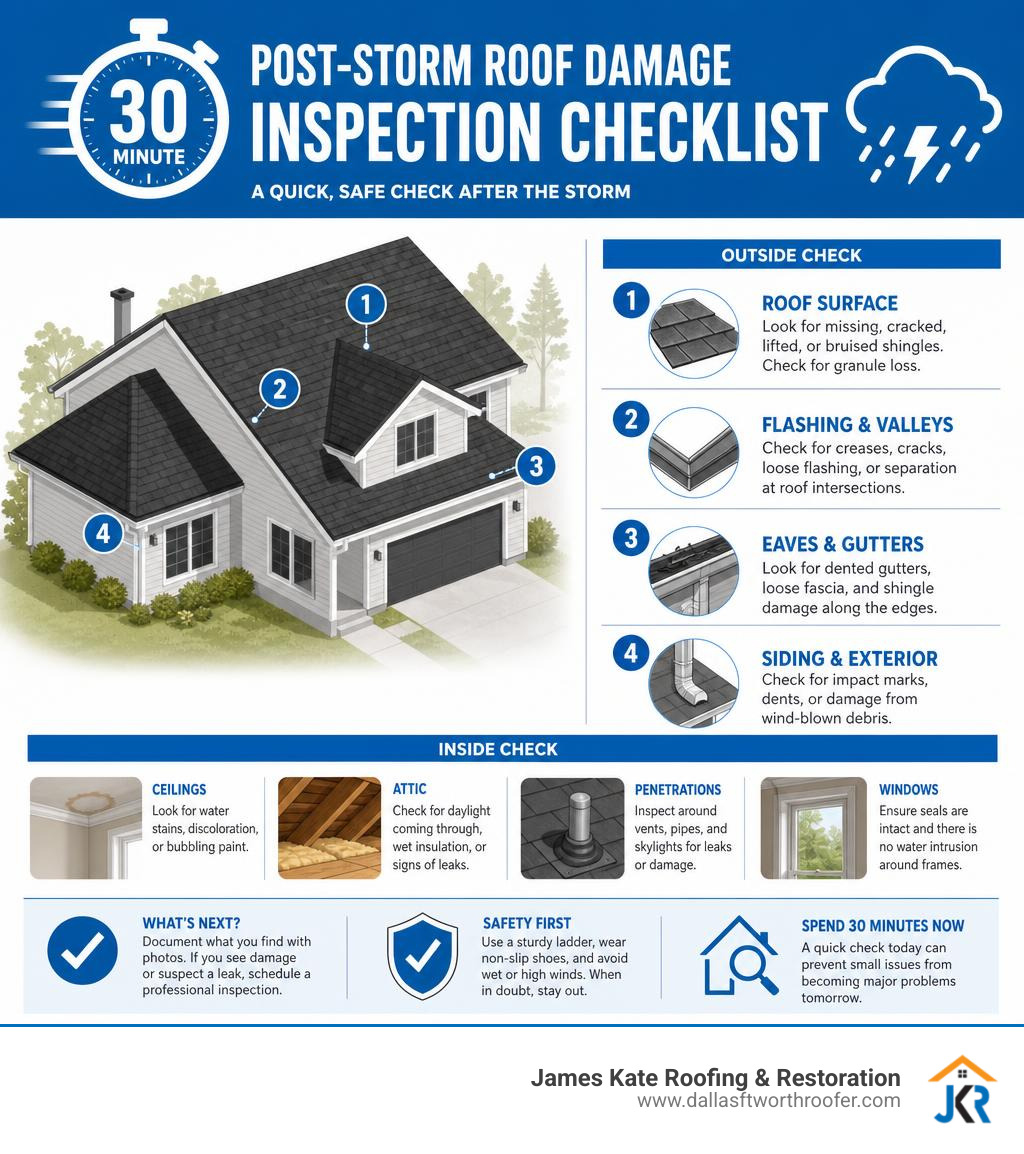
When inspecting from the ground, look for:
- Missing Shingles: Entire sections of shingles that have torn away, exposing the dark underlayment or plywood decking beneath.
- Creased and Lifted Shingles: Shingles that have been bent backward by the wind. Even if they lie flat again after the storm, the fiberglass mat inside is fractured. You will see a dark, horizontal crease line near the top of the shingle where granules have broken away.
- Exposed Flashing: Metal flashing around chimneys, valleys, and dormers that has been bent, loosened, or completely displaced.
If you suspect minor wind issues, we recommend checking out this Minor Wind Damage Advice For Concerned Homeowners to assess whether immediate action is needed, and review these 6 Steps To Repairing Wind Damage Before Your Roof Takes Flight to prevent structural failure.
Recognizing Hail Bruising and Granule Loss
Hail is one of the most deceptive threats to asphalt shingles. Unlike wind, which often leaves highly visible gaps, hail causes hidden, functional damage that compromises the longevity of your roof without causing immediate leaks.
When a hailstone strikes an asphalt shingle, it creates a localized compression point. This impact does two things:
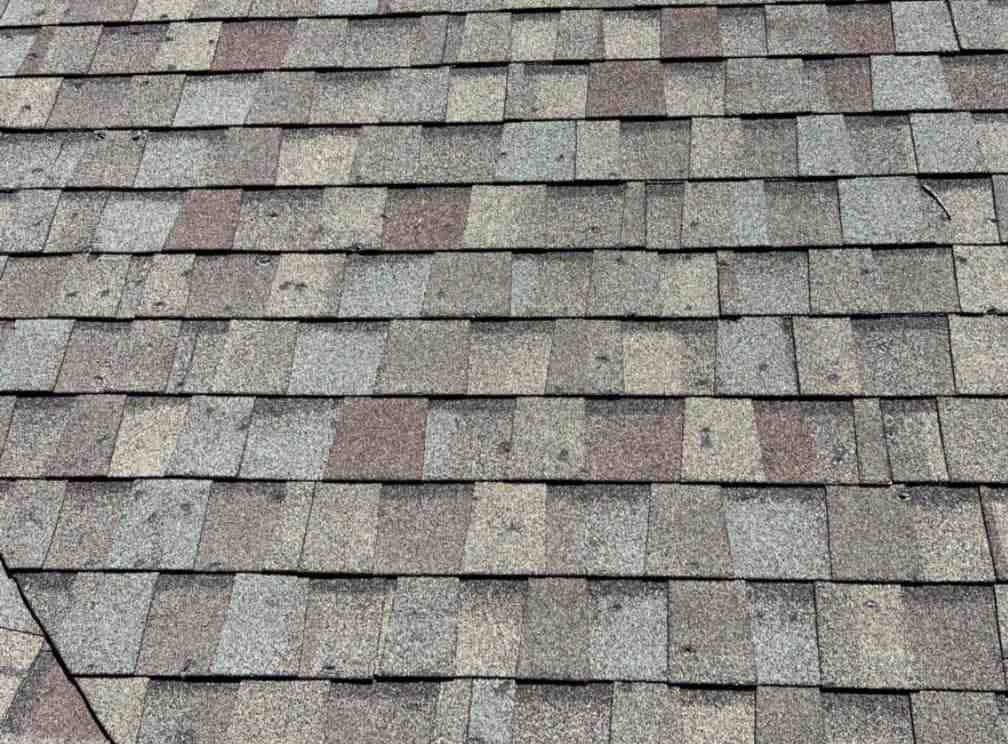
- Granule Loss: It forcibly knocks away the protective mineral granules coating the shingle. These granules are your roof’s primary shield against ultraviolet (UV) radiation. Without them, the underlying asphalt is exposed to solar heat, causing it to dry out, crack, and fail prematurely.
- Fractured Matting (Bruising): The impact can crack the internal fiberglass mat of the shingle. This is called a “bruise.” If you gently press your thumb onto a suspected hail hit, it will feel soft and spongy, similar to a bruised apple.
Always look for collateral damage on the ground first. If your metal gutters, downspouts, mailbox, or window screens are dented, there is a very high probability that your roof shingles sustained similar impact damage.
Detecting Water Intrusion and Attic Leaks
Water is patient, and it will always find the path of least resistance. Once wind or hail compromises your shingles, rainwater works its way underneath the underlayment and pools on the plywood sheathing (decking).
If left unaddressed, water causes sheathing decay, rot, and structural sagging. Inside the home, this manifests as wet insulation, mold growth, and damaged drywall. It is important to note that a leak might not appear directly below the damaged shingles; water often enters through a gap near the ridge, travels down a rafter, and drips onto your ceiling feet away from the original entry point.
If you discover that water has compromised your roof’s foundation, you may need a structural repair. For a comprehensive look at this process, see our A Step By Step Guide To Replacing Damaged Roof Decking.
Step-by-Step Guide to Safely Inspecting Your Roof
Safety must be your absolute priority when inspecting for roof damage. Walking on a roof—especially one that has recently been subjected to severe storms—is highly dangerous. Wet shingles, loose granules, and weakened decking can easily cause slips or structural collapses.
We strongly advise homeowners to perform their inspections from the safety of the ground and the attic. Leave the high-altitude climbing to licensed professionals who have the proper safety harnesses, soft-soled roofing shoes, and specialized training.

Ground-Level Visual Assessment
You can conduct an incredibly thorough initial assessment without ever leaving the ground. Grab a pair of binoculars and walk slowly around the entire perimeter of your home.
- Check the Valleys and Ridges: Scan the peaks and valleys of your roof, as these areas are highly susceptible to wind uplift and flashing displacement.
- Inspect the Gutters and Downspouts: Look for a heavy accumulation of shingle granules in your gutters or at the exit of your downspouts. A high volume of granules indicates that your shingles have lost their protective coating.
- Scan for Debris: Note any fallen tree branches, dislodged vent caps, or torn pieces of shingle lying in your yard or landscaping.
Interior and Attic Inspection
Your attic is the window into your roof’s health. Assessing the underside of your roof deck can reveal active leaks long before they stain your living room ceiling.
- The Daylight Test: Go into your attic during a bright, sunny day. Turn off all the lights and your flashlight. Look up at the roof deck. If you see pinpricks of daylight shining through the decking boards, you have open gaps that will allow water to enter during the next rainstorm.
- Inspect the Rafters and Sheathing: Turn your flashlight back on and scan the wooden rafters and plywood sheathing. Look for dark water stains, white powdery mineral deposits (efflorescence), or active dripping.
- Check the Insulation: Feel the attic insulation in various areas. Wet, matted, or moldy insulation is a surefire sign of an active roof leak.
- Sniff for Musty Odors: A persistent damp, musty smell in your attic or upper closets indicates trapped moisture and mold development.
Professional Roof-Level Evaluation
While ground and attic checks are excellent starting points, some damage can only be verified at the roof level. A professional inspection by a qualified roofing contractor provides the definitive evidence needed for repairs or insurance claims.
At James Kate Roofing & solar, we utilize advanced diagnostic tools to safely and accurately evaluate your roof. This includes FAA-approved drone technology to capture high-definition aerial imagery of steep or inaccessible slopes, and physical test squares (10×10 foot areas) to document the exact number of hail impacts per square. A professional roofer knows how to distinguish between normal wear and tear, manufacturing defects like blistering, and actual storm-induced functional damage.
Navigating Roof Damage Insurance Claims in 2026
Filing an insurance claim for roof damage in 2026 requires a clear understanding of your policy’s terms, exclusions, and documentation requirements. Insurance carriers have tightened their guidelines in recent years, making thorough preparation more important than ever. For a deep dive into the fundamentals of coverage, read this comprehensive guide on Roof Damage Insurance: What’s Covered, What’s Not, and When to File (2026).
Cosmetic vs. Functional Roof Damage Exclusions
One of the most critical distinctions in modern insurance policies is the difference between cosmetic and functional damage.
- Functional Damage: Damage that compromises the water-shedding capacity of the roof or shortens its expected lifespan. Examples include fractured shingle mats, torn shingles, or displaced flashing.
- Cosmetic Damage: Damage that alters the appearance of the roof but does not affect its performance or structural integrity.
Many insurance policies now include cosmetic damage exclusions, particularly for metal roofs. If a hailstorm leaves shallow dents on a standing-seam metal roof but does not puncture the metal or compromise the seams, the insurer may deny the claim under this exclusion. Understanding whether your policy has a cosmetic endorsement is vital before filing a claim.
Actual Cash Value (ACV) vs. Replacement Cost Value (RCV)
How your policy calculates payouts determines your out-of-pocket expenses when dealing with severe roof damage.
- Replacement Cost Value (RCV): This is the ideal policy type. If your roof is damaged by a covered peril, the insurance company will pay the full cost to repair or replace it with materials of like kind and quality, minus your deductible.
- Actual Cash Value (ACV): Under an ACV policy, the insurer depreciates the payout based on the age and condition of your roof. For example, if your 15-year-old roof has a 20-year lifespan and is completely destroyed by hail, the insurer will subtract 75% of its value for depreciation, leaving you to cover the remaining balance out of pocket.
Additionally, pay close attention to your deductibles. Many Texas policies feature a percentage deductible (often 1% to 2%) for wind and hail rather than a flat dollar amount. On a home insured for $300,000, a 2% wind/hurricane deductible means you must pay $6,000 out of pocket before your insurance policy contributes a single dollar.
Essential Documentation for a Successful Claim
To support a successful claim, you must present a clear, undeniable package of evidence to your insurance adjuster. We recommend compiling the following documentation:
- Date-Stamped Photos and Videos: Capture wide-angle shots of your entire home, close-ups of specific roof-level damage (taken by your contractor), and any interior water stains.
- Local Weather Reports: Save screenshots of weather alerts, radar data, or local news reports showing the exact date, time, and severity of the storm (such as hail size or wind speed gusts).
- A Detailed Damage Log: Write down a chronological timeline of when the storm occurred, when you first noticed the damage, and any temporary mitigation steps you took.
- Professional Contractor Estimates: A written estimate from a reputable local roofer detailing the exact scope of repairs and material specifications.
Repair vs. Full Replacement: Deciding the Best Path Forward
When faced with roof damage, one of the biggest decisions you will make is whether to patch the existing system or invest in a full replacement. Making the wrong choice can lead to recurring leaks and wasted money. For an in-depth analysis of this decision, refer to The Great Roof Debate When To Replace And What To Expect.
When a Targeted Roof Fix is Sufficient
A localized, professional Roof Fix is often the most sensible and cost-effective path forward when the damage is isolated and the overall roof system is still in its prime.
If your roof is less than 10 to 12 years old, the asphalt remains pliable, and only a few shingles were blown off during a high-wind event, we can easily perform a spot repair. This involves carefully removing the damaged shingles and weaving in new, matching materials. Localized repairs are also ideal for addressing minor leaks around flashing, plumbing boots, or chimneys.
If you live in Mansfield or surrounding areas, you can request a detailed assessment through our Mansfield Roof Repair: Free Estimates & Expert Roofing service to see if a repair is right for you. You can also consult our Roof Repair Guide 2026 for more details on common repair scopes.
When Widespread Damage Demands Full Replacement
A full roof replacement becomes necessary when the structural integrity of your roof is compromised, or when the cost of ongoing repairs outweighs the value of a new system.
We typically recommend replacement under the following conditions:
- Widespread Storm Damage: If hail has bruised shingles across multiple slopes, or if wind has removed large sections of shingles.
- The 25% Rule: Many local building codes dictate that if more than 25% of a roof slope is damaged, the entire slope—or the entire roof—must be replaced to meet modern safety standards.
- Aging Materials: If your asphalt shingle roof is over 15 to 20 years old, the materials have naturally degraded. Attempting to repair an old, brittle roof often causes more damage to the surrounding shingles, as they crack when lifted.
- Material Matching Issues: If the original shingles are discontinued and cannot be matched, a spot repair will leave your home looking patchy, which can lower its resale value.
For urgent situations in the Arlington area where severe weather has left your home exposed, our team provides rapid response through our Emergency Roof Repair Arlington service to stabilize your structure before a full replacement can be scheduled.
Comparing Repair and Replacement Criteria
To help you visualize the decision-making process, we’ve put together this quick comparison table:
| Decision Factor | Choose Targeted Repair | Choose Full Replacement |
|---|---|---|
| Roof Age | Under 10–12 years old | Over 15–20 years old |
| Damage Extent | Isolated to one area (under 25%) | Widespread across multiple slopes (over 25%) |
| Shingle Condition | Pliable, good granule retention | Brittle, bald spots, curling edges |
| Leak History | First-time, minor leak | Recurring leaks in multiple areas |
| Material Match | Matching shingles are readily available | Discontinued or severely faded shingles |
| Insurance Coverage | Below deductible or minor repair | Covered full replacement (RCV policy) |
Best Practices for Preventing Future Roof Damage
While we can’t control the wild North Texas weather, we can take proactive steps to fortify our homes against future storms. Preventative maintenance is the single best way to maximize your roof’s lifespan and minimize the risk of sudden, catastrophic failure.
Mitigating Wind, Hail, and Ice Dam Risks
- Upgrade to Class 4 Impact-Resistant (IR) Shingles: If you are replacing your roof, consider upgrading to Class 4 IR shingles. These shingles are engineered to withstand impacts from 2-inch steel balls dropped from a height of 20 feet (per the UL 2218 standard). In addition to superior protection, most insurance carriers offer premium discounts of 20% to 35% in Texas for homes with Class 4 roofs, paying back the upgrade cost within a few years.
- Install Hurricane Ties: Ensure your roof trusses are securely anchored to your wall studs using metal hurricane ties or straps, which dramatically increases wind uplift resistance.
- Optimize Attic Ventilation and Insulation: Proper ventilation keeps your attic cool in the summer and prevents ice dams from forming in the winter. Ice dams occur when warm attic air melts snow on your roof, which then refreezes at the cold eaves, backing up water under your shingles.
Managing Trees, Moss, and Debris
- Maintain Tree Clearance: Keep tree branches trimmed at least 10 feet away from your roof line. Overhanging branches can scrape against shingles during windy days, stripping away protective granules. They also present a severe risk of snapping and falling onto your roof during storms.
- Keep Gutters Clear: Clean your gutters and downspouts at least twice a year (in the spring and fall). Clogged gutters trap rainwater, causing it to back up under your lower shingles and rot your roof’s eave sheathing.
- Address Moss and Algae Promptly: Moss traps moisture against your shingles, leading to rot and structural decay. Use algae-resistant shingles featuring copper particles to prevent dark streaks, and avoid power washing your roof, as high-pressure water will strip away shingle granules.
Frequently Asked Questions about Roof Damage
What size hail causes functional roof damage?
Generally, hail must be one inch in diameter (about the size of a quarter) or larger to cause functional damage to standard asphalt shingles. However, smaller hail (0.75 inches) can cause damage if it is driven by high winds or if the roof is older and brittle. Hail that reaches 1.25 inches and above consistently produces functional fractures on standard shingles, while hail larger than 1.75 inches (golf ball size) will damage almost all residential roof types.
How long do I have to file an insurance claim after a storm?
While many standard policies allow up to one year (or sometimes two years depending on the state and carrier) from the date of loss, you should always file your claim as promptly as possible. In Texas, waiting too long can make it difficult to prove that the roof damage was caused by a specific storm event rather than normal wear and tear. Always check your specific policy declarations for exact deadlines.
Can wind damage a roof without causing immediate leaks?
Yes, absolutely. Wind can break the adhesive seal strip on shingles, causing them to flap and crease without tearing completely away. While this won’t cause an immediate leak, it destroys the roof’s water-shedding integrity. Over the next several months, subsequent rains will drive water under the loose shingles, leading to hidden wood rot and eventual interior leaks.
Conclusion
Assessing the severity of roof damage after a storm doesn’t have to be an overwhelming process. By taking a systematic, safety-first approach — starting with ground-level visual checks, moving to an interior attic inspection, and partnering with a trusted professional — you can protect your home, streamline your insurance claim, and avoid costly structural repairs down the road.
At James Kate Roofing & solar, we are dedicated to serving our North Texas neighbors with honesty, integrity, and exceptional craftsmanship. As a family-owned DFW business recognized with GAF President’s Club honors, we back our work with up to 25-year workmanship warranties. Whether you are in Mansfield, Arlington, Granbury, Grand Prairie, or Midlothian, our team is ready to help you navigate storm recovery, from water mitigation and structural build-backs to complete roof restorations.
Don’t let hidden storm damage compromise your home’s safety. Contact us today to Schedule a Professional Roof Assessment and gain peace of mind for the seasons ahead.

Dustin Eatman is a seasoned roofing professional with deep, hands-on expertise that spans residential and commercial roofing, insurance solar, and long-term roof asset management. As the owner of James Kate Roofing & solar in the Dallas–Fort Worth metroplex, he’s built a reputation for diagnosing roof systems accurately, communicating clearly, and executing projects with a high standard of workmanship and documentation. Dustin understands the technical details that make roofs perform—proper underlayment selection, slope and drainage considerations, ventilation strategy, flashing and penetration detailing, and manufacturer-specific installation requirements—because he’s worked through the real-world challenges that cause leaks, premature wear, and warranty issues. He’s equally fluent in the operational side of roofing: jobsite planning, quality control, safety, material ordering, crew coordination, and customer experience from inspection to closeout. In insurance-related projects, Dustin brings practical knowledge of claim workflows, adjuster meetings, scope alignment, supplements, and the importance of photo evidence and thorough records, helping property owners navigate stressful situations with confidence. For commercial clients—especially property and facility managers—he emphasizes proactive maintenance and targeted repairs that reduce disruption, extend roof life, and prevent expensive interior damage. Dustin also stays focused on doing things the right way: educating customers on realistic options, setting expectations, and prioritizing solutions that hold up over time rather than quick fixes. That blend of technical skill, field experience, process discipline, and owner-level accountability is what makes Dustin Eatman a trusted expert in the roofing industry.