What Every DFW Homeowner Should Know About Wind Damage Roof Problems
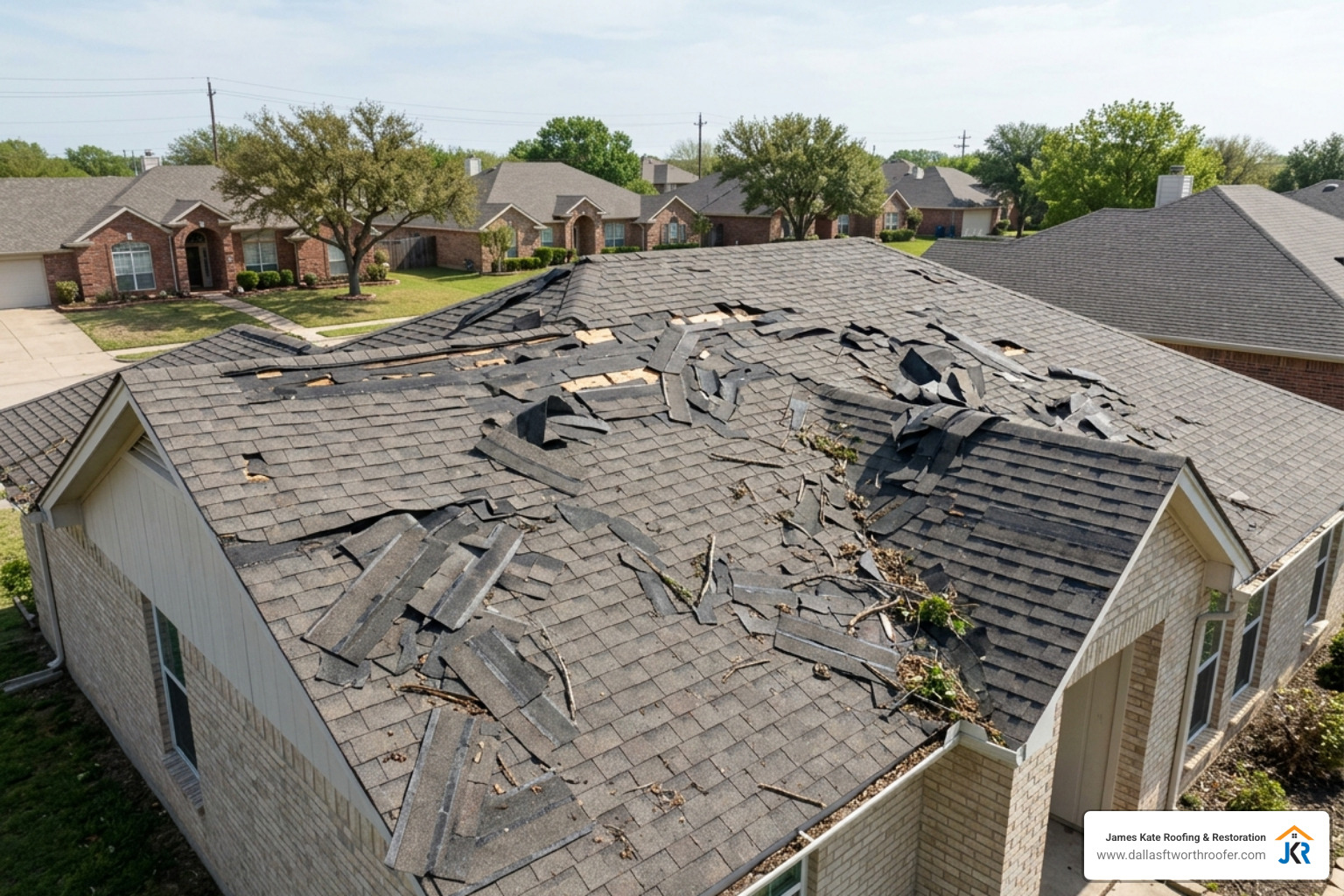
Wind damage roof problems are more common — and more sneaky — than most homeowners realize. Your roof can be compromised after a storm even when it looks perfectly fine from the street.
Here are the most important things to know right away:
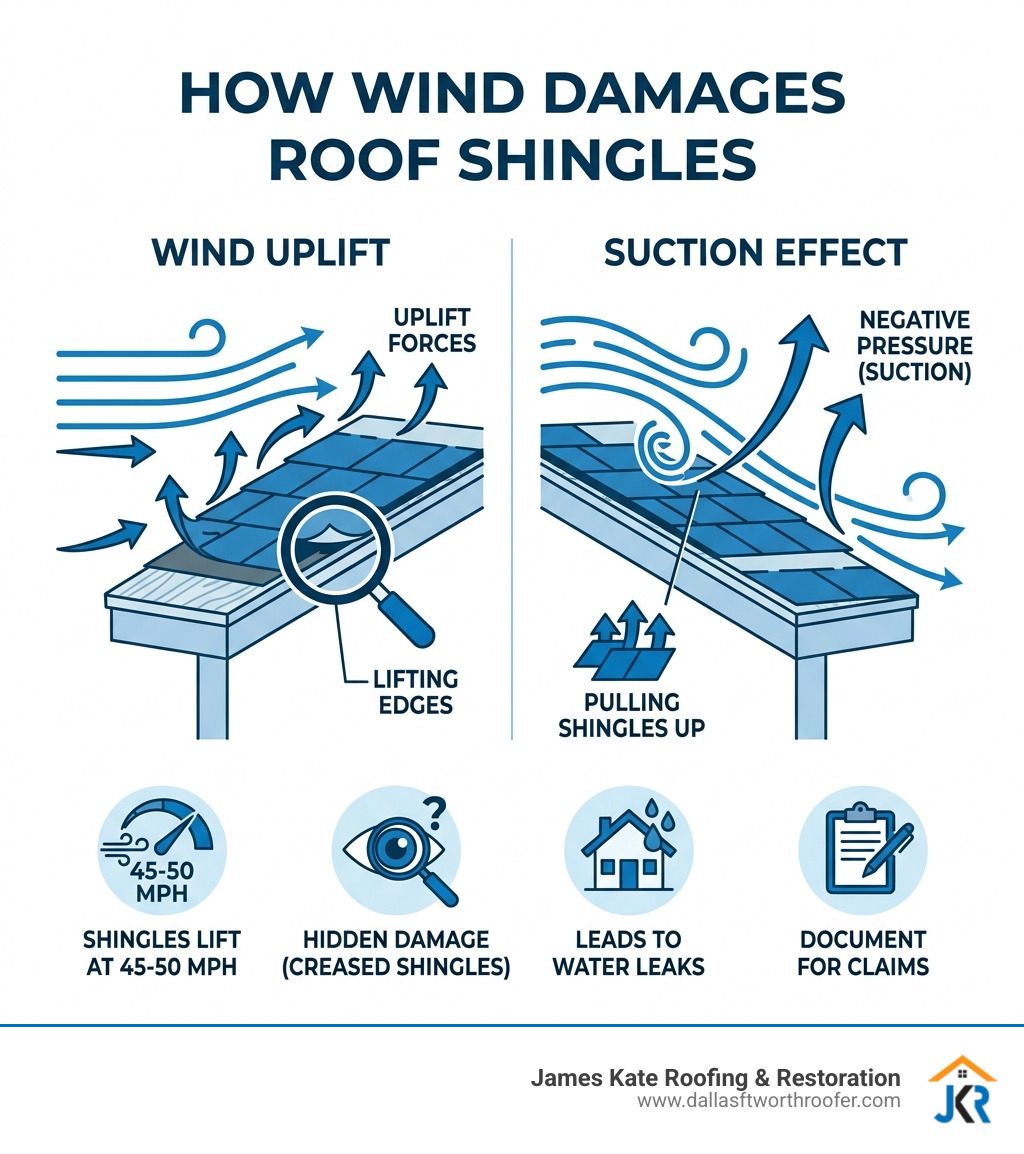
- Shingles can start lifting at winds as low as 45–50 mph — well below hurricane force
- Damage often hides in plain sight: lifted seals, creased tabs, and granule loss don’t always look alarming
- The biggest risk is waiting — small wind damage quietly becomes water damage, rot, and mold
- Always inspect from the ground first — binoculars and a walk around your yard can reveal a lot without climbing
- Document everything before calling your insurer — photos and storm dates matter for your claim
Even a single missing shingle or a patch of lifted flashing can let water into your home over weeks or months, long after the storm is forgotten.
In the Dallas–Fort Worth area, spring storms and seasonal wind events regularly push gusts past 50–60 mph — enough to peel back aging shingles or crack tile on roofs that seemed perfectly healthy going into storm season.
I’m Dustin Eatman, owner of James Kate Roofing & solar, and I’ve spent years diagnosing wind damage roof issues across the DFW metroplex — from subtle granule loss after a spring squall to major structural uplift following derecho-level events. In this guide, I’ll walk you through exactly what to look for, what to do next, and how to protect your home and your wallet.
Simple guide to Wind damage roof terms:
Identifying the Subtle Signs of a Wind Damage Roof
When we talk about a wind damage roof, most people picture a house with half the shingles missing or a tree lying in the living room. While those things certainly happen, the most dangerous damage is often the kind you can’t see from your driveway. Wind doesn’t just blow things off; it creates complex pressure differentials.
As wind flows over your roof, it creates a “suction” effect, especially at the edges, corners, and ridges. This negative pressure pulls upward on your shingles. If the adhesive seal is old or was poorly installed, the shingle lifts. Once the wind dies down, the shingle often drops back into place. It looks fine, but that waterproof seal is now broken, leaving your home vulnerable to the next rainstorm.
Exterior Indicators of Wind Damage Roof Issues
If you are walking your property in Mansfield or Arlington after a storm, keep an eye out for these specific red flags:
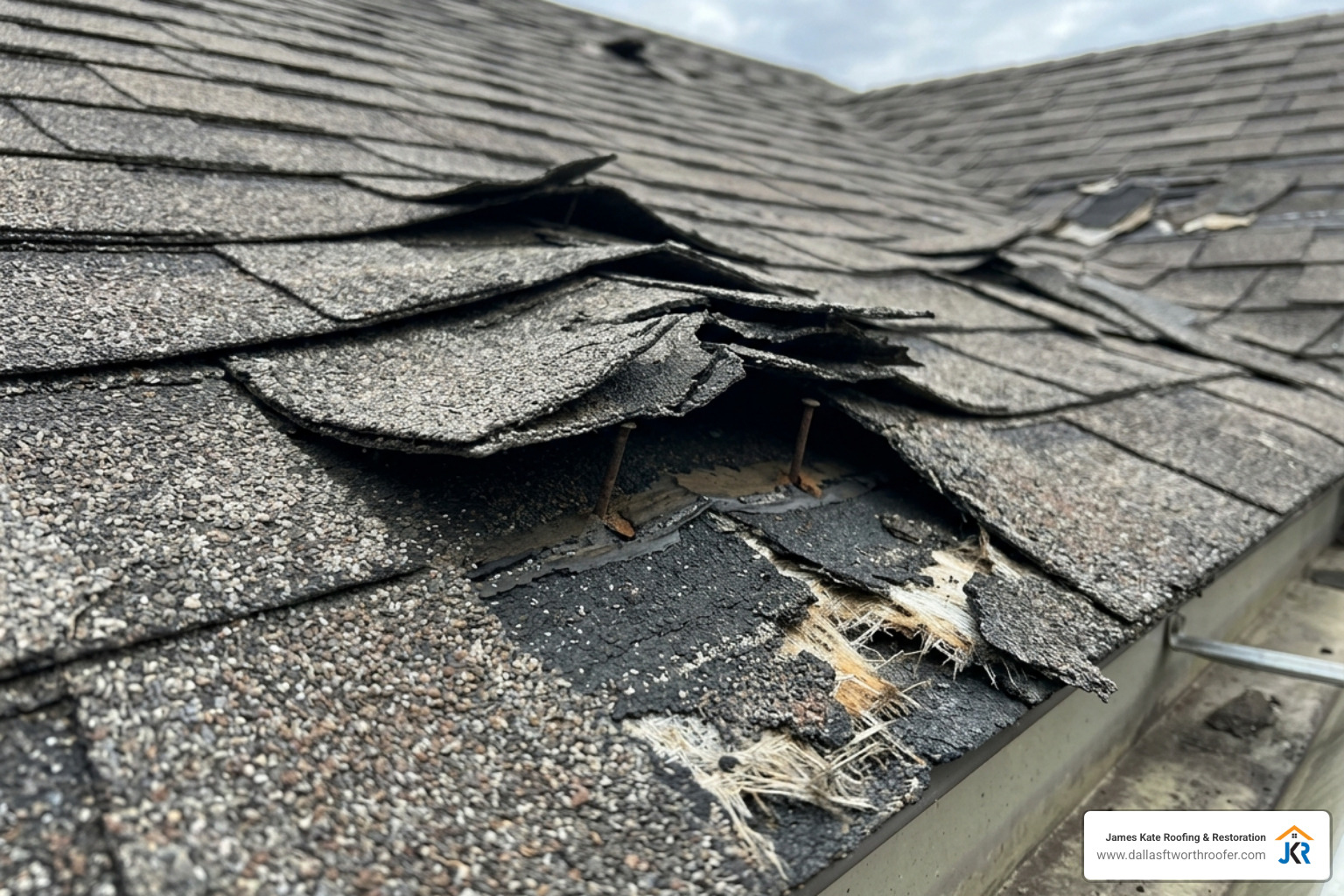
- Lifted Seals and Creased Tabs: This is the “silent killer” of roofs. When wind lifts a shingle but doesn’t tear it off, it can create a horizontal crease where the shingle folded back. This weakens the fiberglass mat inside the shingle.
- Granule Accumulation: Check your gutters and the splash pads under your downspouts. If you see what looks like piles of dark sand, your shingles are losing their protective coating. Wind-driven rain and debris act like sandpaper, stripping away the granules that protect your roof from Texas UV rays.
- Exposed Underlayment: If you see black felt or synthetic fabric showing through, you have missing shingles. This is an emergency because your primary water barrier is gone.
- Chimney Flashing and Ridge Caps: Wind often targets the “accessories” of your roof first. If the metal around your chimney looks bent or the shingles at the very peak of your roof (the ridge caps) are missing, you have a high risk of immediate leaks.
For more information on how we handle these issues, check out our solar services. According to research from HazardHub, corners and eaves are the most vulnerable points because wind speeds accelerate as they move around the edges of your home.
Interior Clues: Attic and Ceiling Red Flags
Sometimes the best way to find a wind damage roof is to look inside your house. After a heavy wind event in Grand Prairie or Midlothian, grab a flashlight and head to the attic.
- Daylight Through the Decking: If you see pinpricks of light coming through the roof boards, you have a breach.
- Damp Insulation: Wet insulation loses its R-value and becomes a breeding ground for mold. If it feels heavy or clumpy, water is getting in.
- Water Stains and Peeling Paint: Look at your ceilings and the tops of your walls. Yellow or brown “halos” are a classic sign of a slow leak caused by wind-lifted shingles.
If you find moisture, it’s important to act fast. We provide full solar services including water mitigation and mold remediation to ensure your home stays healthy.
Wind Speed Thresholds and Material Vulnerability
Not all roofs are created equal when the wind starts howling. In the DFW area, we see everything from traditional asphalt to modern metal and classic tile. Each reacts differently to high-velocity air.
| Wind Speed | Damage Potential | Material Impact |
|---|---|---|
| 45-50 mph | Minor/Threshold | Aging asphalt shingles may begin to curl or lift. |
| 58-70 mph | Moderate (Derecho) | Shingle “zippering” begins; loose flashing may detach. |
| 74-90 mph | Severe (Hurricane) | Widespread shingle loss; metal panels may bend; tiles can shatter from debris. |
| 90+ mph | Critical | Exceeds standard residential design limits; structural uplift possible. |
Asphalt shingles are the most common in North Texas. They often suffer from “zippering,” where one loose shingle allows wind to get underneath the next one, peeling them off in a line. Metal roofs are much more wind-resistant, but if a fastener is loose, the wind can catch a large panel and peel it back like a sardine can. Tile roofs are heavy and great in wind, but they are brittle; flying debris from a 60 mph gust can easily shatter them.
Explore our Roofing Service Areas to see how we help neighbors in your specific city.
Safe Post-Storm Inspection and Immediate Protection Steps
Your safety is our priority. As much as we love roofs, we don’t want you on one — especially after a storm when surfaces are slick and structural integrity might be compromised.
Immediate Actions After a Wind Damage Roof Event
- The Binocular Survey: Stay on the ground. Use a pair of binoculars to scan the roof for the signs we mentioned earlier — missing pieces, “flipped” shingles, or bent metal.
- Yard Debris Check: If you find shingles in your yard or your neighbor’s yard, they likely came from your roof. Collect them; they are evidence for your insurance claim.
- Photo Documentation: Take photos of the roof from the ground and photos of any debris you found. If there is interior leaking, take photos of the stains and any buckets you’ve had to set out.
- Storm Date Logging: Note the exact date and time of the storm. Insurance companies use weather data to verify claims.
- Emergency Tarping: If you have an active leak or missing shingles, you need a temporary seal. We offer rapid response for Storm Damage Roof Repair in Arlington, TX to prevent further interior damage.
Whether you need a quick patch or a full Residential Roofing assessment in Mansfield, TX, our team is ready to help you secure your property.
Navigating Insurance Claims: ACV vs. RCV Coverage
The average wind-related insurance claim in recent years has topped $10,000. Understanding your policy is the difference between a small out-of-pocket deductible and a massive financial headache.
There are two main types of coverage:
- Actual Cash Value (ACV): This pays you what your roof is worth today. If your roof is 15 years old, the insurance company subtracts “depreciation” from your payout. You might only get a fraction of what a new roof actually costs.
- Replacement Cost Value (RCV): This is the gold standard. It pays to replace the roof with a new one of similar quality, regardless of how old your current roof is.
Note on Deductibles: In Texas, many policies have a separate “Wind and Hail” deductible, which is often a percentage of your home’s total insured value (e.g., 1% or 2%) rather than a flat dollar amount.
Be aware that many insurers have a 30-day reporting window. If you wait six months to report a wind damage roof issue, they may deny the claim, citing “wear and tear” or “failure to mitigate damage.” For more help navigating these details, see our roofing services page.
Professional Repair Process and Cost Expectations
Once the storm has passed and you’ve documented the damage, the repair process begins. At James Kate Roofing & solar, we focus on material matching and long-term durability.
Cost expectations vary wildly based on the severity of the damage:
- Minor Repairs ($150–$600): This usually covers replacing a few missing shingles, resealing flashing, or fixing a ridge cap.
- Moderate Repairs ($600–$1,800): This involves larger patches, replacing entire “valleys,” or repairing significant sections of flashing and underlayment.
- Full Replacement ($8,000–$25,000+): If the wind has “unsealed” more than 25-30% of the roof, most insurance companies and professional roofers will recommend a full replacement to ensure the structural integrity of the home.
We take pride in our Roof Replacement & Repair in Midlothian TX, offering up to a 25-year workmanship warranty to give you peace of mind.
When to Call a Pro for Wind Damage Roof Repairs
While some homeowners might be tempted to nail down a loose shingle themselves, we strongly advise calling a professional for the following:
- Structural Sagging: If the roofline looks uneven, the wind may have caused structural damage.
- Flashing Failure: Metal work requires specialized tools to seal correctly.
- Large-Scale Loss: If you’ve lost more than a few shingles, the “zipper effect” has likely compromised the surrounding area.
We also specialize in commercial roofing for businesses in the DFW area that have suffered storm damage.
Long-Term Prevention and Maintenance Strategies
You can’t stop the wind, but you can prepare your roof for it. In April 2026, we are seeing more homeowners opt for high-wind upgrades during their Mansfield residential roofing projects.
- Wind-Rated Shingles: Look for Class F (rated up to 110 mph) or Class H (rated up to 150 mph) shingles. These have much stronger adhesive strips.
- Hurricane Straps: These metal connectors tie your roof rafters directly to the wall studs, preventing the entire roof from lifting off in extreme winds.
- Sealed Roof Decks: Using high-quality tape or specialized underlayment over the seams of your roof decking ensures that even if the shingles blow off, water stays out.
- Tree Trimming: Keep branches at least 10 feet away from your roof. In a wind storm, those branches become “whips” that strip granules or “bats” that break tiles.
- Biannual Inspections: Get a professional to check your roof every spring and fall. Catching a loose fastener or a drying adhesive seal in October can save you from a disaster in April.
Frequently Asked Questions about Wind Damage
How long does it usually take to repair wind damage on a roof?
For emergency situations, we can usually have a crew out for emergency tarping within 2 to 4 hours. Minor shingle or flashing repairs typically take one day. If a full replacement is required, the process usually takes 2 to 5 days, depending on the size of the home and the complexity of the roof.
What are the risks of ignoring minor wind damage?
Minor damage never stays minor. A single lifted shingle allows water to seep into the wood decking. This leads to structural rot, mold infestations, and ruined insulation. What could have been a $300 repair today can easily become a $15,000 structural rebuild if left for a year.
Does homeowners insurance always cover wind damage?
Generally, yes, if the damage was caused by a “sudden and accidental” storm event. However, insurance will not cover damage if they determine the roof failed due to age, lack of maintenance, or poor initial installation. This is why having a professional inspection report is vital for your claim.
Conclusion
Dealing with a wind damage roof can be stressful, but you don’t have to face it alone. At James Kate Roofing & solar, we bring our commitment to honesty, integrity, and Biblical principles to every job we do. As a GAF President’s Club recognized contractor, we provide the highest level of expertise in the DFW metroplex.
Whether you are in Mansfield, Arlington, or Grand Prairie, we are here to help you navigate the repair process, from the initial ground-level assessment to the final shingle. We don’t just fix roofs; we restore homes and provide the peace of mind that comes with a 25-year workmanship warranty.
Don’t wait for the next storm to turn a minor issue into a major leak. Contact James Kate Roofing & solar for a Professional Inspection today, and let us protect what matters most to you.
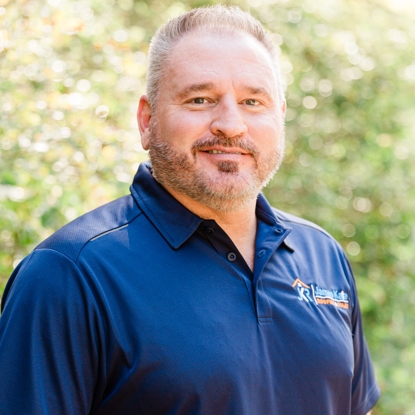
Dustin Eatman is a seasoned roofing professional with deep, hands-on expertise that spans residential and commercial roofing, insurance solar, and long-term roof asset management. As the owner of James Kate Roofing & solar in the Dallas–Fort Worth metroplex, he’s built a reputation for diagnosing roof systems accurately, communicating clearly, and executing projects with a high standard of workmanship and documentation. Dustin understands the technical details that make roofs perform—proper underlayment selection, slope and drainage considerations, ventilation strategy, flashing and penetration detailing, and manufacturer-specific installation requirements—because he’s worked through the real-world challenges that cause leaks, premature wear, and warranty issues. He’s equally fluent in the operational side of roofing: jobsite planning, quality control, safety, material ordering, crew coordination, and customer experience from inspection to closeout. In insurance-related projects, Dustin brings practical knowledge of claim workflows, adjuster meetings, scope alignment, supplements, and the importance of photo evidence and thorough records, helping property owners navigate stressful situations with confidence. For commercial clients—especially property and facility managers—he emphasizes proactive maintenance and targeted repairs that reduce disruption, extend roof life, and prevent expensive interior damage. Dustin also stays focused on doing things the right way: educating customers on realistic options, setting expectations, and prioritizing solutions that hold up over time rather than quick fixes. That blend of technical skill, field experience, process discipline, and owner-level accountability is what makes Dustin Eatman a trusted expert in the roofing industry.