
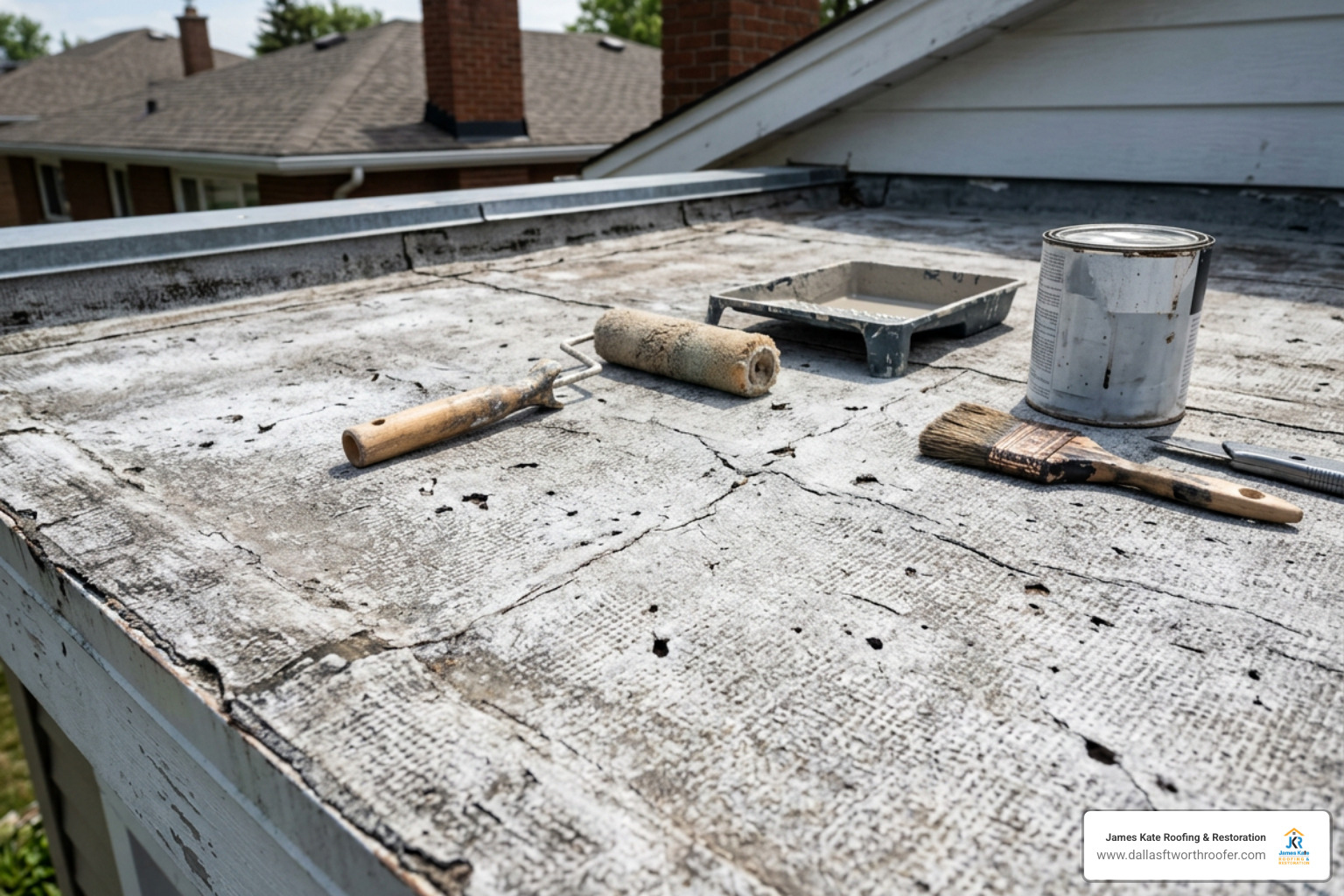
Recoating a Fibreglass Roof Before Small Defects Become Leaks
Recoating a fibreglass roof works when the GRP laminate and roof deck are still dry, firm, and well bonded. Clean the roof, sand away the glossy or chalky outer surface, repair cracks and pinholes, then apply a GRP-compatible topcoat or flexible solar membrane during dry, mild weather.
A recoat is not a fix for soft spots, widespread delamination, trapped moisture, or a rotten deck. Those problems need structural repair first. But if the issue is a faded topcoat, minor flaking, small pinholes, or surface cracks, a properly prepared coating can restore UV protection and waterproofing without replacing the full roof.
Fibreglass roofs can last 20 years or more when installed well. Acting while damage is limited to the surface can help prevent water from reaching the deck below, where a manageable roof issue can turn into costly interior water damage.
I am Dustin Eatman, owner of James Kate Roofing & solar. My experience diagnosing roof leaks, drainage issues, flashing failures, and long-term roof wear helps property owners make sound decisions about recoating fibreglass roof systems versus repairing or replacing them.
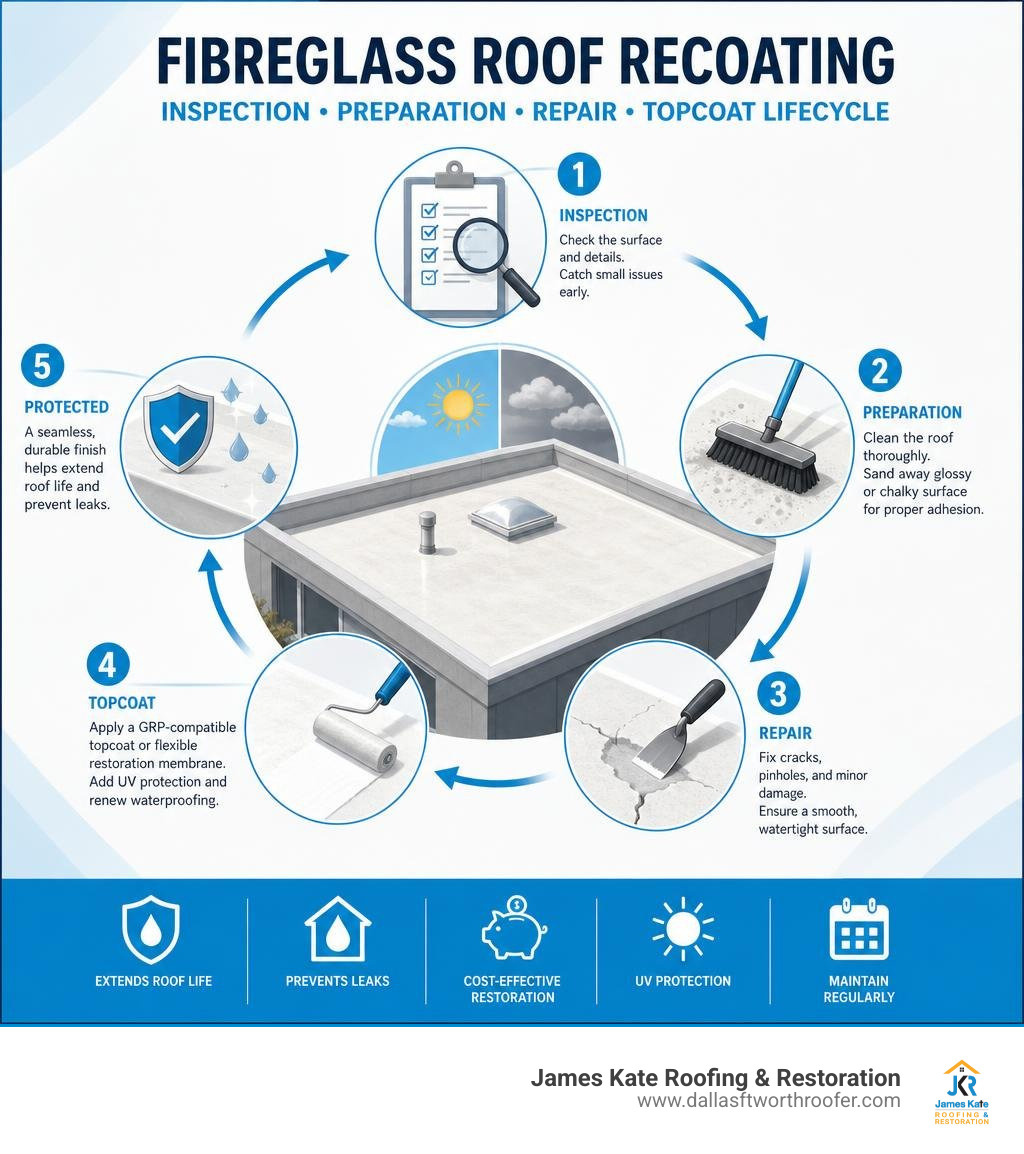
Recoating fibreglass roof terminology:
Understanding GRP Roof solar: Recoating vs. Repair vs. Replacement
Glass Reinforced Plastic (GRP), universally known as fibreglass roofing, is composed of structural timber decking (typically OSB3 tongue-and-groove boards), a catalysed resin-saturated chopped strand mat (CSM) laminate, and a protective outer topcoat or flowcoat. The topcoat serves as the primary barrier against ultraviolet degradation, water penetration, and everyday physical abrasion.
Over years of harsh weather cycles, intense UV exposure causes the topcoat resin to lose its protective wax and plasticiser integrity. Understanding whether your roof needs a simple protective recoat, a localized structural patch, or a complete tear-off is essential for managing your budget and protecting the underlying building structure. Exploring The Smart Business Owner’s Guide to Commercial Roof solar offers extensive insights into how non-invasive roof overlays safeguard structural assets over time.
| Project Scope | Primary Indicators | Structural Impact | Work Required | Typical Lifespan Extension |
|---|---|---|---|---|
| Surface Recoating | Topcoat fading, chalking, pinholes, minor micro-cracking | Base laminate and deck remain completely dry and firmly adhered | Mechanical sanding, solvent wipe, application of topcoat or PU membrane | 10 to 15 years |
| Structural Repair | Localised punctures, cracks along stress points, flashing splits | Impact damage or joint movement affecting <25% of roof area | Sanding back to laminate, resin and CSM matting lamination, topcoat | Restores patch to match remaining roof lifespan |
| Complete Replacement | Spongy decking, widespread delamination, saturated insulation | Sub-deck timber rot, failed falls, widespread structural failure | Full tear-off of timber deck and laminate down to the joists | 20+ years (new system baseline) |
Signs Indicating Surface Degradation
Recognising early warning signs prevents water from penetrating the raw glass matting underneath:
- Topcoat Flaking and Peeling: Occurs when the original topcoat was applied too thick or over a damp laminate layer during installation.
- Micro-Pinholes: Tiny voids in the outer resin matrix caused by rapid gas escape during initial curing or prolonged weathering.
- Surface Alligatoring: Interconnected hairline surface patterns caused by decades of intense UV exposure breaking down resin polymers.
- Milky or Streaky Discoloration: A chalky, milky hue indicating that atmospheric moisture contaminated the topcoat while curing.
- Exposed Glass Weave: When the outer resin erodes enough that the raw chopped strand glass fibres become visible to the naked eye.
When to Recoat Instead of Replacing
A fibreglass flat roof can be successfully restored whenever the underlying laminate remains structurally bonded to a dry, rigid deck. When evaluating your roof, walk across the surface and listen carefully. If the roof deck feels firm and lacks crunching noises (which indicate laminate delamination from the wood), an overlay system is practical.
Conversely, if sections of the roof feel spongy underfoot, moisture has compromised the timber deck. Attempting to roll a liquid coating over wet substrate traps water inside the roofing envelope, accelerating rot. In building standard frameworks, repairs that impact less than 25% of the total flat roof area allow localized remediation, whereas extensive structural board decay requires Getting Your Commercial Flat Roof Replaced to establish a safe, code-compliant barrier.
Selecting the Right Coating: Polyester Topcoat vs. Polyurethane Membranes
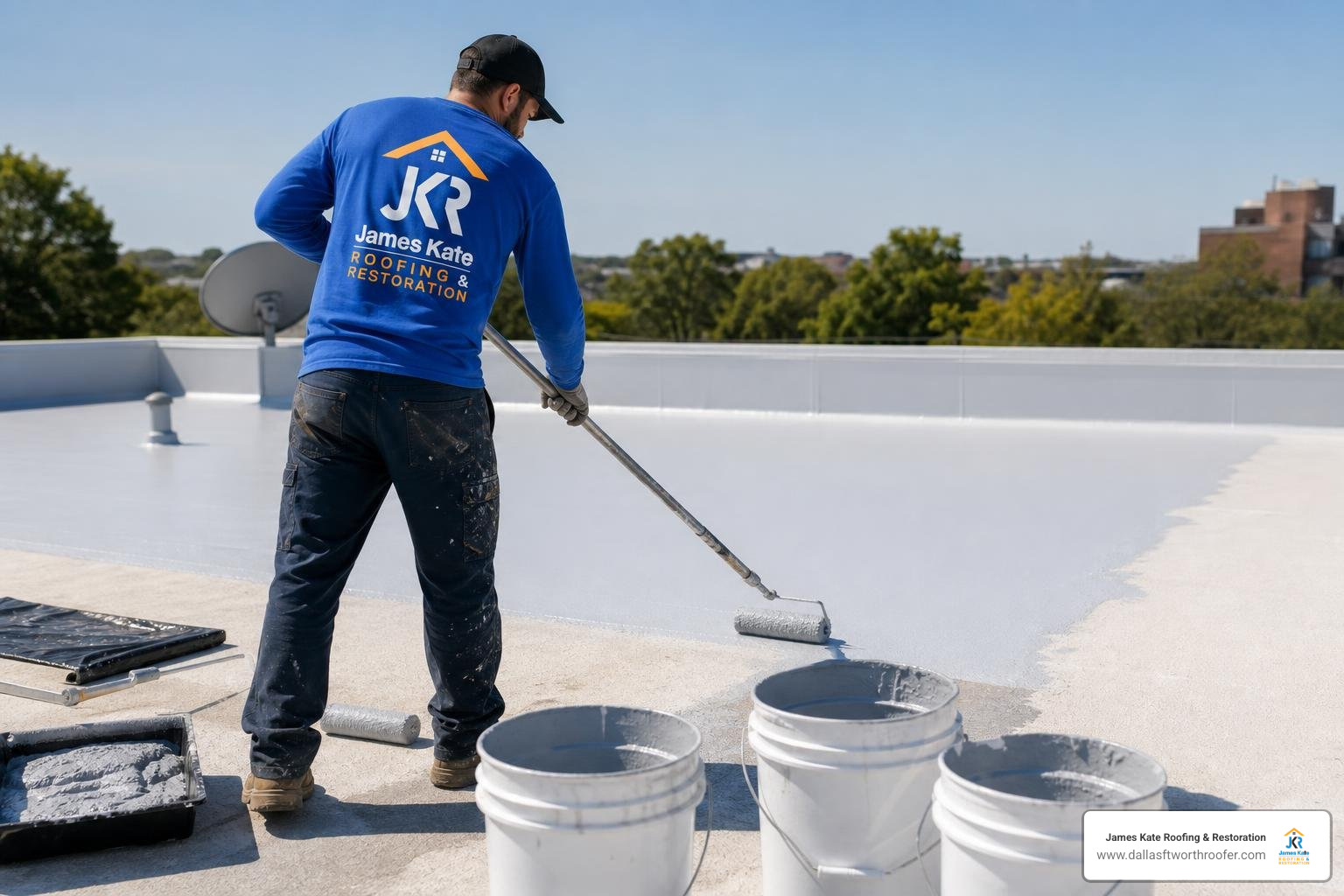
Choosing the correct coating chemistry ensures that your new top layer permanently adheres to the aged GRP substrate rather than peeling off after the first winter freeze or summer heatwave.

- Isophthalic Polyester Topcoat (Flowcoat): This is the traditional GRP finishing resin. It cures through an added methyl ethyl ketone peroxide (MEKP) catalyst (typically mixed between 1% and 3% by volume depending on temperature). It contains styrene, which cross-links directly with prepared polyester laminate. However, polyester resin is naturally rigid. If your roof experiences structural movement, excess flowcoat thickness will crack. Reviewing How to Repair a Leaking Fibreglass Roof [Permanent GRP Fix] highlights how polyester systems achieve a permanent chemical bond when installed on matched substrates.
- Aliphatic Polyurethane Liquid Membranes: Polyurethane solar coatings have become an industry standard for refurbishing sound GRP roofs. Unlike polyester, polyurethane is a single-pack, moisture-curing system that requires no manual catalyst mixing. It delivers exceptional elongation properties, moving naturally with thermal expansion cycles without cracking.
- Acrylic Coatings: Acrylics applied over specialized bonding primers provide a lightweight, accessible seal. However, for maximum ponding water resistance on dead-flat decks, polyurethane or polyester systems provide superior longevity. Understanding Don’t Get Drenched: The Best Waterproof Paint for Flat Roofs helps property owners balance application ease against multi-year weatherproofing demands.
Step-by-Step Guide to Recoating Fibreglass Roof Systems
Restoring an existing GRP flat roof requires precise technical execution. The secret to long-term coating adhesion lies 90% in surface preparation and 10% in the application itself.
Surface Cleaning and Mechanical Sanding Preparation
A fully cured fibreglass topcoat naturally repels new liquid coatings due to surface wax and natural weathering deposits. You must establish a strong mechanical key:
- Deep Surface Cleaning: Wash the roof thoroughly using a specialized biodegradable roof cleaner to strip away moss, lichen, atmospheric grease, and dirt. Rinse with clean water and allow the deck to dry 100% completely.
- Mechanical Abrasion: Sand the entire roof deck using heavy-grit sandpaper (40-grit to 60-grit) or a random orbital sander. Abrade until all gloss is gone, the surface feels uniformly rough, and oxidized topcoat layers are stripped away.
- Solvent Degreasing: Thoroughly sweep or vacuum away all sanding dust. Wipe down the entire abraded surface using lint-free cloths soaked in pure virgin acetone. The acetone removes residual wax, oils, and microscopic dust particles while temporarily preparing the resin surface for bonding.
Patching Structural Cracks and Pinholes
Never attempt to span open fractures with standard topcoat alone; liquid topcoat lacks tensile strength across moving gaps.
- Grind Back Defects: Sand roughly 50mm to 100mm beyond any visible split or puncture down to the raw laminate.
- Cut Chopped Strand Matting: Cut 450g/m² chopped strand mat (CSM) to fit the abraded margin, feathering the edges to eliminate sharp transitions.
- Laminate the Patch: Mix base polyester laminating resin with 1% to 2% MEKP catalyst. Apply resin to the substrate, lay the matting down, and wet it out with additional resin until the white glass fibres turn translucent.
- Consolidate with a Paddle Roller: Roll a ribbed metal paddle roller firmly across the wet patch to force out entrapped air bubbles and ensure structural consolidation. Allow the patch to cure until tack-free.
Applying the Protective Topcoat and Liquid Membrane
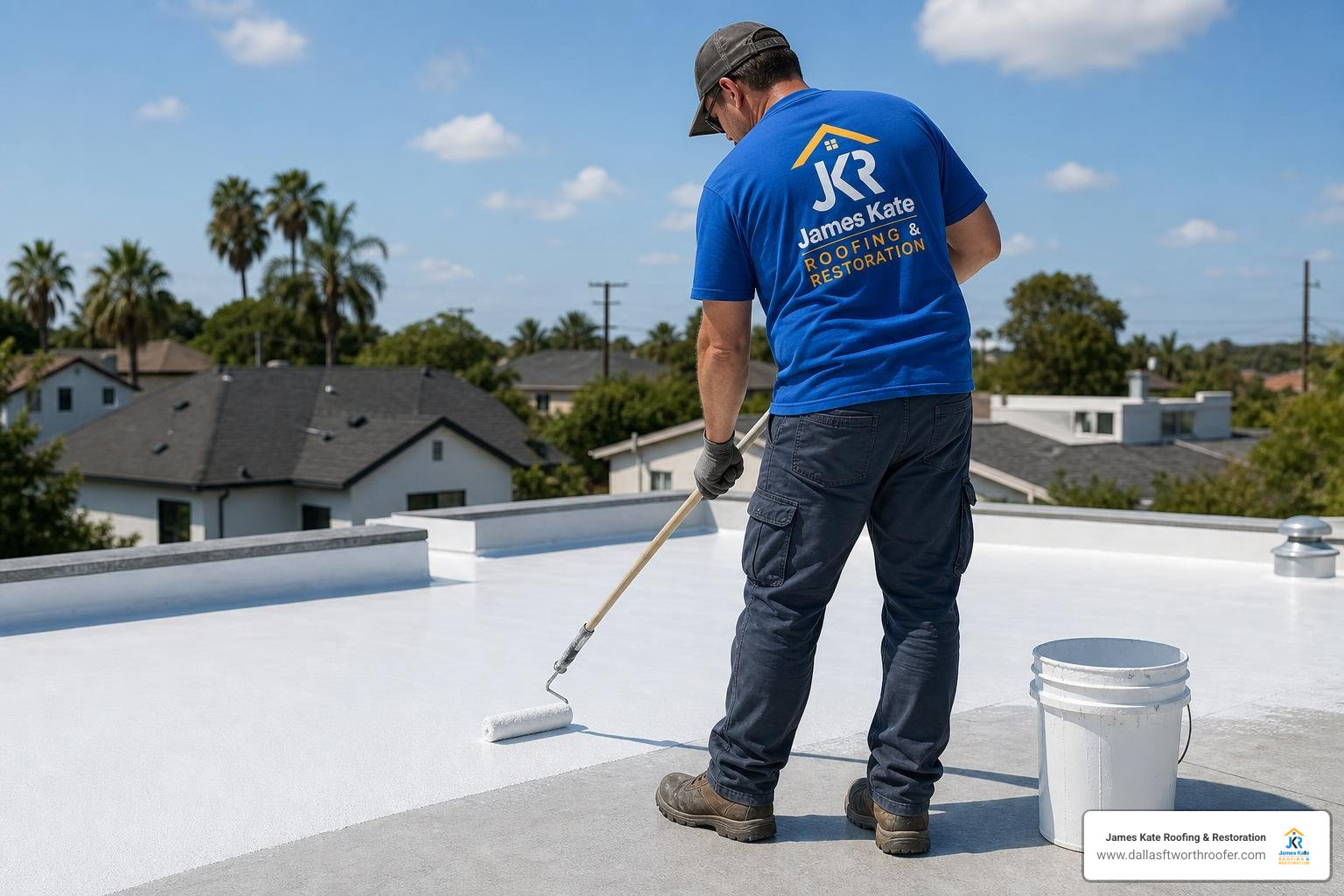
With repairs completed and the surface fully prepared, apply the final weatherproofing membrane across the roof field:
- Environment Verification: Verify that ambient and surface temperatures are between 5°C and 30°C (41°F to 86°F), with zero risk of rain, heavy fog, or dew settling during application.
- Edge Cutting: Mix your coating in manageable batches that can be applied within a 15-minute working window. Using a laminating brush, cut in all perimeter trims, wall upstands, pipe penetrations, and drip edges first.
- Main Deck Rolling: Using a short-pile, chemical-resistant polyester or nylon roller, roll the coating out in uniform, overlapping strokes. Maintain a coverage rate of approximately 0.5 kg to 0.6 kg per square metre, building a wet film thickness of 500 to 600 microns.
- Curing Windows: Under normal conditions (around 20°C/68°F), the topcoat achieves rain resistance within 2 hours and reaches a full mechanical cure within 24 hours. Refer to the manufacturer’s 5-5 Topcoat Application on a Fibreglass Roof guidelines for detailed chemical handling specifications.
Cost Breakdown and Critical Pitfalls in GRP Recoating
Restoring an existing sound GRP roof represents significant financial savings compared to a full structural tear-off. Applying a liquid overlay typically costs a fraction of complete roof replacement because structural timber boards, insulation layers, and flashing trims remain undisturbed. Evaluating A Realistic Breakdown of Roof Coating Costs for Homeowners provides clear perspective on material expenses versus long-term building preservation.
Key Mistakes That Cause Recoating Fibreglass Roof Projects to Fail
- Applying Over Moisture: Moisture is the absolute enemy of curing resins. Applying a coating over a damp laminate prevents cross-linking, turning the resin into a cloudy, unhardened mess that quickly blisters.
- Skipping Mechanical Sanding: Wiping an old, glossy roof with solvent without aggressive 40-grit abrasion will cause the new topcoat to delaminate and peel in sheets over time.
- Excessive Topcoat Thickness: Laying flowcoat on thicker than 0.5 kg/m² does not make the roof stronger; it makes the cured resin overly brittle, causing spider-web cracking under thermal movement.
- Incorrect MEKP Catalyst Ratios: Adding too little catalyst in cold weather leaves the coating tacky, while adding too much in hot weather causes “flash curing” before the resin can bond.
Why Recoating Fibreglass Roof Systems Maximizes Long-Term ROI
A quality recoating project adds 10 to 15 years of waterproof performance to an aging GRP deck. High-grade liquid solar systems achieve top-tier Broof(t4) fire ratings while creating a seamless, joint-free shield against severe weather. By taking action when topcoat wear is first noticed, property owners protect their structural decking, eliminate the waste associated with full tear-offs, and discover How to Make Your Old Roof Look Brand New Again without excessive disruption.
Frequently Asked Questions About Recoating Fibreglass Roofs
Can you recoat a fibreglass roof with standard exterior paint?
No. Standard exterior house paint, oil-based enamels, or bitumen coatings should never be used on a fibreglass roof. Standard paints lack the chemical properties required to bond to cured resin and will rapidly blister under standing water and thermal movement. You must use dedicated isophthalic polyester topcoats or flexible polyurethane liquid membranes formulated specifically for GRP bonding.
How long can an unfinished GRP roof sit without a topcoat?
An unfinished GRP roof should ideally receive its topcoat within 24 hours of base laminate application to achieve a direct chemical bond. If left uncoated for weeks or months, ultraviolet radiation breaks down the unshielded resin matrix. To recover an aged, unfinished laminate, you must thoroughly sand away the weather-degraded top layer, clean it with pure acetone, and often lay a fresh layer of 450g/m² matting before applying the topcoat.
What temperature and weather are required to recoat a GRP roof?
The ideal application window is during dry, mild weather between 10°C and 25°C (50°F to 77°F). Never attempt GRP recoating when ambient temperatures drop below 5°C (41°F) or exceed 30°C (86°F). Ensure no rain, heavy fog, or dew is forecast for at least 12 hours to guarantee a full, tack-free chemical cure.
Conclusion
A fibreglass roof is among the most durable, hard-wearing flat roof systems available, but it depends heavily on an intact outer topcoat to protect against ultraviolet breakdown and thermal wear. Addressing surface pinholes, faded flowcoats, and hairline crazing before water reaches the underlying timber deck saves thousands in unnecessary structural tear-offs.
At James Kate Roofing & solar, our team brings decades of field experience, honest evaluations, and manufacturer-certified workmanship to every roofing project across Mansfield, TX, Arlington, TX, Granbury, TX, Grand Prairie, TX, and Midlothian, TX. Whether you are dealing with minor flat roof wear or exploring professional elastomeric roof coating solutions, timely preventative maintenance guarantees long-lasting protection for your building.

Dustin Eatman is a seasoned roofing professional with deep, hands-on expertise that spans residential and commercial roofing, insurance solar, and long-term roof asset management. As the owner of James Kate Roofing & solar in the Dallas–Fort Worth metroplex, he’s built a reputation for diagnosing roof systems accurately, communicating clearly, and executing projects with a high standard of workmanship and documentation. Dustin understands the technical details that make roofs perform—proper underlayment selection, slope and drainage considerations, ventilation strategy, flashing and penetration detailing, and manufacturer-specific installation requirements—because he’s worked through the real-world challenges that cause leaks, premature wear, and warranty issues. He’s equally fluent in the operational side of roofing: jobsite planning, quality control, safety, material ordering, crew coordination, and customer experience from inspection to closeout. In insurance-related projects, Dustin brings practical knowledge of claim workflows, adjuster meetings, scope alignment, supplements, and the importance of photo evidence and thorough records, helping property owners navigate stressful situations with confidence. For commercial clients—especially property and facility managers—he emphasizes proactive maintenance and targeted repairs that reduce disruption, extend roof life, and prevent expensive interior damage. Dustin also stays focused on doing things the right way: educating customers on realistic options, setting expectations, and prioritizing solutions that hold up over time rather than quick fixes. That blend of technical skill, field experience, process discipline, and owner-level accountability is what makes Dustin Eatman a trusted expert in the roofing industry.