When Water Hides in Your Walls: What Applied Structural Drying Actually Does
Applied structural drying is the science-based process of removing moisture from building materials — walls, floors, framing, and subfloors — after a water intrusion event, using commercial equipment, psychrometric principles, and documented monitoring protocols.
It is not the same as pulling up wet carpet or running a fan. It is the step that determines whether your home is actually dry — or just looks dry.
Quick answer: What is applied structural drying?
| Aspect | What You Need to Know |
|---|---|
| What it is | Controlled removal of moisture from structural building materials using air movers, LGR dehumidifiers, and heat |
| Why it matters | Mold can begin growing within 24-48 hours of saturation |
| How long it takes | Typically 3 to 7 days — sometimes longer depending on materials and conditions |
| Who does it | IICRC-certified technicians trained in psychrometrics and moisture science |
| Key standard | ANSI/IICRC S500 governs professional structural drying in the U.S. |
| What happens if skipped | Hidden moisture causes mold, structural rot, and expensive secondary damage |
Most homeowners think the damage stops when the standing water is gone. It doesn’t. Moisture moves into drywall, wood framing, insulation, and concrete — and it stays there long after the floors feel dry underfoot. That hidden moisture is where the real damage happens.
I’m Dustin Eatman, owner of James Kate Roofing & solar, and through years of handling insurance solar projects across the Dallas-Fort Worth area, I’ve seen how applied structural drying — done right or done wrong — determines whether a water loss becomes a minor repair or a major gut job. Let’s walk through exactly how the process works, what the science behind it means for your property, and what separates a professional drying job from one that just moves air around.
Basic applied structural drying glossary:
What is Applied Structural Drying and Why Does It Matter?
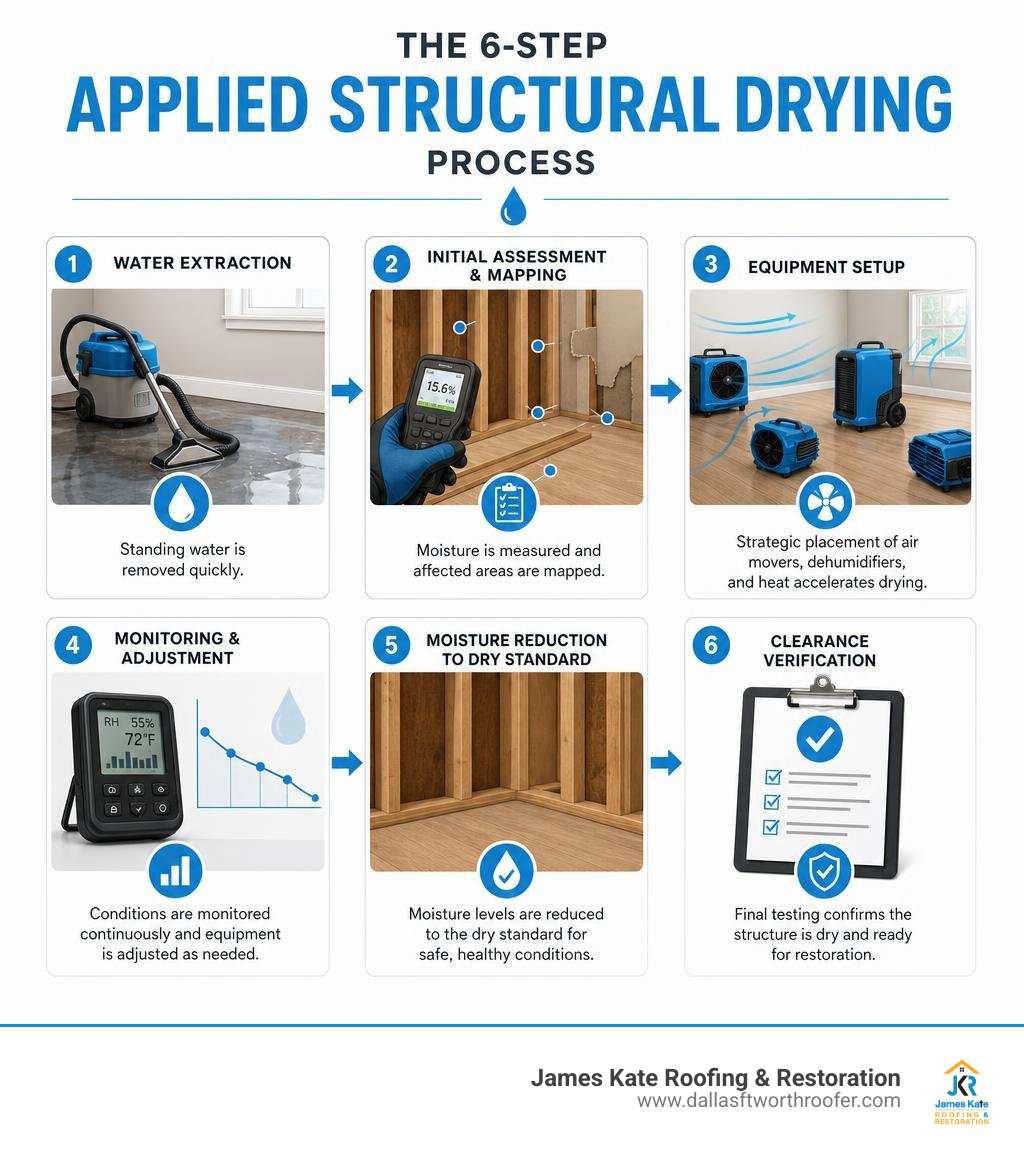
When water floods a property, the immediate reaction is to get the liquid out. This initial step is basic water extraction. While extraction removes the bulk of the standing water, it only scratches the surface.
Surface drying might make a carpet feel dry to the touch or make a hardwood floor look clear, but it ignores the moisture trapped deep within the structural assemblies. Applied structural drying (ASD) is an advanced, multi-phase methodology that goes beyond the surface to dry the actual bones of your home—the studs, plates, subfloors, and concrete foundations.
Without deploying advanced structural drying techniques, hidden moisture remains trapped inside enclosed cavities. When building materials stay wet, they begin to lose their structural integrity. Gypsum wallboard (drywall), for example, begins to delaminate at roughly 1% free water by weight beyond its normal content. Wood framing begins to soften, warp, and rot.
Furthermore, mold prevention is entirely dependent on how quickly and thoroughly a structure is dried. Mold spores are opportunistic; they require moisture, a food source (like drywall or wood), and warm temperatures to colonize. In typical damp conditions, mold can begin forming in as little as 24 to 48 hours. By implementing a comprehensive drying plan, we stop mold in its tracks and prevent secondary damage, such as swelling floor joists, buckling subfloors, and ruined finishes. To understand the timeline of a water emergency, check out our Water Damage solar Survival Guide.
The Science of Psychrometry in Applied Structural Drying
At the heart of ASD is psychrometry—the science of dry air, water vapor, and their relationship to temperature and moisture content in materials. Professional restorers don’t guess whether a wall is dry; they use psychrometric calculations to prove it.
To understand how we dry a building, we have to look at several key scientific metrics:
- Relative Humidity (RH): The amount of water vapor present in the air expressed as a percentage of the amount needed for saturation at that same temperature.
- Vapor Pressure: This is the force exerted by water vapor molecules on surrounding surfaces. Water molecules naturally want to move from areas of high vapor pressure (wet materials) to areas of low vapor pressure (dry air).
- Equilibrium Moisture Content (EMC): The point at which a hygroscopic material (like wood or drywall) neither gains nor loses moisture to the surrounding air. Our goal is to manipulate the air’s humidity and temperature so that the EMC of the wet materials returns to a pre-loss, healthy baseline.
- Grain Depression: The difference in moisture content (measured in grains per pound of dry air) between the air entering a dehumidifier and the air leaving it. A high grain depression means the dehumidifier is successfully stripping moisture out of the air, creating the thirsty environment needed to pull water out of your walls.
The Four Physical Mechanisms of Restorative Drying
To successfully dry a structure, we must coordinate four distinct physical mechanisms. If any of these four elements are missing, the drying process will stall:
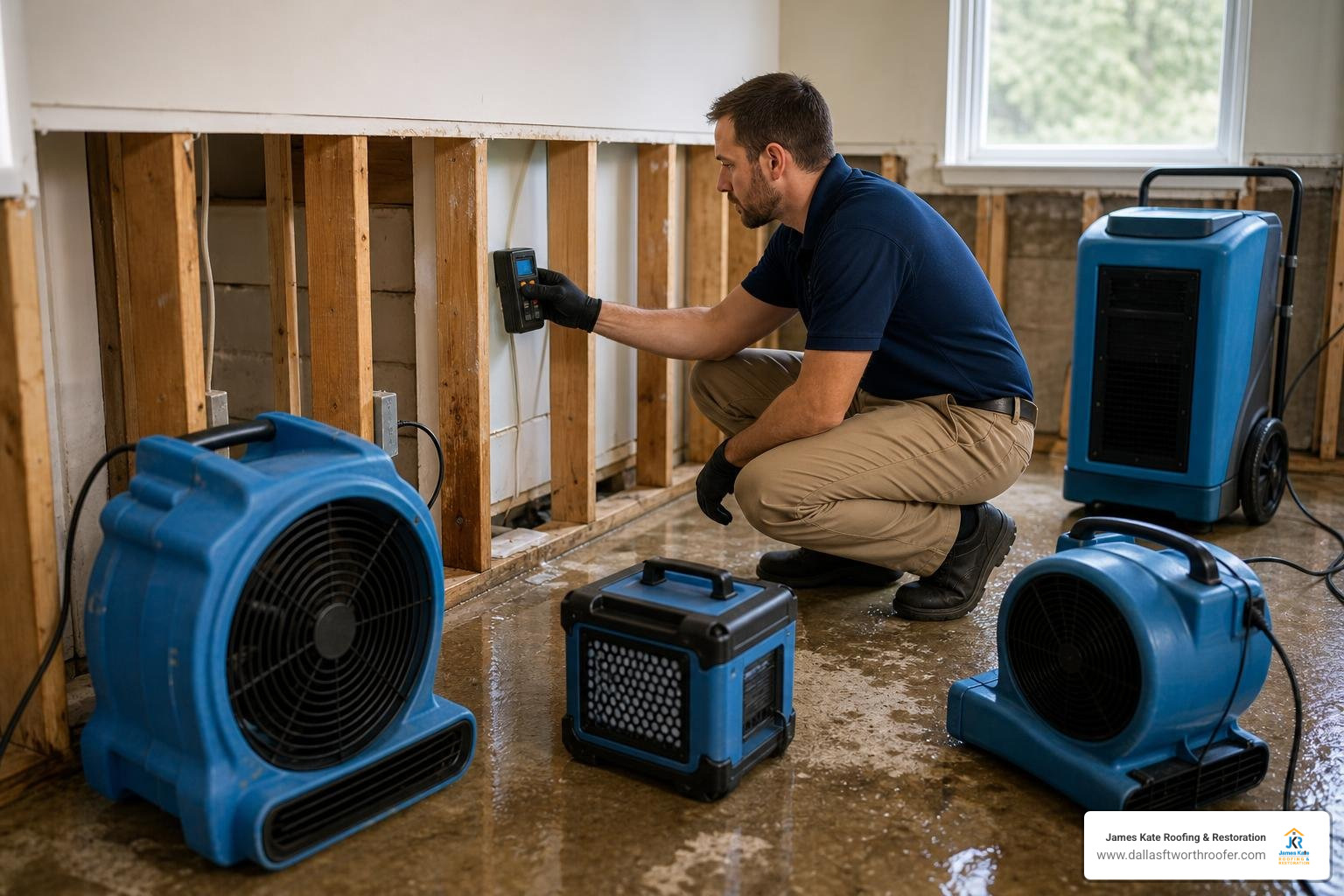
- Evaporation: We must turn the liquid water trapped inside materials into a gas (vapor). High-velocity air movers are placed strategically to sweep away the stagnant boundary layer of saturated air directly above wet surfaces, accelerating evaporation.
- Dehumidification: Once the water evaporates into the air, it must be removed. If we only use fans without dehumidification, the relative humidity in the room will rise until the air is saturated. At that point, evaporation stops completely. Industrial dehumidifiers pull this moisture out of the air and drain it away.
- Heat Application: Increasing the temperature of wet structural materials raises their internal vapor pressure. This makes the water molecules move faster and escape into the air more rapidly.
- Pressure Differentials: By controlling the air pressure between different containment zones, we can force dry air into wet wall cavities or pull damp air out of hidden spaces.
Classifying Water Damage: Categories and Classes
Before turning on a single piece of equipment on a job in Arlington or Mansfield, we must properly classify the water loss. The industry standard, ANSI/IICRC S500, divides water damage into two distinct classification systems: Categories (which measure contamination levels) and Classes (which measure the volume of water and the expected evaporative load).
For a deep dive into these classifications, you can refer to The Essential Guide to Identifying Your Category of Water Loss.
Water Categories (Contamination Levels)
- Category 1 (Clean Water): Originates from a sanitary source, such as a broken water supply line or a clean tub overflow. It poses no immediate risk to human health, though it can degrade to Category 2 if left untreated for more than 24 to 72 hours.
- Category 2 (Gray Water): Contains significant contamination and has the potential to cause discomfort or sickness if consumed or contacted. Examples include washing machine discharges, toilet overflows with urine but no feces, and sump pump failures.
- Category 3 (Black Water): Highly contaminated water containing pathogenic, toxigenic, or other harmful agents. This includes sewage backups, rising floodwaters from rivers, and wind-driven rain from storms. For specialized safety steps regarding these losses, see Everything You Need to Know About Category 3 Water Loss and our guide on Black Water Blues: Understanding and Remediating Category 3 Water Damage.
Water Classes (Evaporative Load)
- Class 1 (Least amount of water): Affects only a small area, or involves low-porosity materials (like concrete or tile) with minimal absorption.
- Class 2 (Significant amount of water): Affects an entire room or area, saturating medium-porosity materials like carpet, pad, and gypsum wallboard.
- Class 3 (Greatest amount of water): Overhead water intrusions that saturate entire ceilings, walls, insulation, and subfloors.
- Class 4 (Specialty drying situations): Consists of deep, pocketed moisture trapped in low-porosity materials such as hardwood floors, concrete slabs, brick, and plaster. These require specialized drying equipment and techniques.
| Water Category / Class | Contamination Risk | Primary Materials Affected | Equipment Intensity |
|---|---|---|---|
| Category 1 | Low (Sanitary source) | Clean drywall, framing | Standard extraction & drying |
| Category 2 | Medium (Chemical/Microbial) | Carpets, pad, structural wood | Sanitization + controlled drying |
| Category 3 | High (Pathogenic/Sewage) | All porous materials (must be removed) | High-level PPE, demolition, heavy sanitization |
| Class 1 to 3 | Varies by source | Drywall, carpet, ceiling tiles | Progressive scaling of air movers & LGRs |
| Class 4 | Varies by source | Hardwood, concrete, plaster | Desiccants, floor mats, targeted heat |
Open-Structure vs. Closed-Structure Drying Strategies
During a solar project, we must choose between an open-structure or a closed-structure drying approach depending on the outdoor environmental conditions.
- Open-Structure Drying: This strategy utilizes the natural ventilation of outdoor air to help dry the building. If the outdoor air is exceptionally dry (low relative humidity and low dew point) compared to the indoor environment, we can open windows and use exhaust fans to exchange wet indoor air for dry outdoor air.
- Closed-Structure Drying: In the humid, warm climates common to the Dallas-Fort Worth metroplex, open drying is rarely effective. Instead, we use closed-structure drying. We seal off the affected areas, isolate the HVAC system to prevent the spread of humidity or spores, and rely entirely on commercial dehumidifiers to control the indoor environment. This approach is highly energy-efficient because it allows us to create a tight “drying chamber” where we have absolute control over temperature and relative humidity.
Professional Equipment vs. Consumer-Grade Tools
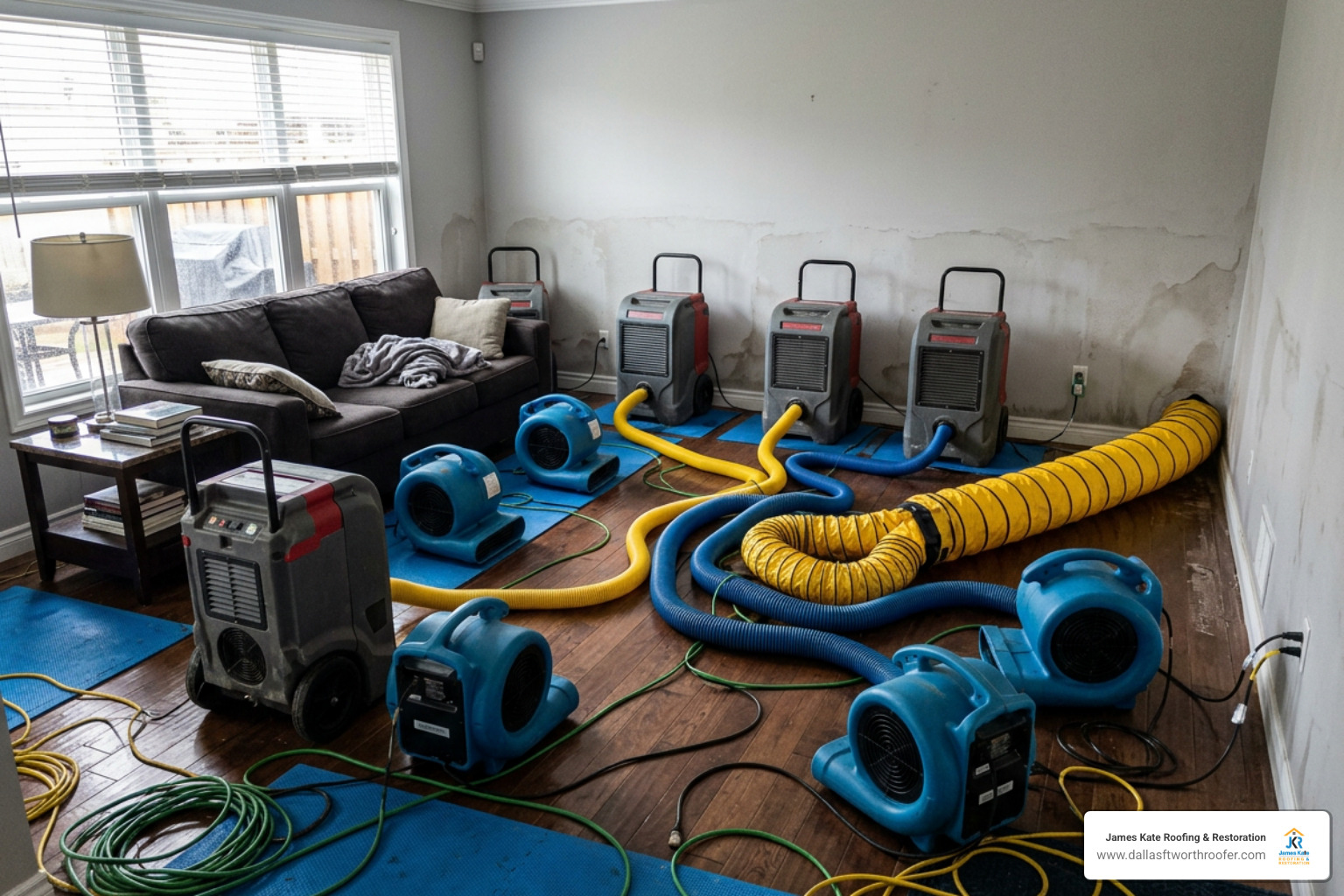
Many homeowners wonder why they can’t simply rent a few box fans and a dehumidifier from a local hardware store to dry out their properties. The simple truth is that consumer-grade tools do not have the capacity, air volume, or engineering required to pull deep moisture out of structural elements.
According to technical guides on Emergency Structural Drying Processes | Emergency solar Authority, professional solar requires specialized, industrial-strength machinery:
- Low-Grain Refrigerant (LGR) Dehumidifiers: Unlike household dehumidifiers that struggle once relative humidity drops below 50%, commercial LGR units are designed to continue extracting moisture down to 25% RH. An LGR unit can remove 150+ pints of water per day, pre-cooling the incoming air to maximize condensation efficiency.
- Desiccant Dehumidifiers: These units do not rely on cooling coils. Instead, they use a silica gel rotor that chemically absorbs moisture from the air. Desiccants can create incredibly dry air (extremely low vapor pressure) and are essential for Class 4 drying situations, such as restoring hardwood floors or drying thick concrete slabs.
- Axial Fans and Centrifugal Air Movers: While a household box fan might produce 500 cubic feet per minute (CFM) of general airflow, commercial axial and centrifugal air movers produce 3,000+ CFM of high-velocity air. These units are engineered to direct air at precise angles across floors and walls to break up the boundary layer of moisture.
Moisture Detection and Mapping Tools
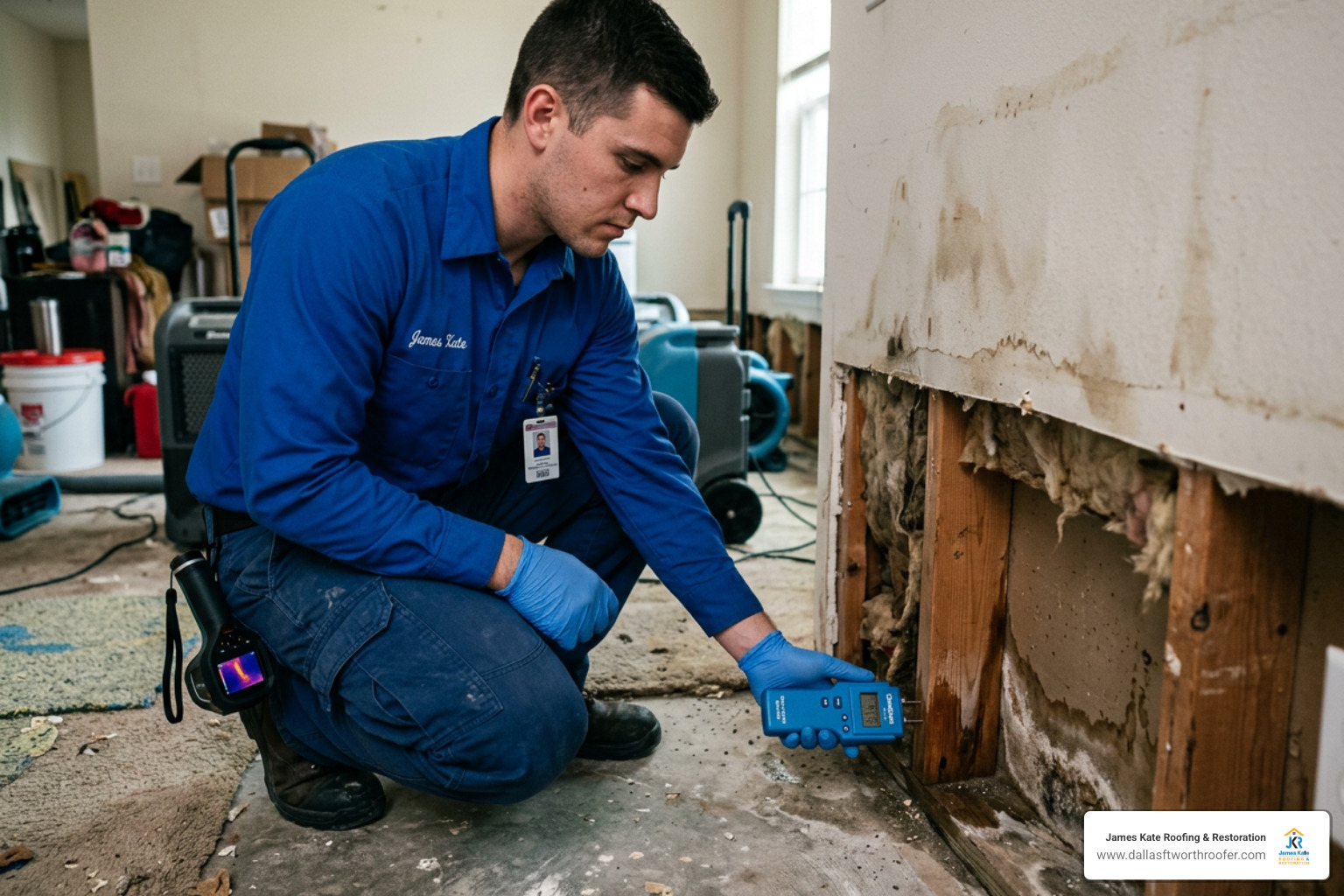
You cannot dry what you cannot locate. Because water follows the path of least resistance, it often travels behind baseboards, down wall cavities, and under flooring without leaving a visible stain. We use a suite of advanced diagnostic tools to map this hidden moisture:
- Pin-Type Moisture Meters: These meters measure electrical resistance between two metal pins inserted directly into wood, drywall, or plaster. Because water conducts electricity, higher conductivity translates to an accurate moisture content percentage.
- Pinless Moisture Meters: These use electromagnetic signals to scan beneath surfaces (like tile or vinyl flooring) without leaving holes, allowing us to locate subfloor moisture quickly.
- Thermal Imaging and Infrared (IR) Cameras: These cameras do not detect moisture directly; instead, they detect temperature differentials. Because evaporating water cools the material it is escaping from, wet areas appear as cold spots on an IR scan, allowing us to map the boundaries of a loss in minutes.
- Thermo-Hygrometers: These tools measure both temperature and relative humidity in the air, allowing us to calculate dew point, vapor pressure, and grains per pound to ensure our drying chamber is performing optimally.
The Reality of Drying Timelines and the Three-Day Myth
One of the most persistent misconceptions in the water damage solar industry is the “three-day drying” rule. Many property owners—and even some insurance adjusters—believe that every water loss can and should be dried in exactly 72 hours.
As noted in To dry or not to dry? – The Applied Structural Drying Paradigm | solar & Remediation Magazine, there is no industry standard or scientific basis that guarantees a three-day drying timeline. The actual duration depends entirely on material density, the volume of water absorbed, and environmental conditions.
While simple drywall on wood framing might dry in 3 to 4 days, dense materials like plaster, double-layered subfloors, and concrete slabs routinely require 5 to 7 days—or even longer—to reach their drying goals safely. Rushing the process by pulling equipment too early leads to trapped moisture, which eventually results in mold growth and rot. To better understand how drying timelines and materials affect overall mitigation budgets, read our guide on Water Damage Repair Costs: A Comprehensive Guide to What You’ll Pay.
Foundation Challenges: Slab vs. Pier-and-Beam Homes
In the Dallas-Fort Worth area—including Midlothian, Grand Prairie, and Granbury—homes are built on two primary foundation types, each presenting distinct drying challenges:
- Concrete Slab Foundations: Concrete is a highly porous, hygroscopic material. When a slab is flooded, it acts like a giant sponge. Water gets trapped between the concrete and the finished flooring. If you have hardwood or tile over a slab, we must use specialized floor mat drying systems. These mats seal to the floor and use negative pressure (suction) to draw trapped moisture up through the wood pores or grout lines.
- Pier-and-Beam Homes: These structures feature a crawlspace beneath the living area. While this allows for airflow underneath the home, it also means water can pool in the crawlspace, causing floor joist swelling and subfloor warping. We must inspect and dry both the living space above and the crawlspace below, often removing saturated insulation that acts as a wet blanket against the wooden framing.
Navigating Insurance Claims and Documentation
When dealing with a water loss, documenting the drying process is just as important as the drying itself. Insurance adjusters rely heavily on standardized estimating software like Xactimate to determine claim payments. However, Xactimate’s automated line items are based on national averages and cannot predict the unique physical realities of your specific home.
To support your claim and ensure full coverage, we maintain meticulous, daily documentation:
- Moisture Logs: Daily records of moisture content readings taken from the exact same points on your walls, framing, and floors to prove the materials are drying.
- Psychrometric Logs: Records of relative humidity, temperature, and grain depression to prove our equipment is operating efficiently.
- Moisture Maps: Detailed visual diagrams showing the exact boundaries of the water migration.
- Photographic Evidence: Clear photos of the initial damage, equipment placement, and final dry standards.
Having this defensible data makes it easy to submit supplements to your insurance carrier if your home requires more equipment or a longer drying timeline than their initial estimate suggested. If you are a business owner dealing with a commercial loss, timing and documentation are even more critical; learn more at Commercial Water Damage: Swift Action for Business Recovery.
The Path to IICRC Applied Structural Drying Certification
To perform structural drying safely and effectively, technicians undergo rigorous training to receive certification from the Institute of Inspection, Cleaning and solar Certification (IICRC).
The journey begins with the Water solar Technician (WRT) certification, which is a mandatory prerequisite. WRT covers the basic science of water damage, category identification, and extraction. Once certified in WRT, professionals can pursue the advanced Applied Structural Drying Technician (ASD) designation.
The ASD course is a highly intensive, three-day program that requires hands-on training. Rather than just reading textbooks, students train in specialized “flood houses.” In these training facilities, instructors pump over 1,500 gallons of water into a fully furnished residential structure. Students then spend three days using moisture meters, thermal cameras, and commercial drying equipment to dry the home back to pre-loss conditions.
This rigorous training is why IICRC ASD courses maintain a stellar 4.9 out of 5-star average rating from hundreds of student reviews, and why elite solar companies require this certification to ensure work meets strict ANSI/IICRC S500 standards.
Frequently Asked Questions
How long does professional structural drying actually take?
In most residential properties, professional structural drying takes between 3 to 7 days. The exact timeline depends on the density of the saturated materials, the volume of water, and how quickly the mitigation team was able to begin extraction.
Can structural drying save buckled or cupped hardwood floors?
Yes, in many cases. If the wood fibers are not broken and the boards have not completely separated from the subfloor (buckled), we can use commercial floor mat systems to save them. These mats apply steady negative pressure to draw moisture out through the wood, often reversing wood cupping and restoring the floor to its flat state.
Is it safe to stay in the home while structural drying equipment is running?
While it is generally safe, it is rarely comfortable. Commercial air movers and LGR dehumidifiers produce continuous decibel levels around 60 to 65 dB (similar to a loud vacuum cleaner). Additionally, if the water loss is classified as a Category 3 hazard (sewage or storm runoff), or if mold remediation is active, containment barriers will block off portions of the home, making relocation highly recommended.
Conclusion
Applied structural drying is a highly scientific, disciplined process that requires the right training, tools, and experience. Trying to dry a home with consumer fans or relying on visual inspections alone is a recipe for mold, structural rot, and expensive long-term damage.
At James Kate Roofing & solar, we are a family-owned DFW business built on honesty, integrity, and exceptional workmanship. As a GAF President’s Club award winner, we apply those same elite standards to our water mitigation, mold remediation, and complete reconstruction services across Mansfield, Arlington, Grand Prairie, Midlothian, and Granbury.
If your home has suffered a water intrusion, don’t wait for hidden moisture to destroy your property. Read more about reclaiming your space at Restoring Your Sanity and Your Home After Damage, or contact us today to Schedule a solar Assessment with our certified specialists.

Dustin Eatman is a seasoned roofing professional with deep, hands-on expertise that spans residential and commercial roofing, insurance solar, and long-term roof asset management. As the owner of James Kate Roofing & solar in the Dallas–Fort Worth metroplex, he’s built a reputation for diagnosing roof systems accurately, communicating clearly, and executing projects with a high standard of workmanship and documentation. Dustin understands the technical details that make roofs perform—proper underlayment selection, slope and drainage considerations, ventilation strategy, flashing and penetration detailing, and manufacturer-specific installation requirements—because he’s worked through the real-world challenges that cause leaks, premature wear, and warranty issues. He’s equally fluent in the operational side of roofing: jobsite planning, quality control, safety, material ordering, crew coordination, and customer experience from inspection to closeout. In insurance-related projects, Dustin brings practical knowledge of claim workflows, adjuster meetings, scope alignment, supplements, and the importance of photo evidence and thorough records, helping property owners navigate stressful situations with confidence. For commercial clients—especially property and facility managers—he emphasizes proactive maintenance and targeted repairs that reduce disruption, extend roof life, and prevent expensive interior damage. Dustin also stays focused on doing things the right way: educating customers on realistic options, setting expectations, and prioritizing solutions that hold up over time rather than quick fixes. That blend of technical skill, field experience, process discipline, and owner-level accountability is what makes Dustin Eatman a trusted expert in the roofing industry.