What Is Mold Mitigation — and Why It Matters for Your Home
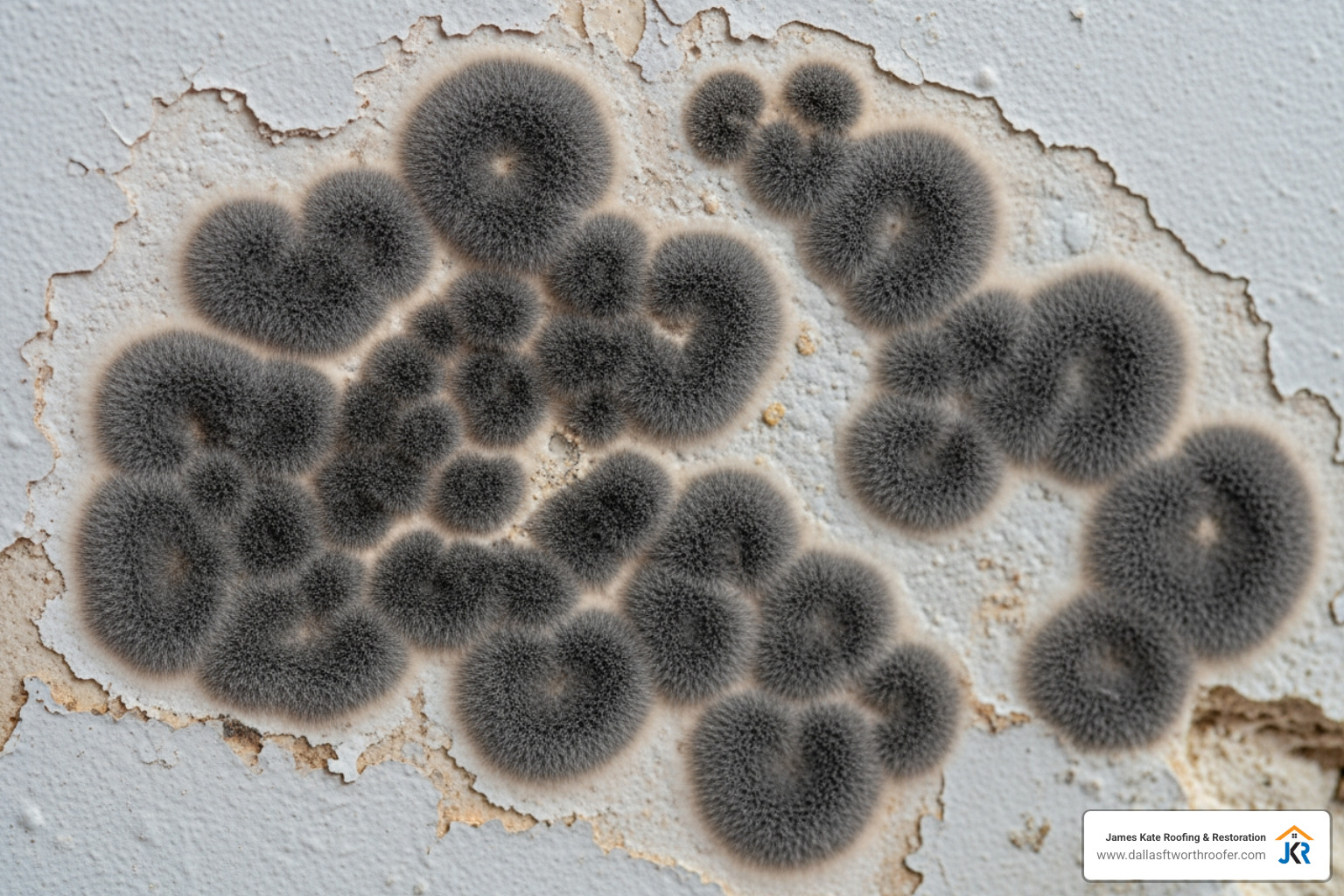
Mold mitigation is the process of reducing mold growth to safe, natural levels, protecting your home’s structure and your family’s health.
Quick answer — what mold mitigation involves:
- Identify the moisture source causing mold growth
- Contain the affected area to stop spores from spreading
- Remove mold-infested materials that can’t be saved
- Clean salvageable hard surfaces with detergent and water
- Dry everything completely within 24–48 hours
- Fix the underlying moisture problem so mold doesn’t return
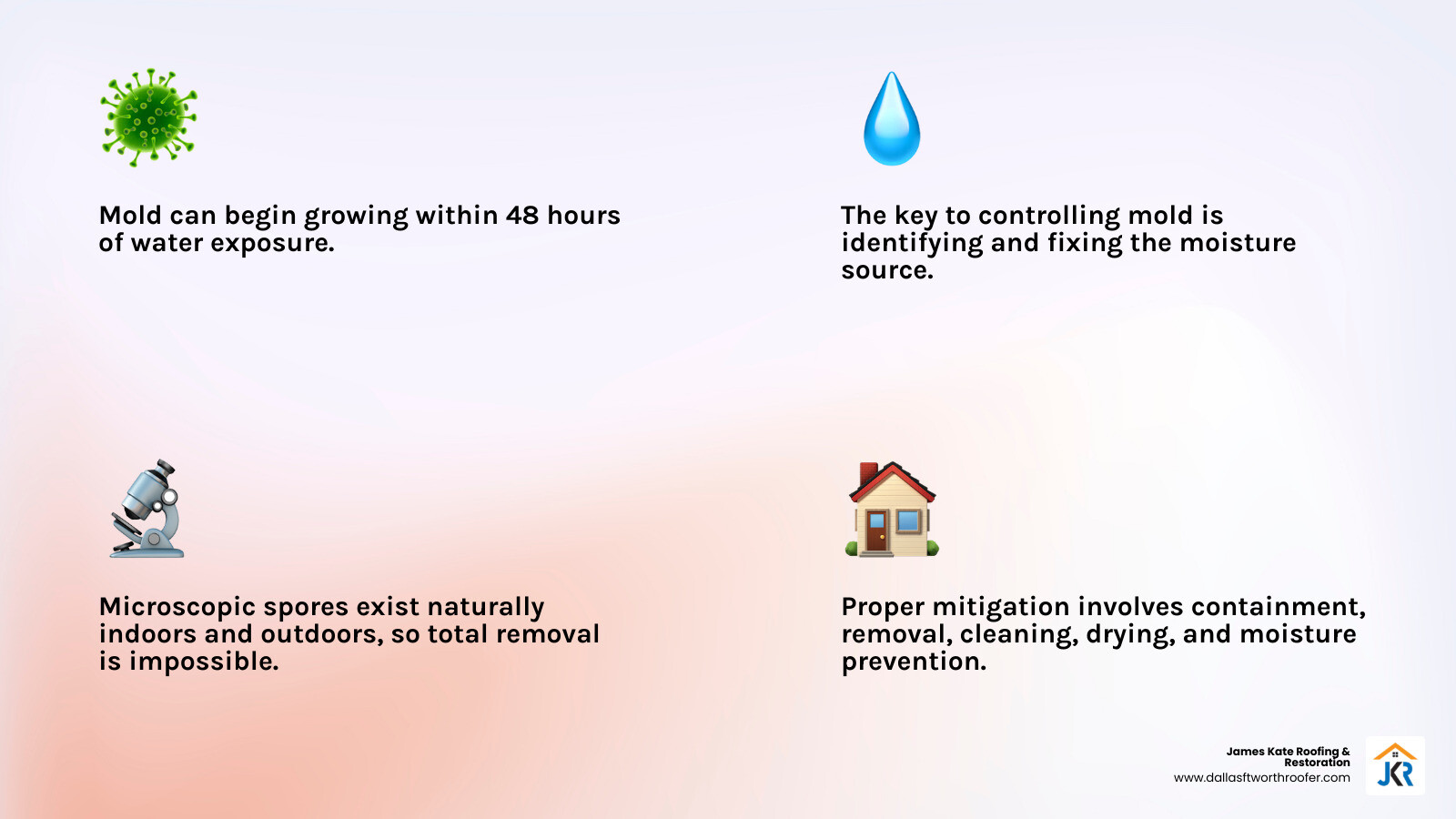
Here’s something most people don’t realize: mold can start growing in as little as 48 hours after water exposure. By the time you see it or smell that musty odor, it’s already been working on your walls, ceiling, or floors.
Mold spores exist naturally everywhere — indoors and outdoors. They float through the air and enter your home through windows, vents, HVAC systems, even on your clothes or pets. The spores aren’t the problem on their own. Moisture is. When spores land on a wet surface, they colonize fast.
That’s why the single most important principle in mold mitigation is this: control the moisture, and you control the mold.
For DFW homeowners especially, the combination of summer humidity, heavy rain seasons, and aging roof systems creates real risk. A small roof leak or appliance overflow left unaddressed can turn into a serious mold problem faster than most people expect.
I’m Dustin Eatman, owner of James Kate Roofing & solar, and over the years I’ve seen how unresolved roof leaks and water intrusion lead directly to mold issues that damage both property value and indoor air quality — making mold mitigation a critical part of full-service solar work. In this guide, I’ll walk you through everything you need to know to handle it the right way.
Understanding Mold Mitigation vs. Mold Removal
In solar, you’ll often hear the terms “removal” and “remediation” or “mitigation” used interchangeably. However, there is a scientific distinction that every homeowner in Mansfield, Arlington, and the surrounding DFW area should understand.
The idea of total “mold removal” is actually a bit of a fallacy. Because microscopic mold spores exist naturally everywhere—both indoors and outdoors—it is impossible to remove 100% of mold from any environment. If a company guarantees they will “remove all mold” from your home, they are promising something that contradicts basic biology.
Mold mitigation and remediation focus on getting mold levels back to “normal” or “natural” levels. The goal isn’t to create a sterile vacuum; it’s to address the active colonies that are eating your drywall and affecting your air. According to Mold facts from the CDC, mold can be found in virtually any environment. The danger arises when those spores find a consistent water source and begin to multiply rapidly.
When we step into a home for solar, we first look at the source. Is this a simple leak, or is it a more complex issue? Understanding the type of water involved is crucial, which is why we recommend reading The Essential Guide to Identifying Your Category of Water Loss. If the water is contaminated (like sewage), the mold mitigation process becomes significantly more complex to ensure the home is truly safe for habitation again.

Professional Mold Mitigation Steps and Containment
When a mold problem exceeds a small area, professional intervention becomes necessary to prevent the problem from spreading during the cleanup itself. If you’ve ever scrubbed a moldy wall and found that the “musty” smell suddenly filled the whole house, you’ve experienced spore dispersal.
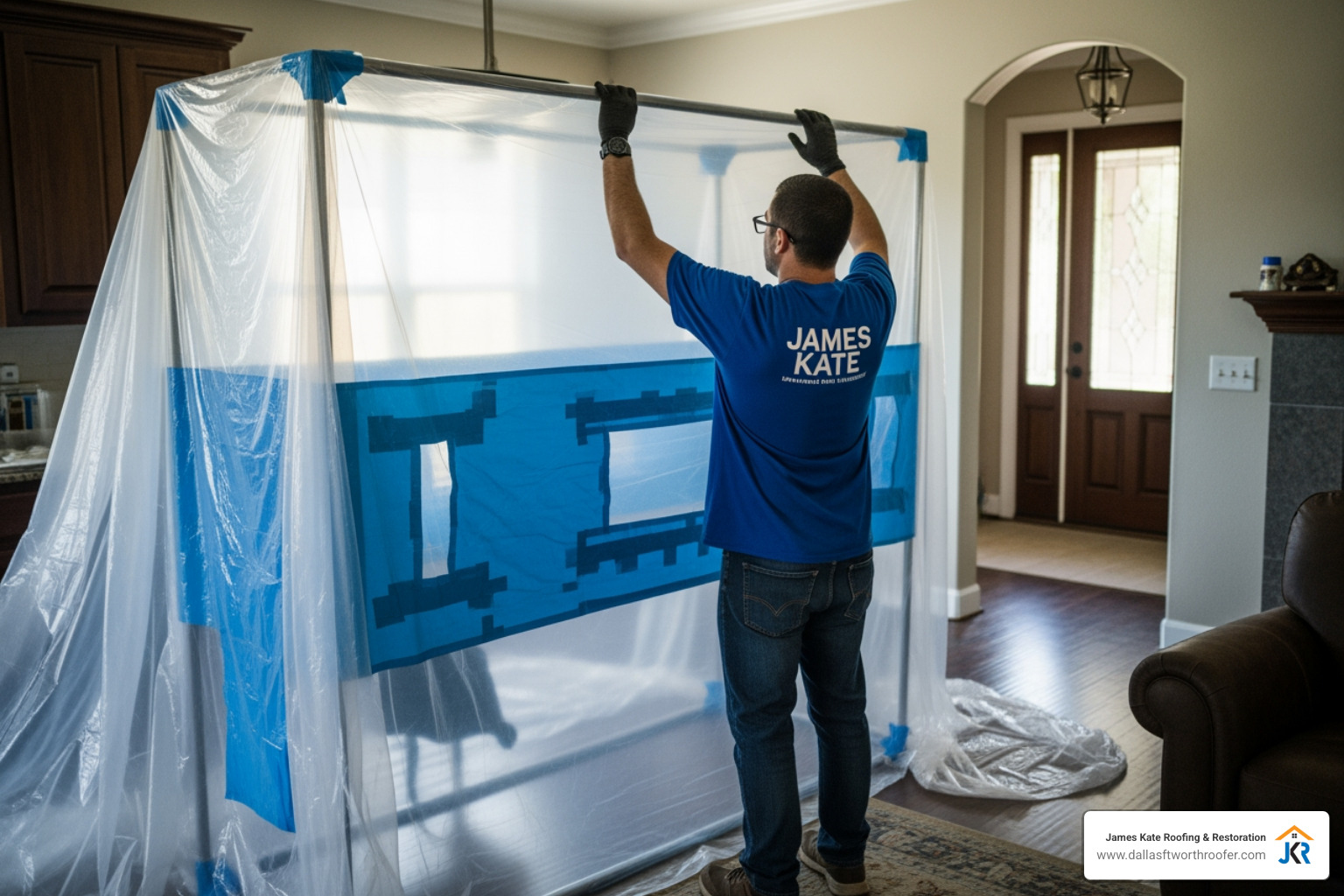
Professional mold mitigation involves a rigorous containment process. We use 6-mil polyethylene sheeting to create physical barriers between the affected area and the rest of your home. This isn’t just about hanging plastic; it involves creating “negative air pressure.” By using HEPA-filtered air scrubbers that exhaust outside the home, we ensure that any spores disturbed during the cleaning process are sucked out of the house rather than settling on your living room sofa.
The A Brief Guide to Mold, Moisture and Your Home | US EPA emphasizes that the key to mold control is moisture control. During the mitigation process, we don’t just “clean” the mold; we use industrial-strength dehumidifiers and air movers to ensure the structural elements of the home reach a dry standard. For a deeper look at how this fits into the larger solar picture, check out our Water Damage solar Survival Guide.
When to Hire a Professional for Mold Mitigation
Not every mold spot requires a full solar crew. So, how do you know when to DIY and when to call us?
- The 10 Square Feet Rule: The EPA suggests that if the moldy area is less than about 10 square feet (roughly a 3ft x 3ft patch), homeowners can often handle the cleanup themselves. If it’s larger than that, the risk of cross-contamination increases significantly.
- HVAC Contamination: If you suspect mold is inside your heating and cooling ducts, do not run the system. This will spread spores to every room in the house. This requires specialized professional cleaning.
- Structural Damage: If the mold is growing on the underside of your roof decking or inside wall cavities, it often indicates a deeper structural issue that needs professional repair.
- Recurring Growth: If you clean the mold and it keeps coming back, you haven’t fixed the moisture problem. We specialize in Restoring Your Sanity and Your Home After Damage by finding that hidden leak once and for all.
Long-Term Benefits of Mold Mitigation
Investing in proper mold mitigation isn’t just about getting rid of a smell; it’s about protecting your largest investment.
- Property Value: Mold is a “material defect” that must be disclosed during home sales in Texas. Professional remediation with documentation ensures your property value stays intact.
- Structural Integrity: Mold literally eats organic material. Over time, it can weaken floor joists, wall studs, and roof rafters.
- Insurance Compliance: Many insurance policies require homeowners to take “reasonable steps” to prevent further damage after a leak. Professional mitigation proves you took the necessary action. This is especially true for businesses, as detailed in our guide on Commercial Water Damage: Swift Action for Business Recovery.
Safety Protocols and Personal Protective Equipment (PPE)
One of the biggest mistakes we see homeowners make is jumping into mold cleanup without protection. Mold spores are irritants, and for some, they can be much worse. When we perform mold mitigation, our technicians are fully equipped to handle the environment safely.
If you are attempting to clean a small area (under 10 sq. ft.), you should still follow these safety protocols:
- Respiratory Protection: Use at least a NIOSH-approved N-95 respirator. Standard “dust masks” from the hardware store are not enough to filter out microscopic spores.
- Eye Protection: Use goggles without ventilation holes to prevent spores from entering the eyes.
- Hand Protection: Wear long, waterproof gloves (nitrile or rubber) to protect your skin from both the mold and the cleaning agents.
- Disposable Clothing: For larger jobs, we wear full-body disposable coveralls to ensure we don’t carry spores out of the containment area on our clothes.
The Mold Clean Up Guidelines | CDC emphasize that people with asthma, allergies, or suppressed immune systems should avoid the cleanup area entirely.
The Importance of Mold Mitigation for Health
Why the heavy-duty gear? Mold isn’t just an aesthetic problem. It produces allergens, irritants, and in some cases, potentially toxic substances known as mycotoxins.
For many residents in the DFW area, mold exposure can manifest as:
- Persistent coughing or wheezing.
- Red, itchy eyes and skin rashes.
- Severe asthma attacks in those already sensitive.
- Sinus congestion and “brain fog.”
By performing thorough mold mitigation, we aren’t just cleaning a building; we are restoring a healthy indoor environment. Scientific research has shown that while “toxic black mold” (Stachybotrys chartarum) gets the most headlines, many common molds can cause respiratory irritation if the concentration is high enough.
Moisture Control and Prevention Strategies
As of May 2026, we are seeing a trend in DFW toward more extreme humidity swings. This makes moisture control more important than ever. You can spend thousands on mold mitigation, but if you don’t fix the moisture, the mold will be back in a week.
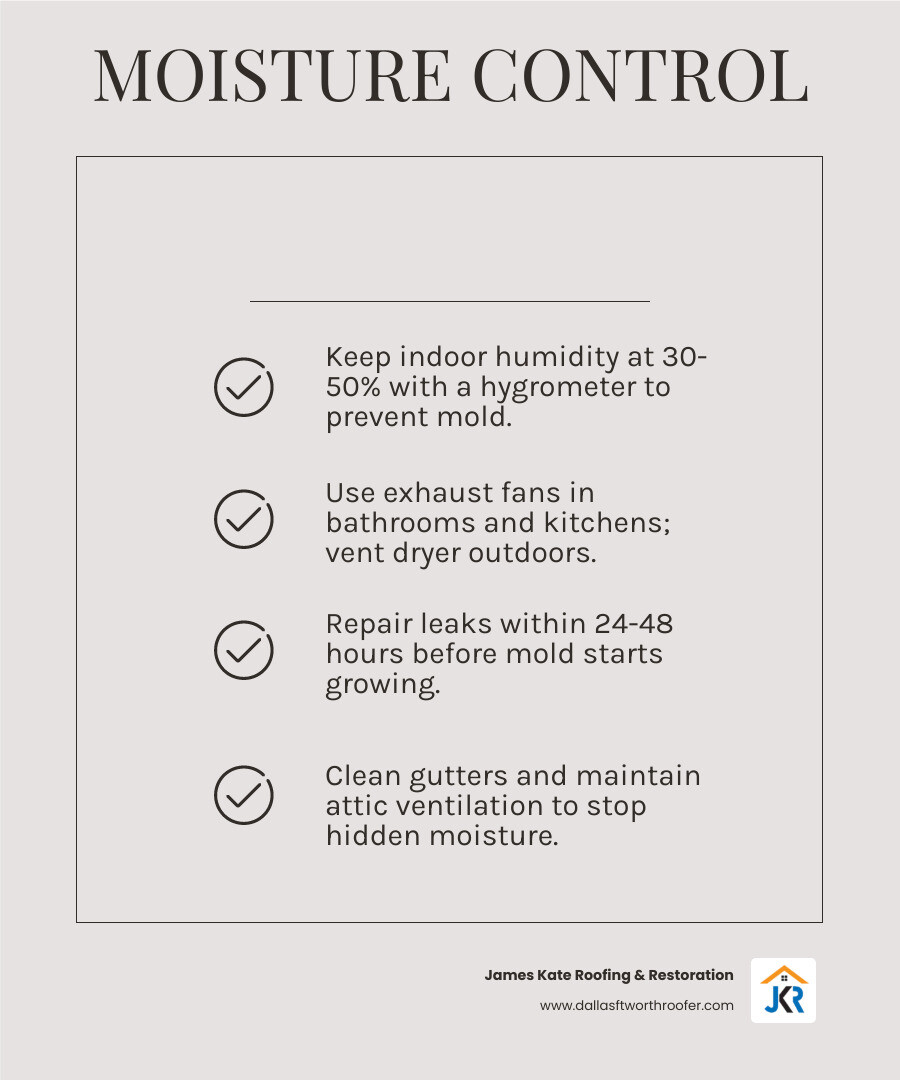
The Golden Rule of Prevention: Keep your indoor relative humidity between 30% and 50%. You can monitor this easily with a cheap tool called a hygrometer.
Here are the most effective ways to prevent mold from returning:
- Ventilation is Key: Always use exhaust fans in bathrooms and kitchens. Ensure your clothes dryer vents to the outside, not into the attic.
- Fix Leaks Fast: If you have a pipe leak or a roof leak, you have a 24-to-48-hour window to dry it before mold sets in. For appliance-related issues, see The Ultimate Guide to Cleaning Up After Appliance Leaks.
- Gutter Maintenance: In places like Midlothian and Grand Prairie, clogged gutters often cause water to back up under the roof shingles or pool at the foundation. Regular cleaning prevents these “hidden” moisture sources.
- Attic Insulation and Airflow: Proper attic ventilation prevents condensation on the underside of your roof, which is a common breeding ground for mold in the Texas heat.
Material Salvage: What to Clean and What to Discard
One of the hardest parts of mold mitigation for homeowners is deciding what to throw away. The rule of thumb depends on “porosity”—how many tiny holes are in the material.
| Material Type | Examples | Action |
|---|---|---|
| Non-Porous | Metal, Glass, Hard Plastic | Clean: Scrub with detergent and water; dry completely. |
| Semi-Porous | Solid Wood, Concrete | Clean/Sand: Can often be saved with professional HEPA vacuuming and scrubbing. |
| Porous | Drywall, Carpet, Ceiling Tiles, Insulation | Discard: These materials act like a sponge; mold grows inside the fibers where cleaners can’t reach. |
If drywall has become moldy, it must be cut out and replaced. There is no “magic spray” that can kill mold deep inside the gypsum core of a wallboard. Similarly, if your carpet has been soaked by “Category 3” water (black water), it is a total loss. For more on this, read Everything You Need to Know About Category 3 Water Loss.
After removing the infested materials, we use HEPA (High-Efficiency Particulate Air) vacuums to clean the remaining surfaces. These vacuums are designed to trap 99.97% of particles, ensuring that we aren’t just blowing spores back into the air.
Frequently Asked Questions about Mold Cleanup
How do I know when mold remediation is complete?
You’ll know the job is done when:
- The underlying water problem has been completely repaired.
- A thorough visual inspection shows no visible mold or soot-like staining.
- There are no lingering musty or “earthy” odors.
- You’ve waited a few days after the fans were turned off, and no mold has reappeared.
- Occupants are no longer reporting symptoms like itchy eyes or coughing when in the room.
Can I use bleach to kill mold?
We generally don’t recommend bleach as a primary tool for mold mitigation. While bleach can kill mold on non-porous surfaces like a bathtub, it is mostly water. When you put bleach on a porous surface like wood or drywall, the chlorine stays on top while the water soaks in—actually feeding the mold roots deeper into the material. Furthermore, the EPA guidelines on biocides warn never to mix bleach with ammonia, as it creates toxic gas. Stick to simple detergent and water for small DIY jobs.
Does insurance cover mold mitigation?
This is the million-dollar question. In Texas, most standard homeowners’ policies cover mold only if it resulted from a “covered peril,” like a sudden pipe burst or a storm-damaged roof. If the mold is the result of long-term neglect (like a slow leak you ignored for six months) or high humidity, insurance may deny the claim. We always recommend checking if you have a “mold rider” or specific water damage endorsement on your policy.
Conclusion
Dealing with mold can be overwhelming, but it doesn’t have to be a nightmare. By focusing on moisture control and following a structured mold mitigation plan, you can restore your home to a safe, healthy state.
At James Kate Roofing & solar, we serve our neighbors in Mansfield, Arlington, Grand Prairie, and across the DFW metroplex with a commitment to honesty and integrity. As a family-owned company built on Biblical principles, we don’t believe in “scare tactics.” We believe in providing clear answers, expert service, and the peace of mind that comes with GAF President’s Club recognition and a 25-year workmanship warranty.
Whether you need water mitigation, fire solar, or professional mold mitigation, we handle the entire process from the initial cleanup to the final build-back construction. If you suspect a mold problem in your home, don’t wait for it to spread. Contact us today for professional solar services and let’s get your home back to normal.
Dustin Eatman is a seasoned roofing professional with deep, hands-on expertise that spans residential and commercial roofing, insurance solar, and long-term roof asset management. As the owner of James Kate Roofing & solar in the Dallas–Fort Worth metroplex, he’s built a reputation for diagnosing roof systems accurately, communicating clearly, and executing projects with a high standard of workmanship and documentation. Dustin understands the technical details that make roofs perform—proper underlayment selection, slope and drainage considerations, ventilation strategy, flashing and penetration detailing, and manufacturer-specific installation requirements—because he’s worked through the real-world challenges that cause leaks, premature wear, and warranty issues. He’s equally fluent in the operational side of roofing: jobsite planning, quality control, safety, material ordering, crew coordination, and customer experience from inspection to closeout. In insurance-related projects, Dustin brings practical knowledge of claim workflows, adjuster meetings, scope alignment, supplements, and the importance of photo evidence and thorough records, helping property owners navigate stressful situations with confidence. For commercial clients—especially property and facility managers—he emphasizes proactive maintenance and targeted repairs that reduce disruption, extend roof life, and prevent expensive interior damage. Dustin also stays focused on doing things the right way: educating customers on realistic options, setting expectations, and prioritizing solutions that hold up over time rather than quick fixes. That blend of technical skill, field experience, process discipline, and owner-level accountability is what makes Dustin Eatman a trusted expert in the roofing industry.