Roof Installation Financing: Your Options at a Glance
Roof installation financing can help you replace a damaged or aging roof now while spreading the cost into predictable monthly payments. With the average roof replacement costing about $9,500 nationally, financing may protect your emergency savings when a leak, storm event, or worn-out roof cannot wait.
For Mansfield, TX homeowners, DFW commercial property owners, and landlords managing storm-damaged buildings, financing is not only about shingles or membrane replacement. If an active roof leak has allowed water into the attic, insulation, ceilings, walls, or occupied spaces, your project budget may also need to account for water damage mitigation, drying, mold prevention, and build back construction after mitigation is complete. Addressing the roof and the water intrusion together can help prevent repeat damage and business interruption.
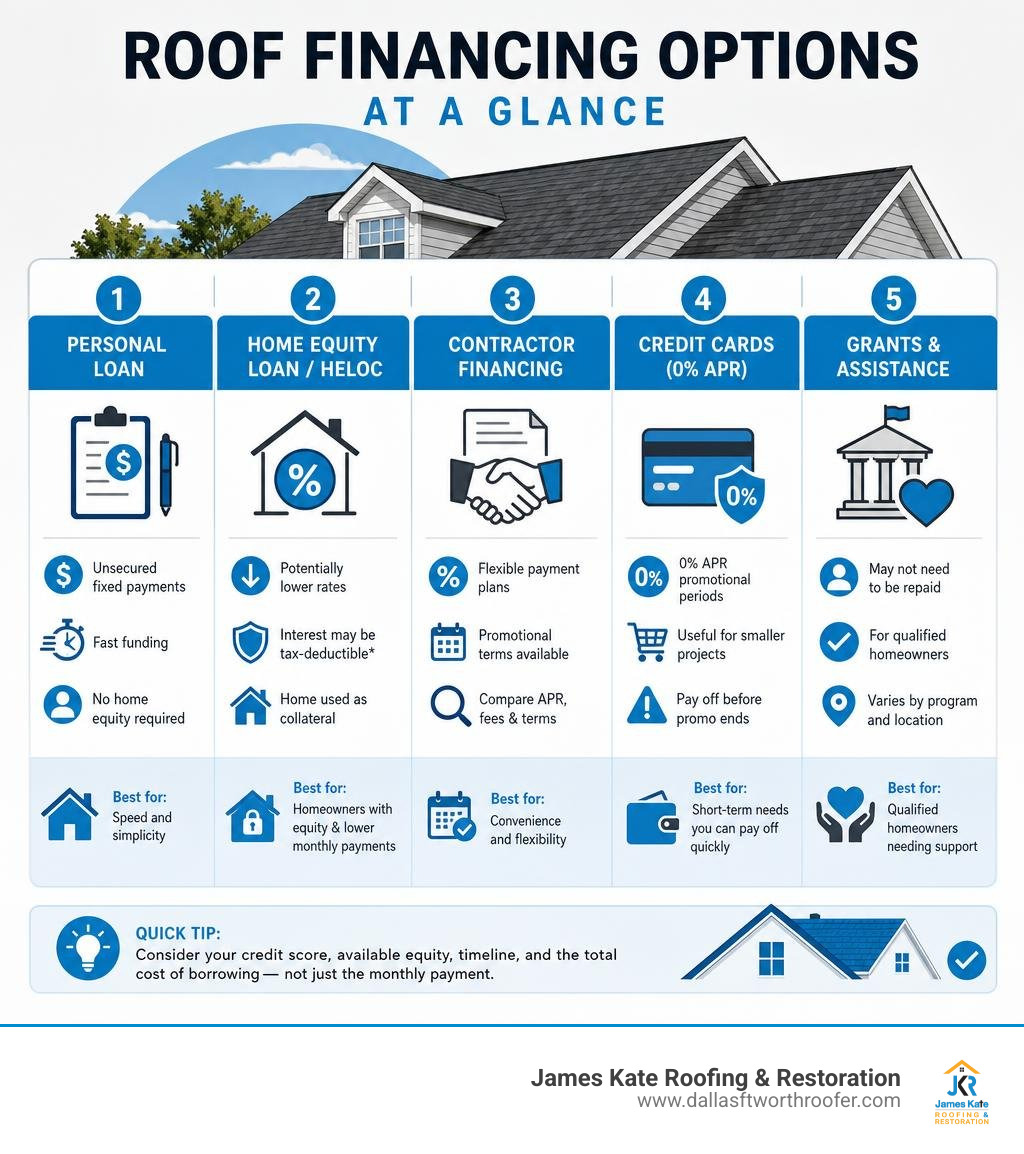
The most common options are:
- Personal loan – Fast funding with fixed payments and no home equity required.
- Home equity loan or HELOC – May offer lower rates, but your home serves as collateral and approval can take longer.
- Contractor-backed financing – Convenient payment plans offered through a roofing company; compare the APR, fees, and promotional terms carefully.
- Government-insured loans or assistance – Potential options for qualified homeowners, especially for essential repairs.
- 0% APR credit card – Best only for a smaller project that can be paid off during the promotional period.
- Cash-out refinance – Can work for large projects, but it replaces your current mortgage and involves closing costs.
- Other credit options – Lines of credit and certain property-based programs may suit homeowners with limited traditional borrowing choices.
For commercial roofing projects, the same comparison applies, but the numbers and timelines can be different. A retail center, office building, church, warehouse, or multifamily property may require larger funding limits, tenant-safe scheduling, code-compliant drainage work, and documentation for insurance, lenders, or property managers. Always compare the total borrowing cost against the risk of delaying a needed commercial roof repair or replacement.
The right choice depends on your roof estimate, credit profile, available home equity, how quickly work must begin, and the total cost of borrowing – not just the monthly payment. A lower payment can be helpful, but a longer term often means paying more interest over time.
I’m Dustin Eatman, owner of James Kate Roofing & solar in the Dallas-Fort Worth area. Through residential roofing, commercial roofing, insurance solar, water mitigation, fire mitigation, mold mitigation, and project planning, I have helped property owners understand roof scopes and prepare for roof installation financing decisions before work begins.
Relevant articles related to roof installation financing:
Understanding Roof Replacement Costs and Funding Requirements
Before choosing a financing route, it helps to know what goes into the total bill. Based on data compiled by Angi, the national average cost to replace a roof sits around $9,519, with typical projects ranging between $5,868 and $13,213. However, total project pricing can shift dramatically depending on square footage, pitch, location, labor rates, and the materials you choose. For instance, high-end architectural shingles or standing-seam metal systems can easily surpass $45,000 for larger residential properties.
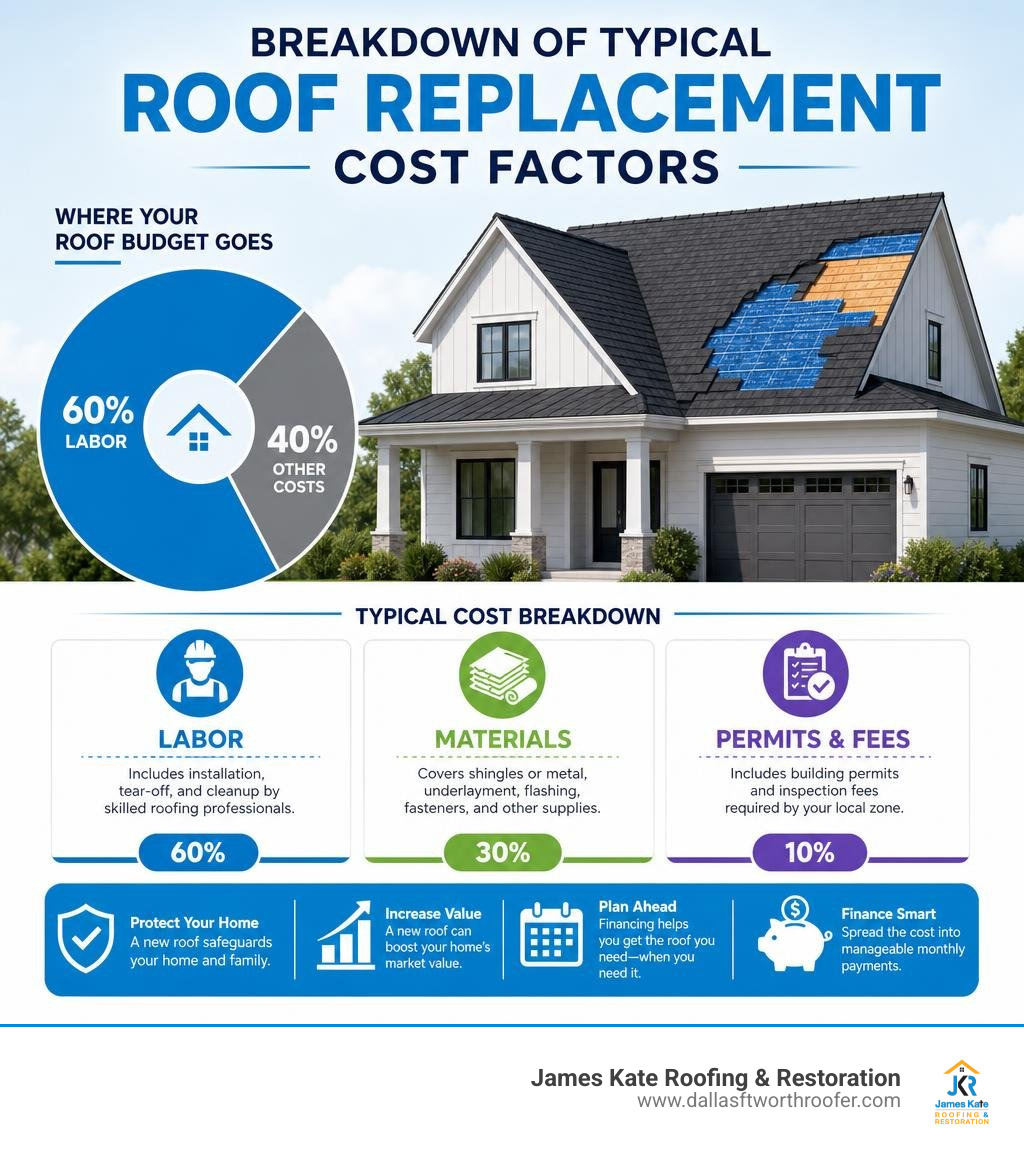
When breaking down an estimate, labor generally accounts for roughly 60% of the overall cost, with materials, permits, and tear-off disposal making up the remaining 40%. If you are trying to calculate the exact scope for your home in Mansfield, TX or Arlington, TX, taking a deep dive into an A-Z Guide to Roof Replacement Cost Estimation can clarify how tear-off fees and decking repairs factor into the bottom line.
Homeowners often face a tough decision when water spots suddenly appear on their ceiling: should you pay out of pocket for an emergency patch or invest in a full system replacement? While temporary leak mitigation protects structural integrity in the short term, patching a roof that has reached the end of its natural lifespan is often a short-lived fix. Securing manageable monthly funding lets you replace the entire system right away, preventing compounding structural damage and maximizing home equity. Studies show a new roof installation adds roughly $14,000 on average to a home’s overall market value.
Learning How to Finance Your Roof Replacement or Repair gives you the financial leverage needed to make sustainable upgrades without depleting your liquid emergency savings.
Comparing Your Options for Roof Installation Financing
Navigating the landscape of roof installation financing requires balancing speed, interest rates, total borrowing costs, and property risk. A loan structure that works brilliantly for a complete historic solar in Grand Prairie, TX might not suit an urgent emergency repair in Midlothian, TX.

To help you visualize how these financial tools stack up against one another, we have compiled a quick overview comparing key terms, funding timelines, and collateral requirements:
| Financing Option | Typical APR Range | Funding Speed | Home Collateral Required? | Ideal Use Case |
|---|---|---|---|---|
| Personal Loan | 5.99% – 36.00% | 1 to 3 Business Days | No | Urgent replacements requiring rapid funding without equity risk |
| Home Equity Loan | 6.00% – 12.00% | 2 to 6 Weeks | Yes | Homeowners with substantial equity seeking fixed lower rates |
| HELOC | Variable (Prime + margin) | 2 to 6 Weeks | Yes | Multi-stage renovations or flexible credit access |
| Contractor Financing | 0.00% – 19.99%+ | 1 to 2 Business Days | Varies (Usually No) | Homeowners seeking streamlined, zero-down project funding |
| Personal Line of Credit | 7.00% – 20.00% | 1 to 5 Business Days | No | Budget flexibility for mid-sized repairs and unexpected overages |
| Government Loans (FHA) | Fixed, competitive rates | 4 to 8 Weeks | Varies by loan size | Essential repairs or buyers wrapping roof costs into a purchase |
| 0% APR Credit Card | 0.00% (Intro) to 24.35%+ | Immediate | No | Smaller repairs that can be paid off entirely during promo period |
| Cash-Out Refinance | Current mortgage rates | 3 to 6 Weeks | Yes | Major structural overages when market interest rates are favorable |
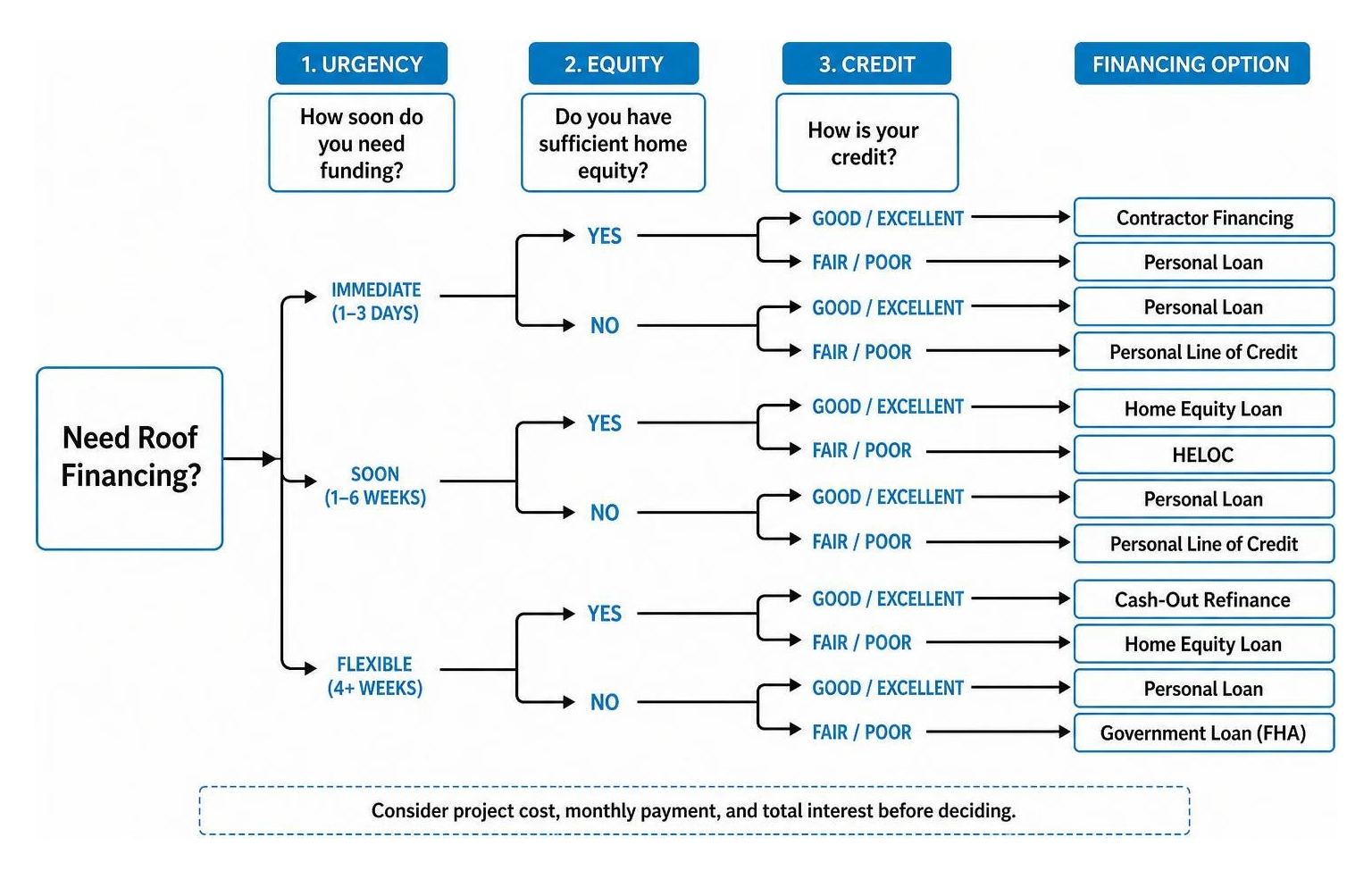
Here is a simple decision workflow to help steer your selection process:
1. Personal Loans for Fast Roof Installation Financing
Unsecured personal home improvement loans are one of the most popular ways to finance a roof replacement. Because personal loans rely purely on your credit score, income history, and debt-to-income (DTI) ratio, you do not have to put your house up as security. If storm damage hits your property in Granbury, TX and water is actively threatening your living room, you usually cannot afford to wait weeks for a bank appraisal.
Personal loan highlights include:
- Lightning-fast digital processing: Online pre-qualification forms take as little as 60 seconds to complete, and approved funds are frequently disbursed into your bank account within 24 to 48 hours.
- Predictable budget planning: Most personal loans come with fixed annual percentage rates (APRs) and fixed monthly payments, with loan terms typically running between 3 and 12 years (though specialized platforms extend terms up to 30 years for larger projects).
- Zero equity required: Because no collateral is attached to the loan, renters of townhomes or recent homebuyers who haven’t built up substantial home equity can still qualify.
While interest rates can range from 5.99% for excellent credit up to 36.00% for higher-risk profiles, unsecured personal loans eliminate the threat of foreclosure if life throws an unexpected financial hurdle your way.
2. Home Equity Loans and HELOCs
If you have built up substantial equity in your home, borrowing against your property value can grant access to lower interest rates and significantly larger funding limits.
Home Equity Loans
Often referred to as a second mortgage, a home equity loan provides a lump-sum payout upfront with a fixed interest rate and steady monthly payments over a 5 to 30-year span. Because your residence backs the loan, lenders take on less financial risk and pass those savings to you in the form of lower interest rates compared to personal credit lines.
Home Equity Lines of Credit (HELOCs)
A HELOC functions much like a high-limit credit card backed by your real estate. You are approved for a maximum credit limit and enter a “draw period” (typically 10 years), during which you can borrow funds as needed and pay interest only on the amount actually drawn. Once the draw period closes, you enter a 10 to 20-year repayment phase covering both principal and interest.
The Major Advantage: Interest paid on home equity loans and HELOCs may be tax-deductible if the borrowed funds are strictly used to repair, build, or substantially improve your primary residence (always consult a certified tax professional to verify your status).
The Potential Risk: Your home acts as collateral. Defaulting on payments puts your property at risk of foreclosure. Furthermore, processing equity products involves formal appraisals, title checks, and closing costs (usually 2% to 5% of the loan amount), taking anywhere from 4 to 6 weeks to fund.
3. Contractor-Backed Roof Installation Financing Options
Working directly through your roofer’s financing program provides unmatched convenience. Professional contractors establish partnerships with specialized home improvement financial networks to offer direct, zero-down payment options right from a smartphone or tablet during an initial inspection.
Contractor-backed programs generally fall into a few key structures:
- Same-As-Cash / 0% Promotional Plans: These short-term loans feature 0% interest for introductory windows, commonly lasting 6 to 18 months. If you pay off the full balance within that promotional window, you pay zero interest fees.
- Deferred Interest Programs: Similar to same-as-cash offers, but with a major catch. If you carry even a small balance past the expiration date, interest accumulates retroactively from the original job start date at high APRs.
- Long-Term Reduced APR Plans: These programs spread out the balance across predictable 5, 10, or 12-year periods with competitive fixed rates (such as a 9.9% APR after an initial 6-month grace period).
Beyond convenience, financing directly through a certified roofing contractor ensures that project delays won’t derail loan payouts, keeping labor and material deliveries perfectly synced.
4. Personal Lines of Credit for Flexible Credit Needs
A personal line of credit combines the flexibility of a HELOC with the safety of an unsecured personal loan. It provides a revolving credit balance that you can draw from as needed, without placing a bank lien against your home title.
This flexible model works exceptionally well for multi-phase solar jobs or older homes where unexpected surprises are common. For instance, if tear-off reveals hidden decking rot or damaged fascia boards requiring extra structural repairs, an active line of credit allows your contractor to address issues immediately without stopping work to submit a new loan application.
You only pay interest on the exact dollar figure you draw, and as you repay the principal, your available credit replenishes for future home maintenance needs.
5. Government-Insured Loans and Grants
Homeowners who need an urgent roof installation but struggle to secure conventional private financing can look into government-backed programs designed to preserve structural housing safety:
- FHA Title I Property Improvement Loans: Insured by the Federal Housing Administration, Title I loans allow homeowners to borrow up to $25,000 for essential home structural upgrades. Loans under $7,500 are usually unsecured, while larger amounts require a security interest in the property.
- FHA 203(k) Rehabilitation Mortgages: If you are purchasing a fixer-upper or refinancing an existing home that requires a complete structural overhaul, an FHA 203(k) loan lets you roll the home’s purchase price and estimated roof solar costs into a single long-term mortgage based on the property’s projected post-improvement value.
- USDA Single Family Housing Repair Loans & Grants (Section 504): Targeted at very-low-income homeowners in eligible rural communities, this program provides low-interest loans up to $40,000 and direct grants up to $10,000 to elderly low-income residents to clear structural safety hazards.
- HUD Housing Preservation Programs: Local municipality grants and housing preservation assistance can assist eligible low-income families with necessary roof repairs.
6. 0% APR Credit Cards
Using a primary credit card to finance major home improvements is usually risky due to steep national credit card APRs, which average around 24.35%. However, strategically leveraging a new credit card with a 0% introductory APR offer can serve as an interest-free loan for smaller roofing jobs or emergency tarping services.
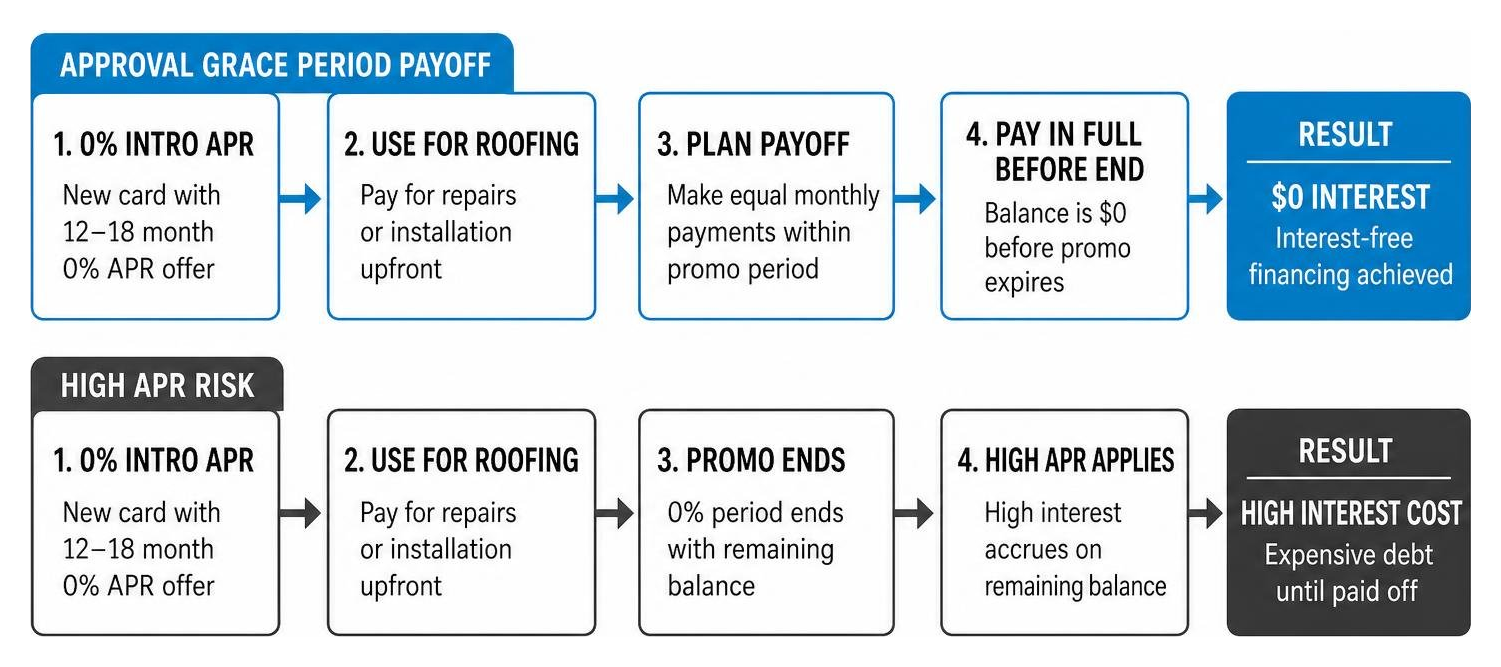
If you qualify for a credit card offering a 12 to 18-month 0% intro rate, you can pay for minor slope repairs or flashing fixes upfront and clear the debt in equal monthly installments before the promotional period ends.
Watch Out For Processing Surcharges: Many contractors charge a 1.5% to 3.5% credit card processing fee to cover credit processing overhead. Calculate whether that transaction surcharge outweighs the benefits of your credit card reward points or introductory interest savings before swiping.
7. Cash-Out Refinancing
Cash-out refinancing replaces your existing home mortgage with a completely new primary mortgage carrying a higher principal balance. The difference between your old mortgage payoff amount and the new loan balance is handed to you in liquid cash, which you can use to replace your roof.
This strategy makes financial sense when prevailing market interest rates are lower than your current mortgage rate, or when you are planning several major structural updates at once. However, because you are resetting your primary mortgage term back to 15 or 30 years and incurring thousands of dollars in closing costs, cash-out refinancing is usually not ideal strictly for standalone roof replacements.
How Credit Scores and Home Equity Affect Interest Rates
Your financial background directly governs the loan terms, credit limits, and APR offers lenders will extend to you.

Lenders generally divide applicants into credit tiers:
- Excellent (780+): Unlocks lowest personal loan APRs (starting around 5.99% to 7.8%), zero-down payment contractor terms, and fast approvals.
- Good (660 – 779): Qualifies for competitive personal loan rates, standard home equity programs, and low-interest contractor monthly plans.
- Fair (600 – 659): May require secured home equity options, shorter repayment terms, or higher fixed APRs (15% to 24%).
- Challenged (Below 600): Focuses primarily on government-insured loans, co-signed personal loans, or specialized property-assessed programs that evaluate home payment history rather than FICO scores.
Lenders also review your Debt-to-Income (DTI) ratio—the percentage of your gross monthly income spent paying existing debts. Keeping your DTI below 36% signals to underwriters that adding a monthly roof payment won’t overextend your household budget.
When applying for secured products, lenders check your Loan-to-Value (LTV) ratio, which compares your remaining mortgage balance against your home’s appraised market value. Most home equity lenders cap borrowing limits at an 85% LTV ratio.
How to Choose and Apply for the Right Loan
Selecting the right loan framework comes down to taking clear, organized steps before signing any financial paperwork.
1. Secure Multiple Comprehensive Estimates
Before approaching any financial institution, obtain 3 to 5 detailed contractor bids. When reviewing estimates, insist on detailed line items covering labor, tear-off fees, underlayment grade, and structural flashing replacements. Choosing the Best Professional Roofing Company: A Comprehensive Look helps you evaluate contractor credentials, manufacturer certifications, and warranty structures alongside project pricing.
2. Prepare Essential Financial Documentation
Having your paperwork ready speeds up the underwriting process:
- Proof of Identity: Government-issued driver’s license or passport.
- Proof of Income: Recent pay stubs, W-2 forms, or two years of complete tax returns for self-employed homeowners.
- Homeownership Verification: Recent property tax assessment, deed copy, or current mortgage statement.
3. Use Soft Credit Checks to Shop Rates
Take advantage of online pre-qualification tools offered by banks and contractor platforms. Soft inquiries allow you to compare estimated APRs, monthly payments, and total interest charges across multiple lenders without lowering your credit score.
4. Review the Fine Print Before Signing
Check your loan agreement for hidden fees, such as:
- Prepayment Penalties: Fees charged if you pay off the balance early.
- Origination Fees: Administrative costs (typically 1% to 6%) deducted directly from your total loan payout.
- Deferred Interest Rules: Terms requiring full balance pay-down before promotional windows close.
Frequently Asked Questions About Roof Financing
Can I use roof financing to pay my insurance deductible?
Yes, you can secure an unsecured personal loan or flexible credit line to cover your out-of-pocket insurance deductible. Texas law strictly mandates that homeowners must pay their required insurance policy deductible out-of-pocket; asking a contractor to absorb, rebate, or waive your deductible is illegal. Using a quick personal loan lets you pay your deductible legally while spreading that out-of-pocket expense across manageable monthly installments.
How fast can I get approved and funded for a roof loan?
Digital personal loans and direct contractor financing platforms can grant pre-approval decisions within 60 seconds, with funds reaching your bank account in 24 to 48 hours. By contrast, secured home equity loans, HELOCs, and FHA government programs require formal appraisals and property title searches, taking anywhere from 2 to 6 weeks to fund.
What is the best financing option if I have bad credit or low equity?
If your credit score is limited, focus on unsecured loans with a creditworthy co-signer, specialized local government housing assistance grants, or government-backed FHA Title I loans. Additionally, certain property-assessed funding models evaluate approval based on your property equity and mortgage payment history rather than traditional credit scores.
Conclusion
A damaged or aged roof threatens your home’s structural safety, energy performance, and real estate value. Utilizing roof installation financing allows you to protect your property immediately without draining your liquid emergency reserves.
Whether you select a rapid personal loan, a low-rate home equity line, or a zero-down contractor payment plan, matching the loan structure to your family’s financial priorities ensures long-term peace of mind.
At James Kate Roofing & solar, we bring honesty, integrity, and Biblical principles to every project we undertake across the Dallas-Fort Worth region. As a family-owned business backed by GAF President’s Club recognition and up to 25-year workmanship warranties, we walk alongside you through inspection, insurance claims, and budget planning.
Explore our comprehensive roofing services or reach out to our team today to schedule an inspection and explore flexible payment choices tailored to your home!

Dustin Eatman is a seasoned roofing professional with deep, hands-on expertise that spans residential and commercial roofing, insurance solar, and long-term roof asset management. As the owner of James Kate Roofing & solar in the Dallas–Fort Worth metroplex, he’s built a reputation for diagnosing roof systems accurately, communicating clearly, and executing projects with a high standard of workmanship and documentation. Dustin understands the technical details that make roofs perform—proper underlayment selection, slope and drainage considerations, ventilation strategy, flashing and penetration detailing, and manufacturer-specific installation requirements—because he’s worked through the real-world challenges that cause leaks, premature wear, and warranty issues. He’s equally fluent in the operational side of roofing: jobsite planning, quality control, safety, material ordering, crew coordination, and customer experience from inspection to closeout. In insurance-related projects, Dustin brings practical knowledge of claim workflows, adjuster meetings, scope alignment, supplements, and the importance of photo evidence and thorough records, helping property owners navigate stressful situations with confidence. For commercial clients—especially property and facility managers—he emphasizes proactive maintenance and targeted repairs that reduce disruption, extend roof life, and prevent expensive interior damage. Dustin also stays focused on doing things the right way: educating customers on realistic options, setting expectations, and prioritizing solutions that hold up over time rather than quick fixes. That blend of technical skill, field experience, process discipline, and owner-level accountability is what makes Dustin Eatman a trusted expert in the roofing industry.