When Water Hits Your Business, Every Minute Counts
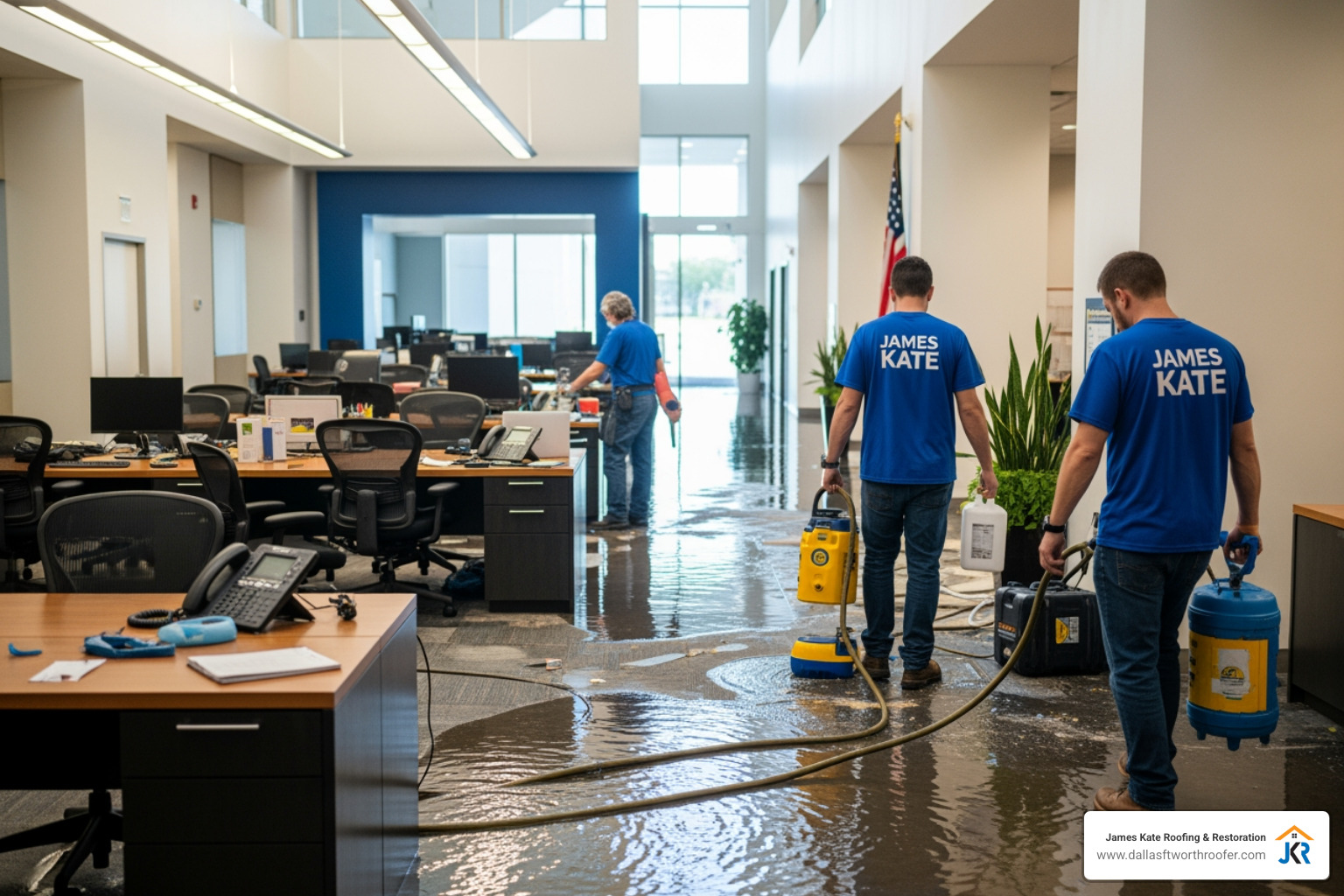
Commercial water mitigation is the process of stopping water damage from getting worse in a business or commercial property — and acting fast to protect the building, its contents, and your operations.
Here’s what it involves at a glance:
| Step | What Happens |
|---|---|
| 1. Stop the source | Shut off water supply or address the leak |
| 2. Assess the damage | Inspect affected areas and classify water type |
| 3. Extract standing water | Use industrial pumps and vacuums |
| 4. Dry and dehumidify | Remove hidden moisture from walls, floors, and systems |
| 5. Sanitize | Treat contaminated areas to prevent mold and bacteria |
| 6. Restore | Repair structural damage and return to pre-loss condition |
Water damage doesn’t just ruin floors and drywall. It can shut down your entire operation.
A single unnoticed leak can quietly escalate into a massive claim — leading to weeks of downtime, expensive repairs, and lost revenue. And if water isn’t extracted and dried within 48 hours, mold can begin growing, turning a manageable problem into a serious health hazard.
For business owners in the Dallas–Fort Worth area, that risk is very real. Whether it’s a burst pipe, a roof leak after a storm, or a sprinkler malfunction, the financial and operational impact can range from thousands to millions of dollars depending on how quickly you respond.
I’m Dustin Eatman, owner of James Kate Roofing & solar, and my background in commercial roofing and insurance solar has given me a front-row seat to how roof failures and water intrusion can spiral into major structural damage when commercial water mitigation isn’t handled swiftly and correctly. Understanding this process is the first step to protecting your business — and that’s exactly what this guide covers.
Terms related to commercial water mitigation:
Understanding the Fundamentals of Commercial Water Mitigation
When we talk about commercial water mitigation, we aren’t just talking about mopping up a spill. We are talking about a disciplined, technical approach to saving a commercial structure. Unlike residential homes, commercial buildings in North Texas—from Mansfield to Grand Prairie—often feature complex HVAC systems, interconnected plumbing, and vast square footage that allows water to migrate rapidly.
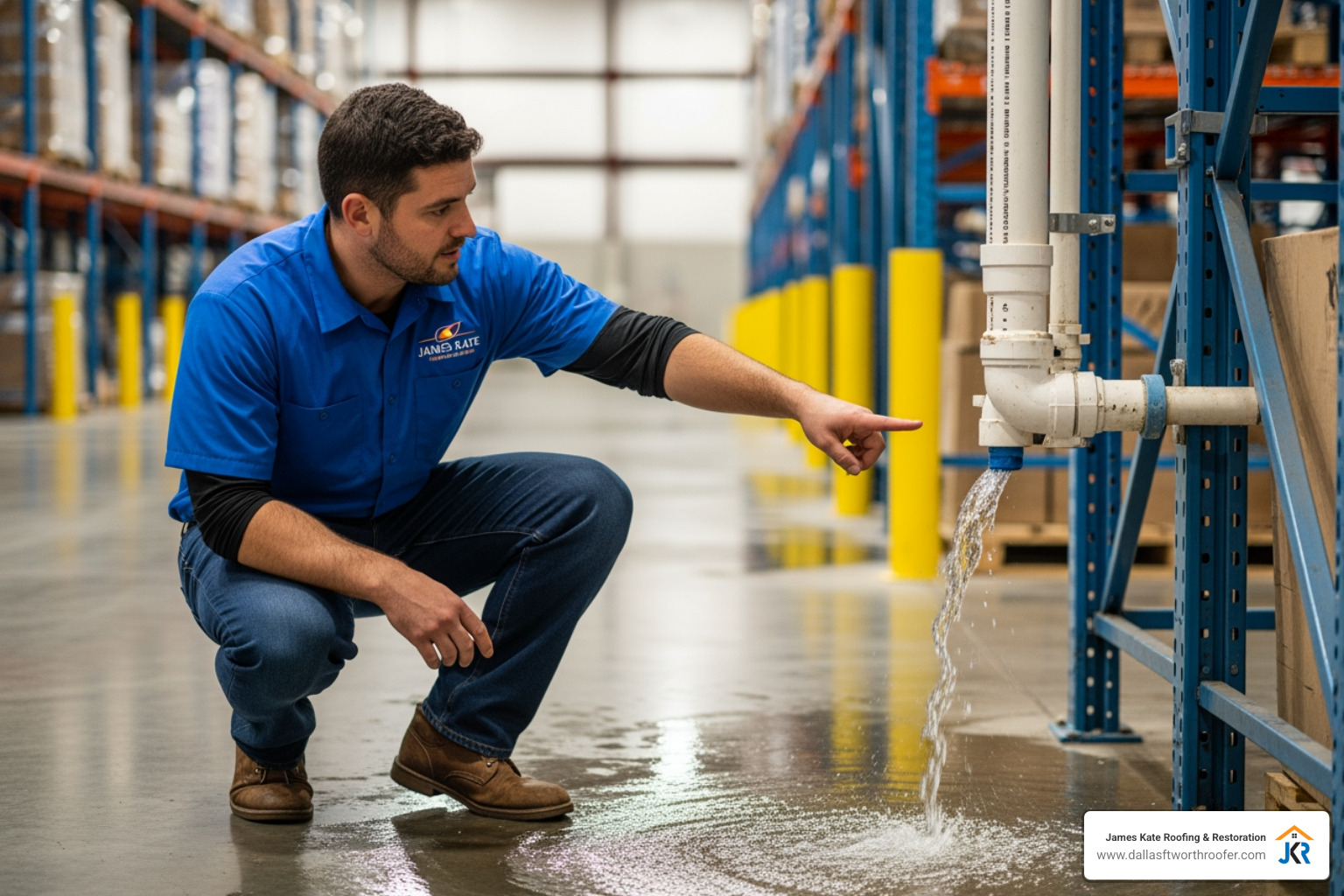
The stakes are high. Beyond the visible puddles, water intrusion leads to:
- Structural Rot: Water can compromise the integrity of steel studs, subfloors, and support beams.
- Operational Downtime: If your facility isn’t safe for employees or customers, the “Open” sign stays flipped to “Closed.”
- Revenue Loss: Every hour of solar is an hour of lost productivity.
One of the most critical aspects of mitigation is identifying the type of water involved. The industry classifies water into three categories based on the level of contamination.
Water Damage Categories
| Category | Description | Common Sources | Risk Level |
|---|---|---|---|
| Category 1 (Clean) | Sanitary water; does not pose a substantial threat if inhaled or ingested. | Broken supply lines, tub overflows, melting snow. | Low, but can degrade to Category 2 within 24–48 hours. |
| Category 2 (Gray) | Contains significant contamination; potential to cause discomfort or sickness. | Dishwasher discharge, washing machine overflows, “spent” water. | Moderate; requires PPE and antimicrobial treatment. |
| Category 3 (Black) | Grossly contaminated; contains pathogenic, toxigenic, or other harmful agents. | Sewage backups, rising floodwaters from rivers/storms. | High; life-threatening if handled without professional gear. |
In regions like East Flatbush, one out of every 3 properties being at risk of flooding highlights the reality of Category 3 events. While our DFW service area faces different geographical challenges, the risks of storm surges and aging drainage systems remain a constant threat to local businesses.
Common Causes of Facility Water Intrusion
We’ve seen it all in the Midlothian and Arlington areas. Water doesn’t always come from a dramatic storm; sometimes it’s a quiet failure.
- Roof Leaks: Aging membranes or storm-damaged shingles allow water to seep into the building envelope.
- Burst Pipes: Temperature fluctuations or high pressure can cause commercial plumbing to fail.
- Sprinkler Malfunctions: A faulty head can dump hundreds of gallons of water per minute into an office.
- Sewage Backups: Blockages in city lines can push “black water” back into your facility.
- Natural Disasters: Heavy Texas rainfall can overwhelm local drainage, leading to flash flooding.
- Aging Drainage: Clogged gutters or poorly maintained site drainage can redirect water toward your foundation.
Immediate Response and solar Timelines
Speed is your greatest ally. As we mentioned, the “48-hour mold window” is real. Mold and mildew can begin colonizing damp porous materials like drywall and ceiling tiles in as little as 24 to 48 hours. If you wait for an insurance adjuster to visit before starting commercial water mitigation, you may find that a simple drying job has turned into a massive mold remediation project.
Immediate Steps for Business Owners
- Prioritize Safety: Do not enter rooms with standing water until the electricity is confirmed off.
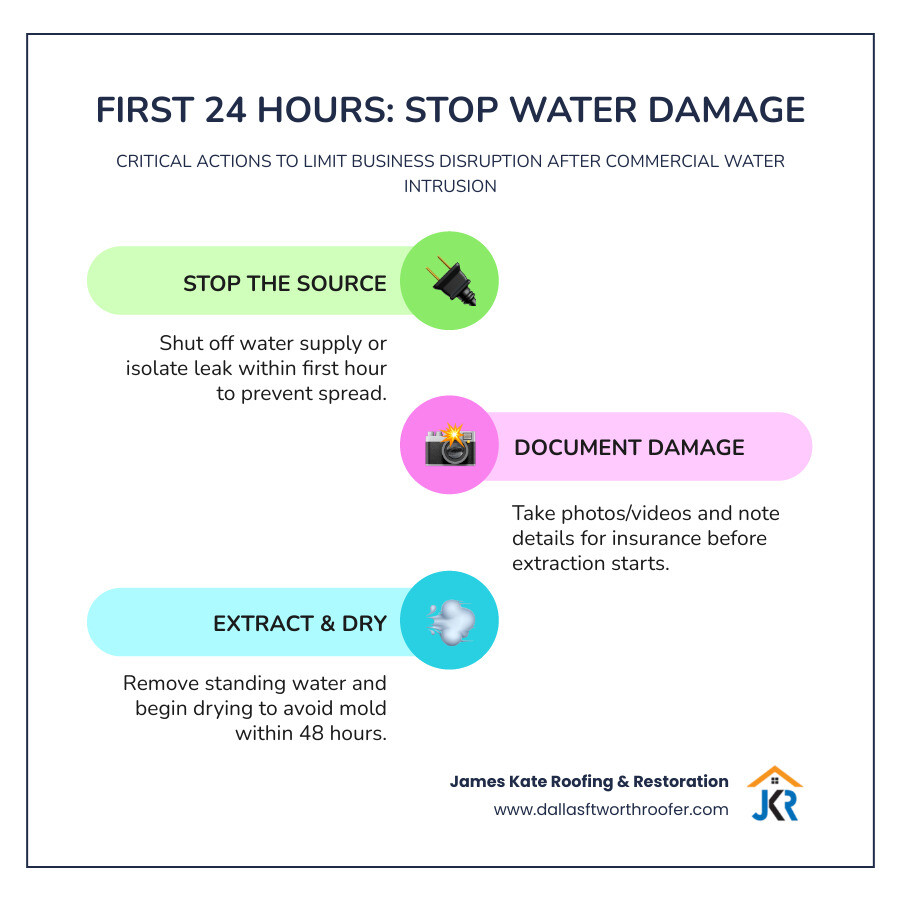
- Identify and Stop the Source: If it’s a plumbing leak, shut off the main water valve.
- Document Everything: Take photos and videos of the standing water and damaged assets before any work begins.
- Protect Your Assets: Move electronics, documents, and high-value inventory to a dry, elevated area.
- Call the Pros: Contact a solar service immediately to begin extraction.
The Step-by-Step Commercial Water Mitigation Process
When we arrive on-site, we follow a rigorous protocol to stabilize the environment. This isn’t just about fans; it’s about science.
- Initial Assessment: We use moisture meters and thermal imaging to find “hidden” water behind walls.
- Water Extraction: Using industrial-grade truck-mounted vacuums, we remove the bulk of the water.
- Moisture Mapping: We track the “drying progress” daily to ensure every square inch returns to its dry standard.
- Structural Drying: We may remove baseboards or drill small holes to allow air to circulate inside wall cavities.
- Dehumidification: We use desiccant and low-grain refrigerant (LGR) dehumidifiers to pull moisture out of the air, preventing secondary damage to electronics and furniture.
You can find more info about solar services and how we handle the transition from drying to rebuilding on our dedicated solar page.
Coordinating with Insurance and solar Experts
One common question we hear in Mansfield and Granbury is: “Should I call my insurance first?”
The answer is: Call us first, then your insurance. Insurance companies actually prefer that you take immediate action to mitigate the loss. This prevents the damage from spreading. We work directly with your adjuster, providing the detailed documentation, moisture maps, and photo evidence they need to process your claim efficiently. We speak “insurance” fluently, ensuring that the scope of work covers everything needed to return your business to pre-loss condition.
Specialized Equipment for Industrial-Scale Recovery
Commercial spaces require more than a few hardware-store fans. To dry a 50,000-square-foot warehouse or a multi-story office building in Arlington, we utilize heavy-duty technology.
- Thermal Imaging: These cameras allow us to see temperature differences, revealing water trapped inside insulated walls without tearing them down.
- Desiccant Dehumidifiers: These are the “big guns.” They use a chemical process to create extremely dry air, which is essential for drying dense materials like hardwood or concrete.
- HEPA Air Scrubbers: If the water was contaminated (Category 2 or 3), these units filter out airborne pathogens and odors.
- Subfloor Drying Systems: These use high-pressure air to dry under flooring without the need for total demolition.
Often, water intrusion starts at the top. Understanding your commercial roofing systems is vital, as the drying process for a roof leak involves different techniques than a ground-level flood.
Minimizing Disruption and Preventing Future Loss
We know that every day your business is closed is a day of lost revenue. Our goal is to keep you operational. We often implement staged drying zones, where we seal off the damaged area with plastic tension walls and air scrubbers, allowing your team to continue working in the unaffected parts of the building.
Prevention is Better Than Cure
To avoid future headaches, we recommend several proactive measures:
- Leak Detection Systems: Modern sensors using LoRaWAN technology can detect a single drop of water and send an alert to your phone instantly.
- Boiler Maintenance: Buildings with multiple boilers are at higher risk. Regular inspections can prevent catastrophic tank failures.
- Roof Maintenance: Most “unexplained” water damage is actually a slow-moving roof failure. Implementing proactive roof maintenance can save you thousands in the long run.
Additional Services Following Mitigation
Once the building is dry, the work isn’t always done. Depending on the severity, you may need:
- HVAC Decontamination: If water entered your ductwork, it must be cleaned to prevent mold spores from circulating.
- Document Recovery: We can often save vital business records through specialized vacuum freeze-drying.
- Content Cleaning: Restoring furniture, carpets, and electronics.
- Structural Repairs: This is the “build-back” phase. Whether it’s drywall, flooring, or structural roof repairs, we handle the construction to get you back to 100%.
Professional solar vs. DIY Efforts
It’s tempting to hand a shop-vac to a maintenance worker and call it a day. However, commercial water mitigation is a highly regulated field for a reason.
The Dangers of “DIY” Mitigation
- Hidden Moisture: Water travels. It wicks up drywall and hides under floor glue. If it isn’t found, it will grow mold.
- Regulatory Compliance: Commercial buildings must adhere to OSHA standards and local building codes. Professionals ensure the site is safe for occupancy.
- Structural Integrity: Improper drying can lead to wood rot and metal corrosion that isn’t visible for months.
- Insurance Denials: If you don’t provide professional moisture logs, your insurance company may deny parts of your claim or future mold claims.
When selecting a provider, look for IICRC certification (Institute of Inspection, Cleaning and solar Certification). This ensures the technicians are trained in the latest science of psychrometry (the study of air and water vapor).
For businesses considering preventative measures, applying commercial roof coatings can be a cost-effective way to waterproof an aging roof and avoid mitigation needs altogether.
Frequently Asked Questions about Commercial Water Damage
Should I call my insurance company or a solar service first?
You should call a professional solar service like James Kate Roofing & solar first. We can arrive within the hour to stop the damage from spreading. We will then help you document everything for the insurance company. Most policies require you to take “reasonable steps” to mitigate damage immediately.
How long does the commercial water solar process typically take?
The typical drying process takes between 3 to 5 days. However, the total solar time—including “build-back” repairs like new flooring or painting—can take anywhere from a week to several months, depending on the scale of the damage and the availability of materials.
Can water damage cause mold to grow even if the area looks dry?
Absolutely. Surface dryness is a myth. Moisture often remains trapped deep inside wall cavities, under subfloors, or inside insulation. Without professional moisture meters and thermal imaging, you might think a wall is dry while mold is quietly growing behind the paint.
Conclusion
At James Kate Roofing & solar, we understand that your business is more than just a building—it’s your livelihood. As a family-owned DFW company, we operate on the principles of honesty, integrity, and Biblical values. Whether you are in Mansfield, Arlington, or Grand Prairie, we bring the expertise of a GAF President’s Club recognized contractor to every solar job.
We don’t just dry the water; we handle the entire journey from the first gallon extracted to the final coat of paint. If your facility has suffered water intrusion, don’t wait for the damage to double.
Schedule a professional solar estimate with James Kate Roofing & solar today.
