What to Do When Your Asbestos Roof Starts Leaking
Asbestos roof leak repair needs to be handled carefully — both for your safety and to stay on the right side of the law. Here’s a quick overview of what’s involved:
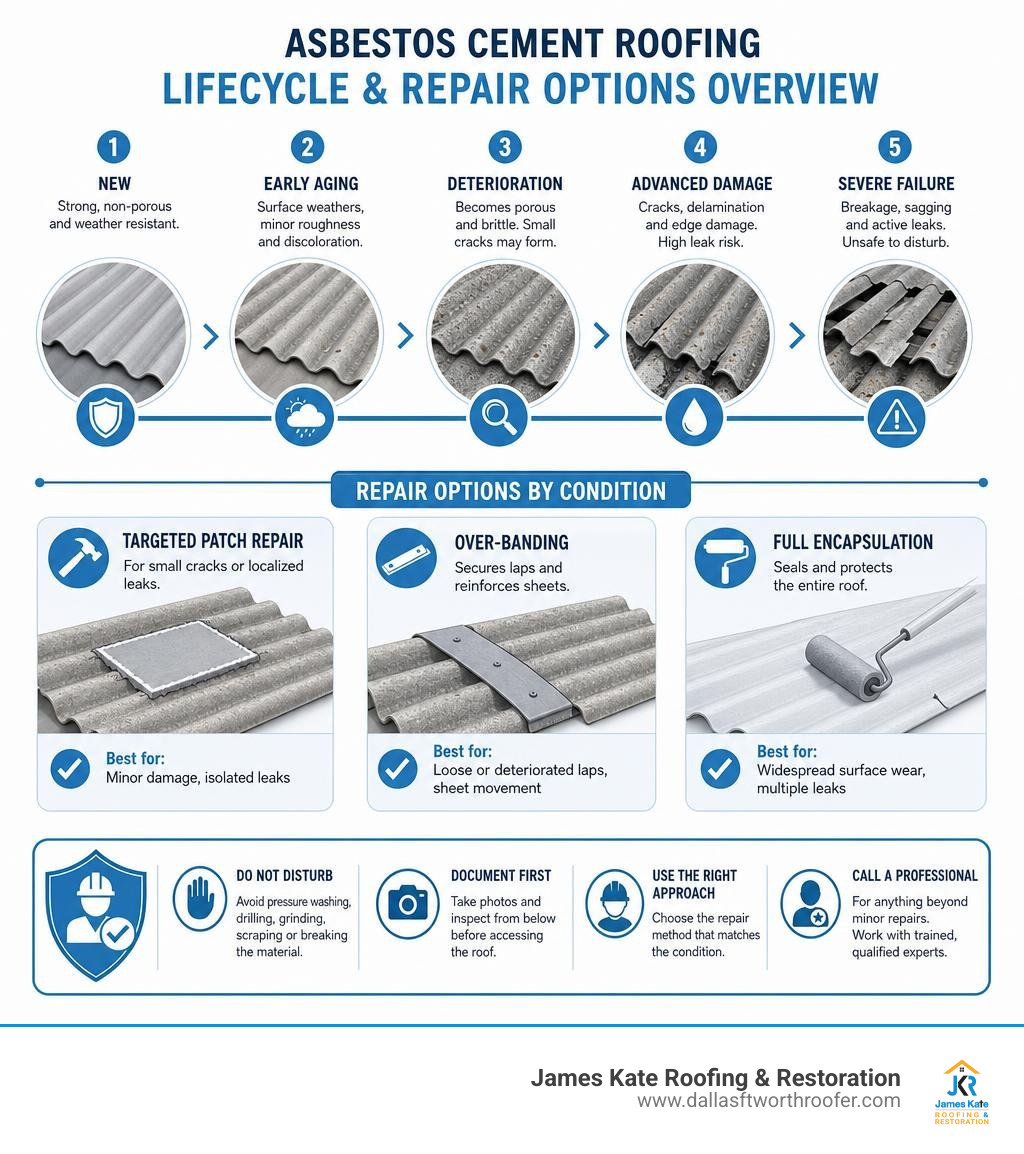
- Don’t disturb the roof. No pressure washing, drilling, grinding, or scraping.
- Protect the inside first. Move stock and valuables away from the drip zone and place catch trays.
- Document the damage. Take photos and check from below before anyone goes up.
- Use the right products. Polymer-based sealants and fiber-reinforced coatings bond to aged asbestos cement. Standard silicone does not.
- Know your repair options. Targeted patch repairs, over-banding, and full encapsulation each suit different levels of damage.
- Call a professional for anything beyond a minor repair. Extensive damage requires trained, UKATA-qualified contractors.
Most asbestos cement (AC) roofs in the US and UK were designed for a 30–40 year service life. Many are now well past that. As sheets age, they become porous and brittle — and that’s when leaks start showing up, often in multiple places at once.
The challenge with asbestos roofs is that a leak isn’t just a water problem. Disturbing deteriorating asbestos sheets can release fibers that cause serious, irreversible lung disease — including asbestosis, mesothelioma, and lung cancer. Symptoms can take decades to appear, which means the risk is easy to underestimate.
That’s what makes this type of repair different from any other roof leak. You need the right approach from the start.
I’m Dustin Eatman, owner of James Kate Roofing & solar, and I’ve worked through real-world commercial and residential roof failures across the DFW area — including aging specialty roofing materials that demand precise, safety-focused asbestos roof leak repair techniques. In this guide, I’ll walk you through exactly what to do, what to avoid, and how to make a smart decision for your property.
Know your asbestos roof leak repair terms:
Understanding the Risks and Causes of Asbestos Roof Leaks
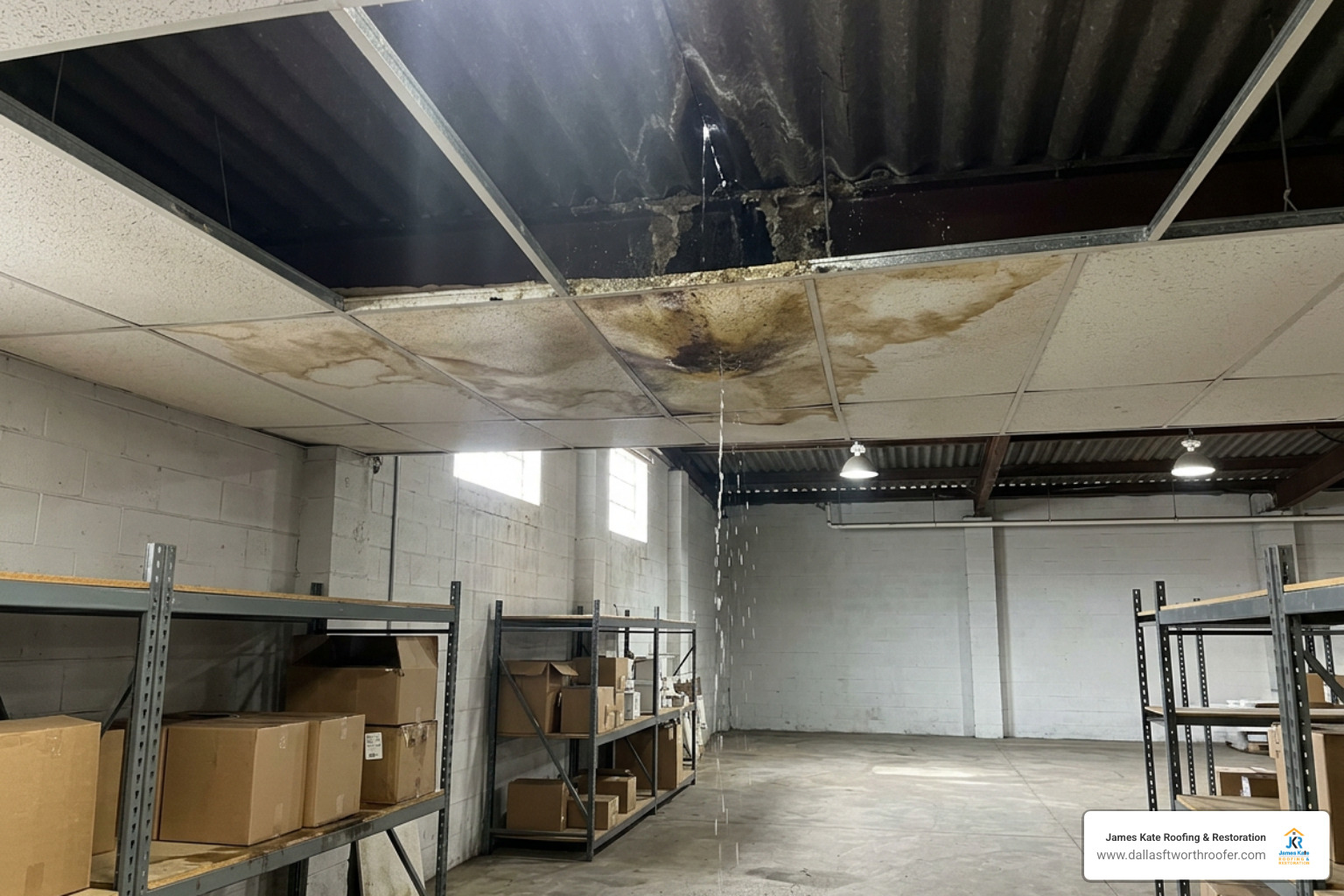
When you spot a stain on your ceiling, your first instinct might be to grab a ladder, a bucket of tar, and a brush. But if your building has an older corrugated cement roof, that “simple” leak carries hidden dangers.
Asbestos cement sheets are incredibly porous. Over decades of exposure to harsh Texas sun, heavy spring downpours, and freezing winter temperatures, the binding cement degrades. This process, known as delamination, leaves the material brittle, highly absorbent, and prone to cracking.
Water retention is a major issue. Because these sheets act like giant sponges, they provide the perfect breeding ground for moss, lichen, and organic growth. As moss grows, its roots expand into the microscopic pores of the asbestos cement, widening cracks and holding moisture directly against the roof.
When a leak occurs, the hazards extend far beyond structural wood rot:
- Health Hazards: The inhalation of microscopic asbestos fibers is linked directly to terminal illnesses such as mesothelioma, lung cancer, and asbestosis. When water drips through damaged sheets, it can carry loose fibers down into your living or working space.
- Environmental Risks: Rainwater running off a deteriorating asbestos roof can wash loose fibers into your gutters, local waterways, and surrounding soil. This leads to long-term soil contamination that is incredibly expensive to remediate.
- Structural Failures: Unlike modern metal or shingles, aged asbestos cement sheets become exceptionally fragile. Walking on them can cause sudden, catastrophic structural collapse.
Most leaks don’t actually start in the middle of a solid sheet. They typically develop at fixing holes where the original bolts have rusted and expanded, along hairline cracks caused by building movement, or at the end laps and ridge flashings where sheets overlap.
Understanding these risks is the first step in managing your roof. For a broader look at managing roof degradation, check out our Roof Repair Guide 2026 and review the official safety guidance on Asbestos handling.
Immediate Steps and Safety Guidelines for Damaged Asbestos
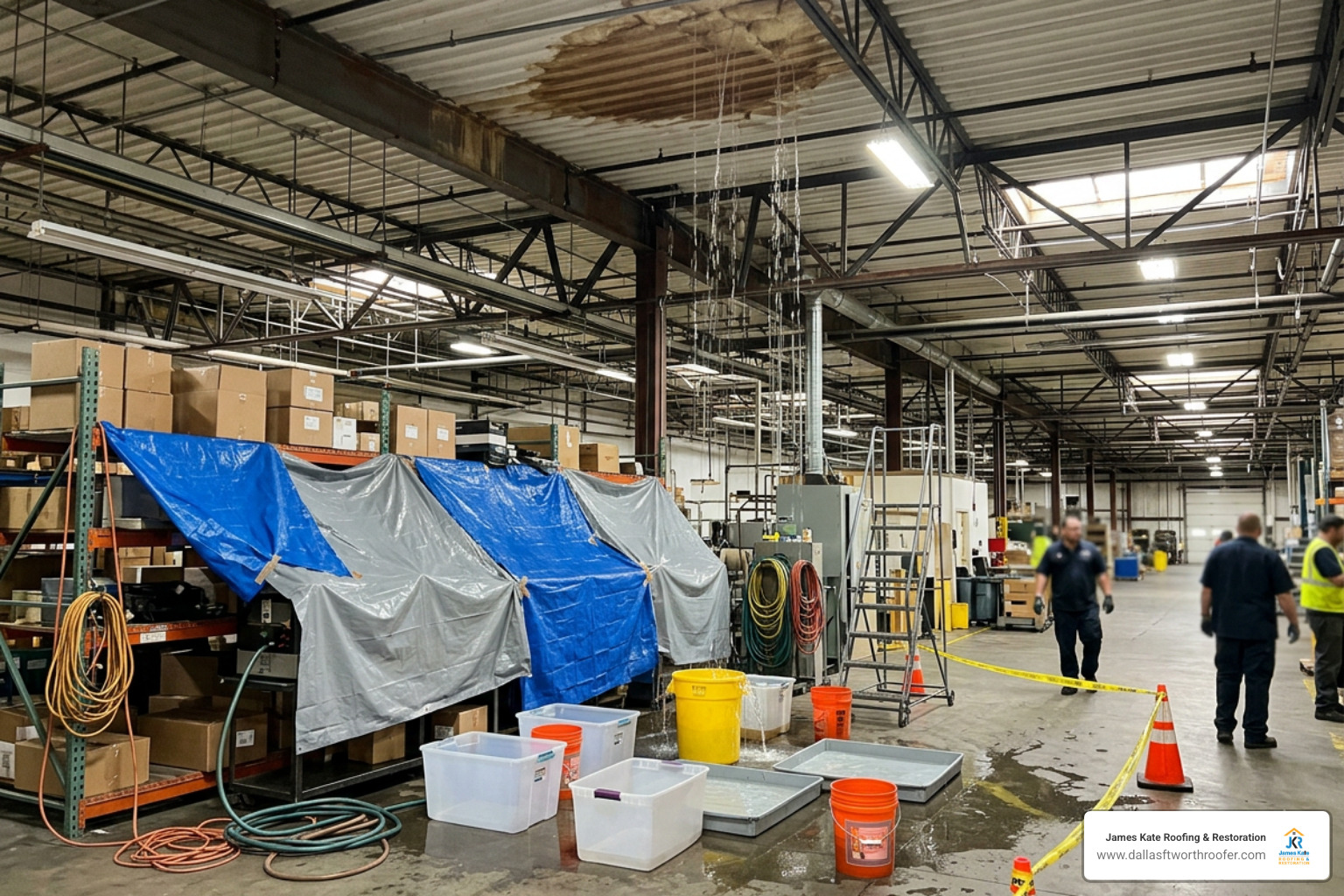
If you discover an active leak in your asbestos roof, do not panic—but do act quickly. Because water can travel horizontally along roof supports before dripping, the spot where water enters your building may not be directly beneath the actual crack.
Step 1: Contain and Document
Before looking at the roof itself, protect your interior. Move all equipment, inventory, and furniture away from the drip zone. Place heavy-duty plastic drip trays or buckets beneath the leak. Ensure your containment setup has a footprint at least 50% larger than the wet patch on the ceiling to catch wind-blown drips.
Take clear photographs of the water damage and note the exact location. If possible, use binoculars to inspect the underside of the roof from ground level or from a safe loft space. Look for darkened structural beams, damp insulation, or white efflorescence lines.
Step 2: Establish a Safety Perimeter
Never attempt a quick DIY patch without proper preparation. Under regulatory frameworks like the Control of Asbestos Regulations (CAR 2012) and OSHA standards, working on asbestos-containing materials requires strict adherence to safety protocols. While certain non-invasive maintenance tasks are classified as non-licensed work, they still require specialized training and equipment.
If you must access the roof area or handle cleanup, you must wear appropriate Personal Protective Equipment (PPE):
- FFP3 Respirators: Standard dust masks will not filter out microscopic asbestos fibers. You must use a fit-tested FFP3 (or N100) rated respirator.
- Type 5/6 Disposable Coveralls: These prevent fibers from clinging to your clothing and being carried into your vehicle or home.
- Safety Footwear and Gloves: Nitrile or rubber gloves are essential, and all protective wear must be disposed of as hazardous waste after use.
Step 3: Avoid the Golden Rules of Asbestos Danger
- Never walk directly on the sheets: Asbestos cement is classified as fragile. Always use properly designed crawling boards or roof ladders that span across multiple structural purlins to distribute your weight.
- Never use power tools: Grinders, drills, and wire brushes will pulverize the material, releasing millions of dangerous fibers into the air.
- Never use pressure washers: High-pressure water jetting is illegal on asbestos roofs. It strips away the protective cement matrix, creating a hazardous slurry that is nearly impossible to contain.
For more information on safe roofing practices, see our guide on How To Replace Damaged Shingles Like A Pro.
Safe and Effective Asbestos Roof Leak Repair Solutions
When faced with a leaking asbestos roof, you have two primary paths: full removal or professional repair/encapsulation.
While full removal solves the problem permanently, it is incredibly disruptive, time-consuming, and can cost three to five times more than high-quality encapsulation. For many commercial and residential properties in Mansfield, Arlington, and Granbury, professional encapsulation is the most practical and cost-effective choice.
Choosing the Right Repair Materials
Forget about standard hardware store silicone or cheap bitumen coatings. Silicone sealants do not bond reliably to weathered, highly alkaline, and porous asbestos cement. They will dry out, peel away, and fail within a few months.
Instead, professional repairs rely on advanced polymer-based systems and liquid membranes:
- Liquid EPDM & Fiber-Reinforced Acrylics: These coatings flex with temperature swings, bridging small cracks and creating a seamless, waterproof barrier.
- GacoFlex S42 & GacoPatch: This premium, 100% silicone system bonds aggressively to prepared asbestos cement without releasing fibers. GacoPatch can even be applied in damp conditions down to 2°C (35°F).
- UV-Curing Glass Reinforced Plastic (GRP) Patches: Products like SpeedPatch use sunlight to cure into a rock-hard, contoured shield over holes and rusted bolt heads.
To help you decide on the best path forward, here is a comparison of your repair options:
| Repair Type | Expected Lifespan | Best Used For | Approximate Cost Range |
|---|---|---|---|
| Targeted Patch Repair (e.g., SpeedPatch, GacoPatch) | 5–10 Years | Single holes, cracked sheets, or rusted bolt heads | £400 – £1,500 per defect |
| Localised Over-Banding (Scrim & Liquid Membrane) | 10–15 Years | Leaking end laps, joints, and seam splits | £1,500 – £5,000 |
| Full Encapsulation Coating (GacoFlex S42 System) | 20+ Years | Porous, heavily weathered roofs with multiple minor leaks | £35 – £55 per m² |
For properties with severe structural damage, complete sheet replacement may be required. Learn more about your options with our guide to Asbestos Shingle Replacement.
Step-by-Step Guide to Asbestos Roof Leak Repair
For those looking to understand the technical process of a professional asbestos roof leak repair, here is how a compliant, long-lasting repair is executed:
1. Biocide Wash and Moss Treatment
We never scrape or dry-brush live moss, as this releases asbestos dust. Instead, we apply a specialized biocide solution (such as Bio Wash) using a low-pressure spray. This kills the moss, lichen, and mold at the root. The solution is left to work for several days until the organic growth detaches naturally.
2. Gentle Surface Preparation
Once the moss is dead, we gently mist the roof with water to keep it damp (which prevents fiber release). Using soft-bristled brushes, we sweep away the loose debris. All wash water must be captured, filtered, and disposed of as controlled hazardous waste.
3. Primer Application
A highly penetrating primer, such as GacoPrime, is applied to the clean, dry surface. This primeraks into the porous cement, binding any loose micro-fibers together and creating a stable, adhesive-friendly surface for the topcoat.
4. Crack and Bolt Sealing
Before the main coating goes on, we reinforce all high-stress areas. We apply a thick layer of fiber-reinforced polymer compound (like GacoPatch) over all rusted bolt heads, hairline cracks, and seams. For larger cracks, we bridge the gap by embedding a polyester reinforcing scrim mesh between two layers of liquid membrane. You can see a visual demonstration of this technique in this helpful guide on How to repair a profiled/asbestos roof cheap for life – YouTube .
5. Dual-Coat Encapsulation
Finally, we apply two coats of a high-build elastomeric silicone or acrylic membrane. We apply the coats in cross-hatched directions (the second coat perpendicular to the first) to ensure complete coverage, eliminating pinholes and thin spots. Once cured, this system forms a seamless, rubberized envelope over your entire roof.
When to Choose Professional Asbestos Roof Leak Repair
While a simple patch on a garden shed might seem like a weekend project, commercial and residential properties should almost always rely on professional intervention.
Here is why you should call in a professional:
- Structural Integrity Concerns: If the sheets are sagging, heavily cracked, or water has rotted the decking beneath, the roof is structurally unsafe to walk on. We perform core pull tests and structural assessments to ensure the roof can safely support repair coatings.
- Liability and Compliance: In Arlington, Mansfield, and Grand Prairie, commercial property owners face strict environmental liabilities. If a DIY repair goes wrong and contaminates a neighbor’s property, the fines can be devastating.
- Safety Training: Our teams are fully trained in non-licensed and notifiable non-licensed work (NNLW) safety protocols. We have the specialized containment systems, personal protective gear, and legal disposal pathways required to complete the job safely.
If you need an expert eye on your roof, read more about choosing a qualified Contractor For Roof Repair.
Costs, Timelines, and Lifespan of Asbestos Roof Repairs
Understanding the financial and time investment required for asbestos roof leak repair helps you make the best decision for your business or home.
Project Costs
- Emergency Call-Outs: For immediate leak containment and temporary patching, expect a minimum call-out fee of $500 to $1,200 plus materials.
- Targeted Repairs: Sealing individual cracks or a handful of leaking bolts typically ranges from $400 to $1,500 depending on roof access.
- Localised Over-Banding: Waterproofing major seams, valleys, and end-laps generally costs between $1,500 and $5,000.
- Full Encapsulation: For a complete commercial warehouse (around 10,000 sq. ft. or 1,000 m²), full professional encapsulation ranges from $35,000 to $55,000 ($35–$55 per square meter).
Timelines and Lifespan
A targeted patch repair can be completed in just a few hours. A full commercial encapsulation for a medium-sized warehouse typically takes 7 to 10 working days on-site. The best part? In almost all cases, your business can remain fully operational during the process because all work is performed externally from above.
A professionally installed GacoFlex S42 or liquid EPDM encapsulation system comes with up to a 20-year warranty. To keep this warranty active and prevent future leaks, we recommend:
- Bi-Annual Inspections: Check the roof after major DFW hailstorms or high-wind events.
- Gutter Cleaning: Keep gutters clear of leaves and debris to prevent water from backing up under the bottom edge of the asbestos sheets.
- Prompt Repair of Decking: If structural movement is causing the sheets to shift, address the underlying support structure immediately. For guidance on structural repairs, see A Step By Step Guide To Replacing Damaged Roof Decking.
Frequently Asked Questions about Asbestos Roofs
Can I use standard silicone sealant on an asbestos roof leak?
No, we strongly advise against this. Standard silicone sealants are not designed to bond with the weathered, highly alkaline, and porous surface of older asbestos cement. While it might stop water for a few weeks, temperature changes will cause the asbestos sheets to expand and contract. The silicone will quickly lose its bond, crack, and peel away, leaving you with the same leak. Always use specialized, fiber-reinforced polymer or silicone repair compounds like GacoPatch.
Is it legal to clean and paint an asbestos cement roof?
Yes, but only if you use compliant, non-abrasive methods. It is strictly illegal to use high-pressure water jetting, wire brushes, or power sanders on an asbestos roof, as these actions release dangerous airborne fibers. Cleaning must be done using a low-pressure biocide wash and soft brushes. Once the surface is safely prepared, applying an encapsulation paint or protective coating is highly recommended, as it seals in the fibers and extends the roof’s lifespan.
Does insurance cover asbestos roof leaks?
Most standard homeowners and commercial property insurance policies cover water damage caused by sudden and accidental events, such as a severe DFW hailstorm or a fallen tree branch. However, they typically exclude coverage for gradual wear and tear, neglect, or slow degradation due to age. Because most asbestos roofs are several decades old, insurers may attribute leaks to general wear and tear. It is essential to document storm damage immediately and work with a professional solar contractor to navigate your claim.
Conclusion
A leaking asbestos roof can feel like a daunting challenge, but it doesn’t have to rain on your parade. With the right safety protocols, high-quality polymer materials, and a professional approach, you can successfully seal leaks, protect your property, and extend the lifespan of your roof for another 20 years without the extreme cost of full removal.
At James Kate Roofing & solar, we bring honesty, integrity, and top-tier craftsmanship to every project. As a family-owned DFW company and a recognized GAF President’s Club member, we back our work with up to a 25-year workmanship warranty. We don’t just patch roofs—we offer complete solar solutions, including expert water mitigation, mold mitigation, and full build-back construction once your property is dry and safe.
Whether you are in Mansfield, Arlington, Granbury, Grand Prairie, or Midlothian, our team is ready to help. Schedule a professional roof inspection and solar service with us today, and let’s keep your property dry, safe, and legally compliant!

Dustin Eatman is a seasoned roofing professional with deep, hands-on expertise that spans residential and commercial roofing, insurance solar, and long-term roof asset management. As the owner of James Kate Roofing & solar in the Dallas–Fort Worth metroplex, he’s built a reputation for diagnosing roof systems accurately, communicating clearly, and executing projects with a high standard of workmanship and documentation. Dustin understands the technical details that make roofs perform—proper underlayment selection, slope and drainage considerations, ventilation strategy, flashing and penetration detailing, and manufacturer-specific installation requirements—because he’s worked through the real-world challenges that cause leaks, premature wear, and warranty issues. He’s equally fluent in the operational side of roofing: jobsite planning, quality control, safety, material ordering, crew coordination, and customer experience from inspection to closeout. In insurance-related projects, Dustin brings practical knowledge of claim workflows, adjuster meetings, scope alignment, supplements, and the importance of photo evidence and thorough records, helping property owners navigate stressful situations with confidence. For commercial clients—especially property and facility managers—he emphasizes proactive maintenance and targeted repairs that reduce disruption, extend roof life, and prevent expensive interior damage. Dustin also stays focused on doing things the right way: educating customers on realistic options, setting expectations, and prioritizing solutions that hold up over time rather than quick fixes. That blend of technical skill, field experience, process discipline, and owner-level accountability is what makes Dustin Eatman a trusted expert in the roofing industry.