
A roof insurance claim pays when sudden, accidental damage from a covered cause, such as hail, wind or a falling tree, hits your roof. It does not pay for age, wear or neglect. The size of your check depends on three things you can check before you call: the cause of the damage, how your policy values the roof, and your deductible. A free roof inspection with a written estimate gives you the facts to bring to that call, and James Kate Roofing & solar, a GAF Master Elite® contractor, offers one across North Texas.
TL;DR
- Insurance covers sudden damage from a named cause (hail, wind, fire, a fallen tree). It generally does not cover wear and tear or a roof that is simply old.
- Read three things in your policy first: replacement cost or actual cash value, your wind/hail deductible, and your claim filing deadline.
- Document the damage, report it promptly, make temporary repairs to stop further damage and keep every receipt.
- With replacement cost coverage, you usually get paid in two checks: the first up front, the rest once repairs are underway or finished.
- If you are denied or underpaid, ask for the decision in writing and use your state insurance department and the appraisal process.
Table of Contents
- What a roof claim covers and what it does not
- Read your policy before you call
- How to file a roof insurance claim, step by step
- Get an inspection and estimate before the adjuster arrives
- How a roof claim is paid
- Your deductible is part of the real cost
- If your roof claim is denied or underpaid
- Will a claim stay on your record?
- Commercial roofs and property managers
- Get your roof inspected
- FAQ
- Sources
What a roof claim covers and what it does not
Homeowners policies typically cover losses that are sudden and accidental and caused by specific perils. The Maryland Department of Insurance lists fire, wind, hail and the weight of ice or snow among them. The same page explains that policies do not provide coverage for maintenance, so damage from wear and tear or deterioration over time generally will not be paid.
The Texas Department of Insurance (TDI) says the same in plain terms: you can file a roof claim if a storm, a tree or something else damaged the roof, but an insurer won’t pay for a new roof just because the old one is worn out.
In practice that gives you a simple sorting test:
| Situation | Usually a claim? |
|---|---|
| Hail bruises or cracks shingles in a storm | Yes, if hail is a covered peril on your policy |
| Wind tears off shingles or lifts flashing | Yes, subject to your wind/hail deductible |
| A tree limb punches through the decking | Yes |
| Shingles curl and granules wash away after 20 years | No, this is wear and tear |
| A slow leak from long-neglected flashing | Usually no, it is a maintenance item |
Roof repair and replacement normally fall under the Dwelling coverage (Coverage A) part of your policy. Westfield Insurance explains that insurers weigh the roof’s age, condition and material when deciding what they will cover.
If you are not sure whether what you see is storm damage or age, that is a question for an inspection, not a guess. Our guides on identifying roofing damage caused by a hailstorm and spotting roof damage after a storm show what the signs look like from the ground.
Read your policy before you call
Two neighbors with identical hail damage can receive very different payments. The Colorado Roofing Association notes that the gap comes down to the settlement basis written in each policy. Find these four items on your declarations page and endorsements before you file.
Replacement cost or actual cash value
With replacement cost value (RCV), the policy pays to repair or replace without subtracting depreciation. Maryland’s insurance department adds that most policies require you to complete the repair to receive full reimbursement. With actual cash value (ACV), the policy pays the depreciated cost, which can be much less for an older roof.
Age matters here. Iowa’s insurance division says a 10-year-old roof may be covered if a covered peril damaged it, but an ACV policy deducts depreciation for age and condition. Montana’s insurance commissioner warns that some policies switch roof claims to ACV once a roof reaches roughly 10 to 15 years. Westfield describes another approach, a limited loss settlement, where a roof over 20 years old may receive 25% to 40% of the cost to repair or replace the damaged parts.
Your wind/hail deductible
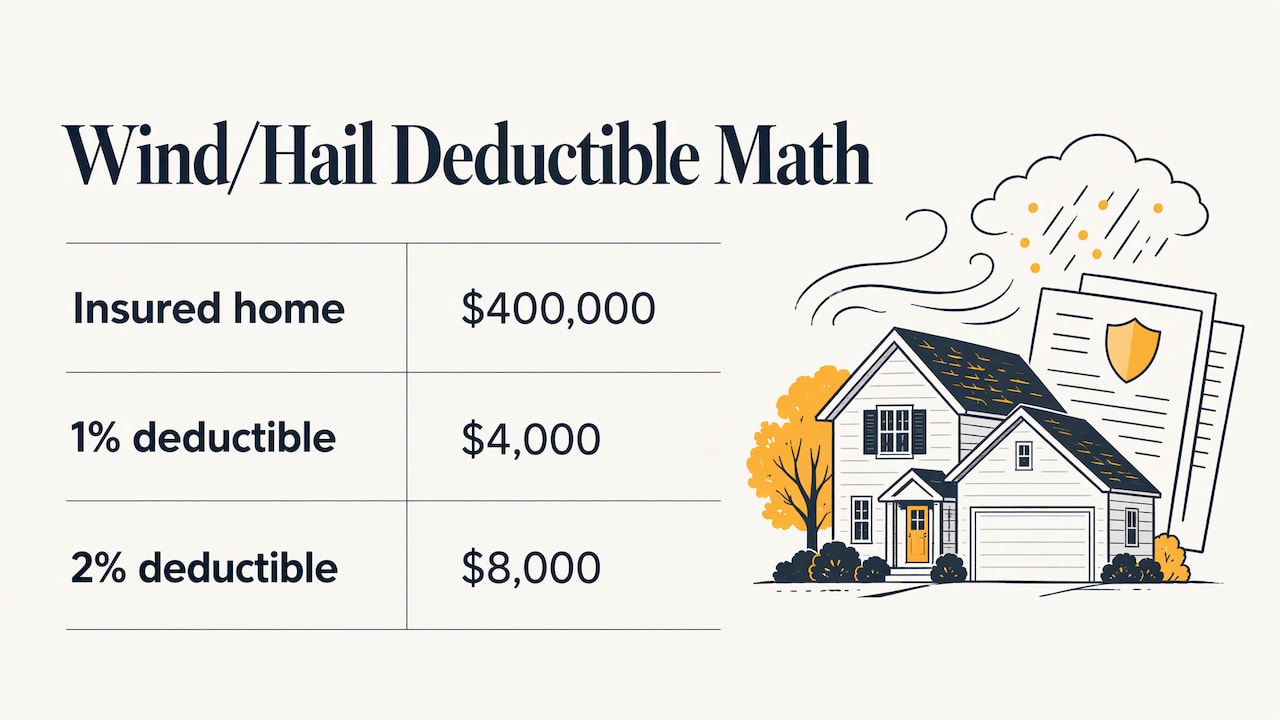
Many homeowners are surprised to learn they have a separate roof or wind/hail deductible. It may be a flat dollar amount or a percentage of the dwelling coverage. A percentage deductible changes the math a lot. On a home insured for $400,000, a 1% deductible is $4,000 and a 2% deductible is $8,000. If the repair estimate is close to your deductible, the claim may pay little or nothing.
Your filing deadline
Most policies set a deadline to file, often one to two years and sometimes less for wind and hail or catastrophe events. The Colorado Roofing Association says missing the window can void coverage entirely. The policy may also require repairs within a set time to collect held-back depreciation. Look for both dates in your policy, and count from the storm, not from the day you noticed the damage.
Exclusions and roof endorsements
Check the policy for roof-specific endorsements, cosmetic damage exclusions and any age-based schedule. These are the clauses that turn a covered storm into a smaller payment.
How to file a roof insurance claim, step by step
GAF’s claims guide lays out five steps. Here they are with what each takes and where each goes wrong.
- Document everything. Take wide photos of the house and close-ups of each damaged area: dented vents, bruised or cracked shingles, displaced flashing, debris on the ground. Note the date and time of the storm. Where it goes wrong: people photograph only the interior stain and skip the roof, or wait until a second storm muddies which event caused what.
- Contact your insurer. Report the loss and ask whether it is covered and how long you have to file. Have your policy number and a short summary of what happened ready. Where it goes wrong: guessing at the cause on the phone. Describe what you saw and when, and leave the diagnosis to the inspection.
- Complete the claim paperwork. This includes the proof of loss form and your photo or video evidence. Where it goes wrong: a vague or incomplete form that delays the adjuster visit.
- Make temporary repairs. Protect the home from further damage. The California Department of Insurance says insurers will reimburse reasonable costs to protect the property, such as covering the roof with plastic sheeting or plywood, as long as you save receipts. Where it goes wrong: throwing away receipts, or doing permanent work before the adjuster has seen the damage.
- Prepare for the adjuster. Hand over your documentation. GAF notes you may have a roofing contractor meet the adjuster to explain the damage they identified.
If water is spilling over the edge in heavy rain, it helps to test your gutters with a hose before you assume the roof itself is leaking. That tells you whether you are dealing with a gutter problem or a roof problem, and it keeps your claim description accurate.
For storm-specific steps in North Texas, see what to do when your roof suffers storm damage and our Texas roof insurance claims guide for DFW homeowners.
Get an inspection and estimate before the adjuster arrives
An adjuster works for the insurer and sees your roof once. You get the most from that visit when you already know what is on the roof, where, and what it costs to fix properly.
Our free inspections and estimates cover hail and wind damage, leaks and storm damage on residential and commercial roofs. We work on asphalt shingle, metal, tile, TPO, PVC, modified bitumen and built-up systems. Our instant roofing quote tool also assesses a roof’s health using historical weather data, so you can see whether a severe storm affected your address.
A written inspection report and estimate gives you:
- photos tied to specific areas of the roof,
- a clear list of storm damage separate from age-related wear,
- a repair or replacement scope you can compare with the insurer’s.
If you want a closer look at how we assess a roof, read how to check, document and decide after roof damage.
How a roof claim is paid
Understanding the payment sequence prevents most of the confusion after approval.
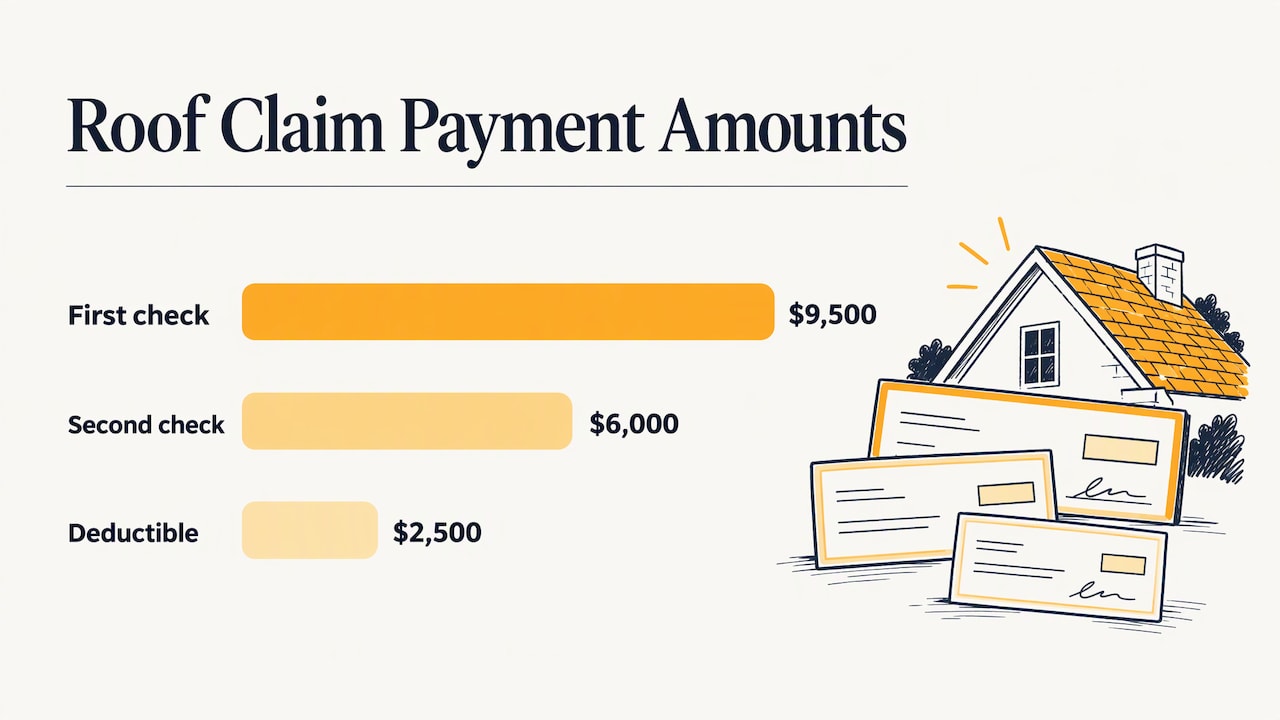
TDI explains that with replacement cost coverage, the insurer pays in two checks: a partial payment first, then the rest after repairs have started. Maryland’s department explains the reason: RCV reimburses in full only once the repair is done.
A worked example with round numbers, for illustration only:
| Line | Amount |
|---|---|
| Approved cost to replace the roof | $18,000 |
| Depreciation held back (RCV policy) | $6,000 |
| Deductible | $2,500 |
| First check (approved cost minus depreciation minus deductible) | $9,500 |
| Second check after repairs are complete | $6,000 |
On an ACV policy the same claim would pay the first check and stop. Keep your final invoice and proof of completion: they are what release the held-back amount. If you have a mortgage, the check may be made out to you and your lender together, so ask your lender how it releases funds.
Your deductible is part of the real cost
The deductible comes out of the settlement. Plan to cover it yourself when the work is done. Ask your insurer, in writing, for the amount that applies to wind or hail on your policy. If the estimate for the repair is close to that figure, a claim may not be worth opening, and a roof repair paid directly is the simpler route.
Perspective
We see the same pattern in North Texas after hail season: homeowners who know their policy type and have a written estimate in hand have a much easier claim than those who learn the details after the first check arrives.
Our approach is to treat the inspection as the foundation. It tells you what happened to the roof, what it needs, and what a lasting fix looks like. We carry the GAF Master Elite® certification, the GAF President’s Club Award and IKO Craftsman Premier Contractor status because we want the work to be judged on quality.
For residential roof replacements we back the work with a transferable 15-year workmanship warranty. We believe a roof you can trust is one where you understood every decision along the way, and we make our communication transparent so you can.
Dustin Eatman
If your roof claim is denied or underpaid
A denial is not always the end. Work through it in this order.
- Ask for the decision in writing. The California Department of Insurance notes that a denial must be in writing with specific reasons and a notice that the Department of Insurance may review the matter. Other states have their own rules, so check your state’s insurance department.
- Keep all paperwork. The NAIC’s post-disaster guide advises keeping every document and, if you are unsatisfied with the offer, contacting your state insurance department.
- Compare the scope. Put the insurer’s estimate beside your inspection report. Disputes often come down to damage the adjuster did not count, or a repair method priced too low.
- Consider appraisal. The same NAIC guide describes appraisal and arbitration as ways to settle disputes over the amount without going to court. Check whether your policy has an appraisal clause.
- In Texas, contact TDI. It is the state authority that handles insurance complaints, and its roof guidance is a good starting point on what insurers may and may not do.
When the dispute turns on legal rights or a large sum, a licensed attorney or public adjuster is the right professional. For the roof itself, the inspection report is the evidence.
Will a claim stay on your record?
Yes, for a time. Homeowners claims can stay on your record for five to seven years, depending on the type and severity of the claim. What an insurer may do with that history differs by state. In some states, regulators limit rate increases or cancellations after inquiries, zero-dollar claims or weather losses. Ask your agent how your insurer treats a first hail or wind claim before you decide, and ask whether a simple question counts as a claim.
Commercial roofs and property managers
Commercial property policies work on the same logic: covered cause, written scope, deadlines. The documentation matters even more when you manage several buildings, because each roof has its own loss date and condition. Our commercial roof inspections give you a written baseline for flat and low-slope systems, and our commercial roof repairs handle the fix once the scope is agreed.
Get your roof inspected
If a storm has hit your area, a free inspection and estimate is the fastest way to know where you stand. We are a GAF Master Elite® contractor serving homeowners and commercial property owners across the Dallas-Fort Worth area, and we back residential roof replacements with a transferable 15-year workmanship warranty. Book a roof inspection and estimate or learn more about our storm-damage assessments.

For related reading, see our guide to hail damage roofs: signs, inspection, repair and claims and our page on roof insurance claims.
FAQ
How long do I have to file a roof insurance claim?
It depends on your policy and state. Many policies set deadlines of one to two years, and some are shorter for wind and hail events. Missing the window can void coverage. Find the date in your policy and report the damage as soon as you find it.
Will insurance cover a 10-year-old roof?
Possibly. A roof of that age can be covered when a covered peril such as hail, wind or fire damages it. Under an ACV policy, depreciation reduces the payment, while replacement cost coverage pays for comparable repair or replacement less the deductible.
Does insurance pay for a new roof that is just old?
No. TDI states that an insurer won’t pay for a new roof just because it’s old or worn out. Coverage applies when a covered event caused the damage.
What should I do first after a storm hits my roof?
Photograph the damage, report the loss to your insurer, and make temporary repairs to prevent further damage. Keep all receipts, because insurers reimburse reasonable protection costs. Then arrange an inspection so you have a written estimate.
What if my roof claim is denied?
Ask for the denial in writing, keep your paperwork, and contact your state insurance department if you disagree. Appraisal and arbitration can settle disputes over the amount without going to court.
Sources
- Texas Department of Insurance: roof guidance
- Maryland Insurance Administration: roof replacement
- Colorado Roofing Association: before filing an insurance claim
- Westfield Insurance: roof insurance explained
- Freedom 1st Insurance: roof claims, deductibles and age
- Iowa Insurance Division: roof coverage options
- Montana Commissioner of Securities and Insurance: hail damaged roof
- GAF: guide to roof damage insurance claims
- California Department of Insurance: Residential Property Claims Guide
- NAIC: Post-Disaster Claims Guide
- Insurance.com: how long claims stay on your record
- Policygenius: does homeowners insurance go up after a claim
- Five Star Aluminum: gutter overflow test
Recommended
- Roof Insurance Claims
- Texas Roof Insurance Claims: The DFW Homeowner’s Guide
- Insurance Roof Inspection: What It Checks and What It Costs
- Top 7 Roofing Insurance Claim Mistakes to Avoid with Residential Roofing

Dustin Eatman is a seasoned roofing professional with deep, hands-on expertise that spans residential and commercial roofing, insurance solar, and long-term roof asset management. As the owner of James Kate Roofing & solar in the Dallas–Fort Worth metroplex, he’s built a reputation for diagnosing roof systems accurately, communicating clearly, and executing projects with a high standard of workmanship and documentation. Dustin understands the technical details that make roofs perform—proper underlayment selection, slope and drainage considerations, ventilation strategy, flashing and penetration detailing, and manufacturer-specific installation requirements—because he’s worked through the real-world challenges that cause leaks, premature wear, and warranty issues. He’s equally fluent in the operational side of roofing: jobsite planning, quality control, safety, material ordering, crew coordination, and customer experience from inspection to closeout. In insurance-related projects, Dustin brings practical knowledge of claim workflows, adjuster meetings, scope alignment, supplements, and the importance of photo evidence and thorough records, helping property owners navigate stressful situations with confidence. For commercial clients—especially property and facility managers—he emphasizes proactive maintenance and targeted repairs that reduce disruption, extend roof life, and prevent expensive interior damage. Dustin also stays focused on doing things the right way: educating customers on realistic options, setting expectations, and prioritizing solutions that hold up over time rather than quick fixes. That blend of technical skill, field experience, process discipline, and owner-level accountability is what makes Dustin Eatman a trusted expert in the roofing industry.