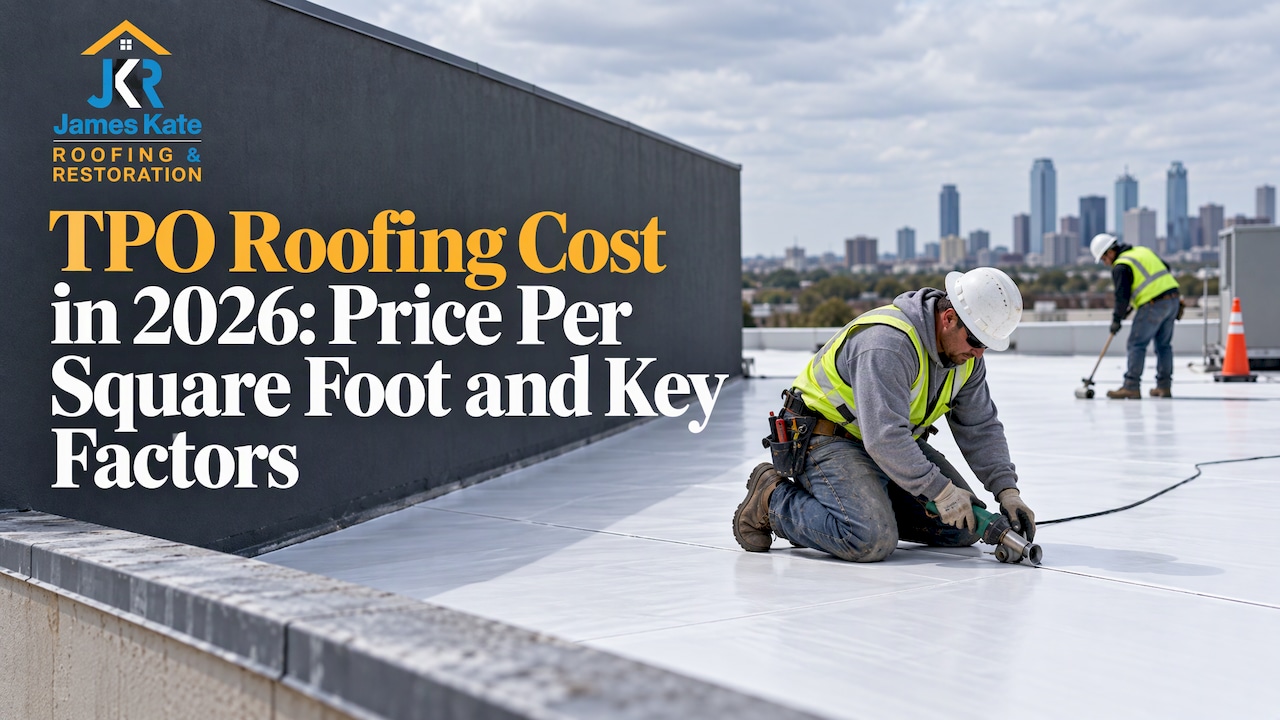
Most installed TPO roofs in the United States land between about $4 and $14 per square foot, and the spread comes from a short list of choices: membrane thickness, how it is attached, how much insulation sits under it, and whether an old roof has to come off first. A bid that spells out each of those lines is one you can compare. A single lump sum is not. If you own a flat or low-slope roof in North Texas, we will help you price it line by line, and our free inspections and estimates give you real numbers for your building.
TL;DR
- Published 2026 guides put installed TPO at roughly $4 to $10 per square foot on the low end, with fully adhered, thicker, insulated systems reaching about $14.
- A 60-mil replacement with tear-off and R-25 insulation runs about $9,350 to $12,100 for 1,000 sq ft and $18,700 to $24,200 for 2,000 sq ft.
- The membrane itself is a small slice of the price. Insulation, labor, tear-off, flashings and warranty make up most of a quote.
- Deck repair and tapered insulation are the usual surprises, so ask for both as separate line items.
- Small residential jobs cost more per square foot than big commercial roofs.
Table of Contents
- What TPO costs per square foot
- TPO roof replacement cost by roof size
- What drives the price up or down
- The membrane is the smallest part of the bill
- TPO versus asphalt shingles and other flat roofs
- How to get a TPO quote you can compare
- Storm damage and your TPO roof
- What we do for TPO roof owners
- Our perspective
- FAQ
- Sources
What TPO costs per square foot
TPO (thermoplastic polyolefin) is a single-ply white membrane whose seams are heat-welded together. It is the most common choice for new flat and low-slope roofs on commercial buildings, and it also shows up on porches, additions and flat sections of homes.
Published ranges differ because each guide assumes a different system. Here is how the 2026 figures line up:
| Source | Installed TPO range per sq ft |
|---|---|
| This Old House | $4 to $10 |
| The Roofing Brief, cost report | $7 to $12 for standard 60-mil mechanically attached |
| The Roofing Brief, new-roof guide | $5 to $11 |
| RoofObservations | about $3.95 (45-mil ballasted) to $13.95 (80-mil fully adhered, R-30) |
Read those as a map, not a quote. The low end is a thin membrane laid loose and held down with ballast over an existing roof. The high end is a thick, fully adhered membrane over deep insulation. A standard 60-mil mechanically attached roof sits in the middle, which is where most buildings fall.
Prices in Dallas-Fort Worth follow the same logic, but labor rates, permit fees and local taxes shift the final number, which is why a written estimate for your address matters more than any national average.
TPO roof replacement cost by roof size
The same guide that gives the per-foot range also prices complete replacements. For a 60-mil system including tear-off and R-25 insulation, RoofObservations’ averages are:
| Roof size | Typical replacement cost |
|---|---|
| 1,000 sq ft | $9,350 to $12,100 |
| 2,000 sq ft | $18,700 to $24,200 |
| 5,000 sq ft | $46,750 to $60,500 |
| 10,000 sq ft | $93,500 to $121,000 |
For homes, This Old House cites a national average of $10,700 for a 1,500-square-foot roof.
Size also changes the rate. The same RoofObservations guide notes that very small residential jobs can run as much as 50% higher per square foot than commercial averages, because crews still have to mobilize, protect the property and detail every edge. At the other end, Commercial Roof Guide reports 10 to 15% lower per-foot pricing on projects of 50,000 square feet and above, thanks to bulk material buying and a single mobilization.
A worked example
Take a 1,200 sq ft flat roof with five drains, a few pipes and one rooftop unit curb. A 2026 TPO calculator prices a standard 60-mil mechanically fastened version at $10,630 to $14,630 installed, or $8.85 to $12.19 per square foot. Its split is useful:
- Materials (membrane, 2 in. polyiso, plates, edge metal, flashings): $4,020 to $5,180
- Installation labor: $4,680 to $6,220
- Extra flashing at drains, pipes and curbs: $730 to $1,430
- Tear-off and disposal of one layer: $1,200 to $1,800
The same source says a roof crowded with penetrations can add 20 to 30%, almost all of it labor.
What drives the price up or down
Membrane thickness and attachment
TPO comes in 45, 60 and 80 mil (a mil is one thousandth of an inch). You might expect thicker membrane to be the big cost jump. According to The Roofing Brief’s pricing by mil, the 60-mil sheet costs only about $5 to $16 more per roofing square than 45-mil at retail, so most of the price gap between thicknesses is labor, warranty and specification. Fleece-backed 60-mil, used on fully adhered systems, costs about $72 more per square than smooth 60-mil, which is why those systems price at the top of the range.
A roofing square is 100 square feet, so a 1,200 sq ft roof is 12 squares.
Insulation
Insulation is often the largest single material cost. The R-value (resistance to heat flow) you need is set by energy code, and the depth and type of polyiso board you choose change the number. Commercial Roof Guide’s component breakdown puts R-30 polyiso at $1.50 to $2.00 per square foot, more than the 60-mil membrane at $1.20 to $1.60.
Tear-off, permits and disposal
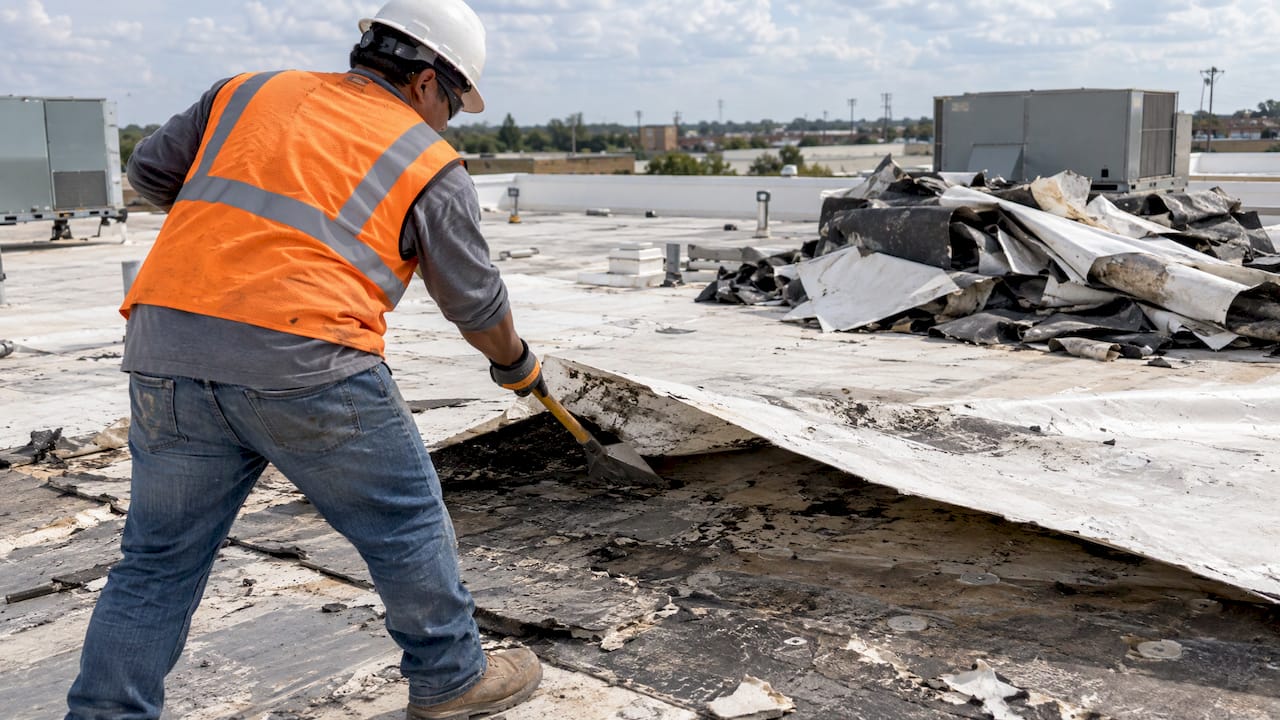
Removing the old roof is its own line. The Roofing Brief puts tear-off and disposal at $1 to $5 per square foot and permits at $150 to $600. A bid that quietly leaves tear-off out can look cheaper than it is, and an estimating guide from Cyanbuild warns that omitting it on a re-roof cuts a bid in a way a crew cannot make up in the field.
Labor and roof complexity
RoofObservations puts labor at roughly 25 to 40% of the total and materials at 60 to 75%. Labor climbs on roofs with skylights, curbs, drains and many penetrations, which can double install time. Flashings and edge metal are where leaks start, so those details deserve the most scrutiny when you read a bid.
A 2026 estimating guide from the same Cyanbuild source splits a commercial re-roof like this: membrane and insulation 50 to 65% of cost, flashings and edge metal 15 to 25%, penetrations and accessories 8 to 15%, and labor 35 to 45% because tear-off and protecting the building below are labor-heavy.
The membrane is the smallest part of the bill
It is tempting to price a job from the roll. GAF EverGuard 60-mil lists at about $980 per 10 x 100 ft roll, or $98 per square, according to The Roofing Brief’s membrane pricing. The same guide estimates membrane at only about 8 to 16% of the installed price. Insulation, labor, tear-off, flashings and warranty make up the rest.
That is why a good quote is itemized. Ask for these lines in writing:
- Membrane thickness and attachment method (mechanically attached, fully adhered or ballasted)
- Insulation type, R-value and any tapered sections for drainage
- Tear-off and disposal, with the number of existing layers
- Flashings, edge metal, drains and curbs
- Per-sheet price for deck repair
- Per-square-foot price for tapered insulation
- Permit fees and warranty terms
The last two matter most. The Roofing Brief notes that deck repair and tapered insulation are the items most likely to surprise an owner, because neither is visible until the old roof is off. Pricing them per unit before signing turns a surprise into a known rate.
The overall job usually runs three to seven days for an average flat roof. Our roof replacement timeline walks through each stage.
TPO versus asphalt shingles and other flat roofs
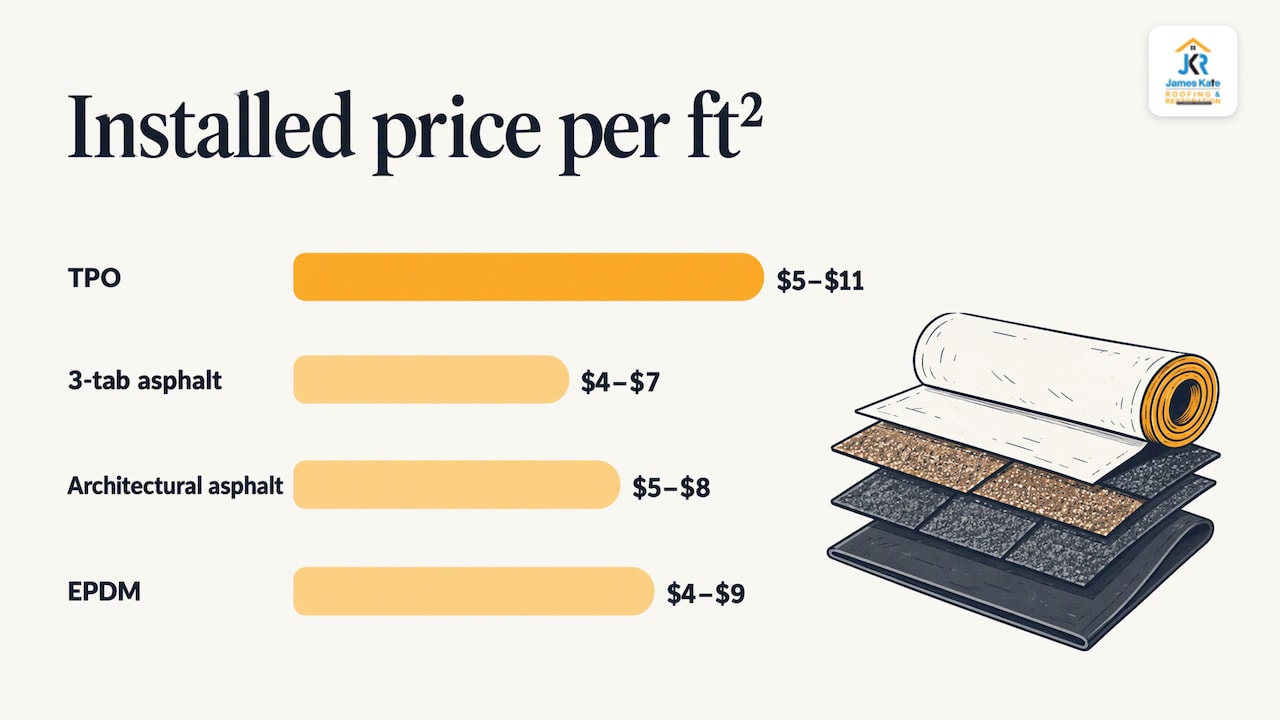
The Roofing Brief’s 2026 new-roof guide lists TPO at $5 to $11 per sq ft installed with a 20 to 30 year lifespan. For comparison, 3-tab asphalt is $4 to $7 (15 to 20 years), architectural asphalt $5 to $8 (25 to 30 years) and EPDM $4 to $9.
Shingles are cheaper because they are quick to install and most crews do them well. They also only work on pitched roofs. On a flat or low-slope roof, shingles are not an option, so the real comparison is between single-ply systems. Our guides on TPO versus PVC, flat roof material options and thermoset versus thermoplastic roofing lay out the differences.
Because TPO seams are heat-welded, many small problems are fixable by patching rather than replacing. See TPO roof repair for leaks, seams and when replacement makes sense.
How to get a TPO quote you can compare
Every estimator builds a bid from a takeoff, a measured list of roof areas, penetrations and details. The inputs the engineer or estimator collects, from roof size and slope to loads, shape the numbers, and this guide on roof information a design needs shows why measured data beats a guess.
Before asking for bids:
- Know your square footage and the number of existing layers.
- Note every drain, pipe, curb, skylight and rooftop unit.
- Share leak history and the age of the current roof.
- Ask each contractor to price the same membrane thickness, attachment and R-value, so you compare like with like.
For commercial owners, our breakdown of commercial roof replacement costs and guide to getting a commercial flat roof replaced follow the same logic at larger scale.
Storm damage and your TPO roof
North Texas hail and wind can puncture membrane, lift seams and loosen flashings. If a storm may have hit your roof, an inspection before you decide on a repair or replacement keeps the scope honest. Our roof damage assessment guide shows how to check, document and decide.
What we do for TPO roof owners
We are James Kate Roofing & solar, a GAF Master Elite® contractor serving homeowners, property managers and commercial owners across Dallas-Fort Worth. We offer free inspections and estimates, commercial roof replacement and installation, repairs, maintenance and storm-damage assessments. Our instant roofing quote tool reviews a roof’s health against historical weather data, so you can see whether a storm affected it.

For a commercial building, start with a commercial roof inspection and estimate. For a home, book a roof inspection. Residential roof replacements carry our transferable 15-year workmanship warranty.
Our perspective
Price per square foot is a useful starting point and a poor way to choose a roofer. Two bids at $8 per square foot can describe entirely different roofs: one with tear-off, tapered insulation and detailed flashings, one without.
We believe an owner should see the roof’s condition and the scope in plain terms before a number is discussed. That is why we lead with inspections and estimates, and why we write down what is included. Manufacturer certification, including our GAF Master Elite® status, exists to hold installers to a standard, and a transferable workmanship warranty is there so the roof stays an asset when the building changes hands.
Flashings, seams and edges are where a TPO roof succeeds or fails. Spend your attention there.
Dustin Eatman
FAQ
How much does a TPO roof cost per square foot?
Published 2026 guides put installed TPO between about $4 and $14 per square foot, with a standard 60-mil mechanically attached system near the middle. Insulation, tear-off and roof complexity move it most.
Is TPO cheaper than shingles?
Not per square foot: The Roofing Brief lists TPO at $5 to $11 and architectural asphalt at $5 to $8. TPO is built for flat and low-slope roofs, where shingles do not belong, so it is usually compared with other single-ply membranes.
How long does a TPO roof replacement take?
An average flat roof replacement takes three to seven days. Size, weather, deck repairs and the number of penetrations change that.
What does a roll of TPO cost?
One 10 x 100 ft roll of GAF EverGuard 60-mil lists at about $980. Rolls are a small share of the installed price, since labor, insulation and tear-off make up most of a quote.
Sources
- TPO Membrane Roof Cost Guide (2026 Update)
- TPO Roofing Material: An In-Depth Guide
- 2026 Roofing Cost Report: National + Regional Data
- How to Replace a Flat Roof: Step-by-Step Guide
- TPO Roofing Cost Per Square 2026: 45/60/80-Mil
- How Much Does a New Roof Cost in 2026?
- TPO Roofing Guide (2026)
- Commercial Roofing Estimating: Flat Roof Takeoff
- TPO Roof Cost Calculator: 2026 Installed Price
- Roof Info for Lateral Design: What to Collect and Why
Recommended
- TPO vs. PVC: Which Is Better?
- TPO Roof Repair: Leaks, Seams, Patches and When to Replace
- Breaking Down Commercial Roof Replacement Costs

Dustin Eatman is a seasoned roofing professional with deep, hands-on expertise that spans residential and commercial roofing, insurance solar, and long-term roof asset management. As the owner of James Kate Roofing & solar in the Dallas–Fort Worth metroplex, he’s built a reputation for diagnosing roof systems accurately, communicating clearly, and executing projects with a high standard of workmanship and documentation. Dustin understands the technical details that make roofs perform—proper underlayment selection, slope and drainage considerations, ventilation strategy, flashing and penetration detailing, and manufacturer-specific installation requirements—because he’s worked through the real-world challenges that cause leaks, premature wear, and warranty issues. He’s equally fluent in the operational side of roofing: jobsite planning, quality control, safety, material ordering, crew coordination, and customer experience from inspection to closeout. In insurance-related projects, Dustin brings practical knowledge of claim workflows, adjuster meetings, scope alignment, supplements, and the importance of photo evidence and thorough records, helping property owners navigate stressful situations with confidence. For commercial clients—especially property and facility managers—he emphasizes proactive maintenance and targeted repairs that reduce disruption, extend roof life, and prevent expensive interior damage. Dustin also stays focused on doing things the right way: educating customers on realistic options, setting expectations, and prioritizing solutions that hold up over time rather than quick fixes. That blend of technical skill, field experience, process discipline, and owner-level accountability is what makes Dustin Eatman a trusted expert in the roofing industry.