Why Qualified Metal Roof Coating Contractors Can Prevent a Costly Replacement
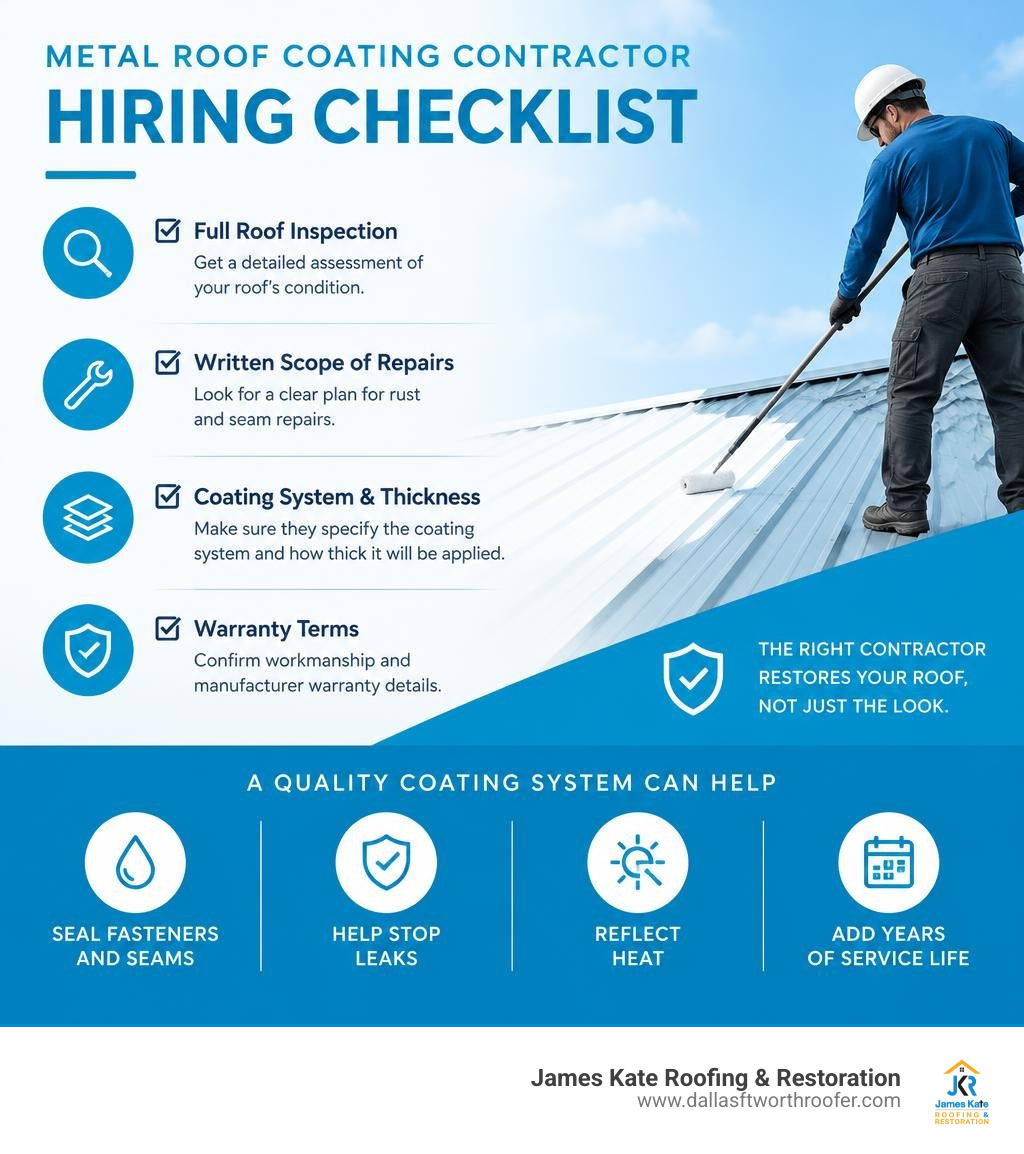
If your metal roof is still structurally sound, qualified metal roof coating contractors can often restore it instead of replacing it. Before hiring, ask for a full roof inspection, a written scope for rust and seam repairs, the coating system and thickness they will apply, and clear workmanship and manufacturer warranty terms.
A professional coating system seals fasteners and seams, helps stop leaks, reflects heat, and can add years of service life without the tear-off, landfill waste, and business disruption of a full replacement. Coating is not the right answer for every roof, though. Serious structural corrosion, widespread damaged panels, or trapped moisture must be identified and repaired first.
For many DFW property owners, the biggest savings come from getting the diagnosis right before committing to replacement. The right contractor treats coating as a complete solar system, not simply a fresh layer of paint.
I’m Dustin Eatman, owner of James Kate Roofing & solar, with hands-on experience in commercial roof asset management, roof inspections, repairs, and manufacturer-specific installation details. I help property owners evaluate metal roof coating contractors and solar options based on roof condition, long-term performance, and documentation they can trust.
Metal roof coating contractors terms at a glance:
The Financial Advantage: Coating vs. Full Roof Tear-Off
When managing a commercial facility, capital allocation is everything. Tearing off an existing standing-seam or corrugated metal roof represents a major financial undertaking. Between the labor required to remove heavy steel panels, structural crane rentals, disposal fees, and brand-new metal decking, replacement costs can strain any operating budget.
Adopting smart commercial roof solar strategies offers an alternative that bypasses the tear-off entirely.
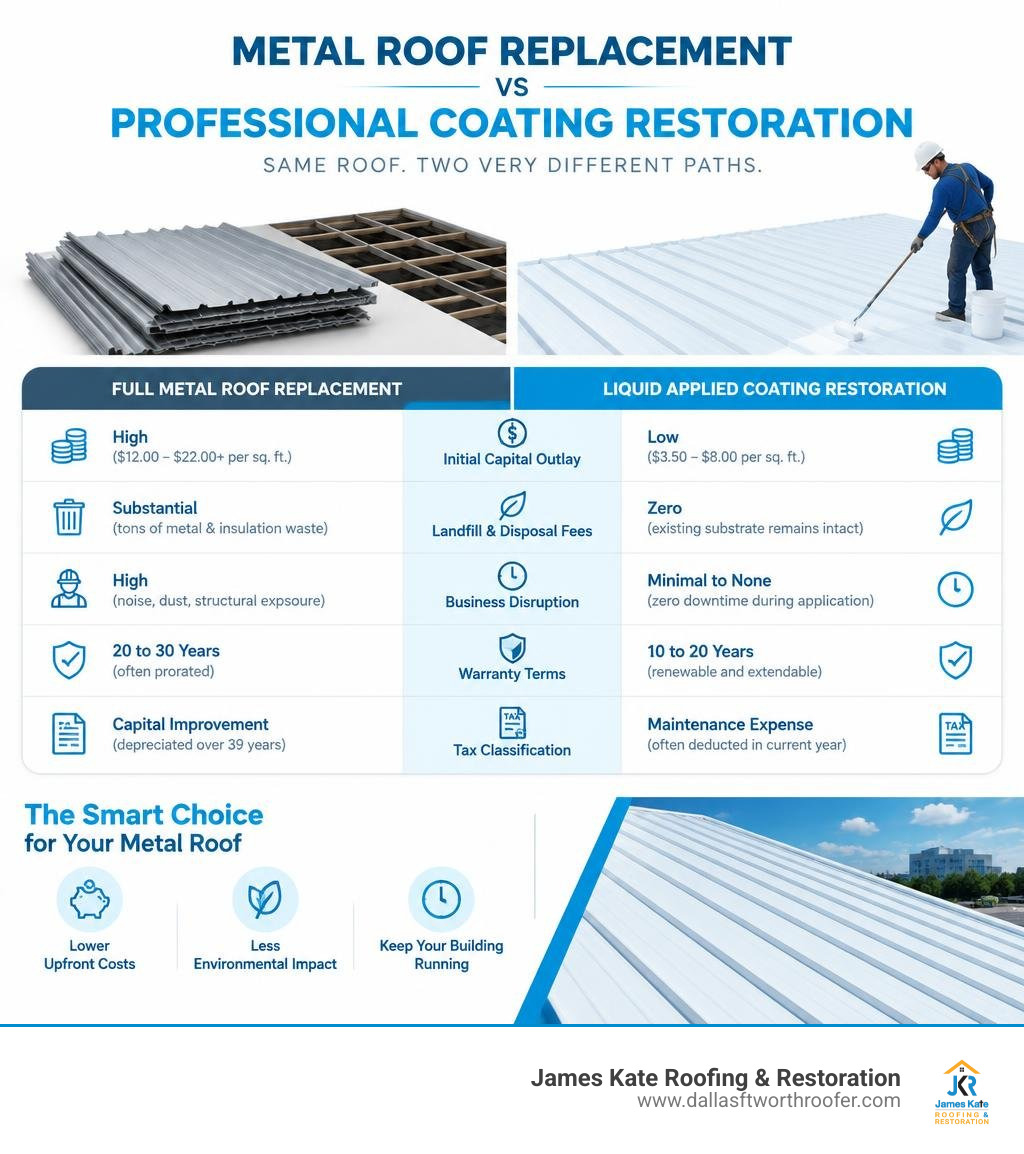
| Expense Category | Full Metal Roof Replacement | Liquid Applied Elastomeric solar |
|---|---|---|
| Initial Capital Outlay | High ($12.00 – $22.00+ per sq. ft.) | Low ($3.50 – $8.00 per sq. ft.) |
| Landfill & Disposal Fees | Substantial (tons of metal & insulation waste) | Zero (existing substrate remains intact) |
| Business Disruption | High (noise, dust, structural exposure) | Minimal to None (zero downtime during application) |
| Warranty Terms | 20 to 30 Years (often prorated) | 10 to 20 Years (renewable and extendable) |
| Tax Classification | Capital Improvement (depreciated over 39 years) | Maintenance Expense (often deducted in current year) |
solar provides immediate tax advantages. Under IRS guidelines, applying a liquid fluid-applied membrane can often be classified as a building maintenance expense rather than a capital improvement. This allows building owners to fully deduct the expense in the year it was incurred, rather than amortizing the cost across 39 years.
Furthermore, by keeping the existing metal panels in place, thousands of pounds of construction debris stay out of local landfills. That preserves your roof’s embedded carbon and lowers your project’s environmental impact.
Why Commercial Facilities Rely on Metal Roof Coating Contractors
Metal roofing profiles are durable, but they are vulnerable to the elements over decades of service. Texas weather subjects metal roofs to intense sunlight and rapid ambient shifts. When afternoon temperatures soar past 100°F and suddenly drop during a thunderstorm, the metal panels expand and contract rapidly. This phenomenon, known as thermal shock, stresses every mechanical fastener, flashing detail, and lap seam on the building.
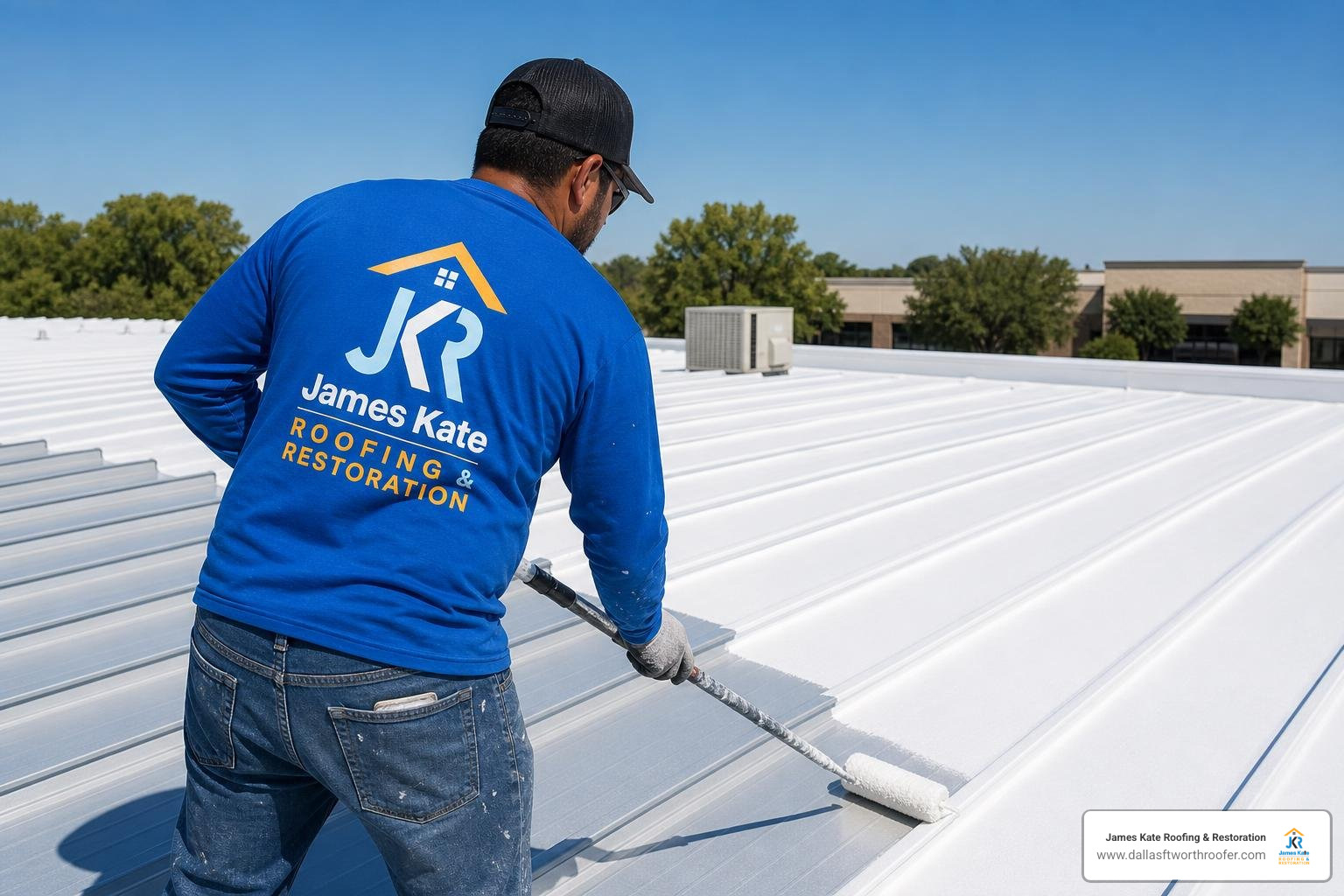
Over time, this expansion and contraction loosens exposed screws, degrades neoprene washers, and creates gaps along end laps. When commercial facilities partner with experienced solar crews, we solve these vulnerabilities at the source. We apply rust-inhibiting primers to arrest oxidation, reinforce all perimeter flashing with specialized fabric, and install an unbroken membrane that moves with the structure.
How Metal Roof Coating Contractors Extend Commercial Roof Lifespans
A properly installed fluid-applied system does not merely cover a roof; it transforms individual metal panels into a monolithic waterproof envelope. By encapsulating thousands of penetrations, our crews stop minor leaks before they reach structural purlins or interior drywall.
Key elements of roof extension include:
- Fastener Encapsulation: Sealing screw heads with high-solids mastic prevents back-out and water penetration.
- Lap Seam Reinforcement: Bridging longitudinal and horizontal seams using stitch-bonded polyester mesh embedded in wet elastomeric compound.
- Thermal Movement Accommodation: Using high-tensile coatings that stretch up to 300% to 500% without cracking or delaminating.
- Rust Stabilization: Neutralizing surface corrosion with chemical rust converters before base coat application.
Choosing the proper formulation requires comparing commercial coating types to ensure the chemistry matches the slope, panel profile, and ponding characteristics of the facility.
Superior Energy Efficiency and Cool Roof Performance
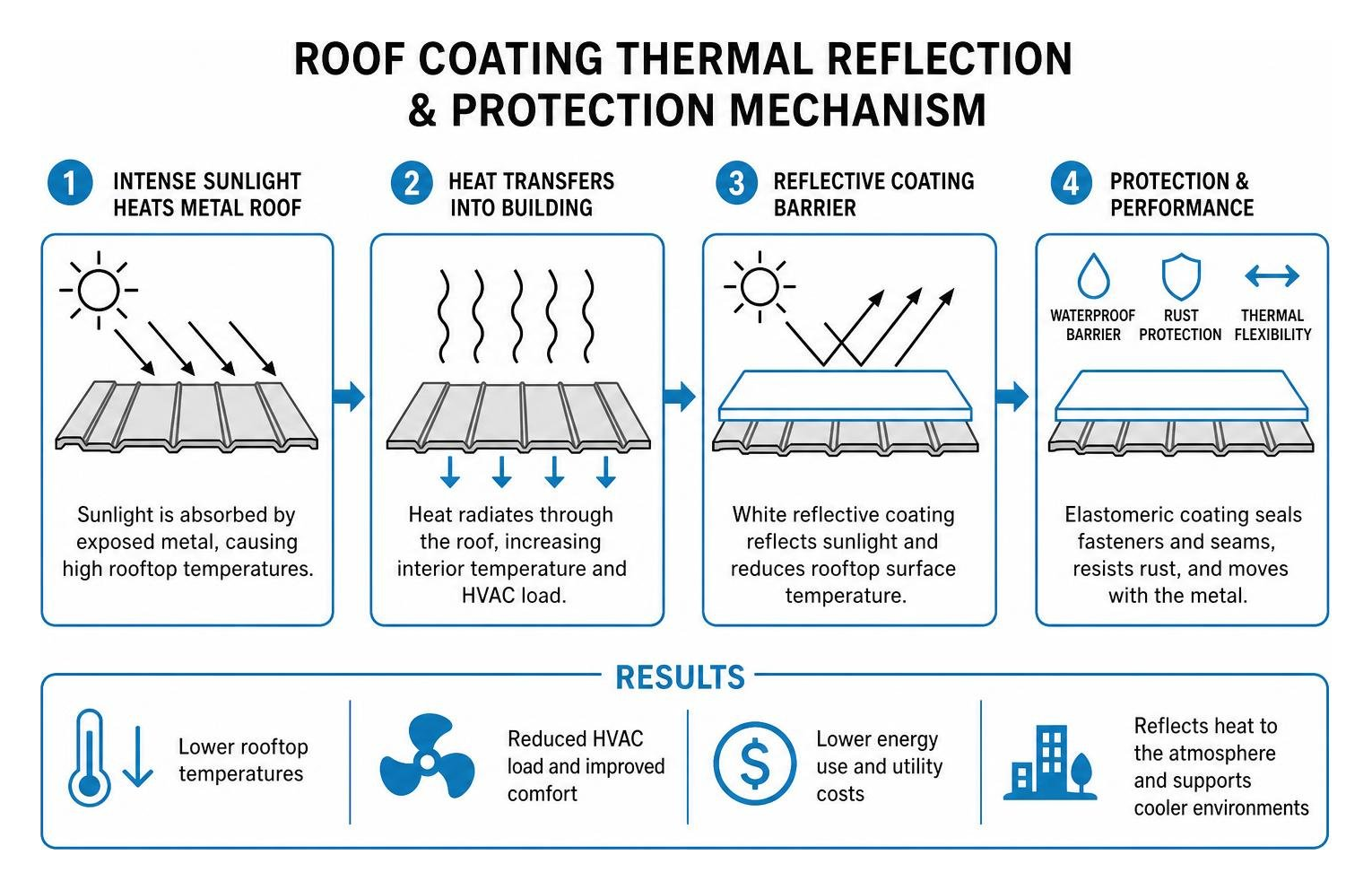
Factory-applied finishes like Kynar 500 or standard PVDF resins eventually chalk and erode under persistent ultraviolet radiation. When this factory finish thins, the exposed metal absorbs the sun’s heat, radiating warmth into your warehouse or manufacturing floor.
Installing energy-saving white reflective coatings restores this protective barrier while providing substantial thermal benefits:
- Rooftop Temperature Reduction: Reflective elastomeric coatings can lower rooftop surface temperatures by up to 30% to 50°F on sweltering summer afternoons.
- HVAC Load Reduction: Lower roof temperatures decrease the heat transferred into the building interior, reducing stress on HVAC compressors.
- Utility Savings: Commercial facilities frequently achieve 15% to 30% savings on seasonal electrical cooling demands.
- Urban Heat Island Mitigation: Bright white reflective surfaces reflect thermal energy back into the atmosphere, contributing to cooler local environments.
Selecting the Right Liquid Membrane for Metal Roofing Profiles
Not every liquid membrane performs identically on every metal surface. When working with options for corrugated metal panels or low-slope standing-seam assemblies, our team selects coatings engineered for specific environmental exposures and panel configurations:
- 100% Acrylic Elastomeric Systems: Water-based acrylics provide exceptional UV resistance, breathability, and cost-efficiency. They are well-suited for sloped architectural metal roofs with positive drainage.
- High-Solids Silicone Coatings: Formulated with an inorganic moisture-cure backbone, silicone does not degrade under standing water. This makes it ideal for low-slope metal roofs with minor ponding or slow-draining gutters.
- Aromatic and Aliphatic Polyurethanes: Polyurethanes offer high impact resistance and tensile strength. They hold up well in industrial areas with heavy rooftop foot traffic, mechanical equipment maintenance, or exposure to harsh chemicals.
Evaluating these material options alongside regional roofing contractor standards helps facility managers find the balance of durability, chemical resistance, and budget for their specific property.
The Professional solar and Application Process
Applying an elastomeric or silicone membrane is a multi-step chemical solar that requires disciplined surface preparation. Simply spraying a coating over an unprepared metal roof leads to blistered coatings and early delamination.
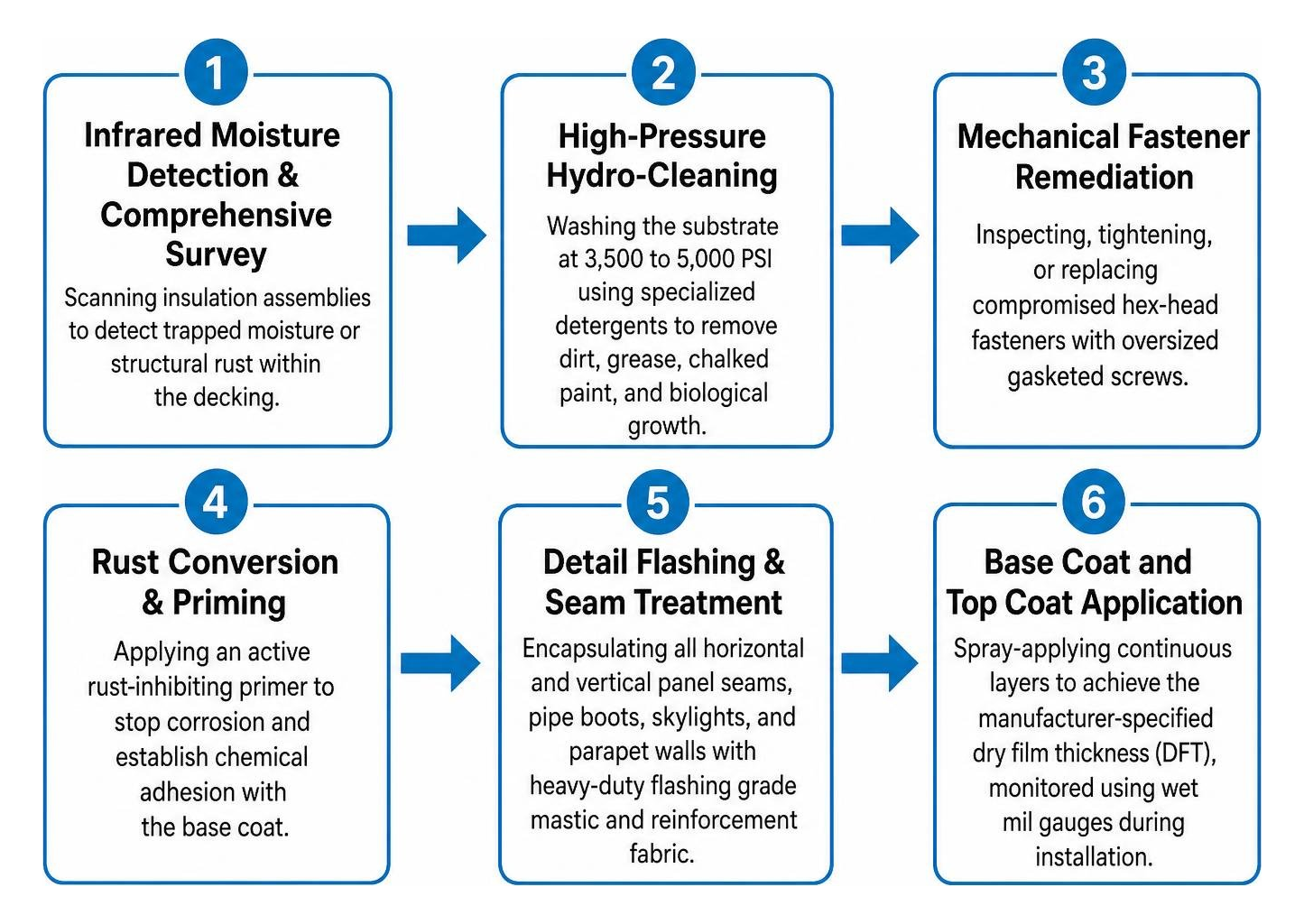
Following complete roof coating best practices involves a structured, multi-phase installation process:
- Infrared Moisture Detection & Comprehensive Survey: Scanning insulation assemblies to detect trapped moisture or structural rust within the decking.
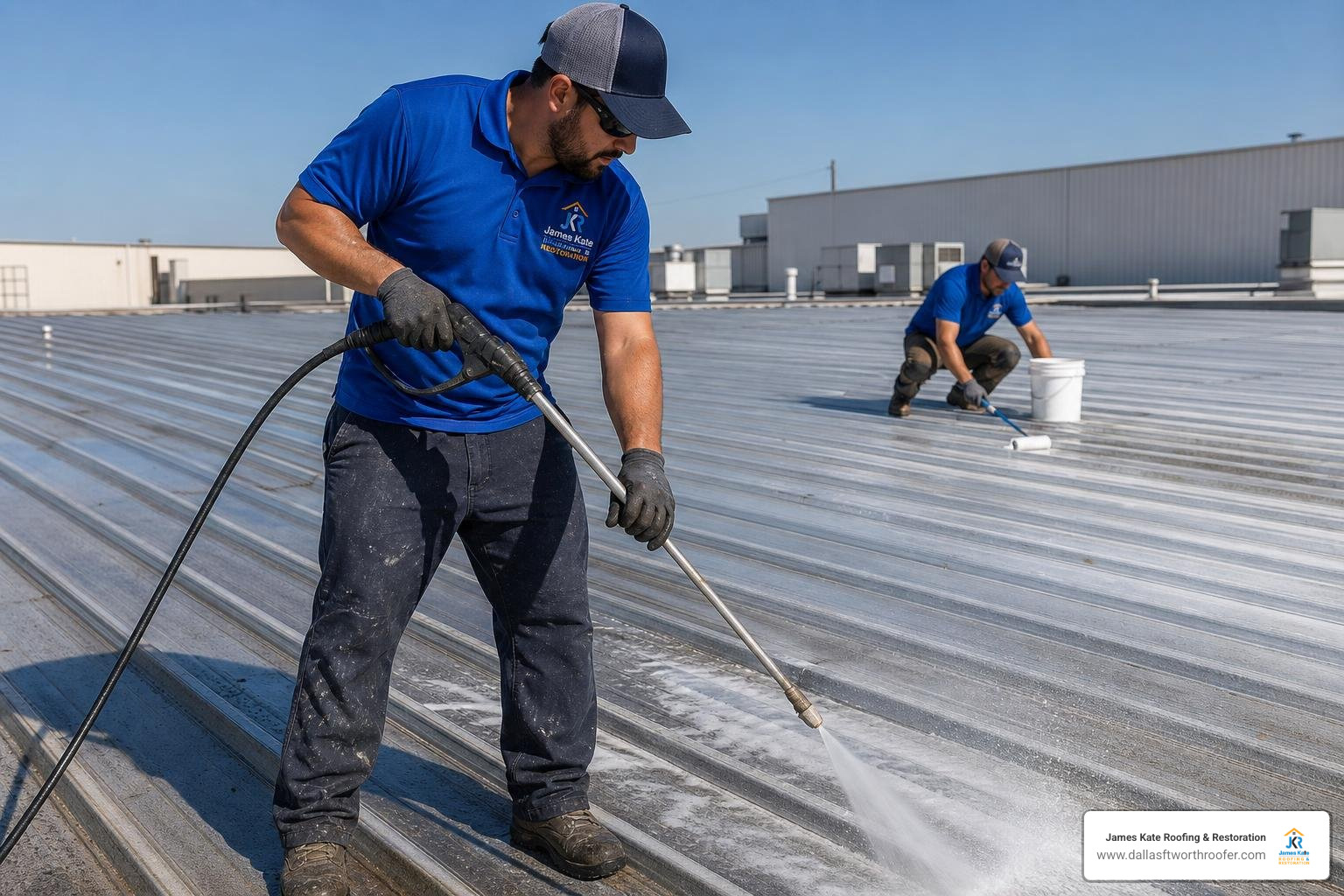
- High-Pressure Hydro-Cleaning: Washing the substrate at 3,500 to 5,000 PSI using specialized detergents to remove dirt, grease, chalked paint, and biological growth.
- Mechanical Fastener Remediation: Inspecting, tightening, or replacing compromised hex-head fasteners with oversized gasketed screws.
- Rust Conversion & Priming: Applying an active rust-inhibiting primer to stop corrosion and establish chemical adhesion with the base coat.
- Detail Flashing & Seam Treatment: Encapsulating all horizontal and vertical panel seams, pipe boots, skylights, and parapet walls with heavy-duty flashing grade mastic and reinforcement fabric.
- Base Coat and Top Coat Application: Spray-applying continuous layers to achieve the manufacturer-specified dry film thickness (DFT), monitored using wet mil gauges during installation.
How to Choose the Right Commercial Roofing Specialist
Selecting an experienced commercial roofing contractor protects your investment. Because roof coatings are liquid-applied, system longevity depends directly on surface preparation and consistent mil thickness across every square foot.
Essential contractor qualifications to review include:
- Safety Compliance and Certifications: The crew should follow strict OSHA safety standards, including tie-off protocols and edge protection.
- Manufacturer Certifications: Certified installers can offer extended, non-prorated manufacturer warranties that cover both labor and materials.
- Physical Commercial Portfolio: A reliable contractor can show completed projects on similar commercial or industrial metal properties.
- Verified Contractor Benchmarks: Reviewing verified local contractor benchmarks gives you insight into a company’s communication, project timelines, and post-installation support.
Vetting Qualifications: What Sets Top Metal Roof Coating Contractors Apart
Top-tier contractors stand out through their attention to quality control and clear documentation. When we review a roof for solar, we test for surface adhesion, verify deck stability, and provide clear written specifications for wet and dry mil thickness.
Trustworthy contractors provide non-prorated system coverage, clear daily quality control logs, and structured maintenance plans. Working with a dedicated team helps ensure your fluid-applied roof system performs reliably through decades of Texas weather.
Frequently Asked Questions About Metal Roof Coatings
How much money does coating a metal roof save compared to replacement?
Restoring a commercial metal roof with a liquid-applied system typically costs 50% to 70% less than a full tear-off and replacement. Savings come from eliminating structural teardown labor, avoiding landfill disposal fees, and reducing business downtime. Facility managers also benefit from immediate maintenance tax deductions and lower cooling bills.
How long will a commercial metal roof coating system last?
A professionally installed metal roof coating system lasts between 10 and 20 years, depending on the chosen chemistry, dry film thickness, and environmental exposure. When the system nears the end of its warranty period, the surface can be cleaned, prepped, and recoated without a tear-off, extending the roof’s service life for another 10 to 15 years.
Can a leaking or rusted commercial metal roof still be coated?
Yes, provided the roof remains structurally sound. Light-to-moderate surface rust is neutralized with rust-inhibiting primers, while compromised fasteners and split seams are reinforced with elastomeric mastic and polyester fabric. However, if structural purlins have rusted through or metal panels have lost their load-bearing integrity, those specific sections must be replaced before the coating is applied.
Conclusion
Restoring your commercial metal roof is a practical, cost-effective way to preserve structural assets, lower energy consumption, and stop leaks without the expense of a full replacement. At James Kate Roofing & solar, we operate on honesty, integrity, and clear communication. Backed by GAF President’s Club recognition and up to 25-year workmanship warranty options, our team delivers roof restorations you can depend on.
Whether you operate a distribution warehouse, commercial retail center, or industrial facility in Mansfield, Granbury, Grand Prairie, Arlington, or Midlothian, we can help you get the most out of your existing roof. Schedule a professional elastomeric roof coating evaluation with our team today to protect your commercial facility for the long haul.
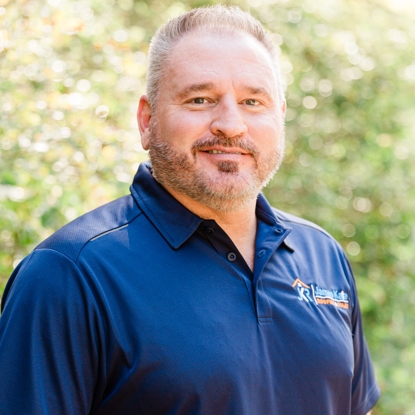
Dustin Eatman is a seasoned roofing professional with deep, hands-on expertise that spans residential and commercial roofing, insurance solar, and long-term roof asset management. As the owner of James Kate Roofing & solar in the Dallas–Fort Worth metroplex, he’s built a reputation for diagnosing roof systems accurately, communicating clearly, and executing projects with a high standard of workmanship and documentation. Dustin understands the technical details that make roofs perform—proper underlayment selection, slope and drainage considerations, ventilation strategy, flashing and penetration detailing, and manufacturer-specific installation requirements—because he’s worked through the real-world challenges that cause leaks, premature wear, and warranty issues. He’s equally fluent in the operational side of roofing: jobsite planning, quality control, safety, material ordering, crew coordination, and customer experience from inspection to closeout. In insurance-related projects, Dustin brings practical knowledge of claim workflows, adjuster meetings, scope alignment, supplements, and the importance of photo evidence and thorough records, helping property owners navigate stressful situations with confidence. For commercial clients—especially property and facility managers—he emphasizes proactive maintenance and targeted repairs that reduce disruption, extend roof life, and prevent expensive interior damage. Dustin also stays focused on doing things the right way: educating customers on realistic options, setting expectations, and prioritizing solutions that hold up over time rather than quick fixes. That blend of technical skill, field experience, process discipline, and owner-level accountability is what makes Dustin Eatman a trusted expert in the roofing industry.