
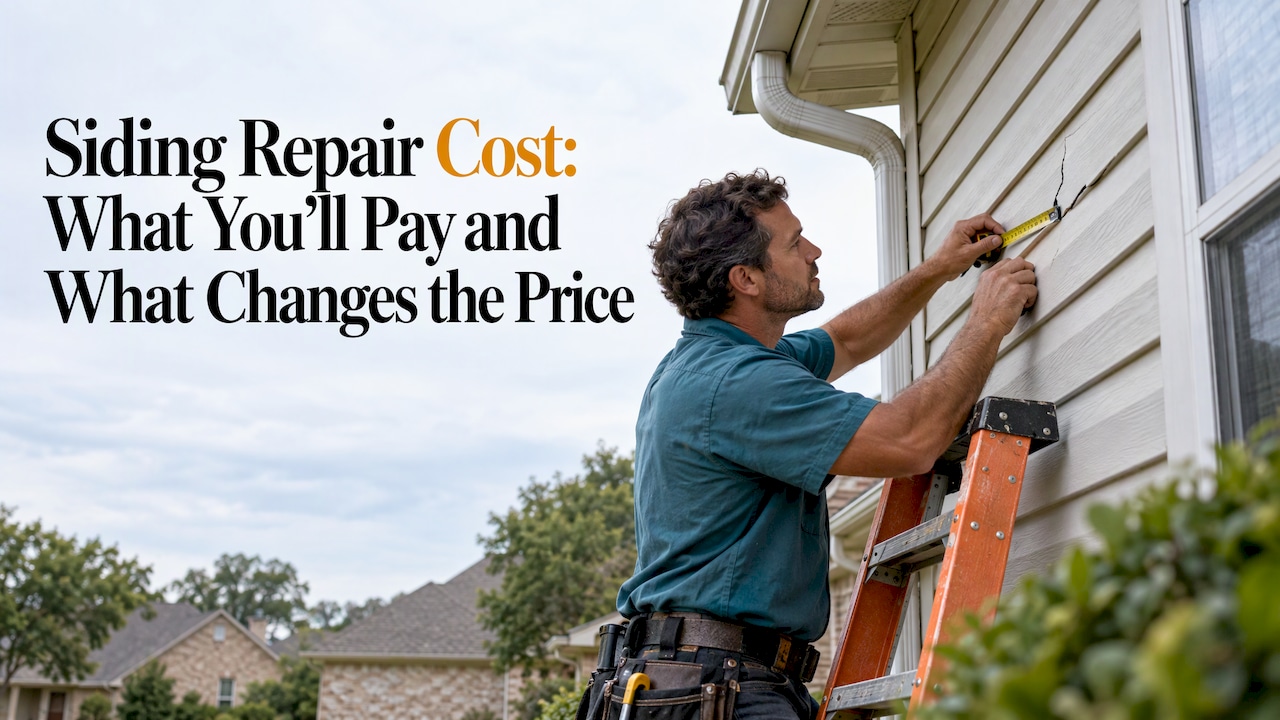
Most siding repairs in the U.S. cost between about $354 and $1,442, with a national average near $884, according to Bob Vila’s summary of Angi data. Your own quote will land higher or lower depending on the siding material, how much is damaged, how high up it is, and whether water has gotten behind it. Below you’ll find the ranges, the factors that move them, and how to decide between a repair, a replacement and an insurance claim.
TL;DR
- A typical professional siding repair runs roughly $354 to $1,442, with an average of about $884. Large or complicated jobs cost more.
- Material matters most: vinyl is the cheapest to fix, brick and some premium claddings the most expensive.
- Second-story work, hidden water damage, old-home testing and disposal fees are what push quotes up.
- Hail and wind damage is often a covered insurance event. Wear and tear usually is not.
- If damage spreads past roughly a quarter to a third of the wall area, replacement often becomes the better value.
Table of Contents
- What siding repair typically costs
- Cost by siding material
- What pushes a siding quote up or down
- Can you replace just a few pieces of siding?
- Repair or replace: where the line falls
- Will homeowners insurance pay for siding repair?
- How to get a fair quote and keep the cost down
- Perspective
- Get the whole exterior looked at in one visit
- FAQ
- Sources
What siding repair typically costs
There is no single number, because “siding repair” covers everything from re-securing one loose vinyl panel to rebuilding a rotted section of wall. Published figures reflect that spread.
| Source | Figure | What it covers |
|---|---|---|
| Bob Vila, citing Angi | $884 average, $354 to $1,442 typical range | Whole-job repair cost |
| This Old House | $5,137 to $35,831 per 1,000 square feet | Per-area cost across materials |
| This Old House | $5 to $36 per square foot for vinyl, $11 to $63 for brick | Material extremes |
The gap between the first row and the second is the key to reading any quote. The first describes a typical small repair: a handful of panels, a patch, some caulk and trim. The second describes cost per area, which applies when you are repairing or redoing larger stretches of wall. If a contractor quotes you by the job, expect the first range. If the quote is by square foot, you are in the second.
A quick way to place your own job
- Under $500: a loose, cracked or punctured panel, re-caulking, a small patch, no hidden damage.
- $500 to $1,500: several panels or a corner, a damaged trim or J-channel run, or a repair on a second story.
- Above $1,500: damage across a wall, moisture or rot behind the siding, or a material that is hard to source.
These tiers are our planning shorthand built on the published ranges, not a quote. Every house is different, which is why a free on-site look beats any calculator.
Cost by siding material
Material changes both the price of the replacement piece and the skill needed to install it.
- Vinyl: the most affordable to repair. This Old House puts it at $5 to $36 per square foot. Panels snap in and out, so a single-panel swap is a common fix.
- Fiber cement and wood: a step up in material and labor. Boards are heavier, need cutting and painting or sealing, and wood needs rot checked before anything is replaced.
- Metal: dents and scratches are the usual problem, and finish matching drives the cost.
- Brick and stone veneer: the high end, at $11 to $63 per square foot according to the same source, because masons rather than general carpenters do the work.
If you are weighing a full re-side instead, our guide to siding replacement cost lays out what homeowners pay for that route.
What pushes a siding quote up or down
Bob Vila lists the main drivers: the type of repair, the size and height of the house, the siding type, the extent of the damage, labor and any required permits. HomeAdvisor, as summarized in the same article, adds regional rates, removal and disposal fees, repairs to underlying structures, access problems and peak-season or emergency rates. Here is how those play out.
Height and access
Ground-level work is the cheapest. According to Bob Vila, a contractor may add 25 to 50 percent when the repair is on an upper level, because the job is more complicated and takes more labor. If the damaged panels sit above a porch roof or a steep grade, ask whether scaffolding or lift equipment is in the quote.
Labor rates
This Old House reports siding specialists charging $40 to $50 per hour, general contractors $300 to $500 per day on larger projects, and helpers $150 to $250 per day. Rates move with your local market, so a Dallas-Fort Worth quote can differ from one in another region.
Hidden damage behind the siding
Siding is the visible layer. Water that gets behind it can soak the sheathing and framing. The same This Old House guide gives these ballpark add-ons:
- Asbestos testing for homes built before 1980: about $482 on average.
- Dry rot repair: $100 to $2,000 depending on scope.
- Mold remediation: $1,150 to $3,400.
If a contractor pulls a panel and finds dark, damp sheathing, treat it as a moisture problem first and a cosmetic problem second. Professional moisture and mold remediation deals with what is behind the wall, and it is far cheaper to find early than after the next rainy season. For a closer look at what homeowners should expect on that bill, see our piece on realistic mold remediation costs.
Matching and availability
Older siding fades in the sun, and manufacturers discontinue colors and profiles. The labor to hunt down a matching piece, or to blend a repair across a wall, is part of the price. This is also the honest answer to a question many homeowners ask.
Can you replace just a few pieces of siding?
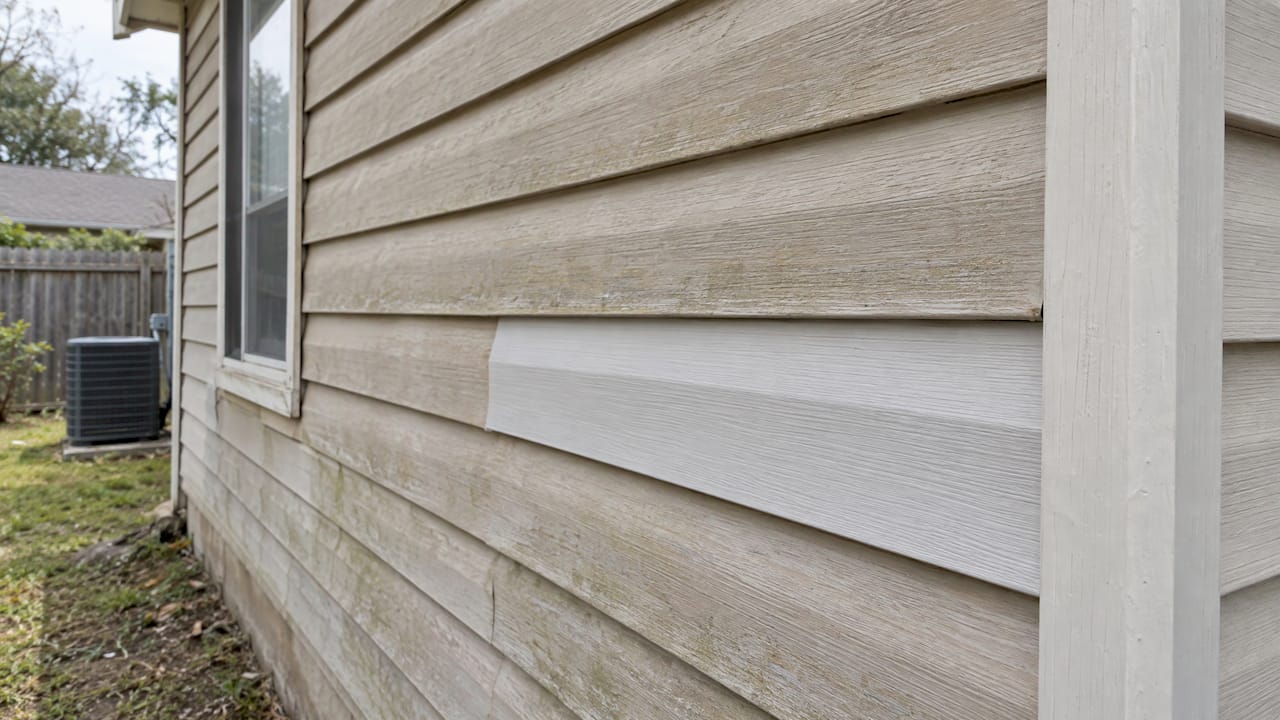
Yes, in most cases. Individual vinyl panels unlock and slide out, and individual fiber cement or wood boards can be cut out and replaced. The physical repair is usually the easy part. The harder part is the match: after years of Texas sun, a brand-new panel can look visibly brighter than the ones beside it, and a profile that is no longer made may force a substitute.
What helps:
- Save leftovers. If your house was re-sided, spare panels from the original job in the garage are the best match.
- Pull a sample. Take a small piece to the supplier, or give the contractor a clear photo of the profile and the manufacturer stamp on the back.
- Choose a hidden wall. Sometimes a good-condition panel from a back wall can be swapped to the front, with the new piece going where it is seen less.
- Paint where it makes sense. For wood and fiber cement, a repair plus fresh paint across the wall blends well.
If the match is poor and the damage is widespread, that is when replacing a full wall or the whole house starts to compete on price.
Repair or replace: where the line falls
A widely used rule of thumb comes from FacadeColorizer’s 2026 guide: if under 10% of the siding is structurally damaged and the rest is in fair to good shape, a spot repair plus paint can outperform a full replacement on return for at least 5 to 8 years. Above 30% damage, the guide finds that demolition, matching and blending cost nearly as much as starting over, so replacement is the better value.
Some signs point toward replacement regardless of the percentage:
- Panels that warp or cup after getting saturated. This Old House explains that saturated siding can pull water in behind it, and that hidden moisture can cause warping that calls for full replacement.
- Repeated repairs in the same area, which suggest a moisture source nobody has fixed.
- Siding that is already near the end of its life, where each repair reveals another failing piece.
Siding and roofing damage often come from the same storm, so it is worth having the roof checked while someone is already looking at the house. Our guide to roof damage assessment shows how to check, document and decide.
Will homeowners insurance pay for siding repair?
Sometimes. It depends on the cause of damage, not the siding.
- Usually covered: sudden events such as windstorms, hail, fire, lightning, falling trees or branches and vandalism. LegalClarity notes that a standard HO-3 policy covers the dwelling against all perils unless the policy excludes them. Bob Vila likewise says weather damage from hail or wind is typically covered.
- Usually not covered: wear and tear, deterioration, rust, dry rot and damage from poor maintenance, which the standard HO-3 form excludes, per the same LegalClarity article.
Two practical points matter before you file.
Check the deductible. LegalClarity says deductibles are commonly a flat $1,000 to $2,500, or a percentage of the home’s insured value. If the repair estimate is near or below your deductible, a claim may add to your claims history without putting money in your pocket. Many Texas policies use a separate percentage deductible for wind and hail, so read your declarations page.
Expect limits on matching. Policies differ on whether they pay to replace undamaged siding so a repaired wall matches. In one 2025 federal case, the court held that the policy covered only damaged property and contained a matching exclusion that barred paying to replace undamaged siding. That ruling turned on that policy’s wording, so your own policy and state rules decide your outcome.
If the storm hit your roof too, document everything before repairs begin. Our Texas roof insurance claims guide for DFW homeowners walks through the process, and dealing with roof storm damage covers the first steps.
How to get a fair quote and keep the cost down
- Get the cause diagnosed first. A repair that ignores a leak, a failed flashing or a gutter overflowing onto the wall will be repeated.
- Photograph the damage. Wide shots plus close-ups, with dates, help for both contractors and insurers.
- Ask for a written, itemized quote. Materials, labor, disposal, trim and flashing, and any moisture or rot allowance should each have a line.
- Bundle exterior work. If gutters, paint or roofing also need attention, one crew and one mobilization is often more efficient than separate visits.
- Repair early. A cracked panel is a $100 fix until water finds its way behind it.
- Schedule outside the rush. HomeAdvisor’s factors, as reported by Bob Vila, include emergency and peak-season rates. After a big hailstorm, everyone calls at once.
For homes built before 1980, ask whether testing is needed before panels come off, since that adds to the budget.
Perspective
Siding problems rarely start at the siding. In North Texas, we see wall damage that traces back to a roof edge, a gutter or a flashing detail that has let water run where it should not. That is why we look at the whole exterior envelope before we talk about cost.
Our approach is data-driven: we document what the storm actually did, separate storm damage from age-related wear, and recommend the smallest fix that will hold. A repair done right on a sound wall is good value. When damage has spread, we say so and explain why replacement is the better long-term investment.
As a GAF Master Elite® contractor, we hold ourselves to manufacturer standards on roofing, and we bring the same transparency to exterior work such as siding, paint and gutters. Our inspections and estimates are free, so you can see what is needed before you decide anything.
Dustin Eatman
Get the whole exterior looked at in one visit
If your siding was damaged in a storm, there is a good chance your roof and gutters were too. James Kate Roofing & solar offers free inspections and estimates, storm-damage assessments, and exterior services including siding, paint and gutters across the Dallas-Fort Worth area. Start with our roof inspection and estimate page or see all of our roofing services.

For homeowners replacing a roof, we offer a transferable 15-year workmanship warranty on residential roof replacements. If hail or wind hit your neighborhood, our storm-damage assessments give you documented findings you can take to your insurer.
FAQ
How much should siding repair cost?
For a typical job, expect roughly $354 to $1,442, with an average around $884, based on Angi data reported by Bob Vila. Upper-story work, hidden moisture damage and hard-to-match materials can push the price above that range.
Is siding damage covered by homeowners insurance?
Often when a sudden event like hail, wind or a falling tree caused it, and usually not when the cause is wear, rot or poor maintenance. LegalClarity also points out that a deductible near the repair cost can make a claim pointless. Read your policy’s wind and hail terms first.
Can you replace just a few pieces of siding?
Yes, most siding types allow individual panels or boards to be replaced. The challenge is matching color, texture and profile on a house that has faded over the years. Saved spare panels or a sample for the supplier make the match easier.
Is it worth replacing siding instead of repairing it?
It can be when damage is widespread or moisture is behind the wall. One 2026 guide suggests spot repairs win below about 10% damage and replacement wins above about 30% (FacadeColorizer). In between, an on-site inspection settles it.
Sources
- Siding Repair Cost: What to Know and How Much You’ll Pay, Bob Vila
- Siding Repair Cost: DIY vs. Professional, This Old House
- How to Get Homeowners Insurance to Pay for New Siding, LegalClarity
- Grote v. American Economy Insurance Co., court opinion
- Siding Repair vs Replacement Cost Guide 2026, FacadeColorizer
Recommended

Dustin Eatman is a seasoned roofing professional with deep, hands-on expertise that spans residential and commercial roofing, insurance solar, and long-term roof asset management. As the owner of James Kate Roofing & solar in the Dallas–Fort Worth metroplex, he’s built a reputation for diagnosing roof systems accurately, communicating clearly, and executing projects with a high standard of workmanship and documentation. Dustin understands the technical details that make roofs perform—proper underlayment selection, slope and drainage considerations, ventilation strategy, flashing and penetration detailing, and manufacturer-specific installation requirements—because he’s worked through the real-world challenges that cause leaks, premature wear, and warranty issues. He’s equally fluent in the operational side of roofing: jobsite planning, quality control, safety, material ordering, crew coordination, and customer experience from inspection to closeout. In insurance-related projects, Dustin brings practical knowledge of claim workflows, adjuster meetings, scope alignment, supplements, and the importance of photo evidence and thorough records, helping property owners navigate stressful situations with confidence. For commercial clients—especially property and facility managers—he emphasizes proactive maintenance and targeted repairs that reduce disruption, extend roof life, and prevent expensive interior damage. Dustin also stays focused on doing things the right way: educating customers on realistic options, setting expectations, and prioritizing solutions that hold up over time rather than quick fixes. That blend of technical skill, field experience, process discipline, and owner-level accountability is what makes Dustin Eatman a trusted expert in the roofing industry.