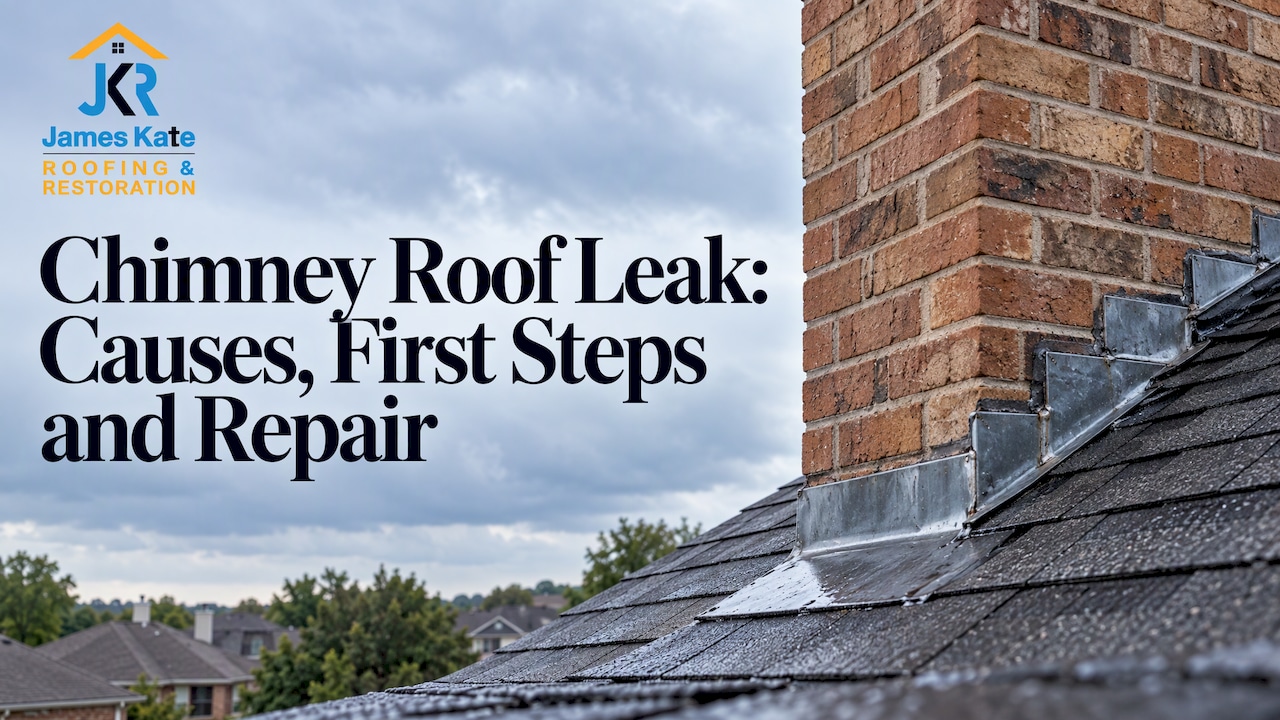
If water is showing up near your chimney after a storm, the most likely culprit is the flashing, the metal that seals the joint between the chimney and the roof. That joint is where a roof moves, ages and gets hit by weather all at once. A leak there rarely fixes itself and tends to get more expensive the longer it runs. We offer free roof inspections and estimates across Dallas-Fort Worth, so the practical next step is to have a roofer find the exact entry point before the next heavy rain.
TL;DR
- Most chimney leaks come from failed or poorly built flashing, but cracked crowns, worn mortar, a missing cricket and clogged gutters can also let water in.
- Water often travels along rafters and decking before it shows up, so the stain on your ceiling may sit well away from the chimney.
- During a leak, protect belongings, document the damage with photos and book an inspection. Do not climb onto a wet roof.
- A proper repair replaces the damaged flashing with correctly overlapped pieces. A smear of sealant is a short-term patch.
- Insurance outcomes depend on your policy, so read it and call your carrier early.
Table of Contents
- Why chimneys leak more than other parts of the roof
- What usually causes a leak around the chimney
- How water travels from the chimney into your home
- Signs of a chimney or attic leak
- What to do when it leaks during or after heavy rain
- How a chimney flashing leak is repaired
- What affects the cost of a chimney leak repair
- Will insurance cover a chimney leak?
- Preventing the next chimney leak
- Our perspective on chimney leaks
- Get the leak looked at
- FAQ
- Sources
Why chimneys leak more than other parts of the roof
A chimney is a brick or stone column that rises through a roof made of wood and shingles. Those materials expand, contract and settle at different rates. The seam between them has to stay watertight through summer heat, hard freezes, wind-driven rain and hail.
The U.S. Department of Energy’s Consumer Guide to Durable Attics names roof leaks and improperly installed flashing around chimneys and other penetrations as routes for moisture into an attic. Virginia Cooperative Extension adds that roof joints and penetrations are common leak locations because flashing, shingles, caulk or tar can expand, contract, shift or crack with temperature extremes.
So, to the question many homeowners ask: is it normal for a chimney to leak in heavy rain? It is common, but it is not something to live with. A properly built chimney joint stays dry in a downpour. If yours does not, something has failed or was never installed correctly.
What usually causes a leak around the chimney
Water can enter at several points. A roofer works through them from the roof surface up the chimney.
Failed or poorly installed flashing
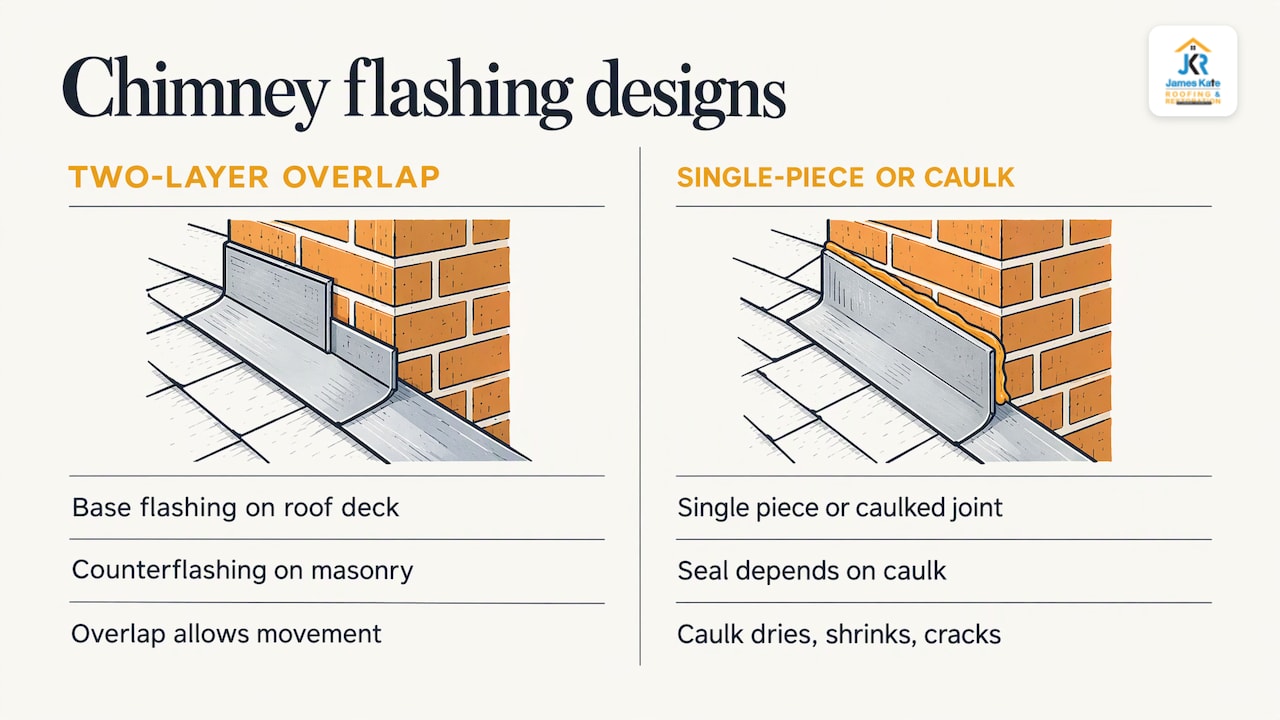
This is the most frequent cause. Good chimney flashing is usually built in two layers. The American Society of Home Inspectors explains that base flashing is attached to the roof deck and counterflashing to the masonry, overlapped so that movement between the roof and the chimney does not break the seal.
That overlap is the point. When flashing is a single piece, or is held to the brick with a bead of caulk, the seal depends on the caulk surviving. ASHI describes a caulked joint at the top of the counterflashing as a temporary maintenance situation, because caulk dries, shrinks and cracks.
What to look for: rust lines, lifted or bent metal, gaps between metal and brick, and dark streaks or stains on the shingles or brick directly below the chimney.
Damaged or deteriorated flashing from age and weather
Even well-installed flashing wears out. GAF’s homeowner guidance lists damaged or deteriorated flashing around chimneys and other penetrations among the common causes of roof leaks. In North Texas, hail and high wind can bend or loosen metal that was fine before the storm, and a leak may appear only after the next rain.
A missing cricket on a wide chimney
A cricket is a small peaked structure built on the uphill side of a chimney. It splits the water running down the roof and sends it around the chimney instead of letting it pool against the masonry. On wide chimneys, the lack of a cricket is a design flaw that causes repeated leaks no matter how often the flashing is touched up.
Cracked chimney crown, open mortar joints and porous brick
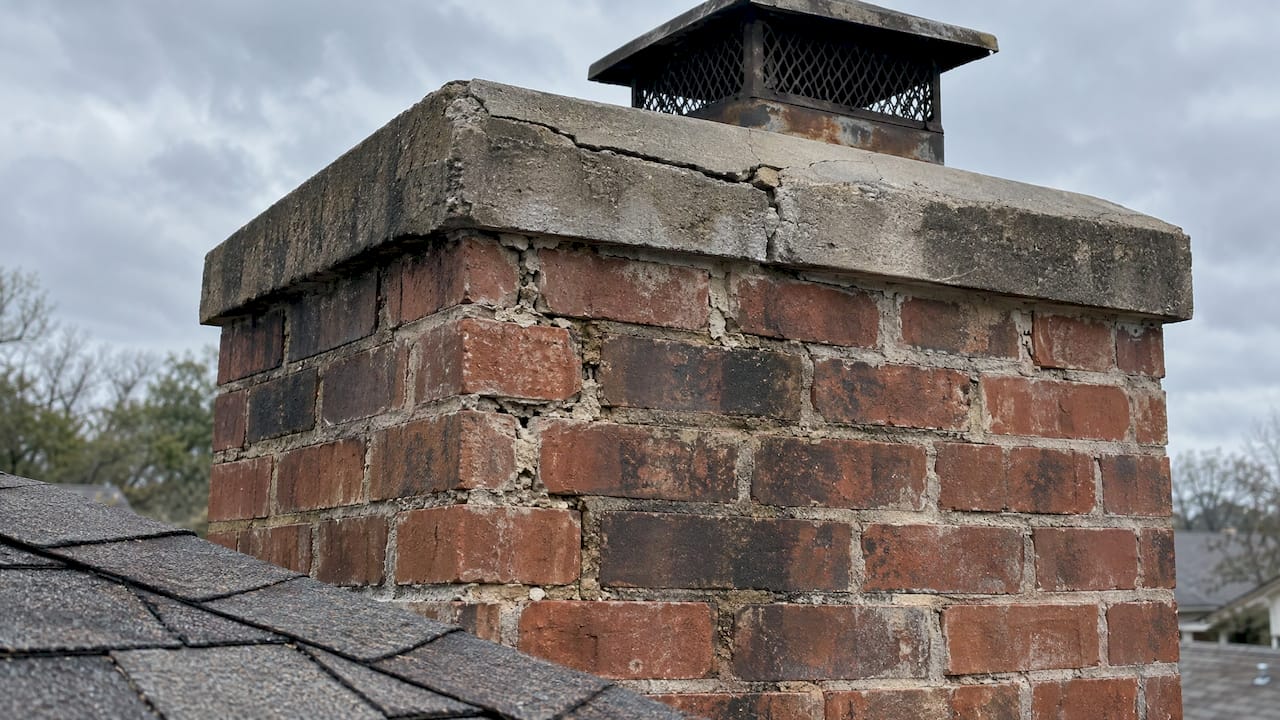
The crown is the cement cap on top of the chimney. If it cracks, rain gets into the masonry and works its way down, which can look like a roof leak from the inside. Worn mortar joints and brick that absorbs water can do the same. These are masonry repairs rather than roofing repairs, and an inspection will tell you which one you are dealing with so you do not pay for the wrong fix.
Clogged gutters and other roof defects nearby
GAF also notes that clogged gutters can redirect water under shingles. If a chimney sits near an eave, backed-up water at the roof edge can create a leak that looks like a chimney problem. Cracked or missing shingles near the chimney have the same effect.
Leaks that are not chimney leaks at all
Sometimes the chimney is simply the nearest landmark. Condensation inside a flue, a plumbing vent boot, a skylight or a failing roof valley can all send water to the same area. Our article on three unsuspected causes of a roof leak covers some of the surprises.
How water travels from the chimney into your home
Roof water seldom drips straight down. It follows the path of least resistance: along the top of the roof deck, down a rafter, across the underside of the sheathing and onto the drywall or insulation. The wet spot you see may be several feet away from where the water got in.
That is why a ceiling stain near a fireplace wall does not prove the chimney flashing is the problem, and why a chimney with bad flashing can show nothing for months while the framing slowly gets wet.
Signs of a chimney or attic leak
Outside, look from the ground or with binoculars for:
- Dark streaks or stains on the shingles or bricks near the chimney
- Rust lines or discoloration on the flashing
- Metal that has lifted, bent or pulled away from the brick
- Cracks in the crown or crumbling mortar
Inside, the Department of Energy’s guide lists wet attic insulation, mold or mildew, warped or rotting attic wood, and warped or rotted soffit or fascia as signs of possible water intrusion. Other common signs are:
- Brown or yellow stains on a ceiling or on the wall beside the fireplace
- Bubbling or peeling paint
- A musty smell in the attic or upstairs rooms
- Drips during or shortly after rain
One caution: the same DOE guide separates water that comes through the roof from moisture caused by indoor water vapor and inadequate attic ventilation. Damp insulation does not always mean a roof leak. A water damage prevention checklist such as this one on spotting early water intrusion can help you think through other moisture sources in the home. For the roof side, our guide to how to identify roof leaks and our article on attic vents and roof ventilation help you tell the two apart.
Mold after a leak
A slow leak around the chimney can leave mold on attic sheathing, rafters and insulation. Mold is a sign that the area has been wet for a while, and it means the source needs to be found and stopped before anything is cleaned or replaced. Cleaning mold off wood that keeps getting wet only buys a few weeks.
What to do when it leaks during or after heavy rain
Stay calm and work through this order.
- Protect people and belongings. Move furniture, rugs and electronics out from under the wet area. Place a bucket under a drip. If a ceiling is bulging with water, a small hole made carefully at the lowest point can relieve it into a bucket. Stay clear of the area if water is near light fixtures or outlets, and shut off power to that circuit if you can do so safely.
- Stay off the roof. A wet roof, particularly around a chimney, is a serious fall risk. Everything you need to see can be photographed from the ground or the attic.
- Document everything. Take dated photos and short videos of stains, drips, the attic and the exterior of the chimney. You will want them for an estimate and for any insurance claim.
- Limit the immediate damage from inside. Our guide to temporarily patching a roof hole from the inside and our article on temporary and permanent solutions for asphalt shingle leaks explain what holds until a repair crew arrives.
- Get a roofer to inspect it. If water is actively coming in, emergency roof repair is the right call. If the leak has stopped, a scheduled inspection is still worth doing promptly, because the flashing that let water in will do it again.
- Call your insurance carrier. More on that below.
Treat it as urgent when water is coming through a ceiling, when insulation or wood is soaked, when you see sagging, or when a storm has just passed and the chimney area looks damaged. For a broader checklist, see 7 roofing problems that need urgent attention.
How a chimney flashing leak is repaired
The usual repair sequence, as This Old House describes it, removes the damaged flashing, cleans the area, installs new flashing with proper overlap and seals the edges. The same source says a professional should handle complex flashing repairs, extensive water damage or structural issues.
Here is what each stage takes and where it goes wrong:
| Stage | What it takes | Where it goes wrong |
|---|---|---|
| Find the entry point | Checking flashing, crown, mortar, nearby shingles and the attic underside | Treating the stain instead of the source |
| Remove failed flashing | Lifting surrounding shingles and taking out old metal and sealant | Leaving old material that traps water |
| Install new base flashing and counterflashing | Base layer on the deck, counterflashing set into the masonry and overlapped | Single-piece flashing or caulk-only joints that crack as the roof moves |
| Add a cricket if the chimney is wide | A peaked diverter on the uphill side | Skipping it, so water pools behind the chimney |
| Seal and restore shingles | Sealing edges, re-laying surrounding roofing | Gaps where the new work meets old shingles |
| Check the interior | Inspecting decking, insulation and ceilings | Closing up wet wood and growing mold |
The common shortcut is a thick bead of roofing sealant across the joint. It may stop a drip for a season, but as ASHI notes, it is a temporary measure and not the watertight overlap that lets roof and chimney move independently. Our roof leak diagnosis and repair work starts with finding where the water enters, which is why a leak that has been “fixed” twice at the same spot usually needs a proper look rather than a third patch.
Repair or replace the roof?
If the flashing is the only failure and the surrounding shingles are sound, a flashing repair is usually the right scope. If the roof near the chimney is worn, hail-damaged or leaking in several places, repairing one joint can mean paying for the same crew to return. In that case it is worth looking at roof replacement and installation. Our residential roof replacements carry a transferable 15-year workmanship warranty.
What affects the cost of a chimney leak repair
We do not publish a fixed price, because the work ranges from a small flashing fix to a larger repair that includes decking, insulation and interior damage. The factors that move an estimate are:
- Size and design of the chimney. A wide chimney, or one that needs a cricket, takes more material and labor.
- Roof pitch and height. Steeper and taller roofs take more time and safety setup.
- Roof material. Asphalt shingle, metal and tile each need different flashing methods.
- How long water has been getting in. Wet decking, rotted wood and soaked insulation add to the scope.
- Masonry condition. A cracked crown or failing mortar is a separate repair from the roof flashing.
- Interior damage. Ceilings, paint and mold remediation are separate from the roof work.
The quickest way to get a number you can trust is a written estimate after an in-person inspection. Ours is free.
Will insurance cover a chimney leak?
It depends on your policy and on what caused the damage. GAF’s homeowner guidance says that homeowners policy coverage varies, and that you should review your own policy and speak with your carrier about a leaking-roof claim. No general rule replaces that conversation.
What helps in practice:
- Report the leak promptly and keep your dated photos.
- Ask your carrier how it treats sudden storm damage compared with gradual wear, and what it requires for documentation.
- If a recent hail or wind event may have damaged the flashing or shingles, a storm damage inspection gives you a written record. Our roof damage assessment guide walks through checking, documenting and deciding, and our page on spotting roof damage after a storm lists what to look for.
We also offer an instant roofing quote tool that assesses a roof’s health using historical weather data, so you can see whether severe storms have affected your roof.
Preventing the next chimney leak
- Have the chimney and flashing inspected once a year and after any hail or high-wind event. Fall is a sensible time to do it, before winter weather. Our piece on how winter weather affects your roof explains why.
- Keep gutters clear so water cannot back up under shingles near the eaves.
- Look at the chimney from the ground after storms for lifted metal, rust and staining.
- Ask about ice and water barrier in vulnerable areas. Our guide to installing roof ice and water barriers explains what it does.
- Do not let a small stain sit. Small stains are cheaper to fix than rotted decking.
Our perspective on chimney leaks
Most chimney leaks we are asked about are really flashing questions. The roof has been patched with sealant, the stain comes back after the next storm, and the homeowner is understandably tired of it.
What we want homeowners to take away is that the repair has to match how the joint is built. Separate layers, properly overlapped, let the chimney and roof move without opening a gap. A bead of caulk cannot do that job for long.
That is why we start with a free inspection and estimate and look at the whole picture: the flashing, the shingles around it, the gutters and what the attic is telling us. Our approach is built on data-driven diagnosis and clear communication, so you know what is failing and why before you decide on anything. As a GAF Master Elite® contractor, we stand behind that work.
Dustin Eatman
Get the leak looked at
We are a GAF Master Elite® contractor serving homeowners and property managers across Dallas-Fort Worth, with inspections, leak diagnosis and repair, emergency roofing and full replacements. If your chimney is leaking, a free inspection and estimate will tell you whether you need a flashing repair, a larger roof repair or nothing more than a gutter cleaning.

Start with our roof inspection and estimate page, or see all of our roofing services. For a leak that is happening right now, go to emergency roof repair in Dallas-Fort Worth. Commercial property owners and managers can go to our commercial roof repairs page.
FAQ
Where do chimneys usually leak?
Most often at the flashing where the chimney meets the roof, especially on the uphill side where water collects. Cracked crowns, worn mortar and nearby damaged shingles are the next most common entry points. A roofer can trace which one is responsible.
Is it normal for a chimney to leak in heavy rain?
It is common, but it means something has failed or was installed poorly. Flashing, the crown or the masonry should keep water out even in a downpour. A leak that shows only during heavy or wind-driven rain still needs inspection, because the opening will widen over time.
Can I fix a chimney leak with roofing sealant?
Sealant may slow a drip briefly, but ASHI describes a caulked joint at the top of counterflashing as a temporary maintenance situation. The lasting fix is correctly overlapped flashing. Because a wet roof is also a fall hazard, leave the roof work to a roofer.
Will homeowners insurance cover a leak around a chimney?
It depends on your policy and the cause of the damage. GAF’s homeowner guidance says coverage varies and tells homeowners to review their policy and check with their carrier. Photos taken right away and a written inspection report make that conversation easier.
How much does it cost to fix a chimney leak?
The price depends on chimney size, roof pitch and material, how long water has been entering and whether decking, insulation or masonry also need work. We give a written estimate after a free inspection, so you see the real scope before you decide.
Sources
- Consumer Guide to Durable Attics, U.S. Department of Energy (2021)
- ENERGY SERIES: What about the Roof?, Virginia Cooperative Extension (2020)
- Chimney Flashings, American Society of Home Inspectors
- How to Identify and Repair Roof Leaks, GAF
- How To Make Common Chimney Repairs, This Old House (2026)
Recommended
- What To Do If Your Roof Is Leaking
- Handle Roof Leaks Before They Escalate
- Three Unsuspected Causes of your Roof Leak
- Don’t Panic: Your Ultimate Guide to Fixing a Roof Leak Near You

Dustin Eatman is a seasoned roofing professional with deep, hands-on expertise that spans residential and commercial roofing, insurance solar, and long-term roof asset management. As the owner of James Kate Roofing & solar in the Dallas–Fort Worth metroplex, he’s built a reputation for diagnosing roof systems accurately, communicating clearly, and executing projects with a high standard of workmanship and documentation. Dustin understands the technical details that make roofs perform—proper underlayment selection, slope and drainage considerations, ventilation strategy, flashing and penetration detailing, and manufacturer-specific installation requirements—because he’s worked through the real-world challenges that cause leaks, premature wear, and warranty issues. He’s equally fluent in the operational side of roofing: jobsite planning, quality control, safety, material ordering, crew coordination, and customer experience from inspection to closeout. In insurance-related projects, Dustin brings practical knowledge of claim workflows, adjuster meetings, scope alignment, supplements, and the importance of photo evidence and thorough records, helping property owners navigate stressful situations with confidence. For commercial clients—especially property and facility managers—he emphasizes proactive maintenance and targeted repairs that reduce disruption, extend roof life, and prevent expensive interior damage. Dustin also stays focused on doing things the right way: educating customers on realistic options, setting expectations, and prioritizing solutions that hold up over time rather than quick fixes. That blend of technical skill, field experience, process discipline, and owner-level accountability is what makes Dustin Eatman a trusted expert in the roofing industry.