
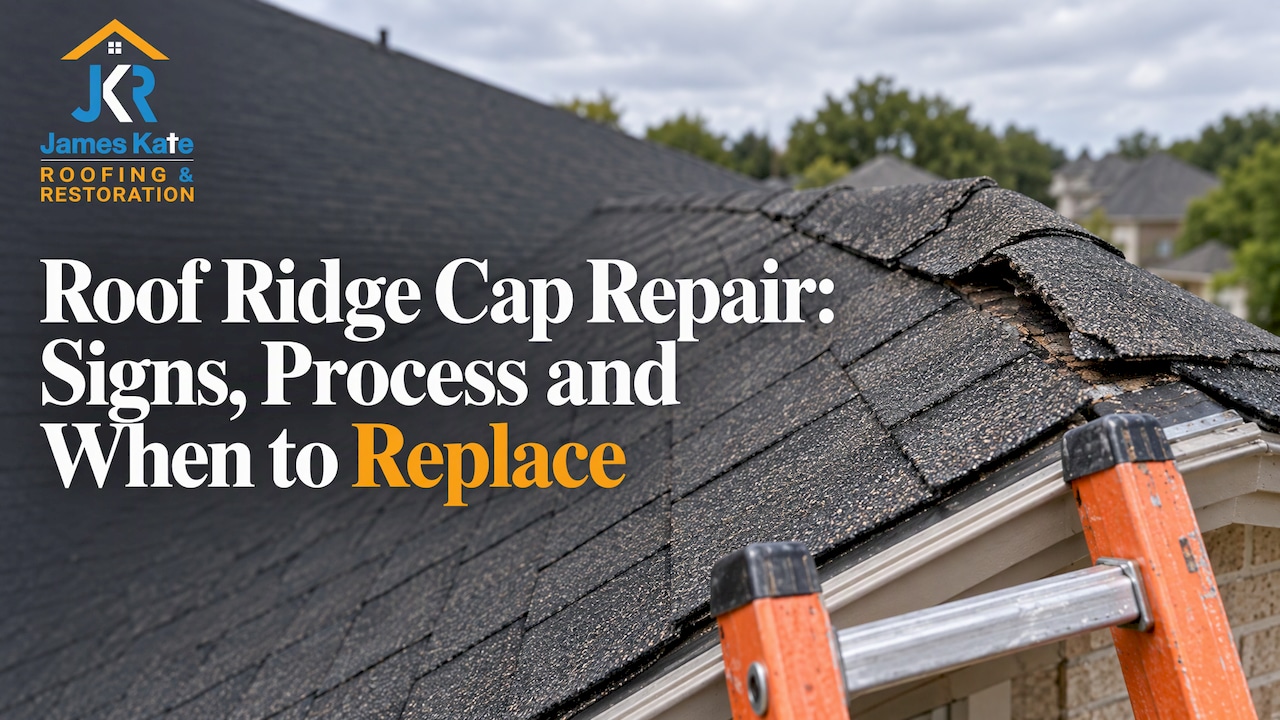
Ridge cap repair means replacing or re-securing the shingles that cover the peak of your roof, and it is a job for a roofing professional, not a weekend ladder project. The ridge sits at the highest, most wind-exposed point of the roof, and a missing cap there lets water reach the deck and the attic. If you see cracked, lifted or missing cap shingles, the right move is to get the roof inspected before the next storm, so the repair stays small and the cause behind it gets diagnosed.
TL;DR
- Ridge caps are among the most hail-vulnerable parts of a shingle roof, so check them after every hail or high-wind event.
- Missing, cracked or lifted cap shingles let water into the deck. Cover exposed areas with a tarp if it can be done safely, then call a roofer.
- A correct repair uses pre-formed cap shingles, lapped away from the prevailing wind, with nails placed where the next piece hides them.
- Whether a patch is enough depends on what is under the cap: the shingles, the underlayment, the deck and any ridge vent.
- Our inspections and estimates are free, and we can tell you whether the damage is isolated or a sign of something bigger.
Table of Contents
- What the ridge cap does
- Signs your ridge cap needs repair
- What to do the day you find damage
- How a ridge cap repair is done properly
- Repair a section or replace more?
- Texas rules that can affect a repair
- What ridge cap repair costs
- Have the ridge inspected by us
- Our perspective
- FAQ
- Sources
What the ridge cap does
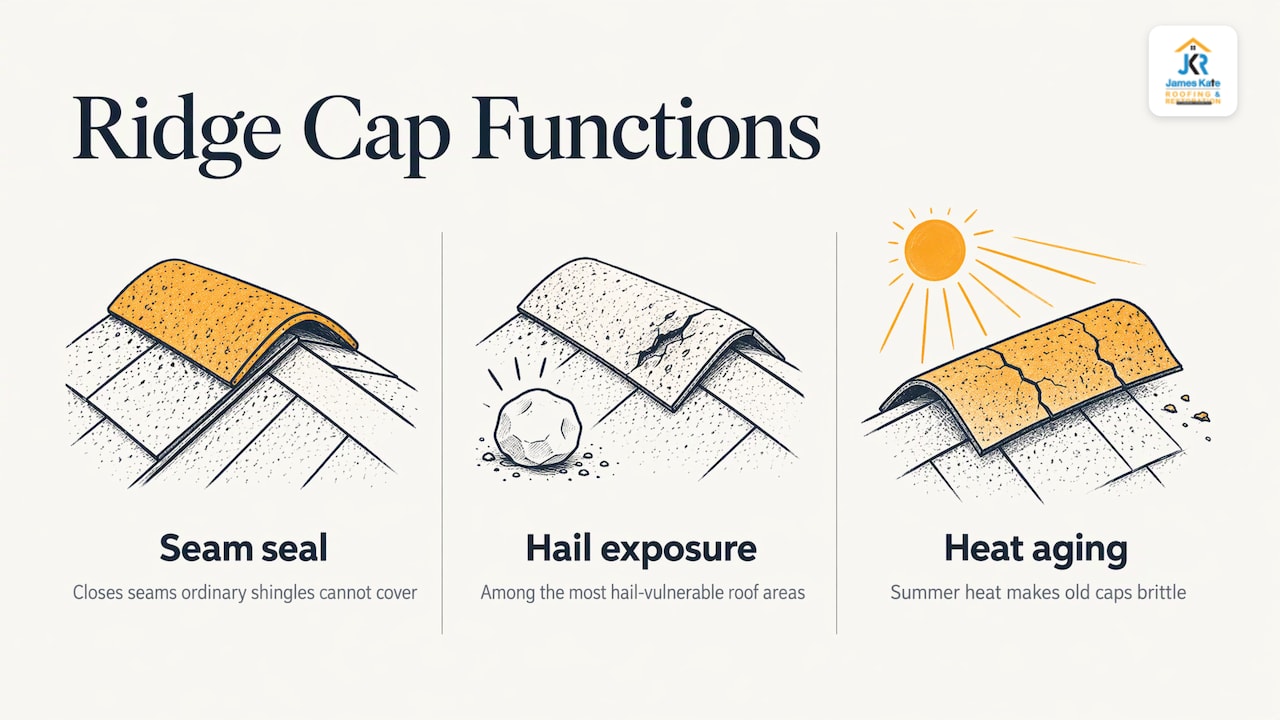
Where two roof planes meet at the peak, or at a hip, there is a seam that ordinary shingles cannot cover. Ridge cap shingles close it. According to a GAF product manager, ridge cap shingles are made of the same materials as regular asphalt shingles but designed to bend over the ridge, protecting that seam from wind-driven rain, snow and blow-offs.
That job makes the ridge a hard place to be a shingle. It takes the full force of wind as air accelerates over the roof. It is also where hail often lands squarely. The Insurance Institute for Business & Home Safety notes that ridge caps are among the most hail-vulnerable parts of a shingle roof, and that a bruise from a real hail impact can usually be felt by hand.
For North Texas homeowners this matters twice. Hail and straight-line wind both hit the ridge first, and the summer heat ages the asphalt, making old cap shingles brittle and more likely to crack when they are bent or struck.
Signs your ridge cap needs repair
You can learn a lot from the ground. A pair of binoculars and a walk around the house in daylight will show most of the following.
- Missing pieces. A gap in the line along the peak, or a dark stripe where bare underlayment or deck shows through.
- Lifted or curled edges. Cap shingles that no longer lie flat have usually lost their sealant bond.
- Cracks across the bend. Aged cap shingles split along the fold, often in a line of several in a row.
- Exposed nails. Nail heads that show on the surface can back out and leak.
- Granules in the gutters or on the ground below the ridge. Heavy granule loss on the cap points to hail or advanced age.
- Stains inside. Brown spots on upstairs ceilings, damp insulation, or a musty attic near the peak can mean water is getting in at the ridge.
- Debris in the yard. Pieces of cap shingle on the lawn after a windstorm are a direct clue.
Damage at the ridge is rarely only at the ridge. The Federal Emergency Management Agency documented one home after Hurricane Michael where damage limited to lost ridge shingles and ridge vents exposed a large opening in the roof deck and ended with collapsed, saturated ceilings. Small damage up high can become interior damage fast.
If you suspect hail, our guide to identifying roofing damage caused by a hailstorm walks through what hail looks like on shingles, and key signs of roof damage after a storm covers the rest of the roof.
What to do the day you find damage
The National Roofing Contractors Association (NRCA) gives clear consumer guidance after strong winds. Do not inspect alone or climb a ladder in the dark, wear sturdy shoes or boots, a long-sleeved shirt and work gloves if you must go outside to look, and temporarily cover openings with tarps rather than attempt repairs.
That last point has a practical reason. NRCA explains that wind damage builds in cycles: suction at edges lifts material, then pressure pushes it further. Poking at blisters or spreading coatings on your own can destroy the evidence a contractor needs to diagnose what happened. So the sequence at home is simple:
- Stay off the roof. Look from the ground.
- Photograph the ridge and any missing pieces, plus any interior stains, with dates.
- If water is coming in and a tarp can be placed safely, cover the exposed area. Keep the attic dry, and move belongings away from drips.
- Call a roofer for an inspection. If water is actively entering, ask for emergency service.
If the roof is already leaking, our emergency roof repair service in Dallas-Fort Worth is built for that situation. For the broader storm routine, see steps to take when your roof suffers storm damage.
How a ridge cap repair is done properly
Ridge cap work looks simple from the street, which is why it is often done badly. The NRCA’s Repair Manual for Asphalt Shingle Roof Systems, released in December 2022, includes 31 step-by-step procedures, among them replacing hip and ridge cap shingles, and it is written for professional field workers and trained maintenance personnel. The details below show what a good repair involves and where shortcuts cause failures.
Step 1: Find the cause before fixing the symptom
A cracked cap can come from age, hail, wind or poor installation. A lifted cap may point to failed sealant, back-out of nails, or movement in the deck. The repair differs for each, and an inspection looks at the neighboring shingles, the underlayment, the deck and any vent along the ridge.
Step 2: Remove the damaged caps without harming what is around them
GAF’s technical bulletin on replacing storm-damaged shingles warns that latent damage to surrounding shingles is difficult to assess. When individual shingles are replaced, the bulletin says nails removed from surrounding shingles must be replaced and the surrounding shingles hand-sealed. Sloppy removal is how a one-piece repair turns into a three-piece problem.
Step 3: Use real cap shingles, not cut-up field shingles
The cap has to bend over the ridge without cracking. One trade reference lists cutting 3-tab shingles in place of pre-formed cap as the biggest warranty-voiding mistake. Manufacturer-matched cap shingles also keep color and thickness consistent along the ridge.
Step 4: Lap away from the wind and place the nails where the next piece covers them
Ridge cap is the last shingle product installed. The same reference explains that installation starts at the downwind end so that each lap faces away from the prevailing wind. One manufacturer’s applicator manual, as that source summarizes it, places fasteners 1 inch from each side edge, driven at least 3/4 inch into or through the deck, and sizes the exposure so the next piece covers the nail heads. Exposed nails and caps lapped into the wind are the usual causes of early leaks.
Step 5: Match the nail length to what is under the cap
On a ridge with a vent, the vent housing adds thickness. Atlas Roofing’s installation instructions specify 2-1/2 inch roofing nails for cap shingles installed over a ridge vent, and note that nailing through the vent along the nailing line also secures the vent. Short nails that never reach the deck are a common reason caps blow off in the next storm.
Step 6: Seal and hand-seal where needed
GAF recommends hand-sealing where sealant bonds were broken by extraordinary winds. In high-wind areas the leading edge needs its adhesive bead, since skipping it is another mistake the trade reference lists. Texas storms qualify.
Our own guide to replacing damaged shingles and our page on asphalt shingle repair show how the same care applies to the rest of the roof.
Repair a section or replace more?
Yes, you can repair just a section of a ridge. Cap shingles are individual pieces, so replacing a damaged run is routine. The real question is what the damage tells you. Use this as a guide:
| What the inspection finds | Usual answer |
|---|---|
| A few cracked or missing caps, deck and underlayment dry and sound | Replace those caps and hand-seal neighbors |
| Caps lifted along a long run, sealant failed, shingles brittle | Re-cap the whole ridge, since patches will keep failing beside old material |
| Wet or soft deck, stained underlayment, interior leaks | Repair the deck and underlayment first, then re-cap |
| Damaged or loose ridge vent | Replace or re-secure the vent with the right fasteners, then cap over it |
| Hail bruising on the field shingles as well as the cap | Treat as a roof-wide storm damage question, which may mean a replacement and an insurance claim |
Notice the pattern: the ridge is the symptom, and the layers beneath it decide the scope. When the field shingles near the peak are also granule-bare, cracked or bruised, a new cap on a worn roof buys little. In that case we compare a repair against replacement with you using what the inspection found.
Texas rules that can affect a repair
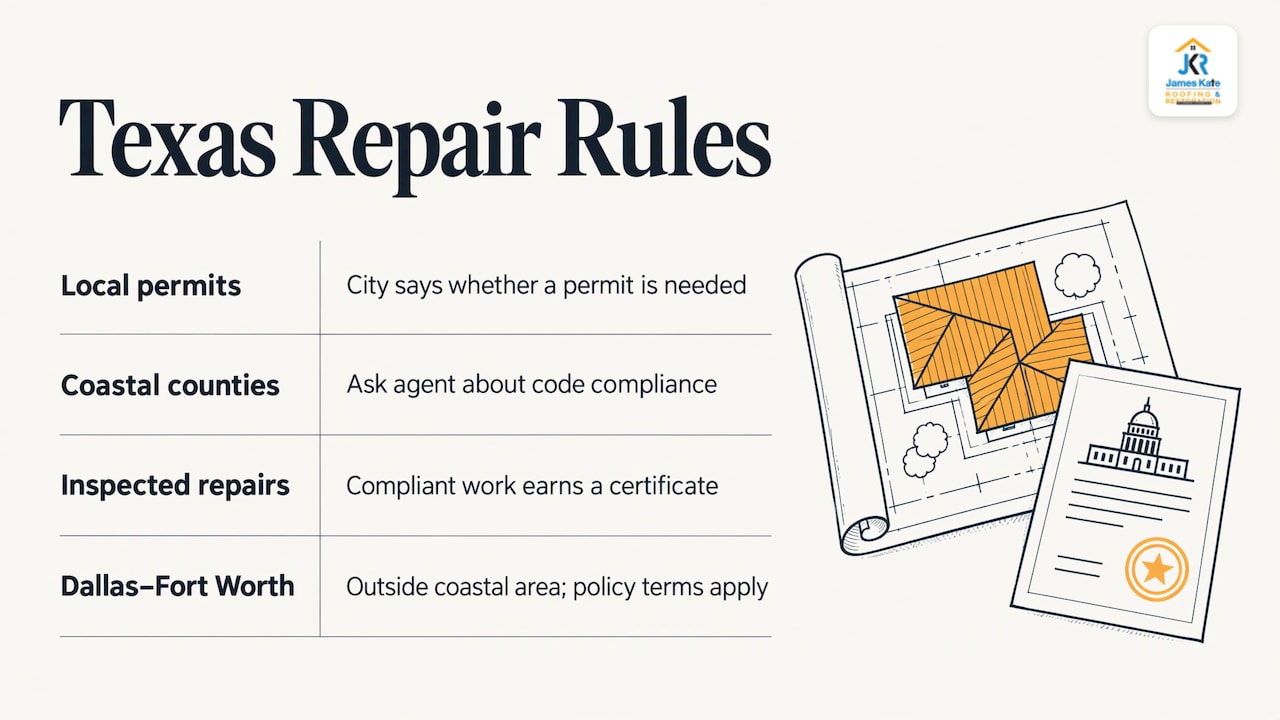
Most North Texas roof repairs are governed by the manufacturer’s installation instructions and local permitting rules, and your city’s building department can say whether a permit is needed. One state rule is worth knowing. The Texas Department of Insurance advises that in the first row of counties along the Gulf of Mexico and certain Harris County cities east of Highway 146, homeowners should ask their insurance agent whether repairs must comply with the building code, and compliant repairs inspected under its Windstorm Inspections Program receive a Certificate of Compliance. The Dallas-Fort Worth counties are not in that coastal area, but your insurer’s policy terms still apply to any claim.
Ventilation is also part of ridge work, and water entry at a vent is a real risk in wet climates. For a view of how vented roofs are sealed against heavy rainfall, this resource on venting roofs in heavy rainfall covers joint sealing on insulated panel roofs.
If insurance is involved, an insurance roof inspection documents what the damage is and how it happened before a claim is filed.
What ridge cap repair costs
Prices vary with ridge length, roof pitch, material, whether the ridge has a vent or other intersections, and what is found underneath. Hidden water damage is the biggest swing factor, because a repair that begins as a few caps can become a deck repair. We do not publish flat prices for ridge work, because a quote has to follow the inspection. Our estimates are free, so you can compare scopes before you commit. For a sense of how a small leak repair is broken down into flashing, shingles and labor, read our breakdown of the cost to fix a small roof leak.
When you collect quotes, ask each contractor what it will replace, what nail length and cap product it will use, and whether the neighboring shingles will be hand-sealed. The answers tell you whether the price covers a real repair.
Have the ridge inspected by us
James Kate Roofing & solar is a GAF Master Elite® contractor serving North Texas homes and commercial properties. We offer free inspections and estimates for roof repairs, hail and wind damage inspections, and storm-damage assessments, and our instant roofing quote tool assesses a roof’s health using historical weather data so you can see whether severe storms hit your address. Book a free roof inspection and estimate and we will tell you whether your ridge needs a few caps or something more.

For repairs, see our roof repair services. If the roof turns out to need replacement, our residential replacements carry a transferable 15-year workmanship warranty. Property managers can start with our commercial roof repairs.
Our perspective
Most ridge cap calls we hear about are described as a small thing: a few shingles gone after the wind. Sometimes that is true. The reason we inspect the whole roof anyway is that the ridge is where a roof tells you its history. A line of cracked caps often sits above shingles that took the same storm.
We built our approach around data-driven diagnosis. Our instant quote tool looks at historical weather for your address, and our inspectors look at the roof itself. Together they let you see what happened and what it calls for, before anyone talks about a price.
Our advice is to treat the ridge as a system: cap, nails, sealant, underlayment, deck and vent. Fix the system and the repair lasts. Fix only the visible gap and the next storm finds the next weak spot. That is also why we back our workmanship, and why residential replacements come with a transferable 15-year workmanship warranty.
Dustin Eatman
FAQ
Can I repair just part of my roof ridge cap?
Yes. Cap shingles are individual pieces, so a damaged section can be replaced without redoing the entire ridge. The neighboring shingles need their nails replaced and their sealant restored, and the underlayment and deck should be checked. If the remaining caps are brittle or unsealed, re-capping the whole ridge usually lasts longer.
How do you attach a ridge cap shingle?
Cap shingles are laid over the ridge starting at the downwind end, so each lap faces away from the prevailing wind. Two nails per piece go near the sides, far enough in to reach the deck, and the next piece covers the nail heads. Over a ridge vent, longer nails are needed. This is roofing work best handled by a professional.
What causes ridge caps to fail?
The common causes are hail impact, high wind that breaks the sealant bond, age that makes asphalt brittle, and installation mistakes such as cutting field shingles for cap, exposed nails, nails too short for a vented ridge, and caps lapped into the wind.
Is a missing ridge cap an emergency?
It can be. A gap exposes the deck or vent opening to rain, and a single storm can soak insulation and ceilings. If you can do so safely, cover the area with a tarp, keep the attic dry, stay off the roof, and call for an inspection right away. If water is entering the house, ask for emergency service.
How do I know if the damage is only at the ridge?
Look from the ground for granule loss, cracks or missing pieces on the roof planes below the peak, and for stains on ceilings or in the attic. A roofer can confirm by inspecting the shingles, underlayment and deck along the ridge, which is what a free inspection is for.
Sources
- GAF: Ridge Cap Shingles, Understanding the Benefits for Your Roof
- IBHS: Do I Have Hail Damage?
- FEMA: Best Practices for Minimizing Wind and Water Infiltration
- NRCA: Roof Repair After Strong Winds
- NRCA: Repair Manual for Asphalt Shingle Roof Systems
- GAF: TAB-R-126 Replacement of Storm Damaged Shingles
- The Roofing Brief: Ridge Cap Shingles
- Atlas Roofing: Roof Ventilation Installation Instructions
- Texas Department of Insurance: Repairing My Roof after a Storm
- Venting roofs in heavy rainfall
Recommended
- Roofing Decisions – To Repair or Replace?
- When to Replace Roof Shingles
- Signs: Roof Needs Repair
- Steps for Effective Roof Repair Services

Dustin Eatman is a seasoned roofing professional with deep, hands-on expertise that spans residential and commercial roofing, insurance solar, and long-term roof asset management. As the owner of James Kate Roofing & solar in the Dallas–Fort Worth metroplex, he’s built a reputation for diagnosing roof systems accurately, communicating clearly, and executing projects with a high standard of workmanship and documentation. Dustin understands the technical details that make roofs perform—proper underlayment selection, slope and drainage considerations, ventilation strategy, flashing and penetration detailing, and manufacturer-specific installation requirements—because he’s worked through the real-world challenges that cause leaks, premature wear, and warranty issues. He’s equally fluent in the operational side of roofing: jobsite planning, quality control, safety, material ordering, crew coordination, and customer experience from inspection to closeout. In insurance-related projects, Dustin brings practical knowledge of claim workflows, adjuster meetings, scope alignment, supplements, and the importance of photo evidence and thorough records, helping property owners navigate stressful situations with confidence. For commercial clients—especially property and facility managers—he emphasizes proactive maintenance and targeted repairs that reduce disruption, extend roof life, and prevent expensive interior damage. Dustin also stays focused on doing things the right way: educating customers on realistic options, setting expectations, and prioritizing solutions that hold up over time rather than quick fixes. That blend of technical skill, field experience, process discipline, and owner-level accountability is what makes Dustin Eatman a trusted expert in the roofing industry.