
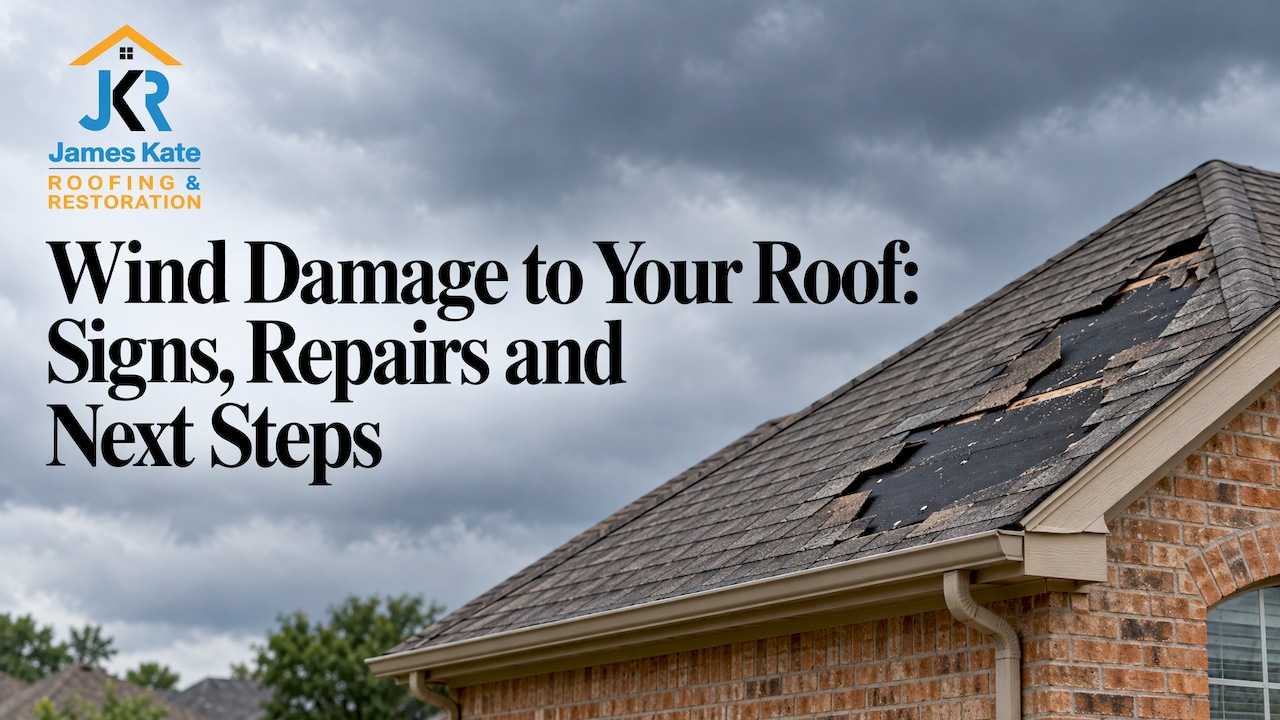
Wind damage to a roof usually starts at the edges and corners, where lifted shingles, bent flashing and loose ridge caps let water in long before a stain shows on your ceiling. The safest move after a high-wind storm is to look from the ground, document what you see, and have a roofer inspect before the next rain. Our team at James Kate Roofing & solar, a GAF Master Elite® contractor in North Texas, offers free inspections and estimates so you can find out whether your roof was hit and what it needs.
TL;DR
- Wind damage concentrates at roof corners, edges and ridge lines, so check those first, from the ground.
- Missing, creased or lifted shingles, bent flashing, granules in the gutters and ceiling stains are the main warning signs.
- Never climb onto a storm-damaged roof. Professional roofing guidance says to inspect from ground level only.
- Small, localized damage can often be repaired. Widespread creasing, tearing or loss usually points to replacement.
- Document everything with dated photos before you call your insurer or a roofer.
Table of Contents
- How wind actually damages a roof
- Signs of wind damage you can see from the ground
- Signs inside the house
- Inspect safely: ground level only
- What to do in the first 48 hours
- Repair or replace: how the decision gets made
- Insurance and wind damage in Texas
- Prevent the next one
- Our approach to wind damage
- Get your roof checked after the wind
- FAQ
- Sources
How wind actually damages a roof
Wind does not just push on a roof. It pulls. A December 2025 article in the journal of the National Association of Forensic Engineers (NAFE) explains that damage is typically caused by uplift or suction forces concentrated at corners, edges and ridge lines. The common patterns are uplift, impact from windborne debris, and progressive failure, where one lost shingle exposes its neighbors.
The National Roofing Contractors Association (NRCA) describes the same sequence: wind damage often begins at roof edges and can spread as wind lifts loosened material. Debris can also damage the surface and clog drains.
Two details matter for the repair decision:
- Creased or flapped shingles do not recover. The same NAFE study identifies four shingle damage modes: creasing, flipping or flapping, tearing or removal, and abrading from debris. A creased or flapped shingle is permanently deformed and cannot return to its installed position, which reduces its wind resistance and its ability to shed water.
- Exposed sheathing is the real risk. The U.S. Department of Housing and Urban Development notes that when high winds blow shingles off, the exposed sheathing will eventually succumb to water damage.
Can 60 mph winds damage a roof?
Yes, they can, particularly on an older roof or one with shingles that have lost their seal. The National Weather Service says storms producing 70 to 80 mph straight-line winds, especially in downbursts, cause significant exterior damage to roofs, awnings and siding, while most homes avoid major structural damage at those speeds. In other words, the roof covering is usually what gets hurt first. Roof age, slope, height, exposure and how well the shingles were sealed and nailed all change how a given gust plays out. North Texas gets plenty of straight-line wind from thunderstorm outflow, so a storm without a tornado warning can still cost you shingles.
Signs of wind damage you can see from the ground
Walk the perimeter of your home in daylight, after the storm has fully passed. Binoculars help. The Colorado Roofing Association lists the ground-visible signs: ceiling stains, missing or loose shingles, granule buildup in gutters, dented gutters or flashing, roofing debris in the yard, and a sagging roofline. It also notes that some storm damage cannot be seen from the ground at all.
Here is what each sign tells you:
| What you see | What it usually means |
|---|---|
| Shingle pieces or tabs in the yard | Shingles have torn or blown off; the layer below is exposed |
| Rows of shingles that look lifted or wavy | Seal strips have failed; shingles can flap and crease |
| Horizontal creases across tabs | Wind has folded the shingle; it will not lie flat again |
| Bent, lifted or missing metal flashing | Water can get in at edges, chimneys and valleys |
| Granules in gutters or at downspouts | The shingle surface is wearing or abraded |
| Missing ridge cap or exposed ridge | The highest, most wind-exposed line has been breached |
| Fence or tree debris on the roof | Impact damage is possible even if shingles look intact |
NRCA also advises homeowners to look for loose attachments and damage from windblown branches or glass, and notes that debris can clog drains and downspouts. Our own guides on spotting roof damage after a storm and early signs of roof damage go deeper on each of these.
Signs inside the house
Water finds the weak spot first and shows up indoors later. GAF’s homeowner guidance recommends starting inside: check the attic for leaks, dark spots, holes or sagging sheathing, and ceilings for stains or mold. Then use binoculars from the ground before you consider anything else.
In the attic, in daylight, look for:
- Daylight showing through the roof deck
- Damp or darkened rafters and insulation
- Sagging sheathing between the rafters
In living spaces, look for brown, yellow or gray ceiling stains, peeling paint on ceilings or upper walls, and any dripping. Even a faint stain after a windy rain deserves a call. A small opening can wet insulation for weeks before the stain spreads.
Inspect safely: ground level only
NRCA’s safety advisory is plain: homeowners and business owners should inspect storm-affected roofs only from ground level and not climb onto the roof because of fall risk. Never inspect during a storm, and never from a ladder in the dark, which NRCA’s strong-wind repair guidance specifically warns against. A damaged deck can give way, and a wet metal, slate or tile roof is slick.
A safe self-check looks like this:
- Wait until the weather is clear and the ground is safe, then check for downed power lines and hanging limbs first.
- Photograph the ground-level view of each side of the house, plus debris in the yard, with the date on your phone.
- Check the attic and ceilings for the interior signs above.
- Scan the roof with binoculars, starting at the corners, eaves, ridge and flashing.
- Note the time and date of the storm. Local weather reports help tie the damage to a specific event.
That is where a do-it-yourself look should stop. What it cannot tell you is whether the shingles that look fine have broken seals, creases or fastener problems. Our roof damage assessment guide walks through how to check, document and decide. Routine upkeep matters too: roof maintenance before the rainy season keeps small lifts and gaps from turning into leaks.
Our team does the part you should not attempt: a hail and wind damage inspection of the whole roof surface, flashing and penetrations, so you do not have to climb or guess.
What to do in the first 48 hours
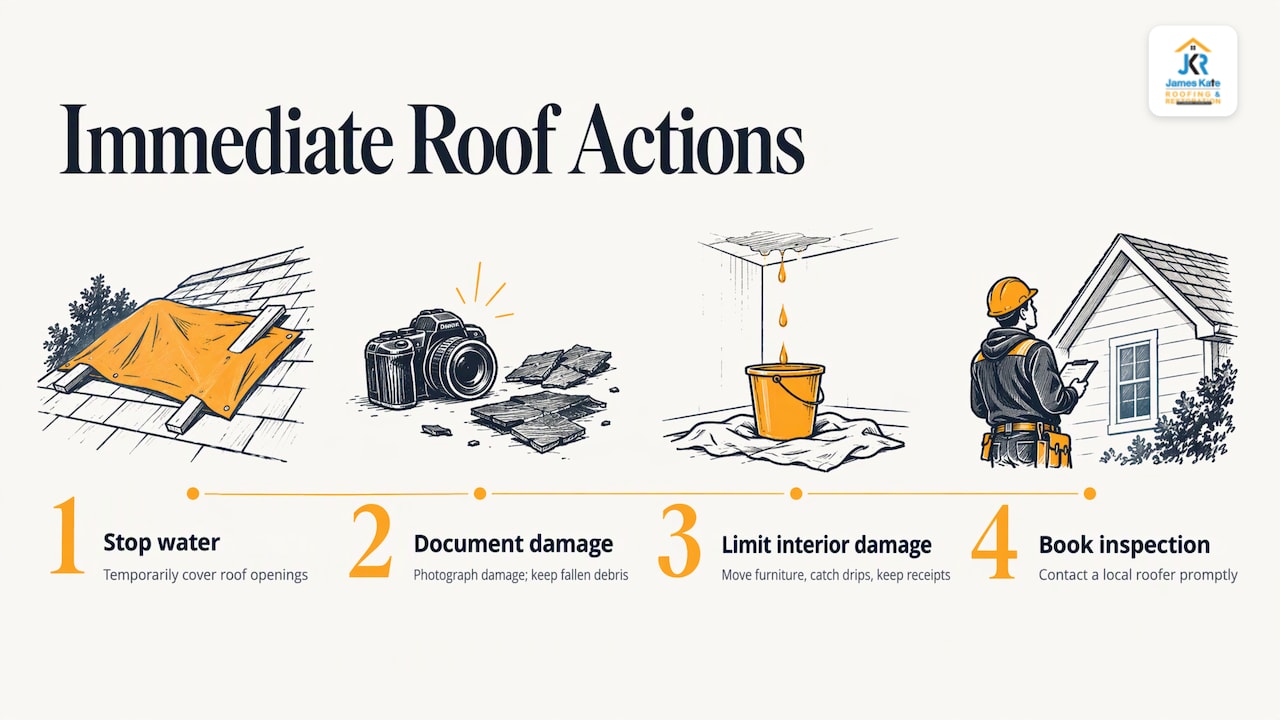
Stop water first. NRCA recommends temporarily covering roof openings to limit rain damage and advises against attempting permanent repairs yourself except in extreme situations. If the roof is open, call an emergency roofer; our emergency roofing in Dallas-Fort Worth team handles tarping and urgent repair.
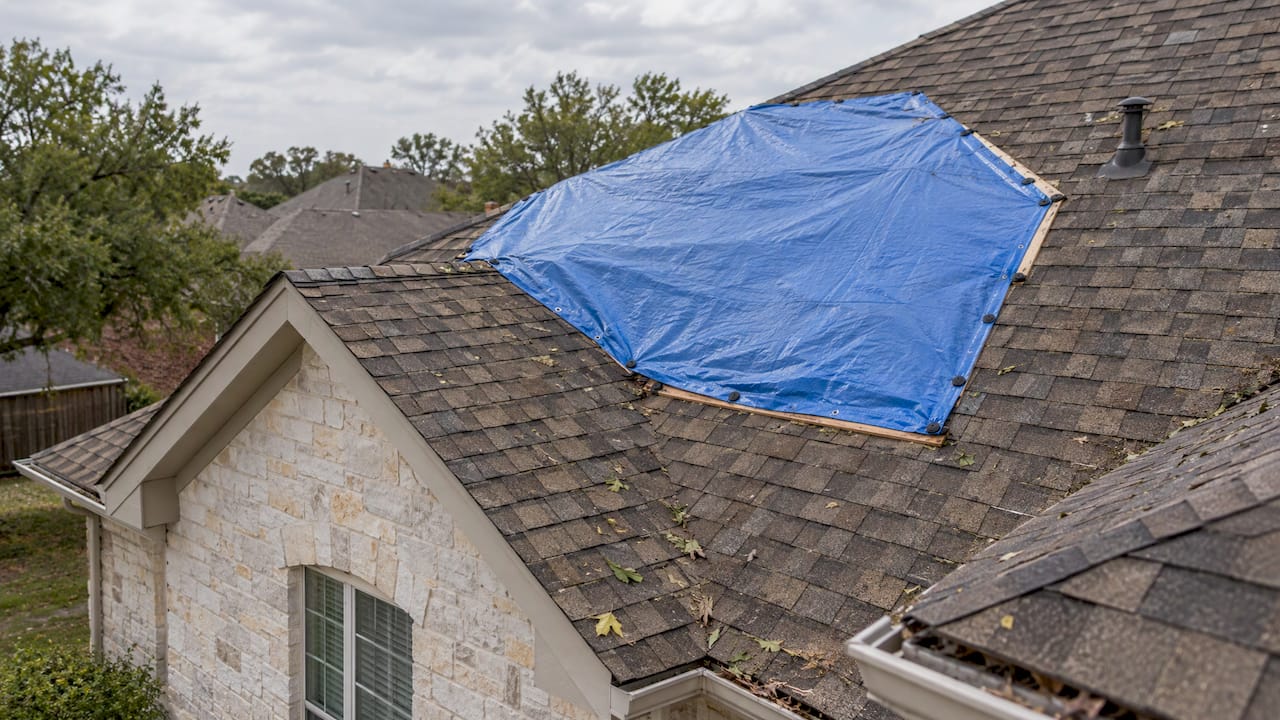
Document before anything moves. Take wide and close photos, and keep any fallen shingles or debris as evidence until your claim is settled.
Limit interior damage. Move furniture, place buckets under drips, and keep receipts for emergency expenses.
Book a professional inspection. NRCA’s advice is to contact a local roofing professional as quickly as possible, and to have roofs inspected even when damage is not apparent. Our 6 steps to repairing wind damage and minor wind damage advice pages lay out what happens next.
Repair or replace: how the decision gets made
There is no single wind speed that decides it. The call comes down to how much of the roof is affected and what condition the rest is in.
| Situation | Usual direction |
|---|---|
| A few missing or torn shingles in one area, roof otherwise sound | Repair: replace the affected shingles and reseal |
| Bent or missing flashing, vent or ridge cap | Repair: replace the component |
| Localized leak traced to one opening | Leak diagnosis and targeted repair |
| Creased or flapped shingles across multiple slopes | Often replacement, since creased shingles cannot return to position |
| Sheathing exposed, soaked or sagging | Deck repair plus re-roofing of the affected area or the whole roof |
| Older roof with widespread seal failure plus storm damage | Replacement is commonly the more durable answer |
The reasoning follows the research. Because a creased shingle is permanently deformed, spot-sealing a roof full of them only postpones the next leak. And because wind damage spreads from the edges and from lost shingles, a repair needs to cover the full extent of the problem, not just the shingle that landed in your yard.
If you are weighing the options, our roof repair and roof replacement and installation pages describe each service. Residential roof replacements from us come with a transferable 15-year workmanship warranty, which also helps if you sell the home.
Insurance and wind damage in Texas
Most homeowners policies cover roof damage from a sudden event such as a windstorm, subject to the policy’s terms and its deductible. In North Texas the wind and hail deductible is often set separately from your regular one, and it may be a flat amount or a percentage of the dwelling coverage, so read your declarations page before you file. Filing windows also exist, so do not wait months.
A few practical points:
- Report the storm date and bring your dated photos.
- Get a written inspection and estimate from a roofer so you can compare it with the adjuster’s scope.
- Keep the damaged materials and every receipt.
Our Texas roof insurance claims guide for DFW homeowners and the roof insurance claims page explain the process in more detail. Property managers and commercial owners can book a commercial roof inspection to document wind damage on flat and low-slope systems such as TPO, PVC and modified bitumen.
Prevent the next one
Wind damage gets worse on roofs that are already aging. Sealed shingles, tight flashing and secure ridge caps all reduce what a gust can grab. Floridian building-code education material notes that uplift pressures vary with roof height, slope, location and roof style, which is why a roofer looks at your specific house, not an average one. Our guide to how to protect your roof from wind damage covers it, and scheduled roof maintenance is one of the services we offer.
Our approach to wind damage
We start from a simple view: a wind-damaged roof should be judged on the whole surface, not on the one shingle that ended up in the yard. The damage usually begins at the edges, and what you see from the driveway is only part of it.
That is why our storm-damage assessments and hail and wind damage inspections cover the full roof, and why our instant roofing quote tool looks at a roof’s health against historical weather data, so you can see whether your address was affected by severe storms.
Inspections and estimates are free, and we explain what we find in plain terms so you can decide with confidence. As a GAF Master Elite® contractor, and recipient of the GAF President’s Club Award and IKO Craftsman Premier Contractor status, we hold ourselves to the manufacturers’ standards. If the answer is replacement, our residential replacements carry a transferable 15-year workmanship warranty.
Dustin Eatman
Get your roof checked after the wind
If the last storm left shingles in the yard, a stain on the ceiling or just a nagging feeling, we will inspect the roof for you. Our team handles storm-damage assessments and hail and wind damage inspections across Dallas, Tarrant, Collin, Denton and the other North Texas counties we serve, with repair, replacement and emergency roofing available when the inspection calls for it. See our roofing services or book a free inspection.

FAQ
Will insurance pay for wind damage to a roof?
Standard homeowners policies generally cover sudden wind damage, subject to the policy terms and the deductible. Your adjuster decides what is covered under your policy, so file promptly with dated photos and a roofer’s written estimate. Our Texas insurance claims guide explains the steps.
Can you get a new roof from wind damage?
Yes, when the damage is widespread, for example creased, torn or missing shingles across several slopes, or exposed and wet sheathing. Isolated damage is normally repaired instead. An inspection of the full roof is what settles which applies to yours.
Are wind-damaged shingles worth replacing?
Yes. A creased or flapped shingle is permanently deformed and no longer sheds water or resists wind as designed, so replacing it protects the deck beneath. Leaving it invites leaks and further loss in the next storm.
Is it safe to check the roof myself after a storm?
Check from the ground only. Inspect the attic and ceilings, then scan the roof with binoculars in daylight. Do not climb onto the roof or use a ladder in the dark, and leave repairs and the surface inspection to a roofing professional.
Sources
- NAFE journal: Discerning Wind-Related Damage to Residential Roofs (December 2025)
- NRCA: Roof Repair After Strong Winds
- NRCA safety advisory for homeowners and business owners
- HUD: Designing for Natural Hazards, Wind
- National Weather Service: straight-line wind explainer
- Colorado Roofing Association: roof storm damage
- GAF: How to identify roof damage
- Florida Building Commission: Residential Roofing and Hurricanes
- Roof maintenance before the rainy season
Recommended
- 6 Steps to Repairing Wind Damage Before Your Roof Takes Flight
- Spotting Roof Damage After a Storm: Key Signs
- Minor Wind Damage Advice for Concerned Homeowners
- Dealing With Roof Storm Damage: Steps to Take

Dustin Eatman is a seasoned roofing professional with deep, hands-on expertise that spans residential and commercial roofing, insurance solar, and long-term roof asset management. As the owner of James Kate Roofing & solar in the Dallas–Fort Worth metroplex, he’s built a reputation for diagnosing roof systems accurately, communicating clearly, and executing projects with a high standard of workmanship and documentation. Dustin understands the technical details that make roofs perform—proper underlayment selection, slope and drainage considerations, ventilation strategy, flashing and penetration detailing, and manufacturer-specific installation requirements—because he’s worked through the real-world challenges that cause leaks, premature wear, and warranty issues. He’s equally fluent in the operational side of roofing: jobsite planning, quality control, safety, material ordering, crew coordination, and customer experience from inspection to closeout. In insurance-related projects, Dustin brings practical knowledge of claim workflows, adjuster meetings, scope alignment, supplements, and the importance of photo evidence and thorough records, helping property owners navigate stressful situations with confidence. For commercial clients—especially property and facility managers—he emphasizes proactive maintenance and targeted repairs that reduce disruption, extend roof life, and prevent expensive interior damage. Dustin also stays focused on doing things the right way: educating customers on realistic options, setting expectations, and prioritizing solutions that hold up over time rather than quick fixes. That blend of technical skill, field experience, process discipline, and owner-level accountability is what makes Dustin Eatman a trusted expert in the roofing industry.