
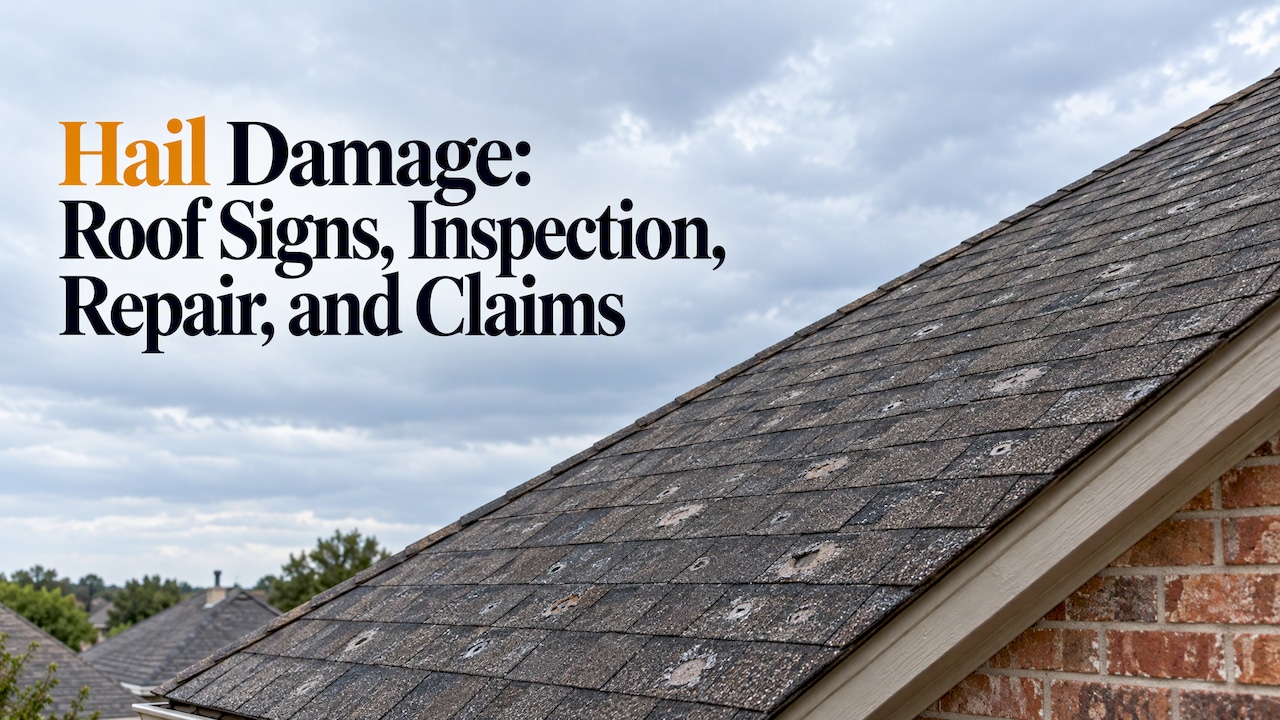
If a hailstorm just crossed your neighborhood, the fastest way to know whether your roof was hurt is a full inspection by a qualified roofer, ideally before you call your insurer. Hail damage often cannot be seen from the ground. It shows up as bruised or cracked shingles, bare spots where granules were knocked off, and dents in metal parts. Some of it calls for a simple repair. Some of it calls for a new roof. This guide shows you how to tell the difference, what to do in the first 48 hours, and how repair and insurance usually work in Texas.
TL;DR
- Look for random dents or divots, missing granules, cracked or shifted tiles, and dented vents, flashing and gutters. Dents in soft metal are often the first clue that hail hit your property.
- Stay off the roof yourself. Photograph what you can from the ground, cover any openings, and keep every receipt.
- Repair is usually practical when only a small share of shingles is damaged. Widespread damage generally points to replacement.
- Texas regulators advise filing a hail claim as soon as possible, getting more than one estimate, and never letting a contractor waive your deductible.
- We offer free inspections and estimates across Dallas-Fort Worth, so you can find out where your roof stands before deciding anything.
Table of Contents
- What hail damage looks like on a roof
- How serious is it? What an inspection should check
- What to do right after a hailstorm
- Repair or replace: how the decision is made
- How long will a hailed roof last?
- Will insurance pay for hail damage to a roof?
- Choosing a hail damage roofer in Texas
- Our perspective on hail damage
- Get your roof checked after hail
- FAQ
- Sources
What hail damage looks like on a roof
Hail does not leave a tidy pattern. Stones fall at an angle driven by wind, so the windward slopes usually take the worst of it. InterNACHI notes that the severity of an impact depends on hail size, density, falling speed, shape, direction and angle of impact. That is why one house can look ruined while the one next door looks fine.
Hail-damaged shingles
On asphalt (composition) shingles, the National Roofing Contractors Association (NRCA) lists granule loss, material removed at the shingle edges, and penetration as the main forms of damage. Shelter Insurance adds random divots and dents or divots in vents, flashing and gutters as things to check.
Here is what that looks like in practice:
- Bruises. Soft, round spots you can feel with a gloved fingertip, often with the mat beneath cracked.
- Bare patches. Dark or shiny circles where the granules were knocked loose and the asphalt shows.
- Granules in the gutters. A pile of grit at the downspout after a storm is worth noticing, though old roofs shed granules too.
- Random placement. Hail damage is scattered across a slope. Damage in neat lines or only along one edge usually has another cause, such as foot traffic or blistering.
Newer shingles generally resist hail better than older ones. The NRCA explains that asphalt becomes more brittle with age, so a roof that has seen many Texas summers can fracture where a younger roof would only scuff.
Our own page on dealing with hail-damaged shingles goes deeper on the shingle side.
Other roofing materials and exterior parts
Shelter Insurance describes the pattern on other materials: wood shingles may crack or split and show bright, unweathered wood, while tile may chip, crack, shatter, shift or go missing, sometimes with crescent- or star-shaped fractures. Hail can also dent aluminum siding and gutters and crack vinyl siding or wood shakes.
The NRCA points out that dents in thin aluminum fixtures, along with weather reports and witness accounts, can help establish that hail actually struck the site. Check these places first:
- Gutters and downspouts
- Roof vents and metal flashing
- Window screens and trim
- Air conditioner fins, fences and garage doors
- Mailboxes and outdoor furniture
If these show fresh dents, the roof deserves a closer look.
How serious is it? What an inspection should check
A roof can look fine from the driveway and still have hidden fractures. A proper hail damage roof inspection is more than a glance from a ladder. It should cover:
- Every slope, not just the one facing the street, with the damage counted and mapped.
- Soft metals and accessories, because their dents show hail size and direction.
- Shingle condition, including granule loss, bruising, fractures and whether the mat is exposed.
- Flashings, vents, skylights and edges, where water gets in first.
- The attic and ceilings, looking for stains, damp insulation or daylight.
The NRCA says an inspection after hail commonly happens anywhere from several days to several months after the storm. That timing is realistic, but it does not mean you should wait. Fresh evidence is easier to document, and your policy has its own reporting requirements.
We offer free roof inspections and estimates for homes and a commercial inspection option for businesses and property managers. If you want to learn the basics before the roofer arrives, our roof damage assessment guide walks through how to check, document and decide, and the severity checklist helps you rank what you find.
What to do right after a hailstorm
The first two days matter most. Follow this order.
- Stay safe. The NRCA advises against inspecting alone or climbing ladders in the dark or on unstable ground. Wet shingles and loose granules are slippery. Look from the ground with binoculars.
- Photograph everything. The Texas Department of Insurance (TDI) advises photographing and listing damage inside and outside the home.
- Prevent more damage. TDI and the NRCA both advise covering broken windows and holes. A tarp on an exposed section is a standard temporary fix. If you need one fast, see our emergency roof tarping service in Dallas.
- Keep receipts. Temporary repair costs belong in your claim file.
- Call your insurer before permanent work. The Arizona Department of Insurance and Financial Institutions explains that a policy may require the insurer to inspect damaged property before you repair or dispose of it. If emergency work is unavoidable, document the damage, the repairs and the costs first.
- Get a roofer’s inspection. An independent report tells you what you are dealing with before the adjuster arrives.
If you are in a hurry and water is coming in, our emergency roofing team can stabilize the roof.
Repair or replace: how the decision is made
The honest answer is that it depends on how much of the roof is affected and how deep the damage goes.
The NRCA says severe wood splitting, significant granule loss, shingle penetration or fracture may require shingle replacement. Published guidance for assessing hail damage to shingle roofs, prepared by a certified professional engineer in 2012, offers a useful rule of thumb:
| Share of shingles damaged | Typical conclusion |
|---|---|
| Below 10% | Replacing individual shingles is generally economically practical |
| 10% to 12% | Case-specific judgment needed |
| Above 12% | Complete replacement is generally required because of hail alone |
This is a guideline for assessment, not a promise for any one roof. Slope, shingle age, and local repair rules all affect the final call.
What a shingle repair involves
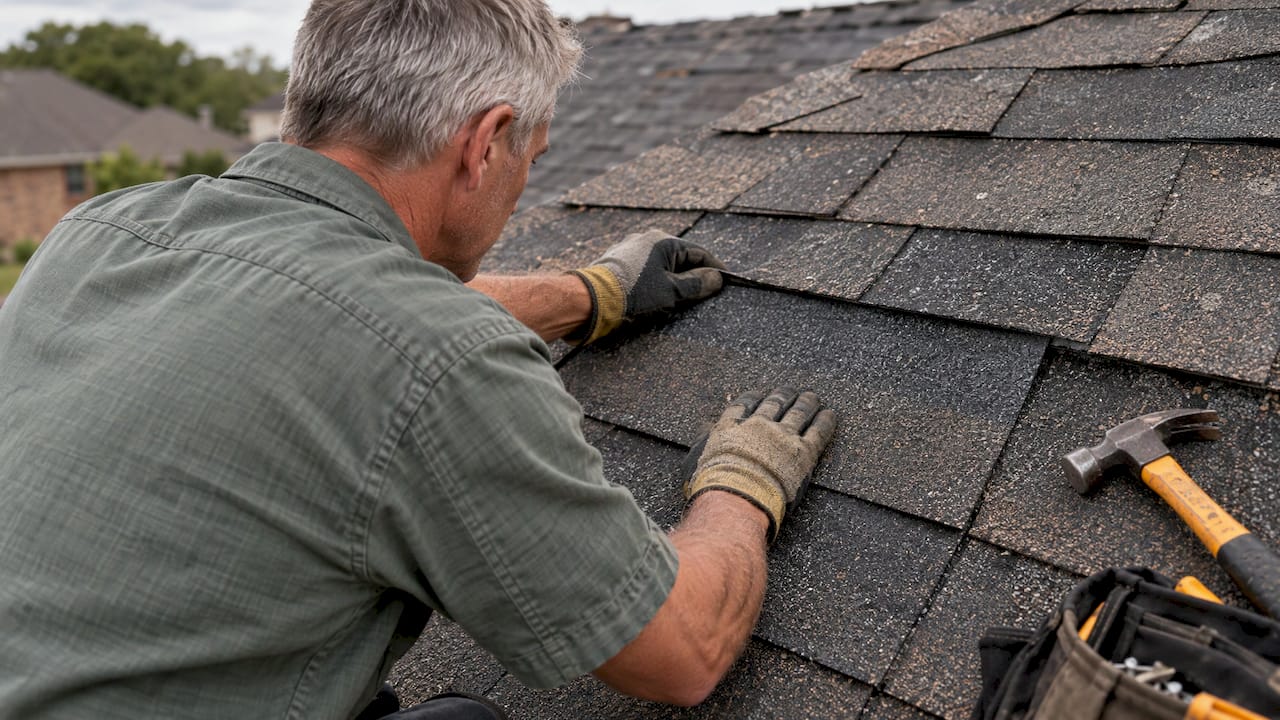
The same guidance describes the standard method: unseal the adhesive strips, remove the relevant nails, install the replacement shingle, then hand-seal the new shingle and any loosened tabs with an acceptable asphalt adhesive. It sounds simple, but a repair done wrong creates leaks and voids sealing. Our page on how to replace damaged shingles explains the process, and our roof repair service handles it for you. For leaks that have already started, we also diagnose and repair them.
When replacement is the better investment
If damage is spread across several slopes, if shingles are brittle with age, or if a repair would mean matching old materials that no longer sit well, a new roof is often the sounder choice. Our roof replacement and installation work covers asphalt shingles, metal and tile. Residential replacements come with a transferable 15-year workmanship warranty, which stays with the home if you sell.
Owners of flat or low-slope commercial roofs have their own set of options, including commercial roof repairs, replacement and coatings for TPO, PVC, modified bitumen and built-up systems.
How long will a hailed roof last?
The NRCA says most hail damage is cosmetic and does not shorten shingle life. It also says that severe splitting, heavy granule loss, penetration or fracture may call for replacement. The takeaway: the same storm can leave one roof with decades of service and another with a short fuse. Only an inspection can tell you which you have, and that is the reason to book one even when nothing looks wrong. Unseen fractures let water in slowly, and the first sign may be a ceiling stain months later.
Age matters too. A younger roof usually absorbs impacts better than an older, brittle one.
Will insurance pay for hail damage to a roof?
Often, yes, if your policy covers wind and hail. TDI says hail damage should be covered when the property has wind and hail coverage. Arizona’s insurance regulator adds that homeowners policies generally cover hail damage to the home and personal property, but limitations and exclusions apply, so read your own policy. Flooding needs separate coverage.
Actual cash value versus replacement cost
This is where claims surprise people. The Nebraska Department of Insurance explains that an adjuster may recommend repair or replacement and calculate the roof’s actual cash value just before the storm, with the deductible subtracted from that figure. With replacement-cost coverage, the insurer may pay the difference between actual cash value and the real cost once the work is finished, subject to a policy deadline that the department says is usually 180 days. Check your own policy for the exact terms.
Is it worth filing?
The Nebraska department advises comparing repair estimates with your deductible. If the estimate sits well above it, a claim usually makes sense. Our guide on estimating hail repair costs before calling your insurer explains how to do that comparison, and our page on insurance roof inspections covers what they check.
Build a claim file that holds up
Before the adjuster visits, put together:
- Dated photos of the roof, gutters, siding and any interior stains
- A written list of other damaged items. Nebraska’s department suggests including windows, shutters, siding, fascia, ceilings and satellite dishes
- Receipts for temporary repairs
- A written estimate from a roofer
This preparation applies to any exterior project, and a step-by-step guide to filing a claim and getting insurance-ready bids shows how the same approach works for a damaged fence, which many hail claims include.
If your findings and the insurer’s differ, the NRCA says a reinspection with the adjuster and contractor reviewing the damage together can be requested. Our team can walk the roof with an adjuster and explain what we found.
Choosing a hail damage roofer in Texas
Storms bring door-knockers. TDI recommends getting more than one estimate, checking references, not paying the full amount up front and not making the final payment until the work is complete. It also warns owners against contractors who offer to waive the deductible. Our guide to finding trusted hail damage repair covers more of the process.
What to ask any roofer:
- Are you licensed and insured, and can I see proof?
- Can you provide local references from past storms?
- What warranty comes with the work?
- Will you document the damage in writing and photos?
We are a GAF Master Elite® contractor, a GAF President’s Club Award winner and an IKO Craftsman Premier Contractor. We explain what we find and why, and we back residential replacements with a transferable 15-year workmanship warranty.
Our perspective on hail damage
We see the same pattern after almost every North Texas storm. Homeowners either assume their roof is fine because nothing leaks, or they assume it is destroyed because the neighbor got a new one. Both guesses cost money.
The roof is a system. Shingles, flashing, vents and the deck all take hits differently, and a surface check can miss fractures that only show up as leaks later. That is why we pair a full inspection with documentation: photos, slope-by-slope counts and a written estimate you can hand to an adjuster.
Our instant roofing quote tool uses historical weather data to show whether your roof was in the path of a severe storm, which gives you a starting point before anyone climbs a ladder. Then our free inspection confirms it on the roof itself.
Our goal is that you understand your roof well enough to feel secure in whatever you decide, whether that is a repair, a claim or a replacement.
Dustin Eatman
Get your roof checked after hail
We serve homeowners, property managers and business owners across Dallas-Fort Worth, including Tarrant, Dallas, Collin, Denton, Johnson, Ellis, Hood and Rockwall counties. Our storm-damage assessments and hail and wind inspections come with free estimates, and our instant roofing quote tool can show whether recent storms hit your address. For a home inspection, start with our roof inspection page.

If you manage a commercial building, we can inspect the roof, rooftop equipment and drainage, then recommend repair, coating or replacement based on what we find.
FAQ
Will insurance pay for hail damage to my roof?
Usually, if your policy includes wind and hail coverage, according to TDI. Your deductible, any actual cash value terms and policy exclusions determine what you receive. Read the policy and call your insurer before permanent repairs.
How serious is hail damage on a roof?
It ranges from cosmetic marks to fractured shingles that let water in. The NRCA says severe splitting, significant granule loss, penetration or fracture may require replacement. A full inspection is the only reliable way to know which applies.
How long should I wait before getting an inspection?
Do not wait. The NRCA says inspections commonly happen days to months after a storm, but fresh evidence is easier to document, and TDI advises filing as soon as possible. Temporary covering for openings should happen immediately.
Can hail-damaged shingles be repaired instead of replaced?
Yes, when damage is limited. Engineering guidance says individual shingle repair is generally practical when under 10% of shingles are damaged, and replacement is generally required above 12%. The range between needs a judgment call on that specific roof.
Sources
- Hail damage to your home or car? What to do next. (Texas Department of Insurance)
- Roof Repair After a Hailstorm (NRCA)
- Hail Damage: Does My Roof Need Repair? (Nebraska Department of Insurance)
- Insurance & Storms or Disasters (Arizona DIFI)
- Guideline to Assess Hail Damage to Shingle Roofs (T. Lozos, CPE)
- Mastering Roof Inspections: Hail Damage, Part 3 (InterNACHI)
- Identifying Hail Damage to Your Home (Shelter Insurance)
- 7 Steps to File a U.S. Fence Claim and Create Insurance Ready Bids
Recommended
- A Comprehensive Guide to Finding Trusted Hail Damage Repair
- Deal With Hail-Damaged Shingles
- Roof Damage Assessment: How to Check, Document and Decide
- How to Estimate Hail Damage Repair Costs Before Calling Your Insurer

Dustin Eatman is a seasoned roofing professional with deep, hands-on expertise that spans residential and commercial roofing, insurance solar, and long-term roof asset management. As the owner of James Kate Roofing & solar in the Dallas–Fort Worth metroplex, he’s built a reputation for diagnosing roof systems accurately, communicating clearly, and executing projects with a high standard of workmanship and documentation. Dustin understands the technical details that make roofs perform—proper underlayment selection, slope and drainage considerations, ventilation strategy, flashing and penetration detailing, and manufacturer-specific installation requirements—because he’s worked through the real-world challenges that cause leaks, premature wear, and warranty issues. He’s equally fluent in the operational side of roofing: jobsite planning, quality control, safety, material ordering, crew coordination, and customer experience from inspection to closeout. In insurance-related projects, Dustin brings practical knowledge of claim workflows, adjuster meetings, scope alignment, supplements, and the importance of photo evidence and thorough records, helping property owners navigate stressful situations with confidence. For commercial clients—especially property and facility managers—he emphasizes proactive maintenance and targeted repairs that reduce disruption, extend roof life, and prevent expensive interior damage. Dustin also stays focused on doing things the right way: educating customers on realistic options, setting expectations, and prioritizing solutions that hold up over time rather than quick fixes. That blend of technical skill, field experience, process discipline, and owner-level accountability is what makes Dustin Eatman a trusted expert in the roofing industry.