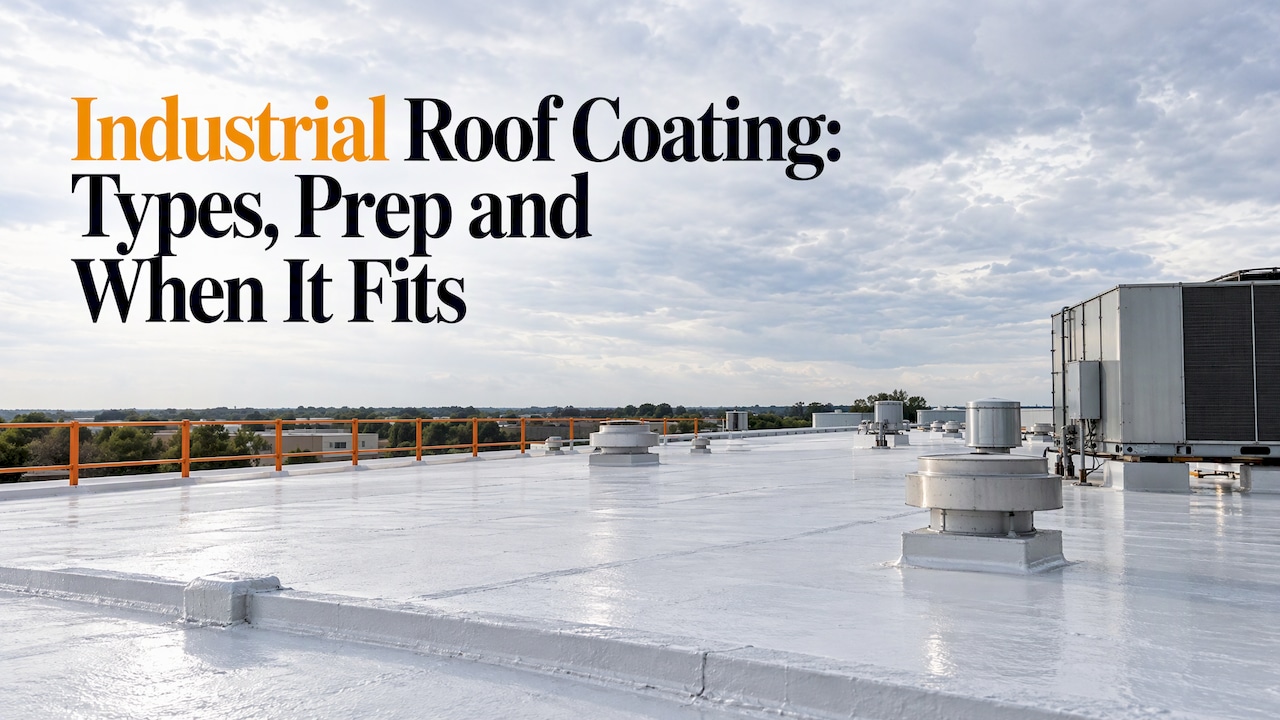
An industrial roof coating is a liquid-applied, rubber-like membrane that cures on top of an existing low-slope or metal roof. It adds waterproofing and UV protection, and it can extend the roof’s service life. It works best on a roof that is dry, drains well and is structurally sound. The right chemistry depends on what the roof is made of, whether water ponds on it, and what lands on it from the building below. Here is how to choose, what has to happen before the first gallon goes down, and when a coating is the wrong call.
TL;DR
- Roof coatings are much thicker than paint. Once cured, they form a flexible film that waterproofs the surface and bridges small cracks and seams.
- The four common chemistries are acrylic, silicone, polyurethane and asphalt. Ponding water, foot traffic, oils and roof material decide which one fits.
- Most coating failures start with the substrate: wet insulation, dirt, rust or poor adhesion. Inspection, repair and an adhesion test come first.
- A coating can extend the life of a sound roof. It does not make a failed roof sound, and it does not add wind or hail strength.
- We offer free inspections and estimates for commercial roofs across DFW, so you can learn whether your roof is a coating candidate.
Table of Contents
- What an industrial roof coating actually is
- The four main types and how they differ
- Matching the coating to your roof
- What has to happen before the first coat
- Application and curing: what the numbers look like
- What you gain: life, energy and budget
- When to coat, repair or replace
- Our perspective
- Get your roof assessed for coating
- Keeping a coated roof performing
- FAQ
- Sources
What an industrial roof coating actually is
The Roof Coatings Manufacturers Association (RCMA) describes roof coatings as products that protect and extend the service life of roof assemblies. They have higher solids than paint and are applied in gallons per 100 square feet rather than fractions of a gallon. After curing, they form a durable elastomeric film that adds waterproofing and bridges small cracks and membrane seams.
“Industrial” usually just means the roof sits on a warehouse, plant, distribution center, or other large commercial building. These roofs are often low-slope or metal, and they often carry rooftop equipment, exhaust, and foot traffic. Those conditions push the choice of coating harder than they do on a house.
Coatings go over many roof types. Elastomeric coatings are used to restore built-up roofs, modified bitumen, TPO, PVC, EPDM, spray polyurethane foam and concrete, according to one manufacturer’s guide, which also notes that a well-maintained roof can be coated and recoated, adding 10 to 20 years of serviceable life. Treat that range as a best case for a roof in good condition, not a promise.
If you want a broader primer, our complete guide to roof coating covers the basics, and this comparison of commercial coating types goes deeper on long-term protection.
The four main types and how they differ
The RCMA lists acrylic, asphalt, polyurethane and silicone as the most common types. Each has a job it does best.
| Coating | Where it shines | What to plan around |
|---|---|---|
| Acrylic | Reflective topcoat on many roof types, common on metal panels | Erodes under standing water |
| Silicone | Roofs where water ponds, strong UV protection | Holds dirt, loses reflectivity over time, harder to recoat |
| Polyurethane | Foot traffic and impact resistance, oily or chemical exposure | Needs an aliphatic topcoat for UV, cost and odor during cure |
| Asphalt | Built-up roofs, asphalt emulsion base coats | Dark unless topcoated, not for single-ply |
The plan-around column comes from The Roofing Brief’s materials overview. Every coating has trade-offs, and a good contractor picks the chemistry whose trade-offs suit your roof.
Acrylic
Acrylics are water-based and widely used as reflective white topcoats. RCMA technical guidance on metal roofing says pigmented acrylics are the most common coating for metal panels because they resist a wide range of chemicals, oils and solvents and show good elongation and recovery. Acrylics should not go on in freezing temperatures or when rain is expected soon after application, and curing is best in warm, low-humidity weather.
Silicone
Silicone coatings are made with a high-solids dispersion of 100 percent silicone. FacilitiesNet notes they have gained market share mainly because they withstand long-term exposure to ponding water and provide excellent UV protection in extreme temperatures. The same article flags that only a few materials can be applied directly over silicone, which matters for future recoats. Our comparison of silicone, acrylic and urethane sealant options walks through the same decision from the repair side.
Polyurethane
Polyurethanes rate best of all coatings for impact resistance and foot traffic. They typically go on as a two-part system: a durable aromatic base coat and an aliphatic topcoat, because the aliphatic layer is UV stable, stays clean and holds color longer. A roof that ponds water for days is generally a better silicone candidate, since polyurethane is more vulnerable to slow hydrolysis under continuous wet contact.
Asphalt-based
Asphalt coatings come as solvent-borne cutback or as water-borne asphalt emulsion. The NRCA guidance notes that water-borne versions have been in use for roughly 60 years as an alternative, and that asphalt emulsions generally meet the fire ratings of the original asphalt built-up system. An independent durability program also observed that other coatings tend to perform better on smooth surfaces when applied over an asphalt emulsion base coat.
Matching the coating to your roof
Start with the roof, not the product.
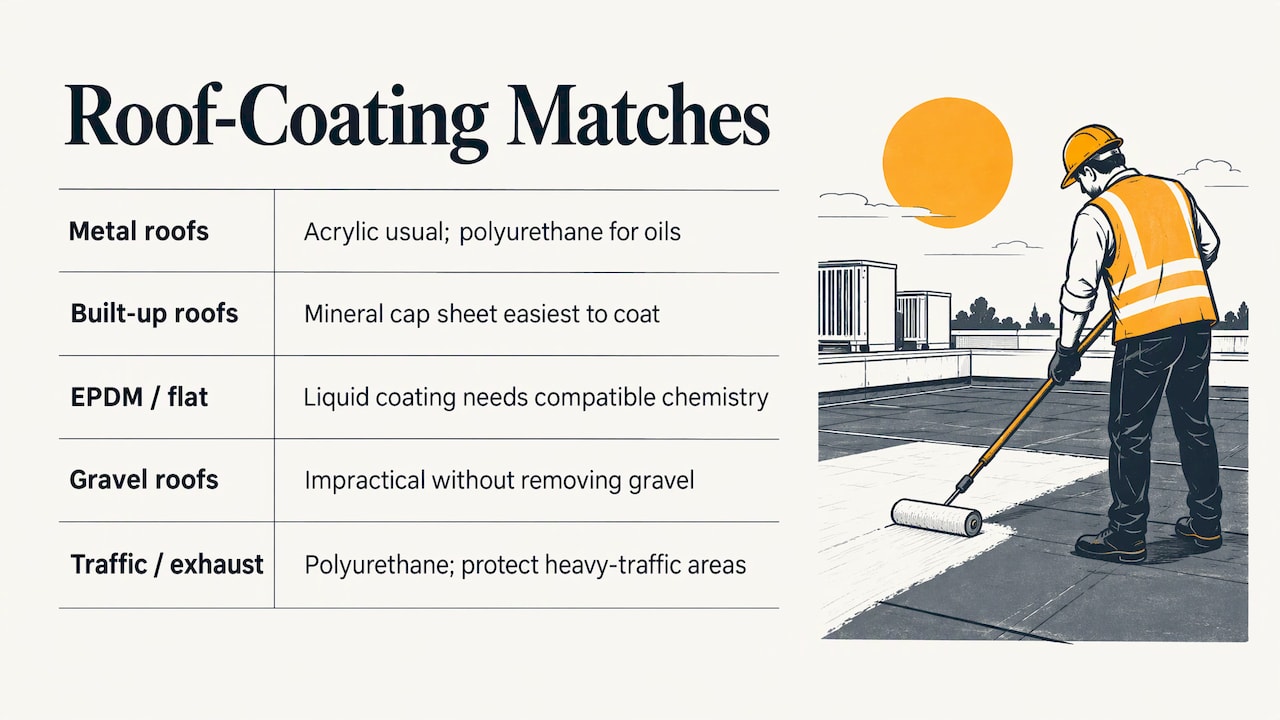
Metal roofs. Acrylics are the usual choice, and polyurethanes are often used where industrial chemicals or oils are present. According to the same RCMA note, solvent-borne elastomeric coatings are not used on areas such as restaurant roofs where oils and solvents are present. Our article on qualified metal roof coating contractors explains what this looks like in practice.
Built-up roofs. The NRCA calls the built-up roof the industry’s workhorse. Common coatings include solvent- and water-borne asphalt coatings, aluminized asphalt coatings and white acrylic elastomerics. A mineral cap sheet is generally the easiest surface to coat, and gravel-covered roofs are generally impractical to coat without removing the gravel.
EPDM and flat roofs. Liquid coatings can restore these, and the chemistry has to be compatible with the membrane. See our guides to liquid coatings for EPDM and waterproof coatings for flat roofs.
Roofs with rooftop traffic or exhaust. Technicians walking to HVAC units, or a kitchen or process exhaust, point toward polyurethane. GAF’s liquid-applied manual says its products should not be used on heavy-traffic bearing substrates, so heavy traffic areas need a different plan such as walkway protection.
What has to happen before the first coat
This is the part that decides whether a coating lasts. Benchmark Inc., a building-envelope consulting firm, puts it plainly: coating performance depends directly on the condition of the substrate and the skill of the applicator. Incomplete preparation can undermine the whole job.
Inspect for moisture and drainage
GAF’s manual requires positive drainage, and the substrate should not pond water for more than 48 hours after precipitation stops. Substrates must be clean, completely dry and free of debris. Moisture trapped in a roof adds weight and can deteriorate the deck and, in some cases, the framing, which is why coating should not go ahead until the roof is confirmed dry or repairable.
IIBEC adds a useful benchmark: most coating products tolerate less than 5% surface moisture content. Clean means free of grease, oils and chemical contaminants, and debris-free means all loose material is gone.
Repair, clean and prime
For metal, the MBMA white paper lists the prep: remove debris, repair deficient panels, strip loose paint, scale and rust, remove oils, grease, dirt and salts, and replace loose screws with larger ones with EPDM-clad washers. It also calls for a mock-up and adhesion testing.
Test adhesion
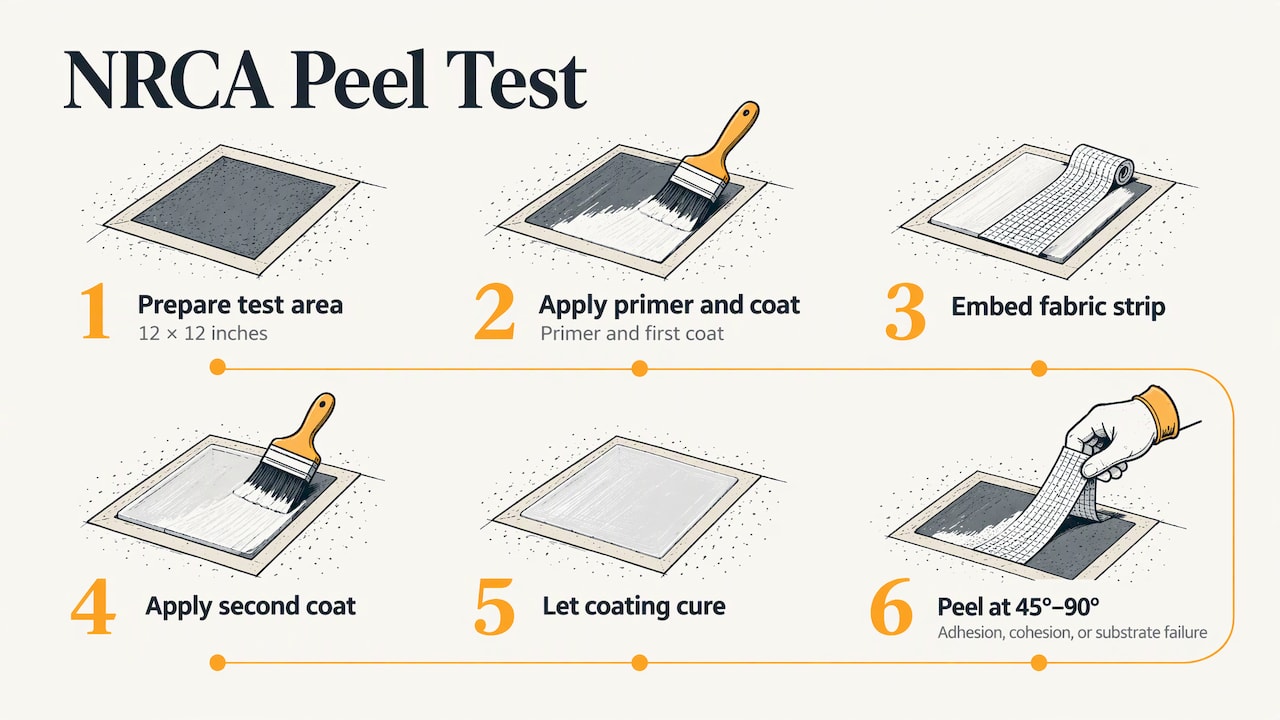
The NRCA’s peel test, as described in that white paper, uses a 12 by 12 inch prepared area. The crew applies primer and a first coat, embeds a fabric strip, applies a second coat, lets it cure, then peels the fabric at 45 to 90 degrees. Adhesion failure, cohesion failure and substrate failure are the three failure modes IIBEC describes, and a test patch catches the first before it covers your whole roof.
The NRCA published guidelines for roof coating applicators in March 2026 covering substrate evaluation, repairs and preparation, and it issued updated roof coating guidelines in July 2026 that include quality control for on-site evaluation. Ask any contractor how their process lines up with them.
Application and curing: what the numbers look like
Thickness is the measure that counts. Coating performance is measured in dry mils, not gallons poured, and many manufacturer warranties tie their term to a minimum dry-mil thickness. Full-system data sheets generally land between about 20 and 35 dry mils.
A typical two-coat polyurethane system illustrates the timing, per one manufacturer guide:
- Prime with the product-specific primer.
- Apply the aromatic base coat, about 20 to 25 mils.
- Recoat within the data sheet window, roughly 10 to 24 hours.
- Apply the aliphatic topcoat, about 10 to 15 mils.
- Allow about 24 hours before walking on it and about 7 days at 77°F and 50% relative humidity for a full chemical cure.
Substrate temperature should be at least 40°F and rising for most products. In North Texas, that makes late spring and early fall the easy windows, with summer jobs scheduled around heat and afternoon storms. Always follow the data sheet for the exact product on your roof.
What you gain: life, energy and budget
Roof coatings extend roof life by preventing water, chemical or physical damage, and reflective coatings lower roof temperatures and cooling costs. That is relevant in Texas heat. The Construction Specifier reports that, per Energy Star, a roof coating can cut peak cooling demand by 10 to 15 percent, and that on a 90°F day a dark roof can reach 150°F while a coated or cool roof may stay closer to 100°F. Actual savings depend on your building, insulation and HVAC.
One manufacturer guide says coating systems are warranted for anywhere from 5 to 25 years, and that once a warranty expires more coating can be applied and a new warranty issued. It also says coating costs about half as much as a full replacement and is far less disruptive to business. Your own quote will show the real comparison for your roof.
Two specifications help when you review a proposal. The RCMA’s recommended minimum is 20 dry mils for most elastomeric waterproofing systems. And ASTM standards such as D6083 for acrylic coatings are material specifications, not warranties: they set lab minimums but do not test wind uplift, fire class or service life.
When to coat, repair or replace
A coating is a solar tool. According to Mule-Hide’s authors in CoatingsPro, solar can extend the life of a roof in good repair, but it will not fix a failed roof, and repairs must be made first.
Coating is usually a strong fit when:
- The membrane or panels are sound and the insulation is dry.
- The roof drains properly, or ponding can be corrected.
- Leaks are localized and repairable.
- You want to extend service life and improve reflectivity without a tear-off.
Repair or replacement is the better path when:
- Insulation is saturated or the deck is deteriorated.
- Leaks and ponding are widespread.
- Structural integrity is lost. The MBMA white paper says that cannot be coated and calls for more aggressive repair.
One more point for storm-prone North Texas. Benchmark notes that coatings are not considered a new roof under model building codes or insurance carrier standards, and they do not add wind uplift or hail resistance. If a hailstorm has already hit, document the damage first. Our guides on roof damage assessment and types of storm damage show how.
Our perspective
We see the same pattern on North Texas commercial roofs. The coating gets the attention, but the inspection decides the outcome. A roof that is dry, drains and has sound seams can take a coating and keep earning its place for years. A roof with wet insulation needs the repair conversation first.
That is why we start with a data-driven assessment, not a product pitch. As a GAF Master Elite® contractor, we work to manufacturer standards, and we build the recommendation around what we find: roof type, drainage, exposure to storms and the way your building uses its roof. Sometimes that points to a coating. Sometimes it points to targeted repair, and sometimes to replacement. Because we install and repair as well as coat, we can recommend whichever fits.
Our advice to property managers: schedule the inspection before budget season, so the coating, repair or replacement decision is made on facts, with time to plan around weather.
Dustin Eatman
Get your roof assessed for coating
We offer commercial roof coatings, repairs, replacement and inspections across the Dallas-Fort Worth area, with free inspections and estimates. Our commercial roof inspection and estimate starts the process: we look at the substrate, drainage and moisture, then tell you whether a coating, a repair or a replacement is the right plan.
You can read more about our commercial coating services, or see our local pages for Fort Worth and Denton.
Keeping a coated roof performing
Maintenance is part of the deal. One fluid-applied roofing manufacturer’s care guide recommends a written annual maintenance program, inspections at least twice a year, in spring and fall, and after every major storm, clearing debris especially around drains, and not letting water stand more than 48 hours after rain.
A second manufacturer’s guidelines say buildings that exhaust debris onto the roof, such as manufacturing facilities and restaurants, need more frequent inspections, about six per year. Check your own coating warranty for its exact requirements, since missed maintenance can matter later.
For small problems between visits, see our guide to prompt commercial roof repairs.
FAQ
What is the best coating for a metal roof?
Pigmented acrylic is the most common coating for metal panels because it resists many chemicals and oils and recovers well after stretching. Polyurethane is often used where industrial chemicals or oils are present, and silicone is the usual pick where water ponds. The panel condition and prep matter as much as the product.
How long does an industrial roof coating last?
It depends on the system, thickness and roof condition. One manufacturer guide cites warranties from 5 to 25 years, with recoating possible once a warranty ends. The warranty term is usually tied to a minimum dry-mil thickness, so ask for that figure in writing.
Can a coating fix a leaking roof?
A coating can seal small cracks and seams on a sound roof, but it cannot turn a wet, failed roof into a good one. Leaks should be diagnosed and repaired first, and wet insulation should be dealt with before coating. An inspection tells you which case you have.
Does a roof coating add hail or wind resistance?
No. Coating does not increase a roof’s structural performance, wind uplift or hail resistance. It protects against water, UV and weathering. After a storm, have the roof assessed for damage before deciding on coating.
Sources
- About Roof Coatings, RCMA
- Elastomeric Coating: The Definitive Guide
- 4 Types of Roof Coatings, FacilitiesNet
- Roof Coating Materials: Types and Substrate Matches
- Roof Coating ASTM Standards
- NRCA roofing guidelines
- RCMA Coatings Tech Note 5, Metal Roofing
- Polyurethane Roof Coating Guide
- GAF Liquid-Applied Roofing Manual
- Your First Step to Coating Success: Substrate Preparation, IIBEC
- Coating of Metal Roofs white paper, MBMA
- Considerations When Evaluating Use of Roof Coatings, Benchmark
- NRCA releases guidelines for roof coating applicators
- NRCA offers updated guidelines for roof coatings
- Stretching roofing budgets further, The Construction Specifier
- Roof Coating Failure Modes
- Notes From the Field: Roof solar or Replacement, CoatingsPro
- Care and Maintenance Overview
- Maintenance Guidelines for fluid-applied roofs
Recommended
- Comparing Commercial Roof Coating Types for Long-Term Protection
- Why Qualified Metal Roof Coating Contractors Save You Thousands on Replacement
- The Complete Guide to Roof Coating
- Built-Up Roof Coating Solutions Explained for Commercial Owners

Dustin Eatman is a seasoned roofing professional with deep, hands-on expertise that spans residential and commercial roofing, insurance solar, and long-term roof asset management. As the owner of James Kate Roofing & solar in the Dallas–Fort Worth metroplex, he’s built a reputation for diagnosing roof systems accurately, communicating clearly, and executing projects with a high standard of workmanship and documentation. Dustin understands the technical details that make roofs perform—proper underlayment selection, slope and drainage considerations, ventilation strategy, flashing and penetration detailing, and manufacturer-specific installation requirements—because he’s worked through the real-world challenges that cause leaks, premature wear, and warranty issues. He’s equally fluent in the operational side of roofing: jobsite planning, quality control, safety, material ordering, crew coordination, and customer experience from inspection to closeout. In insurance-related projects, Dustin brings practical knowledge of claim workflows, adjuster meetings, scope alignment, supplements, and the importance of photo evidence and thorough records, helping property owners navigate stressful situations with confidence. For commercial clients—especially property and facility managers—he emphasizes proactive maintenance and targeted repairs that reduce disruption, extend roof life, and prevent expensive interior damage. Dustin also stays focused on doing things the right way: educating customers on realistic options, setting expectations, and prioritizing solutions that hold up over time rather than quick fixes. That blend of technical skill, field experience, process discipline, and owner-level accountability is what makes Dustin Eatman a trusted expert in the roofing industry.