What It Costs to Repair Hail Damage on a Hood
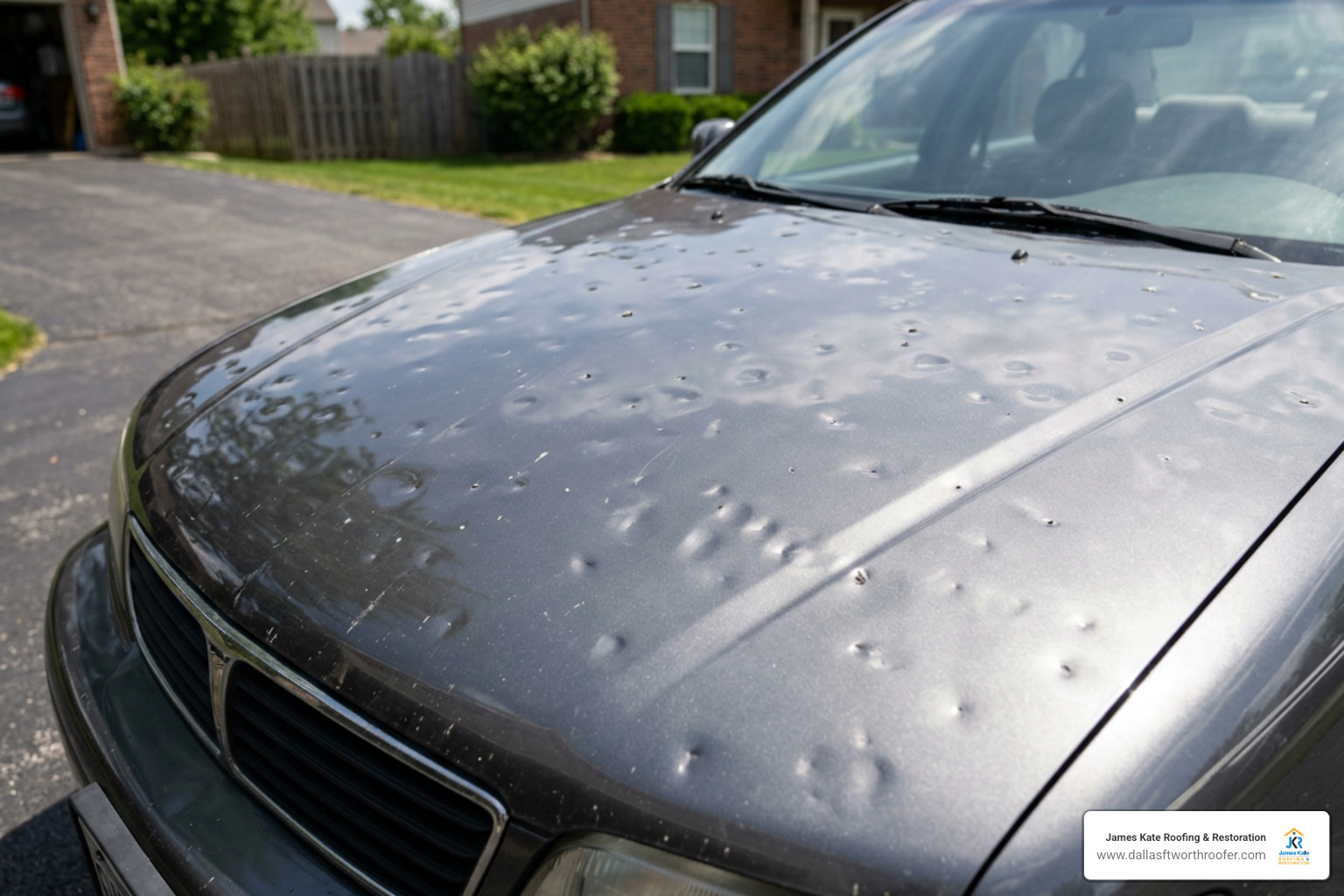
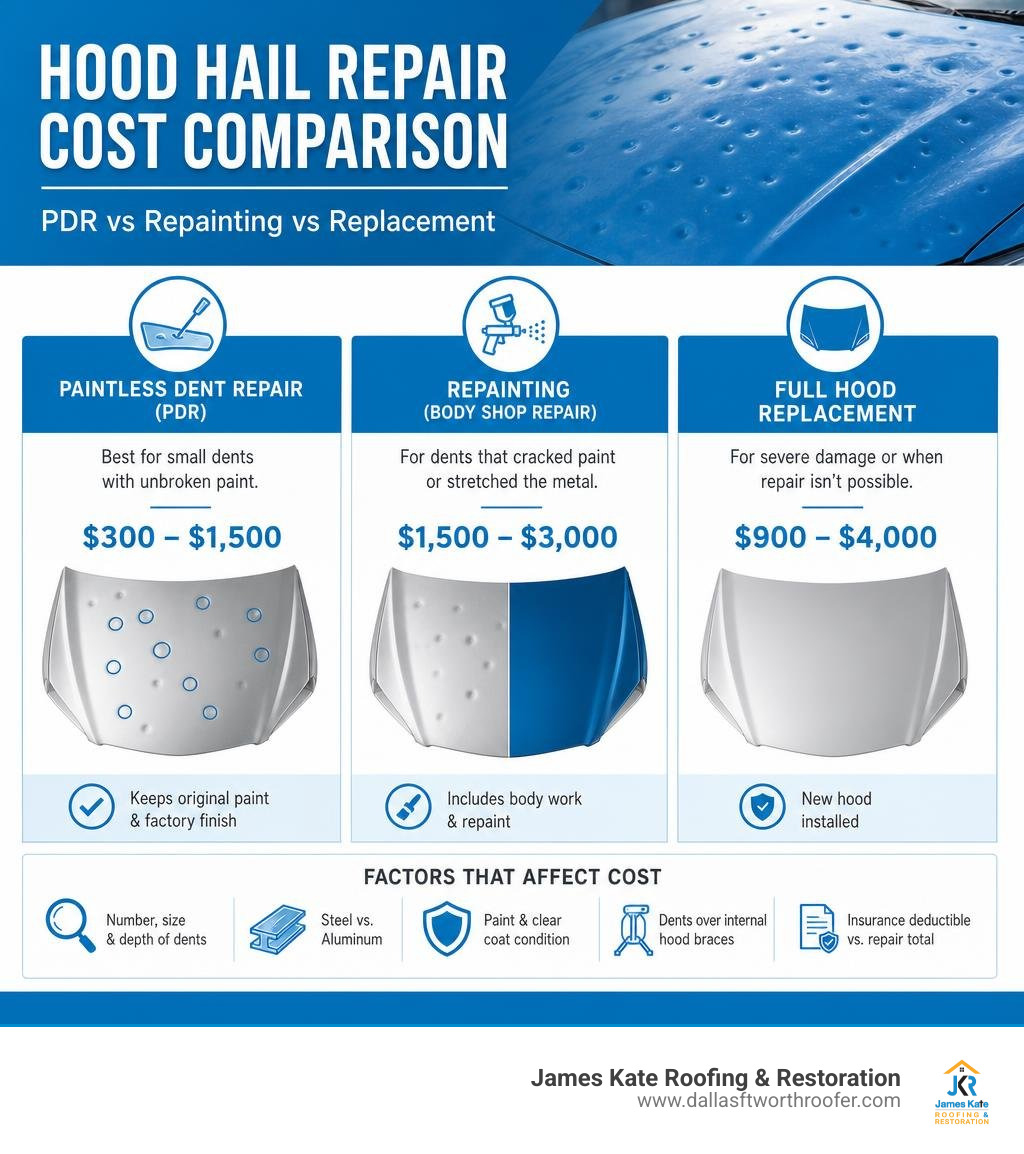
The cost to repair hail damage on a hood is usually $300 to $1,500 when paintless dent repair (PDR) is possible. A hood with 20 to 40 small hail dents often costs $400 to $900 for mobile PDR. If hail cracked the paint or badly stretched the metal, a body shop repair and repaint can run $1,500 to $3,000, while full hood replacement may cost $900 to $4,000.
The fastest way to avoid overpaying is to get an itemized estimate that identifies:
- The number, size, and depth of dents
- Whether the hood is steel or aluminum
- Whether the factory paint and clear coat are still intact
- Whether dents sit over internal hood braces, which can limit PDR access
- Your comprehensive-insurance deductible versus the repair total
PDR is usually the best value for shallow dents with unbroken paint because it keeps the original finish and avoids filler, repainting, and paint-matching costs. Aluminum hoods, common on many trucks, EVs, and luxury vehicles, generally cost 25% to 50% more to repair than steel because the metal is harder to reshape without damaging the finish.
I am Dustin Eatman, owner of James Kate Roofing & solar in DFW, with hands-on storm-solar and insurance-claim experience that helps property owners understand the real cost to repair hail damage on hood and other storm losses. Clear documentation, a careful inspection, and a realistic scope are the best starting points for a smart post-storm budget.
Learn more about cost to repair hail damage on hood:
Average Cost to Repair Hail Damage on Hood in 2026
When severe storms sweep across North Texas communities like Mansfield, Arlington, Grand Prairie, and Midlothian, car hoods take the brunt of falling ice. Because hoods sit horizontally, hailstones strike at a direct 90-degree angle, transferring maximum kinetic energy straight into the metal.
Pricing out the repair depends entirely on the chosen repair method, dent density, and metal severity. In 2026, standard auto body labor rates across the region range from $70 to $150 per hour, making labor-intensive bodywork significantly more expensive than specialized dent manipulation. Understanding a detailed Cost breakdown for vehicle hail damage ensures you can spot inflated quotes right away.
| Repair Method | Damage Level / Dent Count | Typical Cost Range | Average Turnaround |
|---|---|---|---|
| Mobile / Shop PDR | 1–5 Minor Dents (Pea/Nickel size) | $125 – $350 | 1 – 3 Hours |
| Mobile / Shop PDR | 20–40 Moderate Dents | $400 – $900 | 1 – 2 Days |
| Extensive PDR | 50–100+ Dents (Intact Paint) | $1,000 – $2,500 | 2 – 4 Days |
| Conventional Body Shop | Heavy Dents / Cracked Paint (Respray) | $1,500 – $3,000 | 5 – 10 Days |
| Hood Panel Replacement | Severe Stretching / Structural Damage | $900 – $4,000+ | 7 – 14 Days |
Per-dent pricing generally starts at $50 to $75 for pea-sized indentations, climbing to $75 to $110 for nickel-sized dents, and $110 to $180 or more for quarter-sized or deeper impacts. Interestingly, while a single isolated dent might cost roughly $125 to remove, an extensive cluster of 30 severe dents on the same panel can push labor up toward $255 per dent when bracing, stretching, and access challenges compound.
Paintless Dent Repair vs. Traditional Body Shops: Cost to Repair Hail Damage on Hood
For the vast majority of storm victims, paintless dent repair (PDR) is the undisputed gold standard. PDR relies on fine-tuned metal manipulation, using specialized reflection LED boards and surgical-grade steel rods to massage dents out from the backside of the hood skin.
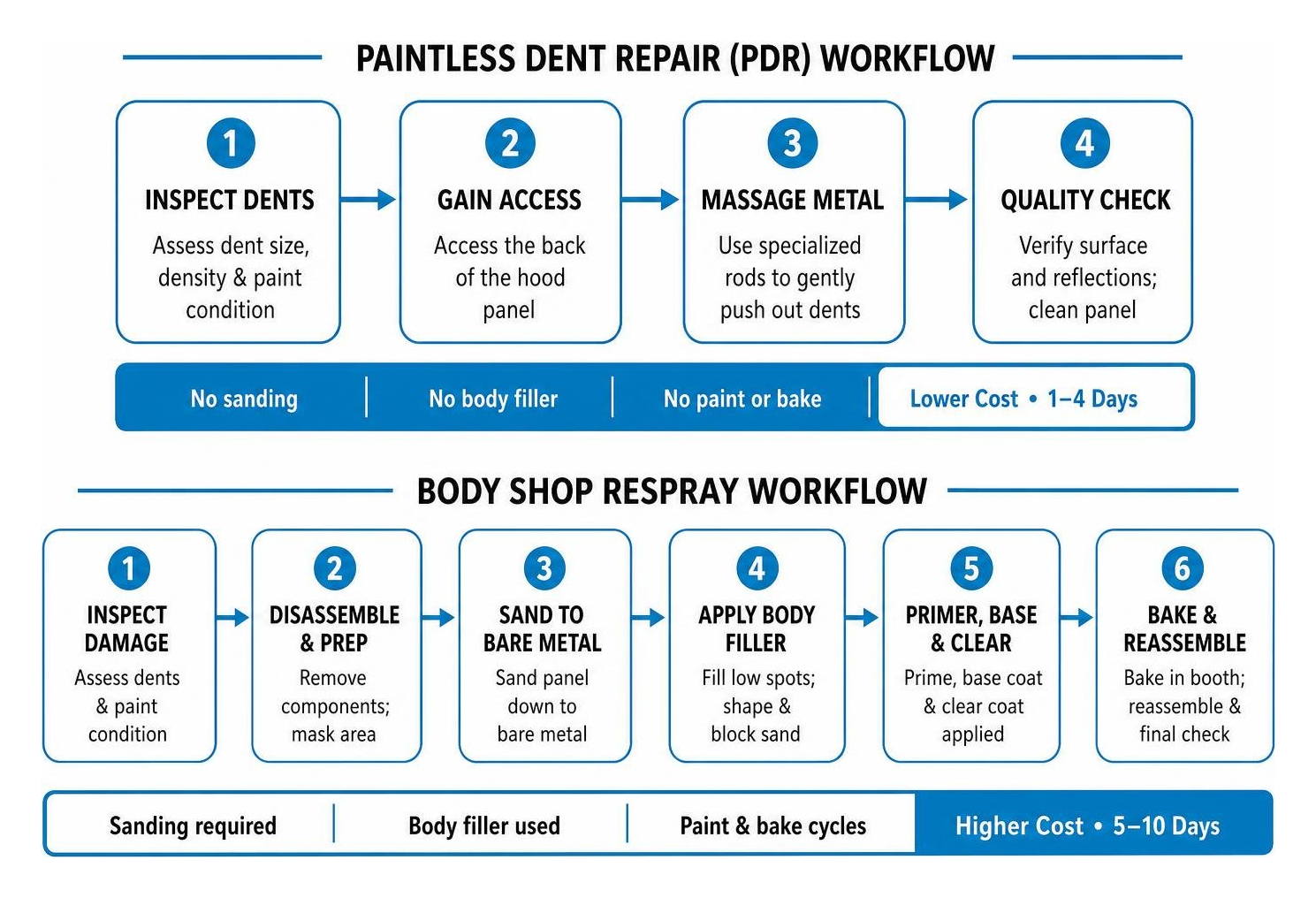
The primary reason PDR costs 40% to 70% less than a conventional body shop comes down to labor efficiency. When eliminating storm dents through PDR, technicians bypass the entire conventional body shop pipeline:
- No sanding down the vehicle panel to bare metal
- No body filler or polyester putty that can crack or shrink over time
- No primer coats, base coats, or baking cycles in a heated paint booth
- No need to blend adjacent fenders to conceal slight color variances
Most importantly, PDR preserves your vehicle’s factory e-coat and original paint finish. Once a panel is repainted in an aftermarket spray booth, it will never perfectly match the factory-applied, robotically cured thermal coating. Keeping that original paint intact protects your vehicle’s resale standing and eliminates paint-depth red flags on future inspections.
When Replacement Outweighs Repair for Severe Hail Dimpling
While PDR works wonders on 85% to 90% of hail-damaged vehicles, severe supercells can drop golf-ball or baseball-sized hail that pushes sheet metal beyond its physical elastic limit. When sheet metal stretches too far, it develops “oil-canning”—a condition where the metal becomes loose, floppy, and incapable of holding its structural crown.
A hood must be replaced rather than repaired under three specific circumstances:
- Severe Metal Stretching: The center of the dent is so deep that massaging it back leaves a protruding high spot or wavy surface.
- Fractured Clear Coat and Paint: If the hail strike cracked, chipped, or shattered the paint down to the primer or bare steel, moisture will enter, leading to rapid corrosion unless the panel is repainted or replaced.
- Internal Frame Separation: Modern hoods feature an underside structural skeleton bonded to the top skin. Violent impacts can break these adhesive welds, compromising crash safety and crumple zones.
When replacement is required, costs climb rapidly. A replacement hood for an everyday vehicle like a 2015 Honda Civic might run $400 to $600 for the raw OEM panel, plus several hundred more in labor and finish blending. On a luxury vehicle, such as a 2022 Audi A6, the bare aluminum hood alone can exceed $1,000, with specialized metallic or three-stage pearl paint adding another $800 to $1,200. This is one of the main reasons why hail estimates double when initial visual inspections miss underlying structural stretching.
Key Factors That Inflate or Lower Hood Repair Estimates
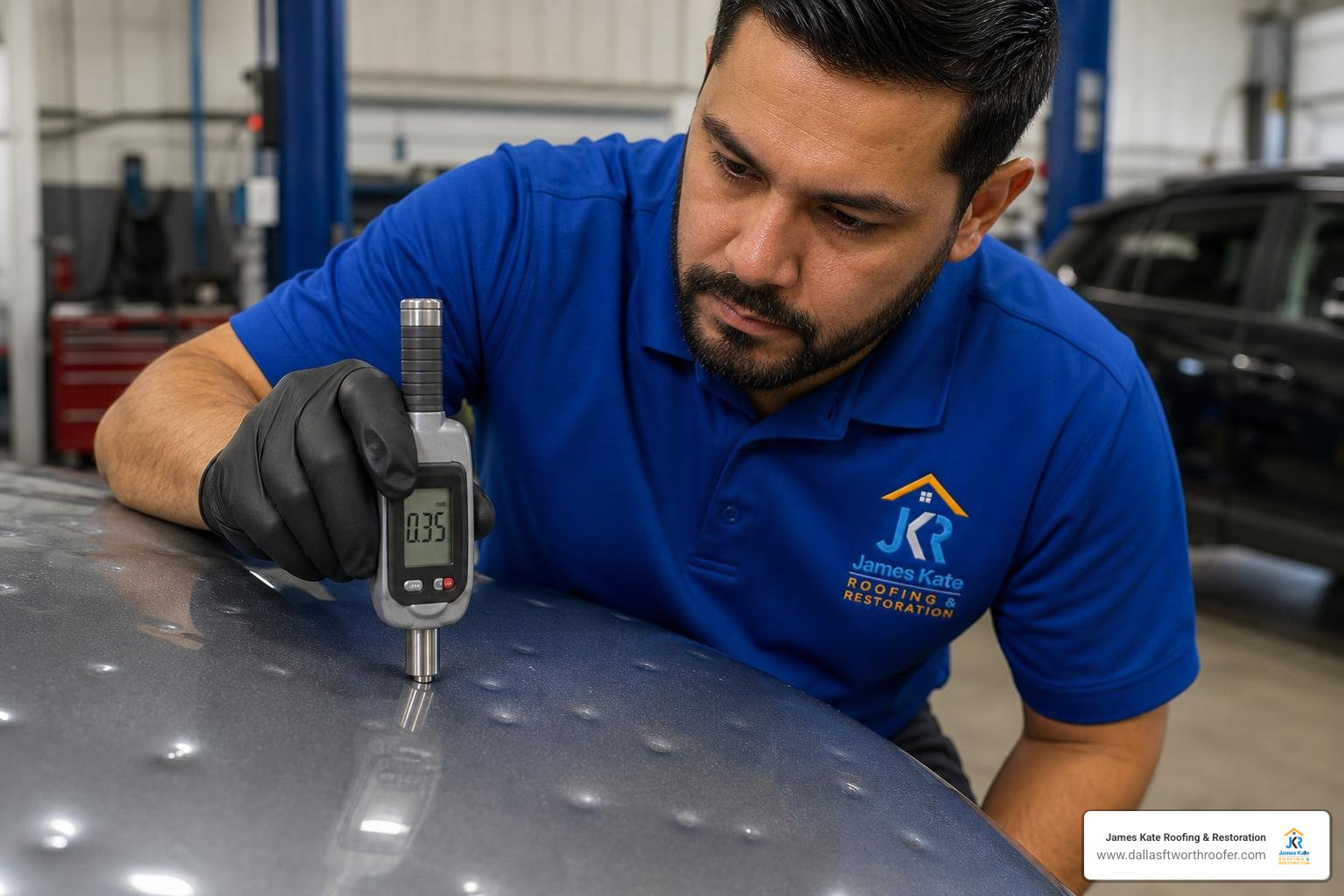
Estimating hood repairs is never a one-size-fits-all equation. Two vehicles hit by the exact same hailstorm in Grand Prairie or Mansfield can receive wildly different repair quotes based on four fundamental mechanical variables.
The physical construction of your hood plays a massive role. Modern hoods are double-skinned. The outer cosmetic skin sits atop an inner structural reinforcement frame known as the “hat-channel.” Dents that land in the open pockets between hat-channel ribs are easy for technicians to access with standard PDR bars. However, dents located directly over hat-channel glue joints or structural ribs require intricate glue-pulling systems from the exterior or extensive panel disassembly, adding substantial labor time.
Ignoring these dents can quietly devastate your equity. We always remind homeowners that physical vehicle degradation parallels structural exterior issues; unaddressed dimpling creates a massive resale price impact that routinely knocks $1,500 to $4,000 off trade-in values.
How Panel Material Affects the Cost to Repair Hail Damage on Hood
The metal composition of your vehicle’s hood is one of the largest pricing variables in modern automotive repair. Over the past decade, automakers have shifted heavily toward aluminum hoods to reduce front-end weight and improve fuel economy. Common aluminum-hood vehicles include:
- Ford F-150 (2015–present)
- Tesla Model S, Model 3, and Model X
- Late-model Lexus sedans and SUVs
- Audi A6, A8, and Q7
- BMW M-series and 5-Series
- Porsche, Jaguar, and Land Rover models
Repairing hail dents on an aluminum hood carries a 25% to 50% labor surcharge compared to standard stamped steel.
Aluminum lacks the “metal memory” of steel. It is stiffer, work-hardens rapidly when manipulated, and dissipates heat quickly. If a technician pushes an aluminum dent too aggressively, the metal can tear or crack the clear coat instantly. A 4-inch hail crease on a steel hood that costs $300 to repair via mobile PDR will easily cost $400 to $450 on an aluminum panel due to the specialized heat induction tools, glue tabs, and meticulous micro-tapping required.
Hidden Add-Ons: Clear Coat, Blending, and Calibration
When conventional body shop repairs become necessary, itemized estimates often swell with hidden ancillary operations that vehicle owners rarely anticipate:
- Multi-Stage Finishes: Standard solid base coats are simple to spray. However, metallic, tricoat, and pearl finishes require delicate multi-stage applications. Matching these finishes to a sun-aged vehicle hood requires adjacent fender blending, which can add $500 to $1,000 to the paint labor total.
- Advanced Driver Assistance Systems (ADAS): Forward-facing cameras, radar sensors, and LiDAR units mounted behind the grille, windshield, or emblem frequently require electronic recalibration after front-end hood removal. ADAS recalibration runs anywhere from $150 to $400.
- Under-Hood Insulation & Clips: Removing the heat blanket and sound-dampening liner under the hood often destroys brittle single-use plastic retaining clips, requiring replacement parts.
- Corrosion Protection and Cavity Wax: Restoring factory anti-corrosion coatings inside the structural hat-channels after heat application adds material and labor lines to a professional body shop quote.
Insurance, Deductibles, and Out-of-Pocket Budgeting Strategies
Understanding how auto insurance categorizes storm damage is essential for protecting your wallet. Auto hail damage is covered exclusively under comprehensive insurance (also known as “other than collision”), not collision insurance.
Because severe weather is an unavoidable act of nature, filing a comprehensive hail claim will almost never increase your baseline insurance premiums. However, deciding whether to file a claim or pay out of pocket comes down to simple deductible math.
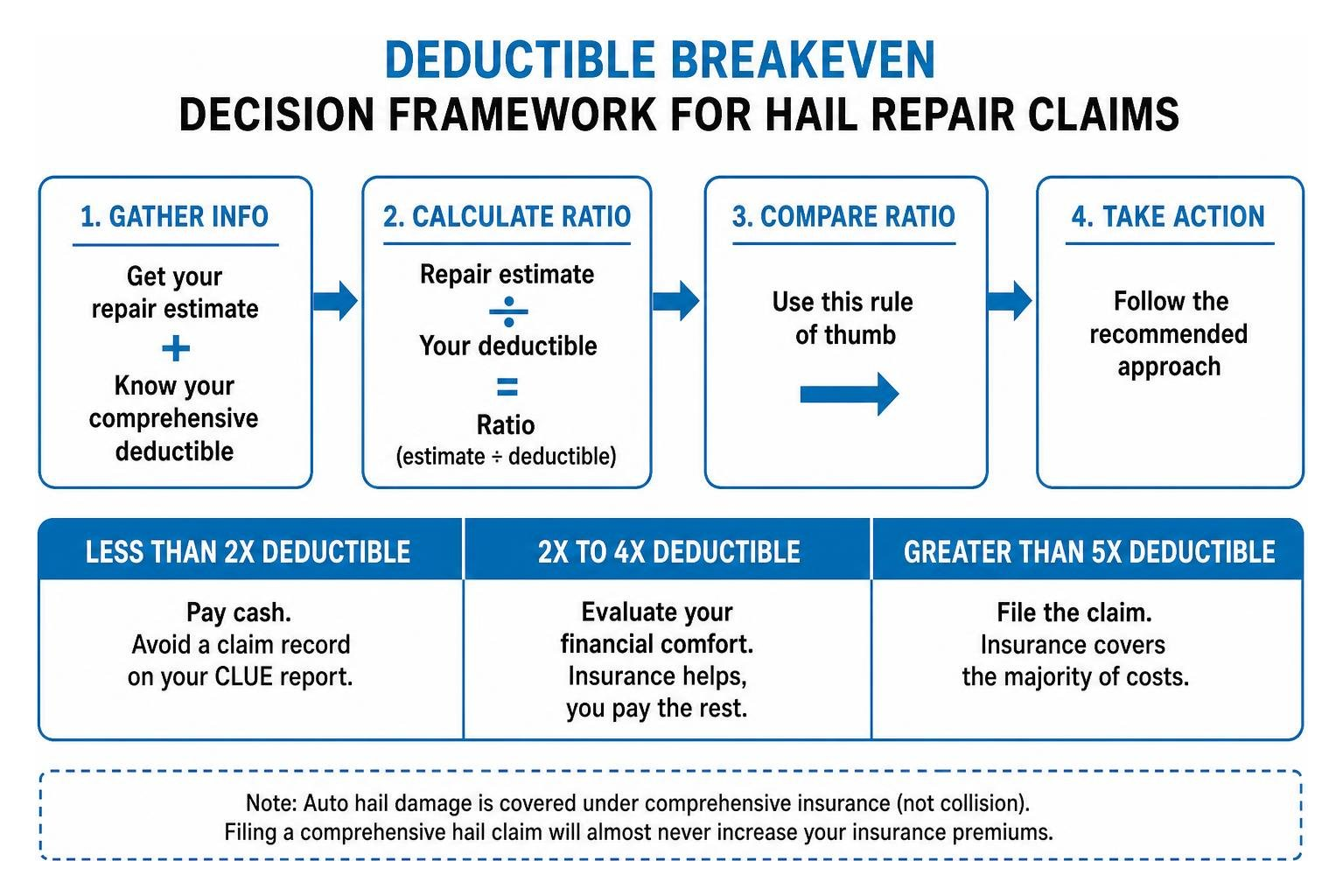
We recommend using this straightforward rule of thumb:
- Repair estimate is less than 2x your deductible: Pay cash. If you have a $500 deductible and the hood PDR quote is $650, paying out-of-pocket avoids placing a claim record on your vehicle’s CLUE report.
- Repair estimate is 2x to 4x your deductible: Evaluate your financial comfort. On an $1,100 repair with a $500 deductible, filing nets you $600 in insurance assistance.
- Repair estimate exceeds 5x your deductible: File the claim immediately. When storm damage across the hood, roof, and trunk totals $2,500 to $6,000+, paying your $500 or $1,000 deductible saves thousands in out-of-pocket expenses.
Much like managing residential types of roof storm damage and how to handle them, documenting vehicle dents immediately after a supercell event prevents adjusters from claiming existing pre-storm wear.
Navigating Insurance Claims and Out-of-Pocket Thresholds
When filing an auto hail claim in North Texas, insurance adjusters frequently use computerized estimate software to calculate initial payouts. Adjusters inspecting cars outdoors in direct sunlight often miss 30% to 50% of shallow indentations.
To ensure you receive fair market value:
- Never settle on a quick drive-by photo appraisal: Photo-based mobile apps fail to capture micro-dents that only appear under specialized reflection line boards.
- Take your vehicle to a certified PDR shop for a supplemental scan: Reputable repair facilities will scan the hood with specialized reflection arrays, document every missed dent, and submit an insurance supplement directly to your carrier.
- Beware of total-loss thresholds: In Texas, if the total cost of repair approaches 75% to 80% of the vehicle’s actual cash value (ACV), insurers may declare the vehicle a total loss. On older, high-mileage sedans, extensive hood and roof dimpling can easily trigger a total-loss payout.
Why DIY Hail Repair Kits Usually Backfire
With consumer suction-cup kits, hot-glue pullers, and dry-ice tricks readily available online for $30 to $60, many vehicle owners are tempted to tackle hood hail repairs in their garage.
In our experience, DIY dent repair almost always turns a minor cosmetic annoyance into an expensive body shop repair.
The primary dangers of DIY dent repair include:
- Over-Pulling and Creating “High Spots”: Pulling too hard with a mechanical bridge tool stretches the metal upward into an inverted crater or “volcano.” Lowering a high spot requires delicate tap-down techniques that take months of training to master.
- Paint Stripping and Clear-Coat Delamination: Consumer-grade hot glues combined with improper release agents will tear aging clear coats right off the primer, forcing an unavoidable $1,000+ panel respray.
- Stretching Metal Past the PDR Threshold: Improper pulling stretches the molecular grain of the sheet metal, making it impossible for a certified PDR technician to massage the panel smooth afterward.
Unless you are working on an old practice vehicle with zero resale concern, leave hail dent removal to certified technicians who back their work with written lifetime warranties.
Frequently Asked Questions About Hood Hail Repair
How long does it take to repair hail damage on a hood?
A hood with light to moderate hail damage (20 to 40 dents) repaired via paintless dent repair typically takes 2 to 5 hours, allowing most mobile PDR technicians to complete the job in a single afternoon. If your vehicle requires conventional body shop repair—involving panel filling, primer curing, basecoat application, and clear-coat baking—turnaround times generally range from 5 to 10 business days. Following major supercell events across North Texas, regional shop backlogs can extend repair timelines by several weeks.
Can I fix aluminum hood hail dents with PDR?
Yes, aluminum hood hail dents can be repaired with PDR, provided the paint remains unbroken and the metal has not stretched past its physical limit. However, repairing aluminum requires specialized high-heat induction, specialized alloy leverage tools, and smaller, more frequent micro-pushes. Because aluminum work-hardens rapidly and has no native metal memory, technicians charge a standard 25% to 50% labor surcharge over traditional steel hood repairs.
Will repairing hail damage on my hood show up on a vehicle history report?
If you pay for paintless dent repair out of pocket, the repair is completely invisible on vehicle history databases like CARFAX, and because PDR retains your original factory paint, dealer paint-depth gauges will read factory-spec. If you file a comprehensive insurance claim, the claim itself will be recorded on your vehicle’s insurance history (CLUE report) and may appear on vehicle history reports as a comprehensive storm repair. However, a properly executed PDR repair does not carry the severe negative valuation penalty associated with structural collision repairs or aftermarket panel resprays.
Conclusion: Protecting Your Vehicle and Property After Severe Storms
Dealing with the aftermath of a severe storm is frustrating, but restoring your vehicle’s hood doesn’t have to drain your savings. By securing itemized estimates, understanding whether your hood is steel or aluminum, choosing paintless dent repair whenever factory paint remains intact, and calculating your insurance deductible breakeven point, you can navigate hail solar with total confidence.
When severe hail hammers your driveway, the damage rarely stops at your vehicle. The same violent hail strikes and wind gusts that dent car hoods often cause hidden shingle bruising, cracked tile, and compromised roof decking overhead.
At James Kate Roofing & solar, our family-owned team brings honest, integrity-driven storm solar solutions to property owners throughout Mansfield, Arlington, Grand Prairie, Midlothian, and Granbury. Whether you need a comprehensive post-storm roof inspection, emergency water mitigation, or full exterior build-back construction backed by our GAF President’s Club recognition and 25-year workmanship warranty, we are here to protect what matters most. Visit our team at https://www.dallasftworthroofer.com/ today to schedule a detailed storm damage assessment.
Dustin Eatman is a seasoned roofing professional with deep, hands-on expertise that spans residential and commercial roofing, insurance solar, and long-term roof asset management. As the owner of James Kate Roofing & solar in the Dallas–Fort Worth metroplex, he’s built a reputation for diagnosing roof systems accurately, communicating clearly, and executing projects with a high standard of workmanship and documentation. Dustin understands the technical details that make roofs perform—proper underlayment selection, slope and drainage considerations, ventilation strategy, flashing and penetration detailing, and manufacturer-specific installation requirements—because he’s worked through the real-world challenges that cause leaks, premature wear, and warranty issues. He’s equally fluent in the operational side of roofing: jobsite planning, quality control, safety, material ordering, crew coordination, and customer experience from inspection to closeout. In insurance-related projects, Dustin brings practical knowledge of claim workflows, adjuster meetings, scope alignment, supplements, and the importance of photo evidence and thorough records, helping property owners navigate stressful situations with confidence. For commercial clients—especially property and facility managers—he emphasizes proactive maintenance and targeted repairs that reduce disruption, extend roof life, and prevent expensive interior damage. Dustin also stays focused on doing things the right way: educating customers on realistic options, setting expectations, and prioritizing solutions that hold up over time rather than quick fixes. That blend of technical skill, field experience, process discipline, and owner-level accountability is what makes Dustin Eatman a trusted expert in the roofing industry.