
What Are Flood solar Specialists and Why Is Fast Action Essential?
When water enters a building, the clock starts ticking immediately. Water is inherently destructive; it dissolves drywall, swells wood framing, degrades adhesives, and creates an ideal breeding ground for microbial growth within 24 to 48 hours. Flood solar specialists are specialized emergency responders trained to stabilize the structure, extract standing water, map hidden moisture, and dry building assemblies before permanent secondary damage sets in.
A rapid response—ideally arriving on-site as fast as possible—can mean the difference between drying high-value materials in place and executing costly gut-rehabs. Uncontrolled water migrates horizontally across slab surfaces and vertically up wall assemblies through capillary action. By deploying high-capacity extraction units immediately, flood solar specialists stop the spread of moisture at its origin. For comprehensive step-by-step guidance during a property crisis, consult our Water Damage solar Survival Guide.
Emergency Mitigation and Rapid Damage Control
Emergency mitigation is the vital first step of the water recovery process. When our emergency response team is dispatched, our initial objective is to secure the site, isolate active leaks, and perform immediate standing water extraction.
In multi-story structures, water from an upper floor failure quickly flows downward into ceiling assemblies, saturating insulation and interior finishes. Heavy, water-logged materials present severe collapse hazards. Rapid water removal combined with tactical controlled breaching releases trapped water pockets before structural finishes fail. Preventing vertical moisture migration requires specialized containment barriers and immediate moisture mapping, ensuring that water traveling behind wall cavities is identified and mitigated.
What Qualifications Define Certified Flood solar Specialists?
Not all solar contractors are created equal. True flood solar specialists possess specific credentials that verify their technical competence, adherence to industry standards, and financial accountability:
- IICRC Certification: The Institute of Inspection, Cleaning and solar Certification (IICRC) sets the premier global standards for water loss management (such as the IICRC S500 standard). Certified technicians undergo rigorous training in applied structural drying, psychrometrics, and microbial remediation.
- BBB Accreditation: Better Business Bureau accreditation verifies transparent pricing, ethical business practices, and reliable customer service.
- Licensing and Insurance: State licensing along with robust general liability and pollution liability insurance protect property owners from liability during hazardous cleanup operations.
- Proven Local Experience: A trusted solar partner understands regional building codes, climate considerations, and municipal waste protocols.
Review our complete Water Damage Checklist: What to Do Right After the Flood to take proper initial safeguards before our certified team arrives.
Categories of Water Loss, Contamination, and Health Risks
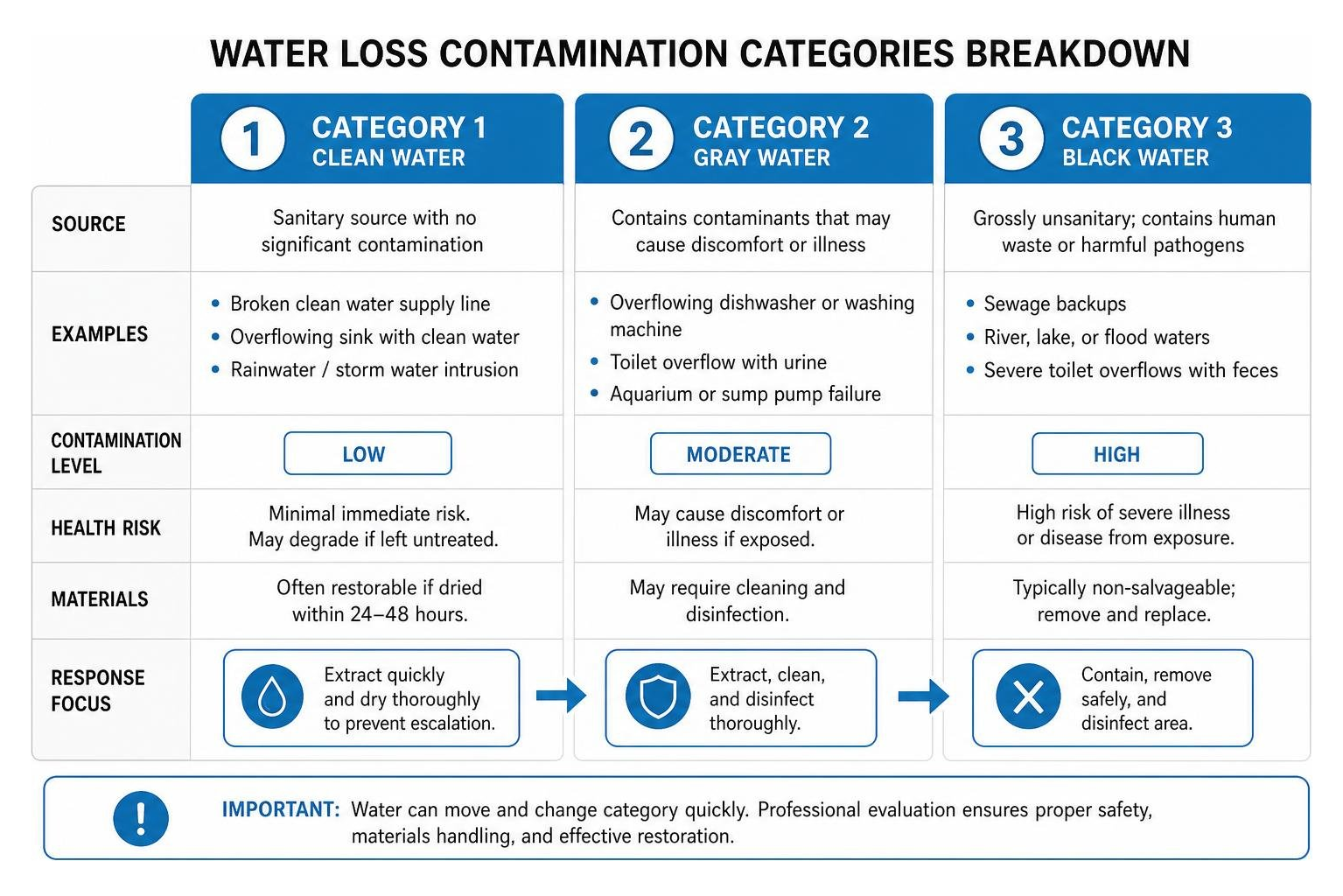
Water intrusion is evaluated according to the degree of contamination present in the source water. Understanding these distinct classifications allows flood solar specialists to implement correct safety protocols, select appropriate personal protective equipment (PPE), and determine which building materials can be sanitized and saved versus discarded. To better understand how these classifications govern response strategies, refer to The Essential Guide to Identifying Your Category of Water Loss.
Category 1 Clean Water vs Category 2 Gray Water Intrusion
Category 1: Clean Water Clean water originates from sanitary sources such as broken clean water supply lines, overflowing sink basins with clean water, or falling rainwater. While Category 1 water does not pose an immediate biological hazard to occupants, it can rapidly degrade into Category 2 or Category 3 if left standing in contact with building materials or organic matter for more than 24 hours.
Category 2: Gray Water Gray water contains significant chemical or biological contamination and has the potential to cause discomfort or illness if consumed or contacted. Common sources include discharge from washing machines, dishwasher overflows, toilet bowl overflows containing urine (no feces), and sump pump failures. Gray water remediation requires physical removal of porous padding, specialized cleaning agents, and controlled surface disinfection.
Category 3 Black Water Contamination and Sewage Cleanup
Category 3: Black Water Black water is grossly contaminated and contains highly dangerous pathogenic, fungal, and viral agents. Common Category 3 events include sewage backups, rising floodwaters from rivers or surface runoff, and combined sewer overflows. Category 3 water presents severe health risks, including E. coli, Salmonella, hepatitis, and norovirus exposure.
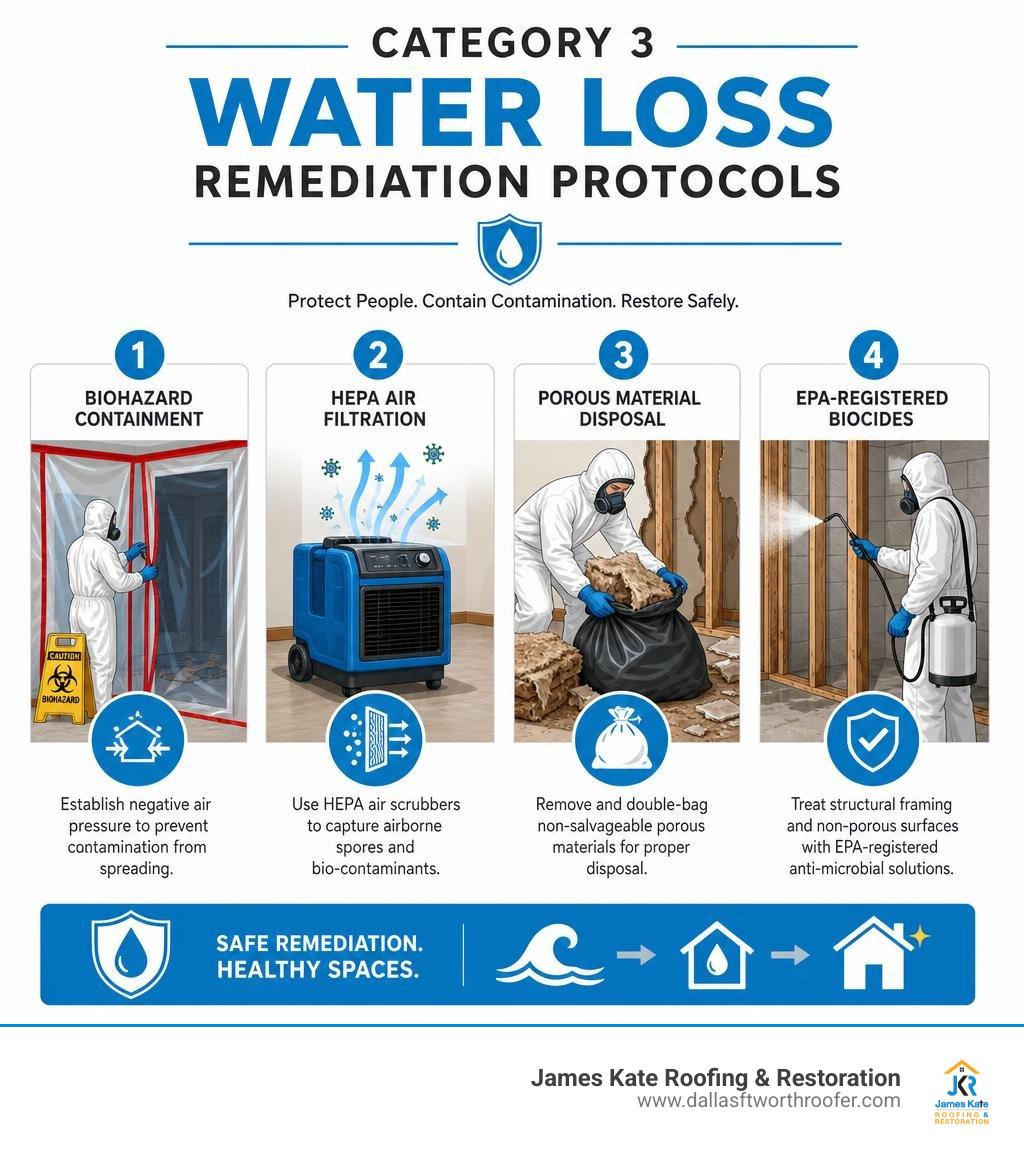
Remediating Category 3 water loss demands specialized hazardous containment procedures:
- Biohazard Containment: Establishing negative air pressure differentials to prevent airborne pathogen distribution throughout clean areas of the property.
- HEPA Air Filtration: Continuous deployment of commercial air scrubbers outfitted with High-Efficiency Particulate Air (HEPA) filters to capture microscopic spores and bio-contaminants.
- Porous Material Disposal: Non-salvageable porous items such as drywall, carpet, padding, and soft insulation exposed to Category 3 water must be double-bagged and removed.
- EPA-Registered Biocides: Structural framing and non-porous assemblies are thoroughly treated with EPA-registered anti-microbial and biocide solutions.
For a deeper look at managing severe biohazard water intrusions, explore our complete guide on Everything You Need to Know About Category 3 Water Loss as well as our deep dive into Black Water Blues: Understanding and Remediating Category 3 Water Damage.
Step-by-Step solar Process and Advanced Drying Equipment

solar requires a methodical, science-backed approach governed by psychrometrics—the study of thermodynamic properties of moist air. Flood solar specialists do not simply rely on surface appearance; we measure specific humidity, grain depression, and moisture content percentage to guarantee thorough drying.
| solar Phase | Primary Equipment Used | Technical Purpose |
|---|---|---|
| 1. Detection & Mapping | Thermal imaging cameras, pinless moisture meters | Map thermal anomalies and measure moisture content % without damaging surfaces |
| 2. Bulk Water Extraction | Ride-on rovers, commercial truck-mounts, submersible pumps | Remove standing water rapidly to prevent capillary migration |
| 3. Evaporation | High-velocity centrifugal & axial air movers | Sheer moisture off damp material surfaces into the surrounding air |
| 4. Dehumidification | Low Grain Refrigerant (LGR) & desiccant dehumidifiers | Pull airborne moisture out of the room environment and drain it away |
| 5. Cavity & Subfloor Drying | Directed floor drying systems, wall cavity injectors | Force dry, warm air directly behind cabinets and under subfloors |
Thermal Imaging Assessment and Invisible Moisture Detection
Water often travels through paths of least resistance, pooling inside wall cavities, behind baseboards, and beneath subfloors where the naked eye cannot detect it. Flood solar specialists utilize infrared thermal imaging cameras to locate hidden moisture pockets by identifying subtle temperature variances caused by evaporative cooling.
Once thermal anomalies are identified, technicians verify exact moisture levels using dual-mode moisture meters. Pinless meters allow surface scanning without puncture marks, while deep-wall pin probes measure moisture content deep inside structural wood studs, sill plates, and subfloor sheathing. This scientific mapping ensures that no damp area is overlooked, preventing future wood rot and mold proliferation.
Commercial Structural Drying and Environmental Dehumidification
Once free-standing water is extracted, moisture bound within building materials must be evaporated and collected. High-velocity air movers are placed strategically to direct laminar air streams along floors and walls, accelerating the rate of evaporation.
As air movers lift moisture into the air, commercial Low Grain Refrigerant (LGR) dehumidifiers lower the relative humidity (RH) of the indoor environment. LGR dehumidifiers continue to extract water vapor even in exceptionally dry conditions, lowering grains per pound (GPP) to maintain ideal drying conditions.
Throughout the process, technicians record daily psychrometric readings to verify that structural materials are steadily drying toward their historic dry standard. To choose the right team for these technical processes, refer to our article on How to Choose the Best Flood Clean Up Services.
Restoring Complex Buildings and Managing Multi-Policy Insurance Claims
Commercial structures, multi-story office buildings, and residential properties each present distinct structural and legal challenges during a major water loss event. Navigating these complexities requires technical proficiency and detailed administrative oversight.
Architectural Challenges in Pre-War and Older Structures
Older structures feature unique architectural components that absorb and hold water differently than modern construction materials:
- Plaster and Lath Walls: Heavy plaster over wood lath retains immense volumes of water. When saturated, plaster loses structural strength and can separate from lath backing, posing severe overhead collapse risks if not addressed immediately.
- Party Wall Water Transfer: Shared party walls constructed of multi-wythe brick or wood framing allow moisture to migrate laterally between adjacent tenant spaces or townhomes.
- Balloon Framing: Older timber balloon framing features continuous vertical wall cavities running from the foundation straight up to the roof line, creating physical chimneys that facilitate rapid vertical water movement.
Restoring these historical or complex architectural assemblies requires tailored drying setups, controlled ventilation, and cautious preservation of structural integrity.
How Flood solar Specialists Navigate Multi-Unit Insurance Claims
When water damage impacts multi-unit residential properties or commercial spaces, resolving insurance claims becomes an intricate, multi-layered procedure. A single plumbing failure can involve several distinct insurance policies:
- Individual Policyholder (HO-6 / Personal Property): Covers interior unit finishes, upgraded flooring, fixtures, and personal contents.
- Property Owner or Building Master Policy: Covers main structural framing, shared vertical risers, common hallways, and building-wide utilities.
- Liability Policies: When water originates in one tenant space due to negligence and floods an adjoining space, liability coverage must be negotiated between carriers.
- Flood Insurance (NFIP): Surface flood waters entering from exterior ground level require distinct coverage under National Flood Insurance Program policies rather than standard commercial or home policy lines.
Flood solar specialists ease this administrative burden by generating fully itemized estimate reports, providing timestamped moisture tracking logs, taking high-resolution thermal images, and coordinating directly with insurance adjusters. For commercial property owners managing revenue risks, consult The Business Owner’s Guide to Surviving Commercial Water Damage and Commercial Water Damage: Swift Action for Business Recovery.
Long-Term Water Mitigation and Flood Prevention Strategies
Once structural drying, sanitation, and build-back reconstruction are complete, implementing proactive water mitigation measures protects your asset against future flooding events.
- Perform Routine Plumbing Inspections: Inspect supply lines under sinks, behind toilets, and attached to washing machines annually. Replace aging rubber flex hoses with braided stainless steel supply lines.
- Install Automatic Water Shutoff Valves: Smart shutoff systems monitor home water flow rate variations and automatically close the main water supply valve when a leak is detected.
- Place Wireless Leak Detection Sensors: Position wireless water sensor pucks near water heaters, HVAC air handler drain pans, and under kitchen sinks to trigger instant smartphone alerts upon water contact.
- Maintain Sewer Backflow Preventers: Install backflow prevention valves on main sewer lines to stop municipal main surcharges from backing raw sewage up through floor drains during severe storms.
- Inspect Roof Coverings and Drainage: Keep gutters clear, verify flashing downspout extensions discharge water at least 5 to 10 feet away from foundation walls, and address roof leaks promptly.
To develop your emergency preparedness strategy, read our comprehensive checklist When the Levee Breaks: Your Emergency Water Cleanup Plan.
Frequently Asked Questions About Water Damage solar
How quickly should professional solar teams arrive after a leak?
A professional solar response team should aim to be on-site as fast as possible, ideally within 60 minutes of your call. Rapid arrival allows technicians to stop active flooding, secure electrical hazards, deploy immediate water extraction equipment, and halt the spread of moisture into dry areas. Fast response significantly lowers secondary damage costs and reduces mold risk.
Who covers water damage originating from a neighboring unit above?
When a upper-level plumbing line breaks, multi-layered coverage comes into play. Your individual insurance policy (such as an HO-6 unit policy) typically covers interior repairs to your own living spaces. Your insurer will then pursue subrogation against the upstairs unit owner’s liability policy if negligence caused the breach. Concurrently, the building master policy handles common structural elements inside shared wall or ceiling cavities. Detailed thermal imagery and timestamped moisture logs provided by flood solar specialists help insurance adjusters assign coverage accurately.
What health risks exist during sewage flood events?
Sewage floods belong to Category 3 (Black Water) contamination and carry significant health hazards. Sewage water harbors harmful pathogenic biological agents including bacteria (Salmonella, E. coli), viruses (Hepatitis A, Norovirus), and parasitic organisms. Contact or airborne exposure can trigger gastroenteritis, skin infections, severe respiratory illness, and toxic mold complications. Category 3 events require professional biohazard cleanup using personal protective gear, HEPA air filtration, EPA-registered antimicrobial biocides, and thorough removal of saturated porous materials.
Conclusion
A sudden flooding event can disrupt your life or business in minutes, but working with certified flood solar specialists ensures a smooth path back to normal. From rapid bulk water extraction and precision thermal moisture detection to complete structural drying and biohazard decontamination, professional solar restores safety and value to your property.
At James Kate Roofing & solar, we bring family-owned dedication, complete honesty, and unwavering integrity to every project across the DFW metroplex—including Mansfield, Arlington, Granbury, Grand Prairie, and Midlothian. Backed by our GAF President’s Club recognition and up to a 25-year workmanship warranty, our team handles the entire recovery continuum: initial emergency water mitigation, certified mold remediation, fire cleanup, and complete build-back construction once drying is complete.
When water threatens your home or business, trust a team that treats your building like its own. Contact us today for reliable, round-the-clock emergency response and discover how our comprehensive Professional Water solar Services can protect your property investment for years to come.
Dustin Eatman is a seasoned roofing professional with deep, hands-on expertise that spans residential and commercial roofing, insurance solar, and long-term roof asset management. As the owner of James Kate Roofing & solar in the Dallas–Fort Worth metroplex, he’s built a reputation for diagnosing roof systems accurately, communicating clearly, and executing projects with a high standard of workmanship and documentation. Dustin understands the technical details that make roofs perform—proper underlayment selection, slope and drainage considerations, ventilation strategy, flashing and penetration detailing, and manufacturer-specific installation requirements—because he’s worked through the real-world challenges that cause leaks, premature wear, and warranty issues. He’s equally fluent in the operational side of roofing: jobsite planning, quality control, safety, material ordering, crew coordination, and customer experience from inspection to closeout. In insurance-related projects, Dustin brings practical knowledge of claim workflows, adjuster meetings, scope alignment, supplements, and the importance of photo evidence and thorough records, helping property owners navigate stressful situations with confidence. For commercial clients—especially property and facility managers—he emphasizes proactive maintenance and targeted repairs that reduce disruption, extend roof life, and prevent expensive interior damage. Dustin also stays focused on doing things the right way: educating customers on realistic options, setting expectations, and prioritizing solutions that hold up over time rather than quick fixes. That blend of technical skill, field experience, process discipline, and owner-level accountability is what makes Dustin Eatman a trusted expert in the roofing industry.